Alkonost and Sirin: The Paradise Birds Whose Song Can Kill
Three birds perch on the World Tree. One sings of joy so overwhelming that the listener forgets his own name. Another weeps with such beauty that the hearer follows the sound into death. The third speaks of things that have not yet happened and names of gods that the living were never meant to know.
These are the Alkonost, the Sirin, and the Gamayun — the prophetic bird-women of East Slavic mythology. They are not fairy tale decorations. For centuries, Russian peasants carved their likenesses above doorways, painted them onto wooden chests, and printed them on cheap broadsheets sold outside monastery walls. Of all the creatures in the Slavic mythological tradition, these three occupy a rare space: they are beautiful, they are holy, and they are genuinely dangerous.
The Bird of Joy That Steals Your Mind
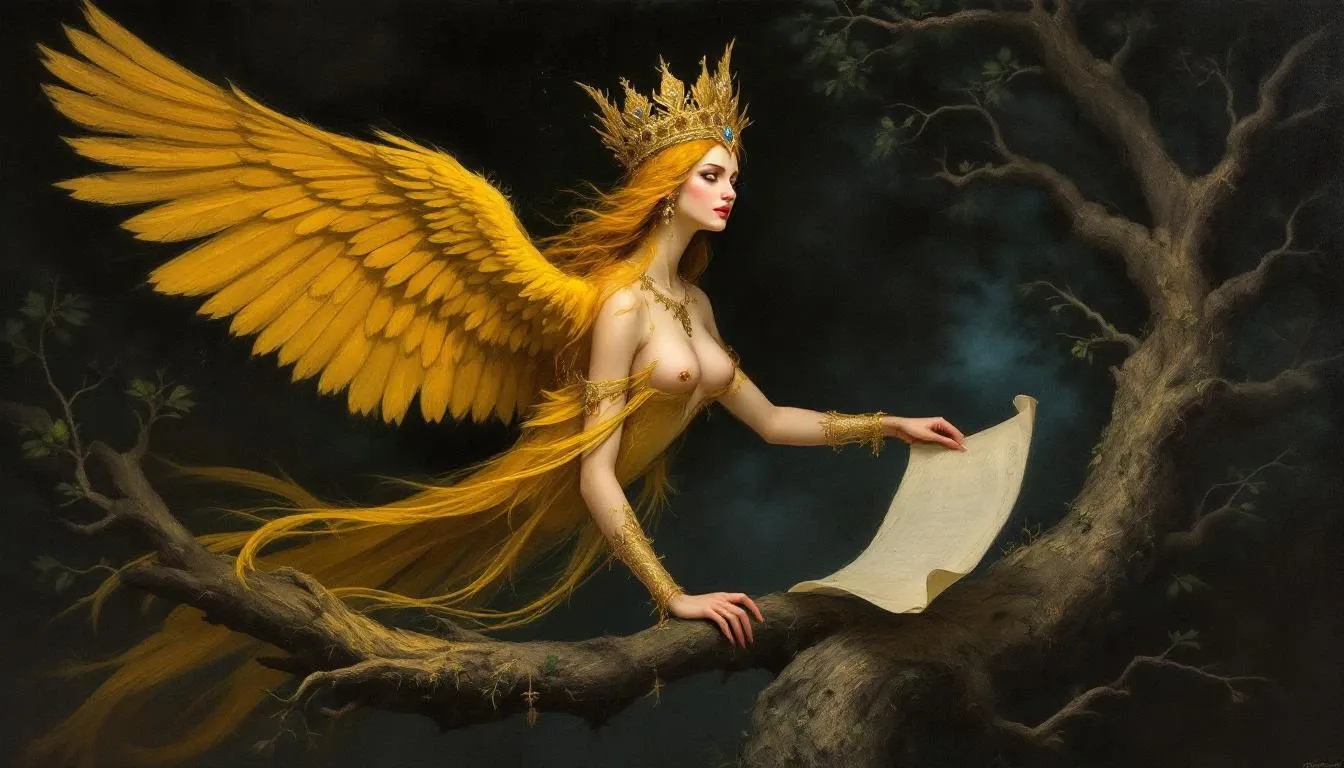
The Alkonost appears in manuscript illuminations and folk prints as a great bird with the head and breast of a woman, often crowned or wearing an elaborate headdress. Unlike the Sirin, she is almost always depicted with human hands, and in those hands she holds either flowers or a scroll bearing a promise of paradise.
Her name betrays her foreign blood. "Alkonost" is a corrupted form of "Alcyone" — the Greek princess who threw herself into the sea after learning of her husband Ceyx's drowning. The gods, moved by pity, transformed them both into halcyon kingfishers. The story traveled east through Byzantine manuscripts and, somewhere along the trade routes between Constantinople and Kiev, the grieving Greek queen became a radiant Slavic bird of paradise.
But the Slavic Alkonost is no longer a figure of grief. She became the opposite: a creature of ecstasy and bliss. Her song is said to be so beautiful that anyone who hears it forgets everything — their family, their duties, their own identity. They want nothing more, ever again. The sound does not kill outright, not the way the Sirin's voice does, but it hollows a person out. You are alive, technically, but you have been emptied of everything that made you who you were.
In the earliest pagan layers of the myth, the Alkonost lived on the island of Buyan — the same mysterious ocean island where the winds are kept and where the sacred Alatyr stone sits at the center of the world. After Christianization, she was quietly relocated. She became a resident of the Garden of Eden, a messenger of God who descended to earth to sing to the righteous and offer them visions of their future in paradise.
This is a pattern you see again and again in Slavic mythology: a pagan figure too beloved to erase, so the Church dressed her in new clothes and gave her a new address. The song remained the same. Only the return address changed.
The Dark Sister: Sirin and the Song of the Dead
Where the Alkonost sings of what is to come, the Sirin mourns what has already been lost.
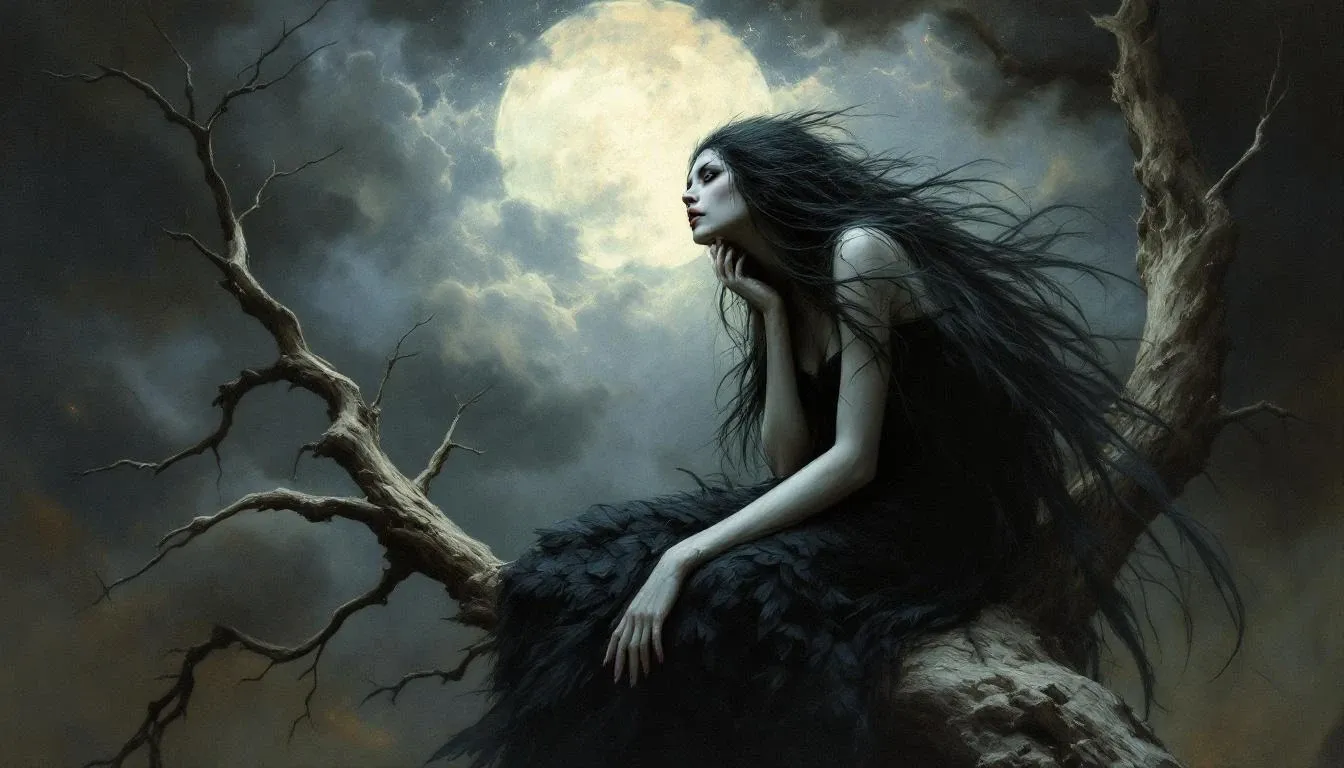
The Sirin is depicted as a bird with the head of a beautiful woman — similar to the Alkonost but usually without hands, without a crown, and with an expression of profound sorrow. Her name comes directly from the Greek Seirēn, the Siren, and the connection is not merely etymological. Like her Mediterranean ancestors, the Sirin sings so beautifully that mortals who hear her lose their will entirely. They follow the sound, unable to stop, and they die.
The legend of the Sirin likely arrived in Kievan Rus' through Persian merchants in the eighth or ninth century, merging existing Greek Siren imagery with Iranian bird-woman figures like the Huma. By the time the Sirin settled into Russian folklore, she had become something distinctly Slavic: not a seductress luring sailors onto rocks, but a mourner whose grief itself is lethal.
There is an important theological distinction in how the Sirin's song works. According to the folk tradition that survived Christianization, her voice was only dangerous to ordinary, sinful mortals. Saints and the spiritually pure could hear the Sirin without harm — to them, she sang not of death but of the joys of heaven. This is a neat bit of doctrinal engineering. It allows the Church to keep the Sirin in the iconographic tradition (she appears on church facades, embroidered vestments, and illuminated manuscripts) while explaining why holy men survived her song and common people did not. The fault lay not in the bird, but in the listener.
The most vivid folk image of the Sirin comes from the tradition surrounding the Apple Feast of the Saviour (Yablochny Spas), celebrated on August 19. According to the old belief, the Sirin descends into apple orchards at dawn on that day and weeps over the fruit. Her tears are the "dead dew" — anyone who eats the apples before the feast day risks consuming that sorrow. But in the afternoon, the Alkonost arrives, laughing and rejoicing, and her "living dew" purifies the fruit. This is why, the old babushkas explained, you must never eat apples before the Spas. You do not know whose tears are on them.
Gamayun: The One Who Knows Too Much
The third prophetic bird is the Gamayun, and she is the strangest of the three. While the Alkonost offers bliss and the Sirin delivers sorrow, the Gamayun simply tells the truth. All of it. Whether you asked for it or not.
She is depicted as a large bird with a woman's head, sometimes shown mid-flight, sometimes resting on a branch or floating in space. Her domain is knowledge — not the comforting kind, but the old, dangerous kind. The Gamayun knows the secrets of creation. She knows how the gods were born. She knows the future of every living thing. She was, according to tradition, the personal messenger of Veles, the god of the underworld, cattle, and the liminal spaces between worlds.
"When the Gamayun falls silent, a great storm rises. When she sings, she foretells the truth — but not all ears can bear what she speaks."
The Gamayun's danger is not in her melody but in her content. To hear her is to receive knowledge that the human mind was not built to hold. She speaks of the origins of the Three Worlds — Prav, Yav, and Nav — and of the wars between gods that shaped the cosmos. In some versions of the legends, merely hearing the Gamayun's prophecy can drive a person mad, not because the song is enchanted, but because the truth is simply too large.
Like the Sirin and the Alkonost, the Gamayun's roots probably reach back to ancient Greece — she has been compared to the Harpies and to the prophetic aspects of the Sirens. But her association with Veles gives her a specifically Slavic flavor. She is not a trickster or a predator. She is an oracle, and oracles have never been safe.
The Tree, the Gate, and the Garden Beyond
All three birds are connected to Iriy (also called Vyrai or Vyriy), the Slavic paradise — a luminous garden located either beyond the sea, at the top of the World Tree, or in the crown of the cosmic oak, depending on which village you asked.
Iriy is where birds go in winter. That sentence, which sounds like a children's explanation of migration, carried genuine theological weight. The pagan Slavs believed that migratory birds were not simply following the weather — they were traveling to paradise and returning from it. The stork, particularly, was thought to carry human souls between Iriy and the world of the living. When a stork brought a baby, it was not a euphemism. It was cosmology.
The gates of Iriy were guarded by Veles, sometimes in human form, sometimes as a great fire-bird called the raróg, clutching the keys to the otherworld. The Alkonost, the Sirin, and the Gamayun dwell in or near this garden. They are its voices. The Alkonost sings of the paradise to come. The Sirin mourns the paradise that was lost (some scholars read this as a reference to the Fall — Eden before the exile). The Gamayun recounts the full history of everything, including the parts that paradise was supposed to make you forget.
This places them in a fascinating relationship with the Firebird (Zhar-Ptitsa), which is also a luminous, paradisiacal bird. But the Firebird is a prize to be captured, a quest object. The three prophetic birds are not quest objects. You do not seek them. They come to you, and when they do, the encounter changes you permanently — through ecstasy, through grief, or through unbearable knowledge.
Carved Above the Door: The Birds in Folk Art
The most prolific visual record of the Alkonost and Sirin comes not from icon painters or manuscript illuminators but from the lubok — the cheap woodcut and copper-plate broadsheets that were sold by street merchants at fairs, outside monasteries, and in village markets from the sixteenth century onward.
Lubki (the plural) were the mass media of pre-modern Russia. Printed in three or four bold colors, combining image and text in a style that was part devotional, part comic strip, they brought mythological and religious subjects to people who could not afford icons or books. The Alkonost and Sirin were among the most popular subjects. A typical lubok composition shows the two birds perched symmetrically on either side of a flowering bush or tree — the Tree of Life — with a text below explaining their natures. Sometimes a small human figure stands at the base of the tree, spellbound; in the more elaborate prints, the same figure is shown dead on the ground in a lower register.
These prints were not just decorative. Carved wooden images of the Alkonost and Sirin flanked the entrances to peasant cottages. The Alkonost guarded by day; the Sirin guarded by night. Together, they formed a protective pair — joy and sorrow as twin sentinels, the full spectrum of human experience standing watch at your threshold.
The tradition reached its artistic peak in Viktor Vasnetsov's 1896 painting Sirin and Alkonost: The Birds of Joy and Sorrow, now in the State Tretyakov Gallery in Moscow. Vasnetsov placed the two birds on a single tree: the Alkonost on the left, smiling, her wings bright with color, the branches around her thick with blossoming leaves; the Sirin on the right, dark-winged and mournful, the foliage around her blackened and shriveled. The tree is alive on one side and dying on the other. It is a painting about the duality that runs through all of Slavic myth — light and dark, Prav and Nav, the upper world and the lower, held together by the trunk of a single tree.
Three years after the painting was exhibited, the young Symbolist poet Alexander Blok dedicated a poem to it. The Symbolists understood what the peasant carvers had always known: the birds were not merely beautiful. They were a map of the human soul.
Why They Endure
The paradise birds survive in modern Russian and Ukrainian culture in ways both obvious and subtle. The Alkonost gave her name to a well-known Russian software company. The Sirin lent hers to a luxury phone brand. The Gamayun appears on the coat of arms of Smolensk. They show up in video games, fantasy novels, heavy metal album art, and tattoo parlors from Moscow to Melbourne.
But these modern appearances, while they keep the names alive, tend to strip the birds of what made them powerful. The original myth is not about pretty bird-women. It is about the danger of transcendence. To hear the Alkonost is to experience joy so complete that you can never return to ordinary life. To hear the Sirin is to touch grief so profound that survival becomes impossible. To hear the Gamayun is to know the truth of the cosmos and discover that your mind is too small for it.
These are not punishments. They are encounters with the absolute. The Slavic tradition understood, in a way that modern culture often does not, that paradise is not safe. The songs of heaven can destroy a mortal just as thoroughly as the fires of hell — not out of malice, but because the human frame was never built to contain that much beauty, that much sorrow, or that much truth.
The three birds sit in the branches of the World Tree, at the border between Yav and Iriy, between the world of the living and the garden of the dead. They are border guards, and border guards exist to remind you that some thresholds, once crossed, do not allow return.
The Alkonost guards the day; the Sirin guards the night. Between them, no darkness enters unopposed, and no light arrives without its shadow.