A bird flies over the garden at night. Its feathers burn gold and copper and a red so deep it looks like the last ember in a dying fire. Where it passes, the darkness pulls back. Fruit trees glow as if lit from inside. The air smells of heat and something older — sulfur, maybe, or the memory of lightning.
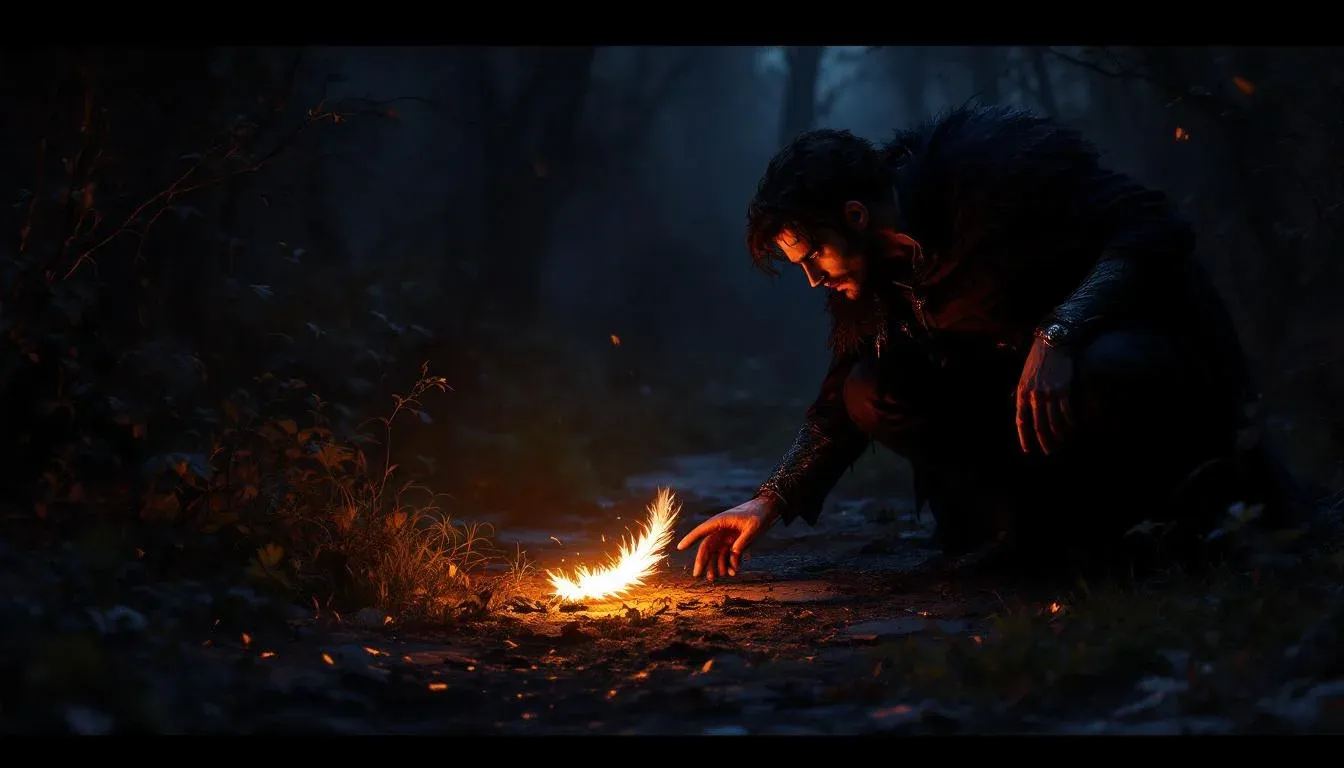
One feather falls.
That feather is the beginning of every disaster that follows. Across hundreds of East Slavic fairy tales, the Zhar-Ptitsa — the Firebird, the Heat Bird, the creature whose plumage blazes like a bonfire just past the turbulent flame — plays the same role. It is the most beautiful thing anyone has ever seen. And the moment you pick up what it leaves behind, your life as you knew it is already over.
The Name That Burns: What Zhar-Ptitsa Means
The Russian name Zhar-Ptitsa (Жар-Птица) translates literally to "heat bird" or "ember bird." Zhar carries the meaning of intense, radiant heat — the kind that comes off a forge or a fever. This is not a creature named for gentle warmth. It is named for the kind of heat that blisters skin.
In Czech and Slovak traditions, the bird appears as Ptak Ohnivak — the Fire Bird. Polish tales know it as Zar-Ptak. Serbian folklore speaks of a golden bird whose feathers light up the night. The details shift between Slavic languages, but the core stays fixed: a bird of supernatural radiance, gold-feathered, crystal-eyed, large as a peacock, glowing with a light that no darkness can swallow. Even a single shed feather, brought indoors, can illuminate an entire room — making candles and lamps pointless. Alexander Afanasyev, who collected more than six hundred Russian folk tales in the mid-nineteenth century, recorded that the Firebird's glow was so powerful that wrapping its feather in cloth did nothing to dim it.
Older scholarship connects the Zhar-Ptitsa to pre-Christian Slavic sun worship. Afanasyev himself argued that the bird was a personification of fire, light, and the sun — a living fragment of celestial flame that occasionally descended into the mortal world and left scorched wonder in its wake.
The Feather Curse: How a Single Plume Ruins a Prince
The Firebird does not attack. It does not issue threats or lay curses. It simply exists — radiant, untouchable, passing through — and drops a feather. That feather is the trap.
The most famous telling is Tsarevich Ivan, the Firebird, and the Grey Wolf, collected by Afanasyev and classified as Aarne-Thompson tale type 550. A tsar owns a garden with a tree that grows golden apples. Every night, one apple vanishes. Guards are posted; they fall asleep. Finally, Ivan Tsarevich — the youngest of three sons, as youngest sons always are — stays awake through the small hours and sees the thief: the Firebird, descending in a blaze of gold, plucking apples with a beak that shines like polished brass.
Ivan lunges. He grabs the bird by its tail. The Firebird tears free, leaving behind a single glowing feather in his fist.
"The feather was so wonderfully bright and radiant that if it were brought into a dark room, it would shine as if a great multitude of candles were lit there."
The tsar sees the feather and is consumed by want. A feather is not enough. He must have the whole bird. He sends all three sons on a quest: whoever brings back the living Firebird will inherit half the kingdom.
This is the mechanism that repeats across dozens of variants. The feather is not a gift. It is a provocation. It shows you what exists, makes you understand that something of impossible beauty is out there in the dark, and then it dares you to go after it. Every hero who picks up the feather enters a chain of escalating catastrophes — each one triggered by the failure to heed a warning, each one worse than the last.
Ivan's quest takes him through encounters with the Grey Wolf (who eats his horse and then, out of guilt or admiration, becomes his guide), a king who owns a horse with a golden mane, and a princess named Elena the Beautiful. At every stage, the Grey Wolf warns Ivan not to touch what he should not touch — do not take the golden cage, do not take the golden bridle — and at every stage, Ivan reaches out anyway. Alarms sound. Guards swarm. The prince who set out to catch a bird ends up bartering for increasingly impossible treasures, each one the price of the last mistake.
And when Ivan finally obtains everything — the bird, the horse, the princess — his own brothers murder him for it, slice his body to pieces, and steal his prizes. Only the Grey Wolf's loyalty, combined with the water of death and the water of life brought by ravens, brings Ivan back from the dead to reclaim what was his.
The message is not subtle: the Firebird's beauty is a gravitational force. It warps the lives of everyone it touches. The tsar becomes greedy. The brothers become murderers. Ivan himself becomes a serial violator of good advice. The bird does nothing but glow, and the humans destroy themselves trying to hold it.
Inside Koschei's Story: The Firebird as Plot Engine
The Firebird's role in Slavic folklore extends beyond its own cycle of tales. It appears — sometimes directly, sometimes as an echo — in stories centered on Koschei the Deathless, the skeletal immortal villain who hoards gold, abducts brides, and hides his death inside a needle nested in an egg.
In Stravinsky's 1910 ballet The Firebird — which introduced Slavic folklore to Parisian audiences and launched the composer's career — the libretto blends two separate folk traditions. The first is the tale of Ivan Tsarevich and the Firebird itself. The second is the legend of Koschei, who holds thirteen princesses captive in an enchanted garden, turning anyone who enters to stone. In the ballet, it is the Firebird who reveals the secret of Koschei's death — the egg containing his soul — and guides Ivan to destroy it.
This fusion was not invented by Stravinsky and his collaborator Michel Fokine. The folk sources already linked the two. In several Afanasyev variants, the Firebird inhabits gardens that belong to sorcerer-kings whose power echoes Koschei's: they own impossible treasures, they imprison the beautiful, and they have hidden their vulnerability somewhere no ordinary person would think to look. The Firebird, in these contexts, is the lure that draws the hero into the sorcerer's orbit — the first spark in a much larger fire.
Baba Yaga surfaces here too. In multiple tale versions, it is the old witch — half-helper, half-threat — who tells the hero where the Firebird can be found and what price must be paid to catch it. She knows because she knows everything about the forest and its creatures. The Firebird nests at the boundary between worlds, and Baba Yaga lives at that same boundary, her hut spinning on chicken legs at the edge of the land of the living.

Not a Phoenix: What the Firebird Actually Is
Western audiences routinely mistake the Firebird for the Greek phoenix. The confusion is understandable — both are birds, both are associated with fire, both have become cultural shorthand for renewal. But the overlap is surface-level, and treating them as interchangeable erases what makes the Zhar-Ptitsa distinctive.
The phoenix is defined by its death cycle. It burns, it dies, it rises from its own ashes. The core meaning is resurrection — the defeat of death through self-immolation and rebirth. The phoenix is its own fuel and its own reward.
The Firebird does none of this. It does not die. It does not burn itself. It does not rise from ashes. It lives its entire life aflame — not as a process of destruction and renewal, but as a permanent state. Its fire is not sacrificial. It is simply what the bird is. The flames are its plumage, its nature, its presence in the world. There is no death-and-rebirth cycle. There is only the endless, dangerous glow.
And the symbolic function is entirely different. The phoenix is a promise: death is not the end. The Firebird is a warning: beauty is not free. The phoenix consoles. The Firebird provokes. One is about what happens after you lose everything. The other is about what happens when you see something so extraordinary that you abandon everything to chase it.
Afanasyev and later folklorists traced the Firebird's deeper roots not to the Greek phoenix but to Slavic solar mythology — to the idea that the sun itself was a living being that moved through the sky, and that fragments of its fire occasionally broke loose and took the form of birds. The Firebird is a piece of the sun that fell to earth and refuses to be caught. The phoenix is a metaphor for eternal life. They are not the same creature wearing different clothes.
The Other Slavic Birds: Alkonost, Sirin, and Gamayun
The Firebird does not exist alone in the skies of Slavic myth. It shares the folklore with three other legendary birds — the Alkonost, the Sirin, and the Gamayun — each one dangerous in her own way, each one beautiful, and none of them anything like the Zhar-Ptitsa.
The Alkonost has the body of a bird and the face of a beautiful woman. She sings songs of paradise — songs so sweet that anyone who hears them forgets everything: their name, their home, their reason for living. They stand in place, listening, until they die of starvation or thirst. The Alkonost does not mean to kill. Her joy is simply too much for mortal minds to hold.
The Sirin is her darker counterpart. Also woman-headed, also a singer, but where the Alkonost sings of heavenly bliss, the Sirin sings of sorrow and loss. In some traditions, she represents the souls of those who did not reach paradise. Her voice carries melancholy so deep it drives listeners to despair. Early Russian Orthodox artists often painted the Alkonost and Sirin together on opposite branches of the same tree — joy on one side, grief on the other, the full spectrum of what the afterlife might hold.
The Gamayun is the wisest of the three. A prophetic bird, she speaks in riddles and foretells the future. She is a messenger of the gods, the keeper of knowledge about the creation of the world and the fates of heroes. Unlike the Alkonost and Sirin, whose danger lies in their songs, the Gamayun's threat is in what she reveals: truths that mortals are not always prepared to hear.
The Firebird stands apart from this trio. It has no human face, speaks no words, sings no songs. It does not seduce through sound. Its weapon is light — pure, overwhelming, irresistible visual splendor. Where the three bird-women work through the ear, the Zhar-Ptitsa works through the eye. It is the thing you cannot stop looking at, the beauty that paralyzes judgment and sends you riding into the dark after something you were never meant to hold. Vasilisa the Wise might resist a song. No one in the tales resists the feather.
Stravinsky, Diaghilev, and the Firebird's Flight West
On June 25, 1910, at the Palais Garnier in Paris, a twenty-eight-year-old Russian composer named Igor Stravinsky watched the curtain rise on the work that would change his life and carry the Zhar-Ptitsa out of Slavic oral tradition and into the concert halls of the world.
L'Oiseau de feu — The Firebird — was commissioned by Sergei Diaghilev for his Ballets Russes. Stravinsky, at the time a student of Rimsky-Korsakov with almost no reputation, was not the first choice. Anatoly Lyadov had been approached first but failed to deliver a score. Stravinsky, hungry and fast, finished in months.
The ballet fused the Firebird tale with the Koschei legend. Prince Ivan captures the Firebird in Koschei's enchanted garden, and the bird — in exchange for its freedom — gives him a magical feather. When Koschei's demons swarm the prince, he waves the feather, the Firebird returns, and forces the entire demonic host to dance until they collapse. Then it reveals the egg containing Koschei's soul. Ivan smashes it. The enchantment breaks. The princesses are freed. The stone warriors come back to life.
Stravinsky borrowed a handful of folk melodies for the score but composed most of it himself, blending the orchestral color he had learned from Rimsky-Korsakov with harmonies that pointed toward the violent revolution of The Rite of Spring three years later. The Firebird's shimmering, flickering music — all tremolo strings and darting woodwinds — became one of the most recognizable sounds in twentieth-century classical music.
What the ballet did for the Firebird was double-edged. It made the creature famous beyond the Slavic world. But it also softened the tale. In the folk sources, the Firebird is amoral — a creature of pure, dangerous beauty that does not care whether Ivan lives or dies. In the ballet, the Firebird becomes a grateful ally, a helper who repays kindness with magical aid. The western adaptation tamed the wildness that made the original stories so unsettling.
Why the Firebird Still Burns
The Zhar-Ptitsa endures because its central metaphor never stops being true. There is always a feather on the ground. There is always something luminous and unattainable that promises transformation if you can just get close enough to grasp it. And there is always a cost — a chain of consequences that begins the moment you decide that you must have the thing that was never meant to be held.
The Slavic storytellers were not warning against ambition. Ivan Tsarevich succeeds in the end. He gets the bird, the horse, the princess, the kingdom. The warning is about the process — about what the pursuit does to you, and to the people around you, on the way to the prize. Brothers betray. Kings grow obsessed. Good advice goes unheeded. The feather does not cause these failures. It reveals them. It shows you who you really are when you want something badly enough.
That is what separates the Firebird from every other magical creature in the Slavic canon. Koschei is evil by nature. Baba Yaga tests you deliberately. The Rusalka drowns you out of grief. The Firebird does not act on you at all. It simply exists in your field of vision, impossibly bright, and waits for you to act on yourself.
A single feather can light a room. But the room it lights is yours, and what it illuminates is everything you were too comfortable to see in the dark.