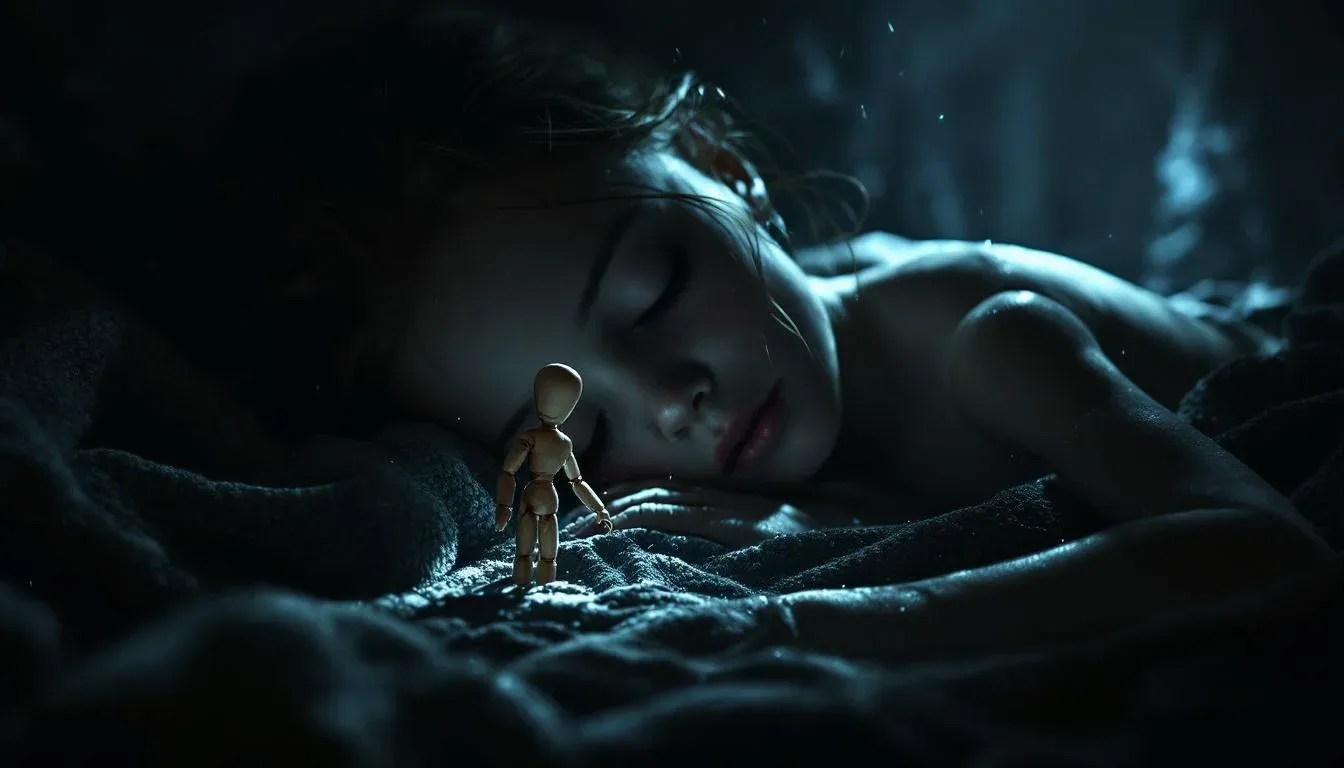
A merchant's wife is dying. She calls her daughter to the bed — a girl of eight, maybe younger — and presses a small wooden doll into her hands. Feed it, the mother says. Keep it close. It will tell you what to do when nobody else can.
Then she dies.
That doll, no bigger than a child's fist, is the most important object in all of Russian folklore. Not the flying carpet. Not the self-setting tablecloth. Not even the water of life that raises the dead. A crude wooden figure that eats breadcrumbs and whispers advice in the dark — that is the thing that defeats Baba Yaga, destroys the wicked, and carries a girl through death's own kingdom and out the other side.
Her name is Vasilisa. And her story is older than any version of Cinderella you have ever heard.
A Stepmother, a Forest, and No Fire
The bones of the plot are familiar enough to feel deceptive. After the mother's death, the merchant remarries. The new wife has two daughters of her own. They despise Vasilisa — her beauty, her kindness, the way the sun seems to favor her while they grow gaunt and sallow with bitterness. The stepmother assigns her the worst labor: hauling water, splitting wood, scrubbing floors, tending the kitchen garden from dawn until the light fails.
Vasilisa survives because of the doll. Each night, she feeds it a scrap of her own supper and tells it her troubles. The doll eats, its painted eyes catch the candlelight for a moment, and then it does the work. By morning, the garden is weeded, the floors gleam, the water is drawn. Vasilisa grows more beautiful. The stepsisters grow uglier with rage.
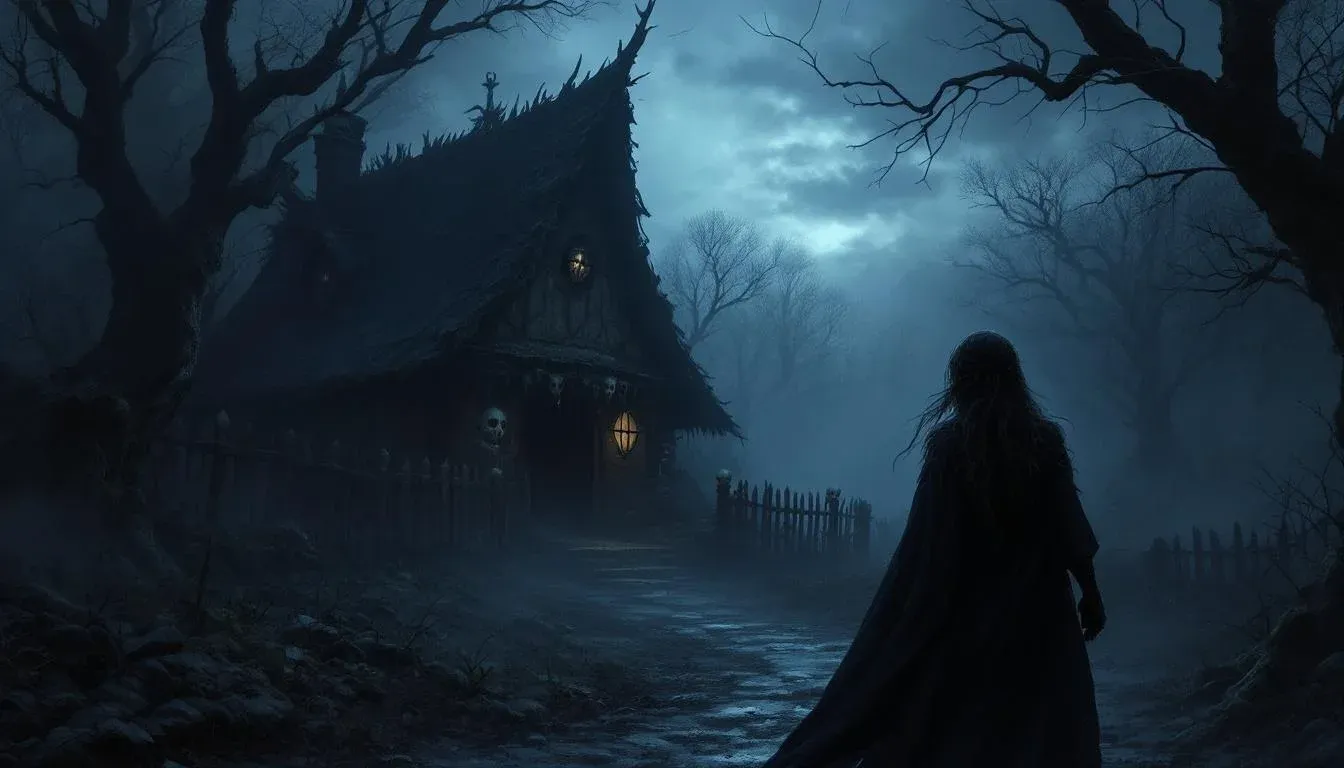
The stepmother decides the girl must die. She moves the household to the edge of a dark forest — the one where Baba Yaga lives in her hut on chicken legs, surrounded by a fence of human bones. And then, one autumn evening, she lets every fire in the house go out. Every candle, every lamp, every coal in the stove — dark. Someone must go to Baba Yaga and bring back fire.
The stepsisters shove Vasilisa out the door.
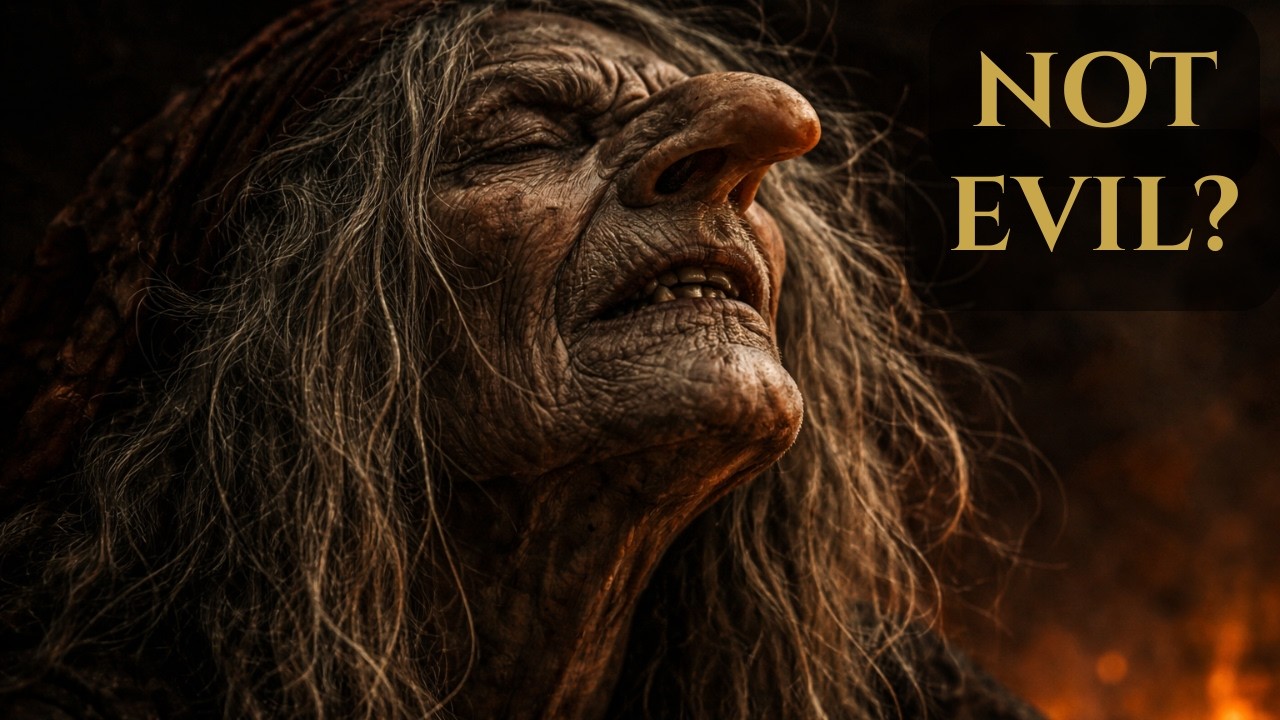
This is not a minor errand. In the Slavic world, going to Baba Yaga for fire means crossing into the realm of the dead. The hut on chicken legs is a grave raised on stilts. The bone fence is an ancestor shrine. The skulls whose empty sockets blaze with light are not decorations — they are the restless dead, keeping watch at the border between this world and the next. Vasilisa is being sent, quite deliberately, to die.
She puts the doll in her pocket and walks into the forest.
The Three Riders
On her way to Baba Yaga's hut, Vasilisa sees three horsemen. The first is dressed all in white, riding a white horse — and when he passes, the sky begins to lighten. Dawn. The second wears red, on a red horse, and the sun rises. The third is black, mounted on a black horse, and the moment he rides by, the forest plunges into absolute night.
These are not random characters. They are the turning of the world itself — day and night, the cycle of time that Baba Yaga commands. Alexander Afanasyev, who collected the tale in the 1850s and 1860s for his Narodnye russkie skazki, noted that many variants include these riders, and some scholars believe they represent the old Slavic understanding of cosmic order. Baba Yaga controls the sun. She controls the darkness. She controls the thin grey hour between them.
Vasilisa sees all three and keeps walking. She arrives at the hut. The bone fence glows. Skulls stare down at her from the posts. The gate is locked with a bolt made from a dead man's leg, and the lock is a jaw with teeth still in it.
The Impossible Tasks
Baba Yaga agrees to give Vasilisa fire — but only if the girl earns it. The tasks are, by design, impossible for a human being to complete in the time given.
Sort a heap of mildewed wheat, grain by grain, separating the good from the rotten. Pick every black speck from a pile of poppy seeds. Clean the hut. Cook the meals. Wash the laundry. Do it all by morning, or be eaten.
Vasilisa waits for the witch to fall asleep, then feeds the doll. She gives it her supper — a crust of bread, a few drops of soup — and whispers what she must do. The doll eats, and its eyes glow faintly. "Go to sleep, Vasilisa," it says. "The morning is wiser than the evening."
By dawn, every task is done. The wheat is sorted. The poppy seeds are clean. The hut is spotless. Baba Yaga inspects the work, finding no fault, and her expression sours. She calls her invisible servants — the pairs of disembodied hands — to press oil from the wheat, and sets Vasilisa more tasks the next night.
Again the doll does the work. Again Baba Yaga can find nothing wrong.
This is the crux of the tale, and it is easy to miss beneath the fairy-tale machinery. Vasilisa does not defeat Baba Yaga through cleverness, or strength, or courage, though she has all three. She defeats her through inheritance. The doll is her dead mother's blessing — the accumulated wisdom of the women who came before her, compressed into a small figure that fits in a pocket. When Vasilisa feeds the doll, she is honoring the dead. When the doll whispers advice, the dead are speaking back.
Baba Yaga, the guardian of the boundary between life and death, cannot destroy a girl who carries the dead with her willingly. Vasilisa has already made her peace with that border. She crossed it the night her mother died.
The Skull That Burns
Baba Yaga, unable to keep Vasilisa through trickery and unwilling to admit it, asks the girl how she manages to complete the tasks. Vasilisa answers carefully: "By my mother's blessing." The words hit like cold water. Baba Yaga recoils. She does not want anyone with a blessing in her house — blessings are a power even she respects.
She gives Vasilisa what she came for. Not a candle, not a coal, not a torch. A skull from the bone fence, mounted on a stick, its eye sockets blazing with pale fire. Take it, the witch says. Here is your light.
Vasilisa carries the skull back through the forest, through the darkness, past the place where the black rider galloped by. The skull's fire lights her way. She is terrified of it — at one point she nearly throws it away — but the skull speaks to her. "Do not be afraid. Carry me home."
She arrives at the stepmother's house. Since the night Vasilisa left, no fire has stayed lit in that house. Every candle gutters and dies. Every coal goes cold. The stepsisters and the stepmother have been sitting in the dark, growing thinner and more desperate, waiting.
They are glad to see the fire. They should not be.
The skull's eyes fastened on the stepmother and her two daughters and burned them. They tried to hide but wherever they ran the eyes followed. By morning, the three of them were burned to cinders. Only Vasilisa was unharmed.
Vasilisa buries the skull in the earth — returning death to its proper place — and leaves the house forever.
This is not a happy ending stitched on for children. It is an execution carried out by the dead. The skull is an instrument of ancestral justice: it sees the truth of a person, and if that truth is cruelty, it destroys them. The stepmother sent Vasilisa to die. The dead sent their fire back.
The Weaving and the Tsar
The second half of the story is quieter but no less significant. Vasilisa goes to live with an old woman in the city and takes up spinning and weaving. The thread she produces is so fine it cannot be seen — thin as hair, thin as spider silk. The old woman says no needle exists that could sew cloth this delicate.
Vasilisa asks the doll for help one last time. By morning, the doll has produced a loom from somewhere (the tale does not explain how, and this is part of the point — the doll's magic is not meant to be understood, only trusted). Vasilisa weaves cloth so fine that it can be drawn through the eye of a needle like a thread.
The old woman brings the cloth to the Tsar. He is astonished, demands shirts be sewn from it, and when no seamstress in the kingdom proves capable, Vasilisa does the work herself. The Tsar sees her and, struck by her beauty and skill, marries her. When her merchant father returns from his long journey, he lives with them in the palace. Vasilisa keeps the doll in her pocket for the rest of her life.
The weaving is not a subplot. In Slavic tradition, spinning and weaving were sacred women's arts connected to fate itself — the goddess Mokosh was both a spinner and a fate-weaver, and the act of producing thread was understood as creating order from chaos. Vasilisa, having passed through death's kingdom, now creates. She transforms raw flax into something so perfect it catches the attention of the highest power in the land.
She entered the forest a frightened child. She returns a woman who can make the world.
The Many Vasilisas
Here is something Western readers almost always miss: there is no single Vasilisa. The name appears across dozens of East Slavic fairy tales, attached to different women with different stories and different gifts. They are connected not by plot but by archetype — by the idea that a woman named Vasilisa is someone extraordinary.
Vasilisa the Beautiful (Vasilisa Prekrasnaya) is the girl with the doll. Her story, Afanasyev's No. 104, is the one told above — the journey to Baba Yaga, the impossible tasks, the skull. Her defining quality is endurance. She survives because she holds fast to what her mother gave her.
Vasilisa the Wise (Vasilisa Premudraya) appears in The Sea Tsar and Vasilisa the Wise and several related tales. She is the daughter of the Sea Tsar — a water king who rules an underwater realm — and she saves a prince named Ivan through shape-shifting, cunning, and magic. She turns herself and Ivan into a well and a dipper, a church and a priest, a lake and a duck, always one step ahead of her pursuing father. Her defining quality is intelligence. She outthinks every obstacle.
The Frog Princess (Tsarevna Lyagushka) is, in many versions, also Vasilisa — cursed into frog form by her father Koschei the Deathless, married to Ivan Tsarevich, and revealed as a woman of staggering beauty and magical skill when she sheds her frog skin. In some tellings, Ivan burns the skin too early, and she vanishes — forced to return to Koschei's power. Ivan must then journey to the edge of the world to win her back.
Three Vasilisas. Three different stories. But the thread that runs through all of them is the same: a woman who possesses something — wisdom, beauty, skill, or all three — that the powers of the world want to control, and who refuses to be controlled.
Death, Rebirth, and the Girl in the Forest
Scholars have argued for generations about what Vasilisa's journey to Baba Yaga really means. The Jungian analyst Clarissa Pinkola Estes, in Women Who Run With the Wolves, reads the tale as a woman's initiation — a symbolic death of the obedient child-self and rebirth as a fully realized adult. Vladimir Propp, the great Russian folklorist, traced the structure to ancient initiation rites: the forest as the boundary between the village and the wild, the hut as the ritual lodge, the impossible tasks as tests the initiate must pass before being accepted as a member of the community.
Both readings point to the same truth. Vasilisa's journey is a passage through death. She walks into the forest — the place where the rules of the living world do not apply. She enters Baba Yaga's hut — a house that is also a grave. She eats the witch's food, which is the meal of the dead. She performs tasks that no living person can perform alone. And she walks out carrying fire — the fundamental symbol of life, warmth, and civilization.
She dies as a girl. She returns as something else.
This is not unique to the Vasilisa tale — the pattern appears across Slavic folklore, from the prince who must enter Koschei's realm to the heroes who chase the Firebird to the edge of the world. But Vasilisa's version is the most intimate, the most domestic, and in many ways the most honest. She does not fight a dragon. She does not wield a magic sword. She feeds a doll, does impossible housework, and carries a burning skull home through the dark.
The weapons she uses are the weapons women have always had: patience, labor, the knowledge passed from mother to daughter, and the quiet refusal to break.
Why She Endures
Vasilisa has survived for centuries not because her story is comfortable but because it is true. Not literally — there are no bone fences or flying mortars in the real world — but in the way that matters. The tale says: your mother will die. The people who replace her will be cruel. You will be sent into the dark alone, with nothing but what she left you. And if you trust that inheritance — if you feed it, listen to it, carry it with you — you will walk through death and come out the other side holding fire.
The doll in the pocket. The mother's voice, small and wooden, saying the morning is wiser than the evening. That is the oldest magic in Slavic folklore. Not spells. Not enchantments. Memory. The dead do not leave us, the story says. They just get very quiet, and you have to know how to listen.
Vasilisa listened. And the fire she carried home burned down the house of cruelty and lit the way to a life she built with her own hands.