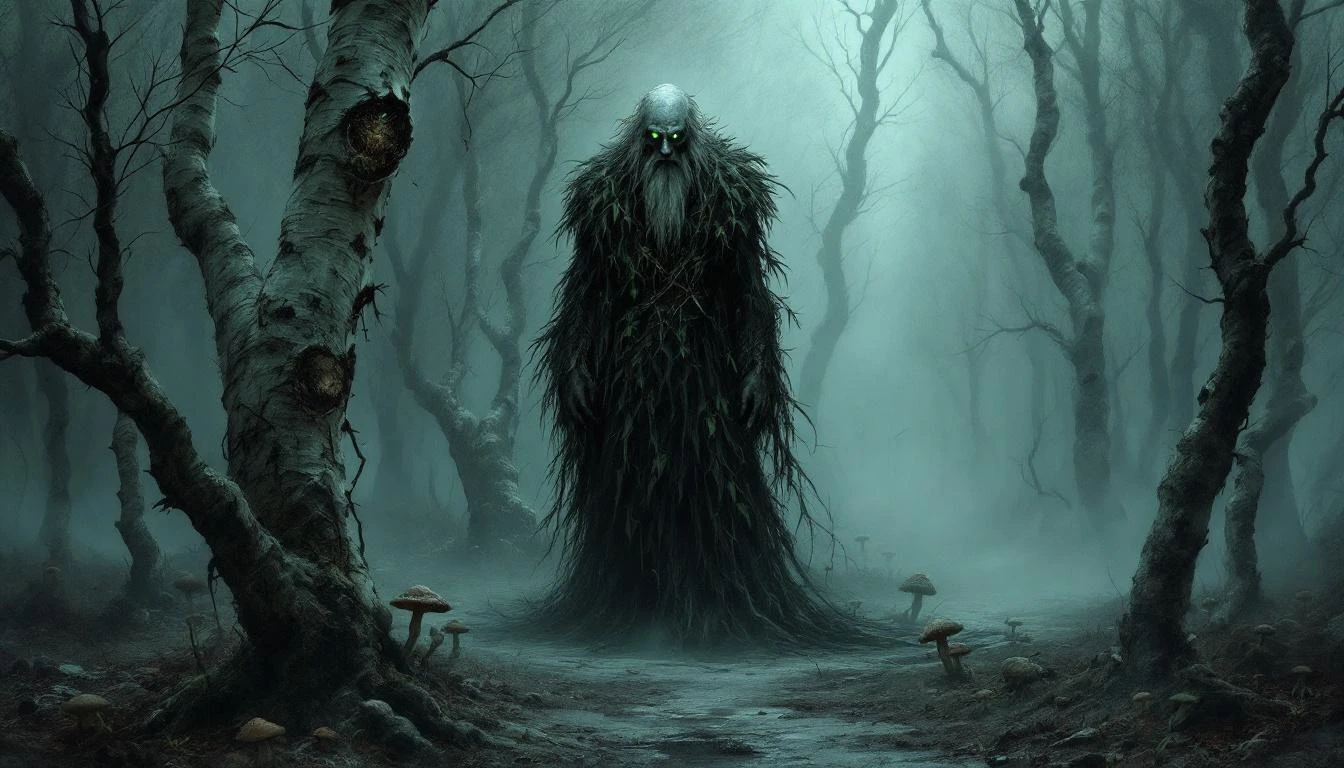
Deep in the birch forests where the Leshy rules of Eastern Europe, where the mist clings to the ground like the breath of the dead, there lives a creature older than memory itself. She has been called a witch, a cannibal, a goddess. None of these words are quite right.
Her name is Baba Yaga. And she is the most misunderstood figure in all of Slavic mythology.
The Hut on Chicken Legs
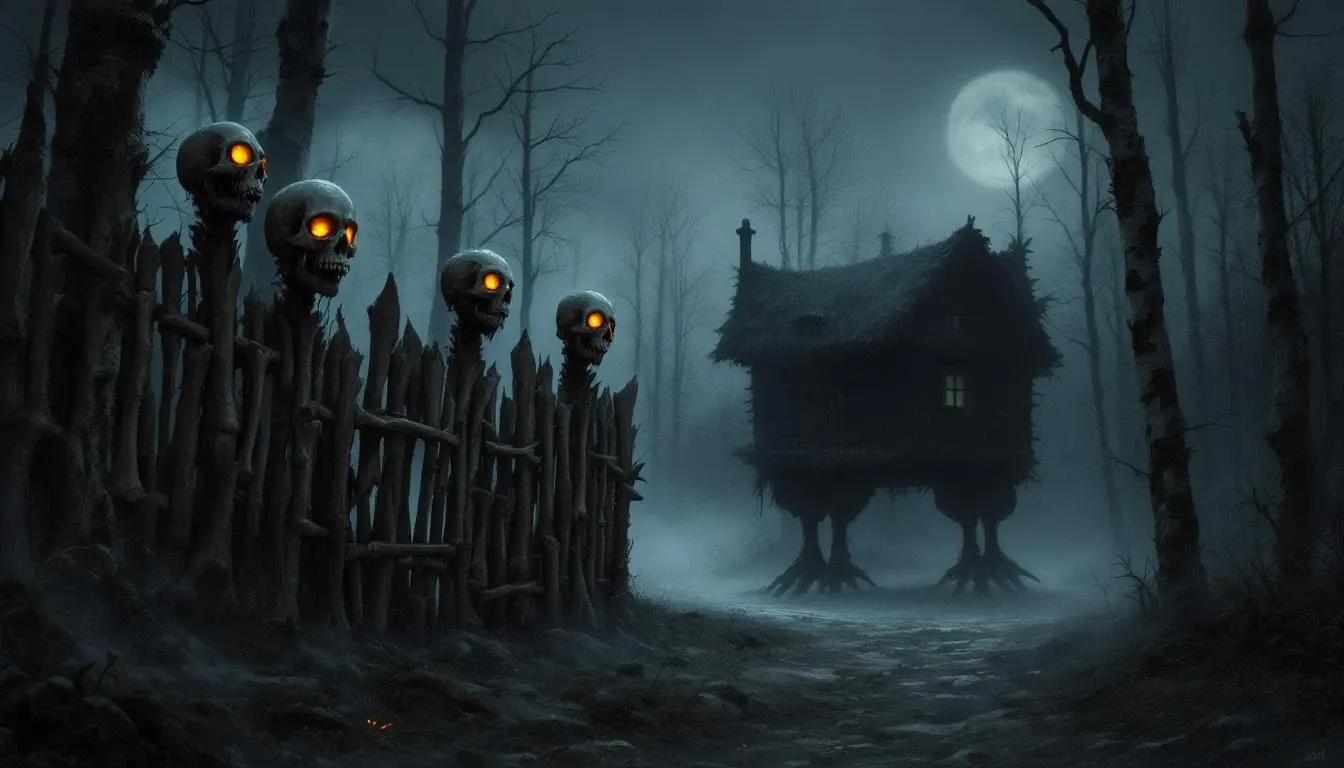
The most recognizable image of Baba Yaga is her dwelling — the izbushka na kur'ikh nozhkakh, a hut that stands on giant chicken legs and can turn to face or turn away from a visitor.
This detail is not whimsical. In ancient Slavic burial practices, the dead were placed in small raised structures — elevated coffins on stilts, lifted above the ground to keep animals away. These structures looked eerily like small huts on legs.
Baba Yaga's house is a grave. And when a hero approaches it, they are literally walking up to the dwelling of death.
The Fence of Human Bones
Around Baba Yaga's hut stands a fence made of human bones, topped with skulls whose eye sockets glow with an inner fire. The gate is fastened with human hands instead of a bolt, and the lock is a jaw full of sharp teeth.
This imagery connects Baba Yaga directly to the Slavic cult of the dead. The skulls on the fence are not decoration — they are ancestor spirits, guardians who watch over the boundary between the world of the living and the world of the dead.
When Vasilisa the Beautiful (in Afanasyev's collection) takes one of these glowing skulls, she carries death-fire back to her stepmother's house. The skull's gaze burns the stepmother and her daughters to ashes. This is not magic — it is ancestral justice.
She Does Not Eat Children
The Western image of Baba Yaga as a child-eating witch is a distortion. In the original tales, collected by Alexander Afanasyev in the 1850s-1870s, Baba Yaga almost never actually eats anyone.
What she does is far more complex:
- She tests the hero with impossible tasks
- She feeds them (the ritual meal of the dead)
- She sends them onward with magical gifts
- She guards the boundary they must cross
In many tales, the hero must eat Baba Yaga's food before they can proceed. This is the meal of the dead — by eating in the realm of death, the hero symbolically dies and is reborn. It is an initiation, not a dinner invitation.
Three Baba Yagas
One of the most fascinating aspects of the Baba Yaga mythology is that there are often three of them. In the tale of Vasilisa the Beautiful, the heroine encounters three horsemen — the White Rider (Dawn), the Red Rider (Sun), and the Black Rider (Night) — servants who traverse the Three Worlds — all servants of Baba Yaga.
Some scholars, particularly Vladimir Propp in his Historical Roots of the Fairy Tale (1946), argue that Baba Yaga is a remnant of a pre-Slavic mother goddess — a figure who presided over death, rebirth, and the cycles of nature.
The Mortar and Pestle
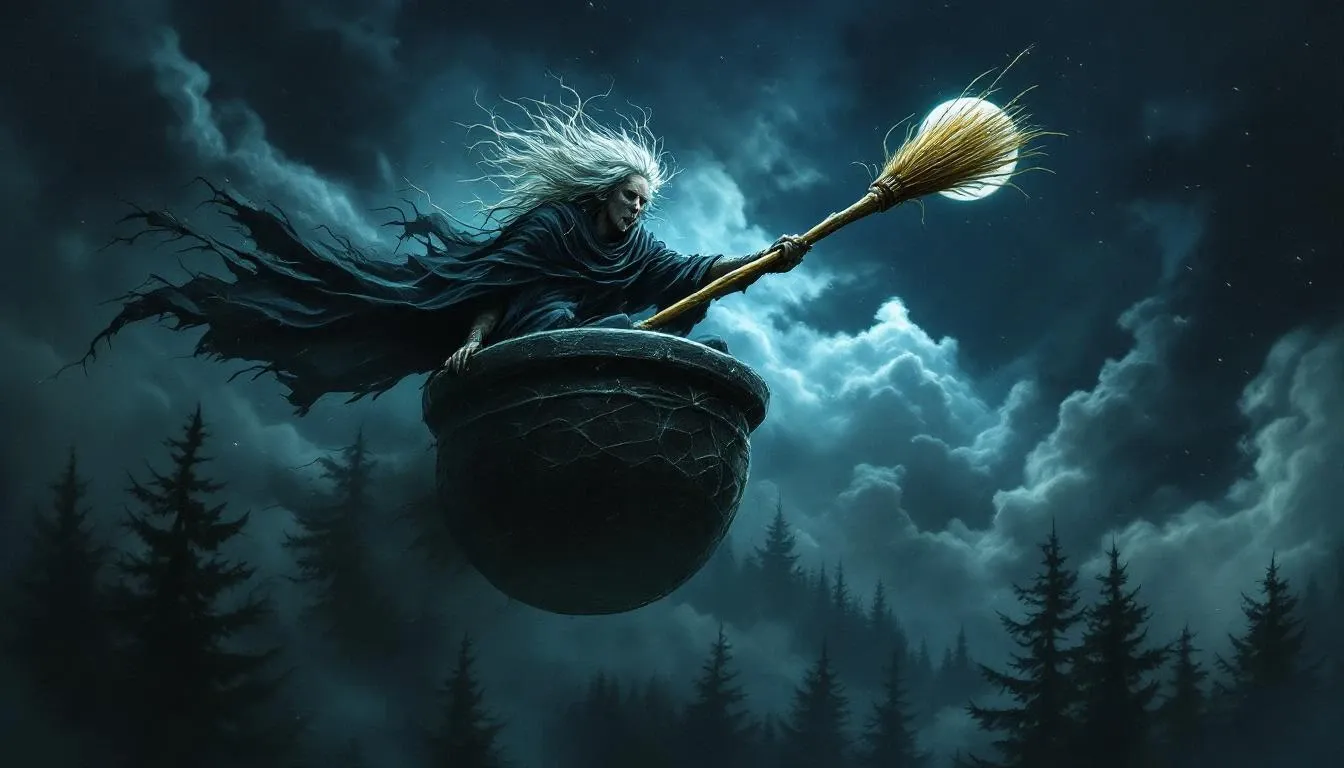
Baba Yaga does not ride a broomstick. She flies through the sky in a giant mortar, steering with a pestle, sweeping away her tracks with a broom made of silver birch.
The mortar is a tool for grinding grain — a symbol of transformation, of breaking down the old to create the new. Baba Yaga is the force that grinds the hero down and remakes them.
And Baba Yaga flew out in her iron mortar, driving with her pestle, sweeping her trail with her broom. And the forest groaned, and the leaves scattered, and the wind howled behind her.
Baba Yaga in Pop Culture
The name crossed into Western pop culture through an unlikely door. In the 2014 film John Wick, the Russian mob calls the assassin played by Keanu Reeves "Baba Yaga" — not as a compliment, but as a warning. The translation the film offers is "the Boogeyman," which is wrong in every way that matters. Baba Yaga is not the monster under your bed. She is the test you must pass to survive, the guardian of the boundary between the world you know and the world that will kill you if you enter unprepared. The mob's terror of John Wick makes more sense when you understand the original figure: not someone who hides in the dark, but someone who decides whether you leave the dark alive.
The Witcher franchise brought Slavic folklore to a gaming audience of millions, and while Baba Yaga herself does not appear in the games, her shadow falls across every forest hut and every quest involving ancient crones. The Ladies of the Wood in The Witcher 3 — three ancient beings who demand sacrifices and speak in riddles — are Baba Yaga split into a trinity, her roles distributed across three faces but her nature unchanged.
Katherine Arden's Winternight Trilogy (The Bear and the Nightingale, 2017) remains the most faithful literary adaptation of the Baba Yaga tradition in English. Arden's version preserves what Hollywood strips away: the ambiguity, the ritual, the sense that this is not a villain but a force of nature that predates morality itself.
Why She Matters
Baba Yaga endures because she embodies a truth that sanitized fairy tales try to hide: the path to wisdom goes through death. Every hero who visits her hut must face their own mortality. Those who are brave, clever, and respectful of the old ways survive. Those who are not... become part of the fence.
She is not good. She is not evil. She is necessary.