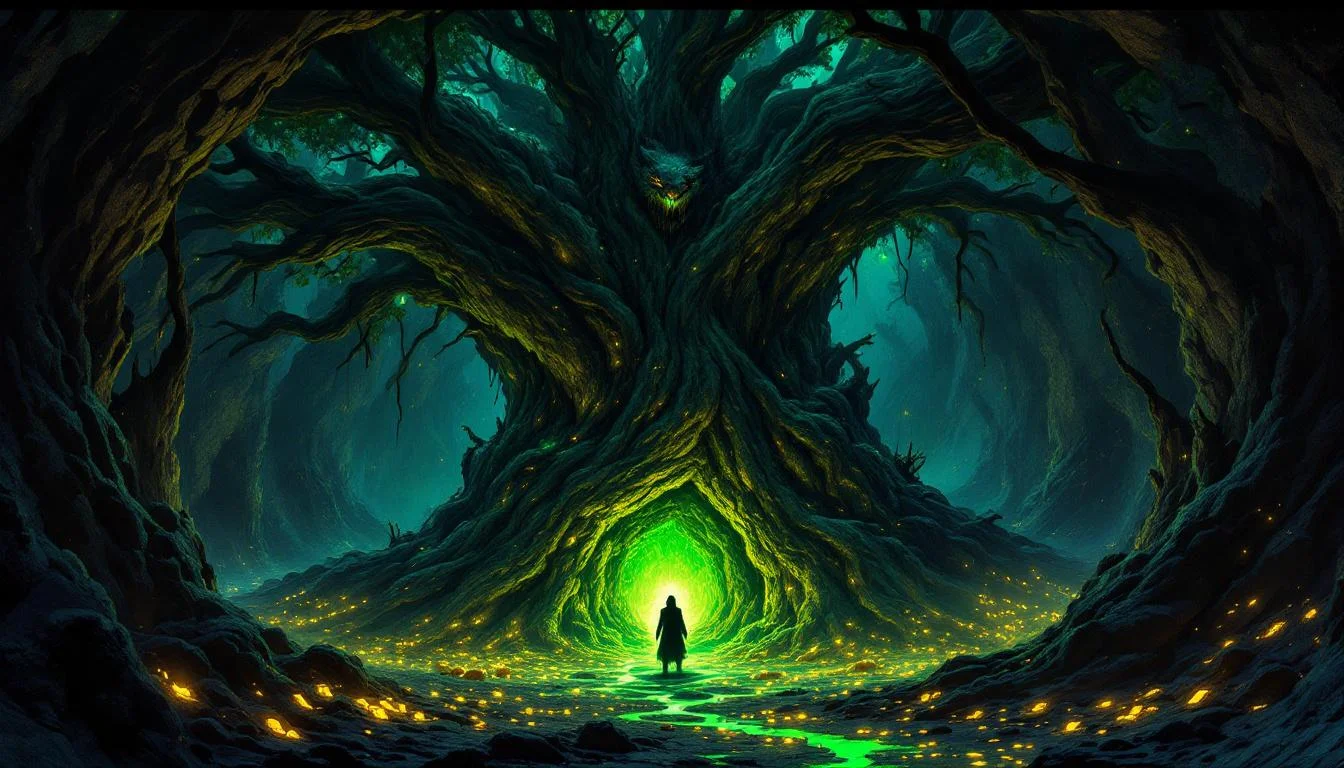
There is an oak tree at the center of everything. Its roots drink from black water that has no bottom. Its trunk rises through a world of fields and rivers and men who think they understand what is real. Its crown disappears into a sky where gods sit in judgment over laws that were old before the first human opened his eyes. The tree has no name that everyone agrees on, but every Slavic culture knew it was there, holding the universe together the way a spine holds a body upright.
Three worlds hang from that tree. The ancient Slavs called them Yav, Nav, and Prav. If you wanted to understand how a person lived, how they died, where they went afterward, why the storms came and why the harvest failed — if you wanted to understand anything at all — you started with the tree and its three worlds.
This was the architecture of Slavic cosmology. Not a creed written down by priests, but a structure carried in folktales, funeral rites, harvest charms, and the patterns embroidered on shirts worn by people who could not read. It survived Christianization, Soviet atheism, and academic neglect. It survives now.
Yav: The World You Can Touch
Yav is the visible world. The word itself is related to the Slavic root for "manifest" or "evident" — that which is apparent, that which stands in light. It is the trunk of the World Tree: solid, tangible, the part you can put your hand on. Fields of rye. Rivers in flood. Villages with wooden fences and dogs that bark at strangers. Everything you experience with your senses belongs to Yav.
But calling Yav "the real world" misses something. The Slavs did not think of it as more real than the other two worlds. It was simply the visible layer of a cosmos that extended far beyond what the eye could reach. Yav was the place where all three forces met and mixed — where divine law pressed downward, where the pull of the dead reached upward, and where mortals walked the narrow plank between them. It was not a neutral zone. It was the most contested ground in the universe.
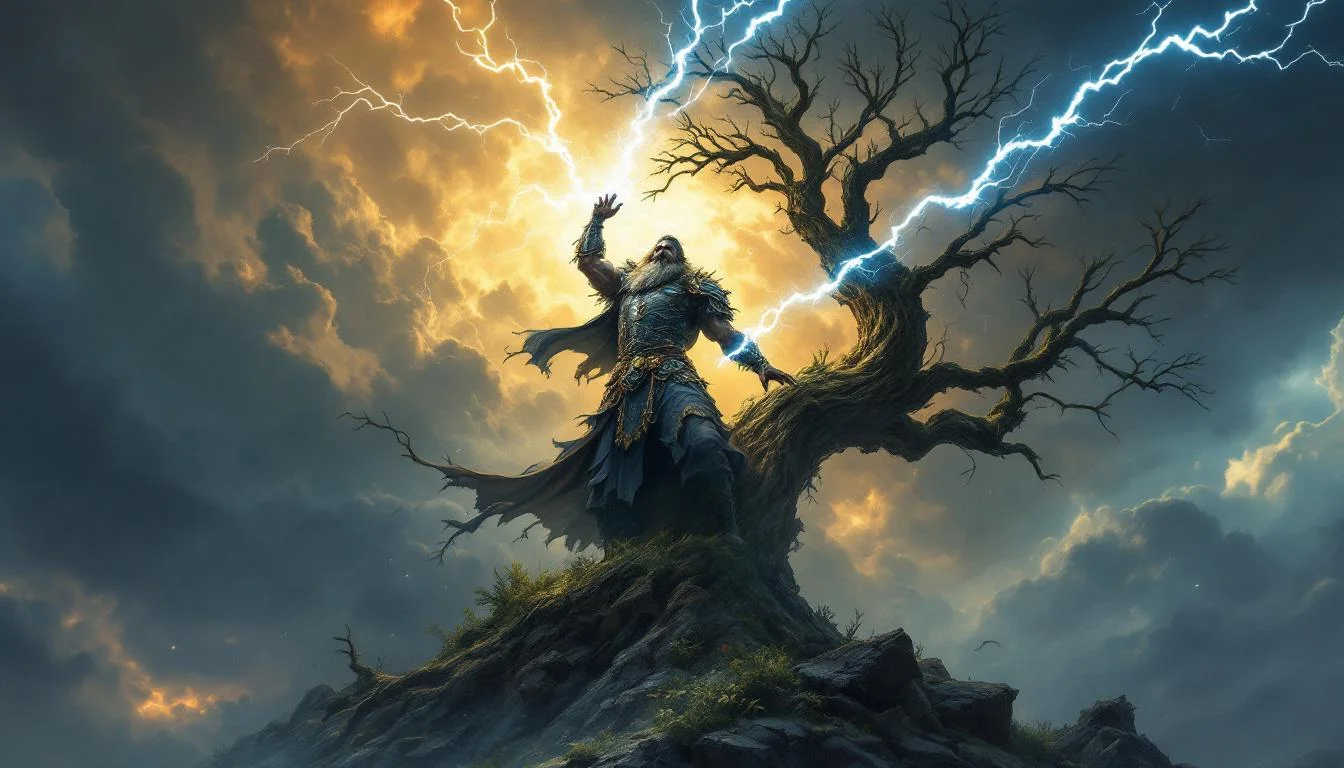
The living experienced Nav and Prav constantly, whether they recognized it or not. The storm that flattened the wheat was not weather — it was Perun hurling lightning at Veles, and the rain that followed was the stolen waters of heaven pouring back to earth. The old woman who died in December and the crocus that broke through the snow in March were part of the same transaction: a soul descending, a force ascending. Yav was where you saw the consequences of things that happened in worlds you could not see.
To live in Yav was to live at the crossroads.
Nav: The Wet Country Below
Nav is the world of the dead. Its name comes from the Proto-Slavic navь, meaning "corpse" or "the dead" — the same root that survives in the Czech word náv and the Old Church Slavonic navĭ. In folk tradition, navki or navje were the spirits of the dead themselves, sometimes dangerous, always uncanny, wandering the borders between their world and ours.
Nav occupied the roots of the World Tree. It extended downward through black water, through the mud beneath rivers, through caves and swamps and every place where sunlight did not reach. It was cold. It was wet. It was dark. But it was not empty, and it was not evil. The Christian concept of hell — a place of punishment for sinners — has no parallel in the Slavic underworld. Nav was simply where things went when they left Yav. Souls, seasons, warmth, the old year swallowed by the winter solstice. Everything that vanished from the visible world descended to Nav, and everything that returned to the visible world — spring, rain, new life — rose from it.
Veles ruled there. The shaggy god of cattle and death sat among the roots in his wet kingdom, receiving the dead the way a shepherd receives his flock at evening. His underworld was sometimes imagined as green pastures — strange, dim, but not a torment. The souls of the dead grazed there like cattle, which is exactly the kind of image you would expect from a people whose word for wealth and word for livestock were the same.
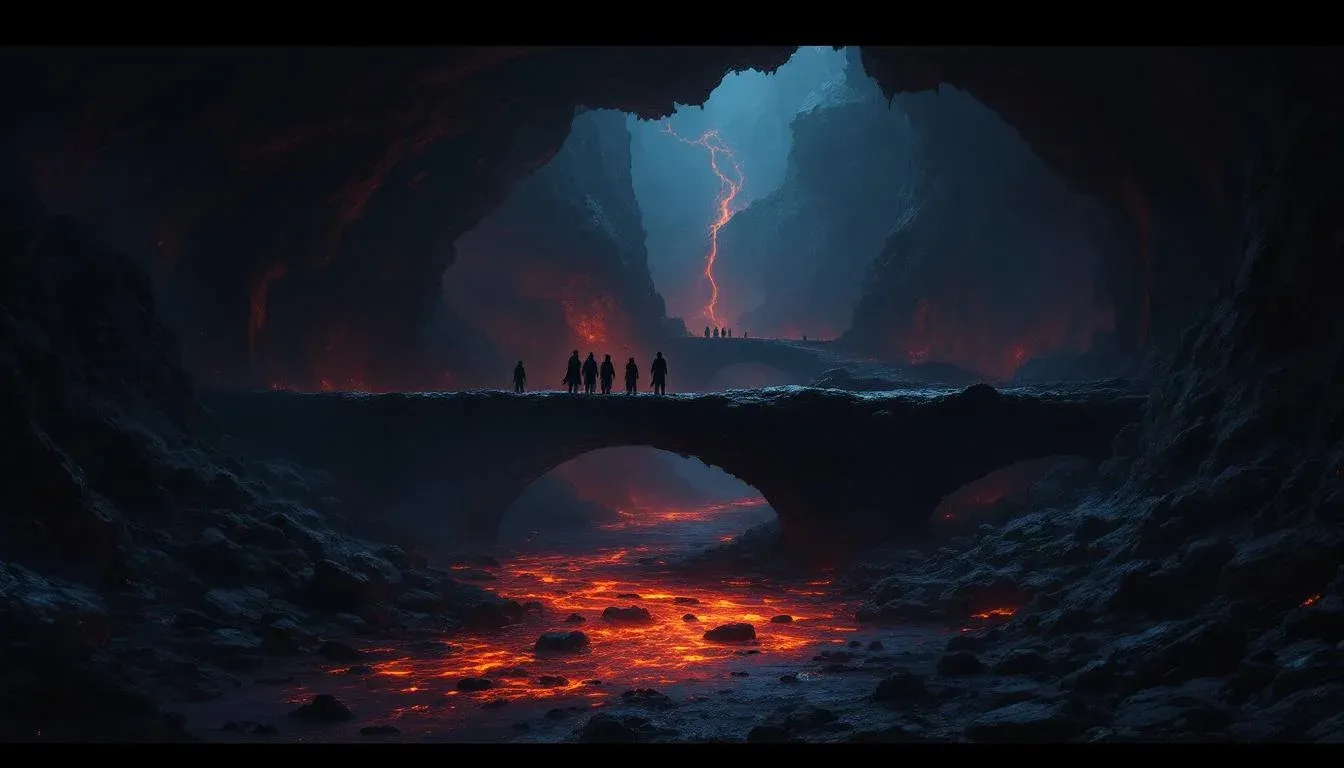
Getting to Nav was not straightforward. Between the living world and the dead lay the Smorodina River — a river of fire in some tellings, a river of stinking black water in others. The only crossing was the Kalinov Bridge, a structure made from the wood of the kalinov (guelder-rose) tree, narrow and treacherous, glowing with the heat of the burning river below. On the far side waited a guardian — in most Russian folktales, Chudo-Yudo, a many-headed dragon who tested every soul that tried to cross.
The phrase "to cross the Kalinov Bridge" became a Russian euphemism for dying. It entered the language the way "crossing the Styx" entered English — except the Slavic version carried its own particular terror. The Styx was dark and quiet. The Smorodina was on fire.
Prav: The Law Above the Gods
Prav is the hardest of the three worlds to explain, because it is not really a place at all. The word comes from the Slavic root for "right," "correct," "law" — the same root that gives modern Russian правда (truth), правило (rule), and право (right, justice). Prav is the cosmic order. It is the principle that makes the universe a universe instead of a chaos. If Nav is the world of what has been and Yav is the world of what is, Prav is the world of what ought to be.
It occupied the crown of the World Tree, the branches that reached into the highest sky. Perun sat there — or rather, Perun enforced its will from there, because Prav was not his personal kingdom. It was larger than any single god. The supreme creative force that some traditions call Rod — the ancestor of all existence — generated Prav before generating anything else. Prav came first. It was the pattern according to which the world was woven. The gods themselves were subject to it.
This is what made Slavic cosmology different from a simple heaven-and-hell binary. Prav was not a reward. Nobody went to Prav when they died, the way a Christian might go to heaven. Prav was the structure — the physics, if you like — of the moral universe. When the seasons turned in the proper order, that was Prav functioning. When Perun defeated Veles and the rains returned, that was Prav restored. When an oath was kept and justice was done, that was Prav manifesting in human life. It was not a place you could visit. It was the reason anything made sense at all.
The World Tree: Spine of the Universe
The three worlds needed something to hold them together, and what held them was the tree.
The Slavic World Tree — most often imagined as an oak, occasionally as an ash — grew from the Stone of Alatyr on the mythical Island of Buyan, somewhere in the ocean at the edge of the world. Its roots went down to Nav. Its trunk stood in Yav. Its crown reached into Prav. Every world was connected through it, every force flowed along its channels, and every mythological event of any consequence took place on, around, or because of it.
The tree was not merely a metaphor. It was a structural element of Slavic ritual and folk art. The three-tier pattern appears on embroidered towels, carved window frames, Easter eggs, and the wooden pillars of peasant houses from the Balkans to the Urals. The bottom register shows roots, serpents, water — Nav. The middle register shows animals, plants, humans — Yav. The top register shows birds, the sun, divine figures — Prav. The same vertical axis, repeated a thousand times in a thousand materials, always the same. The Slavs did not just believe in the World Tree. They stitched it onto everything they owned.
At the top of the tree sat a bird — an eagle or a falcon, depending on the tradition. At the bottom, coiled among the roots, lay a serpent. Between them, running up and down the trunk carrying messages and provocations, sat a squirrel or a woodpecker. If this sounds familiar, it should. The Norse had Yggdrasil, with an eagle at the top, the serpent Nidhogg at the roots, and the squirrel Ratatoskr scurrying between them. The parallel is not a coincidence. Both the Slavic and the Norse world trees descend from a common Proto-Indo-European mythological structure, a vertical axis mundi connecting three cosmic zones. The Slavs and the Norse inherited the same architecture and dressed it in different names.
The differences are instructive. Yggdrasil is an ash tree, and it is doomed — Ragnarok will destroy it. The Slavic oak has no apocalypse. Its cycle is seasonal, not terminal. Veles steals from Perun, Perun strikes back, the rains fall, the world renews. There is no final battle, no twilight of the gods. The tree stands. The worlds keep turning.
The Storm Myth: Cosmology in Action
The three-world structure is not just a static diagram. It moves. And the engine that moves it is the storm myth — the eternal conflict between the god at the top of the tree and the god at the bottom.
The pattern has been reconstructed by scholars — most notably the Russian linguists Vyacheslav Ivanov and Vladimir Toporov — from hundreds of folk songs, weather charms, and mythological fragments scattered across every Slavic culture. The story, stripped to its bones, works like this:
Veles rises from Nav. He climbs the World Tree in the form of a serpent, reaching toward Prav. Along the way he steals — cattle, water, Perun's wife, the rains themselves. This is a violation of the cosmic order. Prav is disrupted. Drought falls on Yav. Perun gathers his storms and attacks, hurling lightning down through the branches. Veles flees, shifting shape — bear, wolf, serpent, tree, man — but Perun's bolts find him. He is struck down. The stolen waters are released. Rain pours onto the parched earth.
Veles retreats to Nav. He is not destroyed — the ruler of the dead cannot die — but the order is restored. Until he rises again.
The basic myth of the Slavic peoples consists of a single action: the Thunder God, situated in the upper world, pursues his adversary, the Serpent, who has stolen cattle (= water, = wealth) and hidden below. The storm is the visible form of this pursuit. Rain is its resolution.
This is Slavic cosmology performing its function. The three worlds are not separate compartments — they are in constant, violent contact. Prav presses downward through Perun's arm. Nav surges upward through Veles's ambition. And Yav — the middle ground, the place where humans stand with their faces turned up at the rain — receives the consequences of both.
Every thunderstorm was a theological event. Every drought was a sign that the serpent had stolen what belonged to the sky. Every downpour was evidence that the sky god had won the round. The Slavs did not need scripture to understand their cosmology. They just needed to stand in a field and watch the weather.
Iriy: The Paradise at the Edge
Not everything in Slavic cosmology fits neatly into the three-world model. There is a fourth place — or perhaps a chamber within one of the three — called Iriy (also Vyrai or Vyriy). It is where the birds go in winter.
The ancient Slavs watched the swallows and storks and cranes disappear every autumn and return every spring, and they concluded that the birds were travelling to a paradise beyond the edge of the world. Iriy was imagined as a garden behind an iron gate, warm and green, located either in the crown of the World Tree or far across the sea at the end of the Milky Way. The birds carried the sun's warmth to Iriy in autumn and brought it back in spring. Some traditions said the birds carried human souls as well — that the dead rode on the wings of migrating storks to a place of rest beyond the reach of winter.
The stork that delivered babies was not an invention of Victorian sentimentality. It was a Slavic belief, rooted in the idea that souls cycled between Iriy and Yav on the bodies of migrating birds. A soul departed to Iriy on the wings of an autumn crane. A soul returned to the womb of a pregnant woman on the wings of a spring stork. Birth and death were the same journey in opposite directions, and the birds were the ferrymen.
Under Christian influence, the single Iriy eventually split into two. A celestial Iriy — bright, warm, associated with heaven — became the destination for birds and righteous souls. A subterranean Iriy — associated with snakes, who also vanished each winter — merged with the developing concept of an underground hell. The original vision, in which there was simply one warm place where all departing creatures went, did not survive the binary demands of Christian theology.
A Note on Sources: The Book of Veles Problem
Anyone who reads about Slavic cosmology will eventually encounter the Book of Veles — a text that claims to be an ancient chronicle of the Slavic peoples, written on wooden planks in a previously unknown script. It describes Prav, Yav, and Nav in detail. It names gods, tells stories, lays out the cosmological structure with the clarity of a catechism. It is, on its face, exactly the kind of primary source that scholars of Slavic paganism have always wished they had.
It is almost certainly a forgery.
The book surfaced in the 1950s, presented by a Russian emigrant named Yuri Mirolyubov, who claimed that a White Army officer named Fyodor Izenbek had found the wooden planks in a destroyed Ukrainian manor during the Russian Civil War. No independent witness ever saw the planks. No photograph of the originals exists. The language of the text is not any known historical Slavic language — it is a patchwork of modern Slavic forms stitched together without consistent grammar, the kind of thing that results from someone trying to invent an ancient language without actually knowing how ancient languages worked.
The scholarly consensus is unambiguous. Linguists and historians — including Andrey Zaliznyak, one of the most respected Slavicists of the twentieth century — have concluded that the Book of Veles is a twentieth-century fabrication. No credible academic institution treats it as a genuine source.
This matters because the neat triad of Prav-Yav-Nav, the way those terms are used in popular accounts of Slavic cosmology, derives heavily from the Book of Veles. Older authentic sources — the Primary Chronicle, the sermons against paganism, the Byzantine accounts — mention Nav and Yav as concepts, but the full three-part system with Prav as a defined cosmic realm appears most clearly in a document that was invented in the 1940s.
Does this mean the cosmology itself is fake? Not exactly. The individual elements — the World Tree, the underworld, the storm myth, the opposition of a sky god and an earth god, the concept of a cosmic order — are all attested in genuine folklore, comparative mythology, and linguistic reconstruction. What the Book of Veles did was package those elements into a tidy system and give it a vocabulary. The underlying structure is real. The labels are at least partly modern.
This is the kind of thing that drives scholars up a wall and that popular writers tend to ignore. For the purposes of understanding Slavic mythology, the three-world model remains the most useful framework available — as long as you remember that the framework was partly assembled from authentic parts and partly from a clever forgery, and that the line between the two is not always where you expect it.
Why the Three Worlds Still Matter
The Slavic three-world cosmology is not a museum piece. Its structure — a vertical axis connecting an underworld of the dead, a middle world of the living, and an upper world of divine order — appears in living folk traditions across Eastern Europe. Rod worship and Rodnovery (Slavic neo-paganism) have revived the terminology of Prav, Yav, and Nav as the foundational language of their theology. Ukrainian, Russian, Belarusian, Polish, Czech, and Serbian folk customs still carry traces of the model in funeral rites, harvest festivals, and the iconography of embroidered textiles.
And the deeper structure — the idea that the universe is a living thing, held together by a vertical axis, animated by a perpetual conflict between the forces above and the forces below, renewed each year by the turning of the seasons — that structure is older than the Slavs themselves. It is Proto-Indo-European. Echoes of it survive in Vedic India, in Norse Scandinavia, in the Greek underworld. The Slavic version is simply the one that kept its shape the longest, preserved not in scripture but in the stubborn memory of people who embroidered the World Tree onto their clothing and poured water on the ground for the dead and knew, when the thunder rolled, exactly who was fighting and why.
The tree still stands. The three worlds still turn.