Somewhere beneath the roots of the World Tree, where the soil turns to water and the water turns to silence, a god sits in the dark and counts his herds. His cattle are not all cattle. Some are the souls of the dead. Some are stolen rains. Some are the secrets men whispered at crossroads and never repeated. He wears the fur of a bear and the scales of a serpent, and when he moves through the world above, he wears a hundred faces that are not his own.
His name is Veles. He is the lord of the underworld, the keeper of wealth, the patron of poets and sorcerers, the trickster who steals from heaven and the shepherd who guides the dead through the wet black earth. No deity in the Slavic pantheon commands so many domains. No deity is so difficult to pin down. Perun throws lightning and everyone understands what he is. Chernobog carries darkness and the name says it all. But Veles — Veles is the god of everything that slips between your fingers when you try to hold it.
He is the most complex figure in all of Slavic mythology, and to understand him you must be willing to descend.
The God at the Roots: Veles and the Slavic Underworld
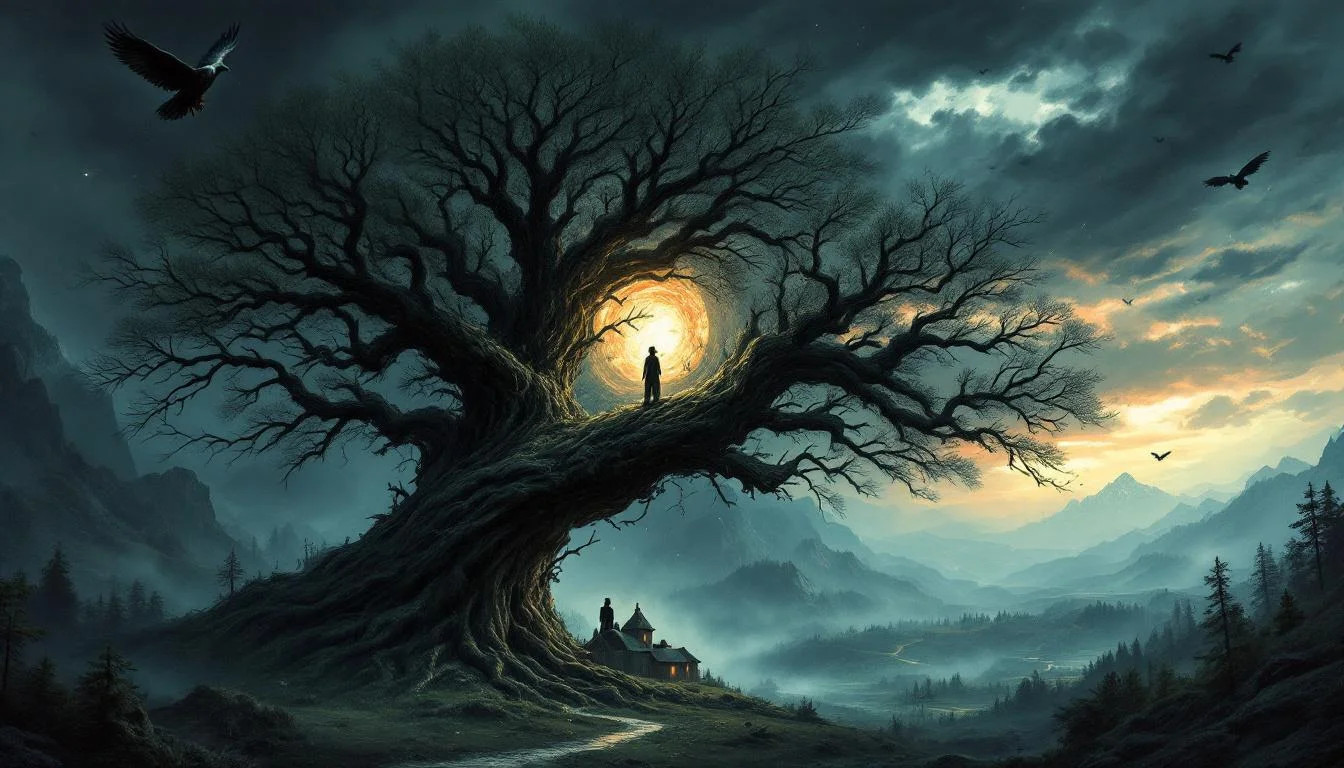
The ancient Slavs divided the cosmos into three worlds. Prav, the realm of divine law, occupied the crown of the World Tree. Yav, the visible world of the living, stretched across its trunk. And Nav — the cold, wet domain of the dead — coiled through its roots, extending downward into subterranean waters, swamps, caves, and every dark place where sunlight could not reach.
Nav belonged to Veles.
This was not a hell in the Christian sense. There was no punishment, no fire, no moral reckoning. Nav was simply the place where things went when they left the world of the living — souls, seasons, rivers in drought, the old year swallowed by winter. Veles presided over this realm not as a torturer but as a shepherd. He received the dead the way a herdsman receives cattle returning from the field at dusk: methodically, without sentiment, into the enclosure he had built for them beneath the earth.
The connection between death and livestock was not accidental. In the Proto-Slavic economy, cattle were wealth itself. The word skot meant both "cattle" and "treasure." When the Primary Chronicle calls Veles skotij bog — "the cattle god" — it is saying something far larger than it appears. He was the god of movable wealth, of accumulation, of the vast unseen reserves that sustained life. And because the greatest unseen reserve was the underworld — the storehouse of all departed souls and dormant forces — his dominion over cattle and his dominion over the dead were, in the Slavic mind, the same dominion.
He guarded what was below. What was hidden. What was waiting to return.
Volos the Oath-Keeper: The God in the Chronicles
The earliest written record of Veles comes not from a myth but from a treaty. In the year 907, Prince Oleg of Kyiv concluded a peace agreement with the Byzantine Empire, and the terms of that accord were sworn upon gods. The Primary Chronicle records the formula: the Rus warriors swore by their weapons and by Perun, their god of thunder — and by Volos, the god of cattle.
The same pattern repeats in the treaty of 971, when Prince Sviatoslav swore a similar oath. The language is blunt and threatening:
May we be cursed by our god in whom we believe — by Perun and by Volos, the cattle god — and may we become yellow as gold, and may we be cut down by our own weapons.
That curse — "may we become yellow as gold" — has fascinated scholars for decades. Most interpret it as a reference to jaundice, a wasting disease that would strip a man of his strength and leave him the color of the treasure he had betrayed. Volos, the god of wealth, would turn the oath-breaker's own body into a grotesque parody of the gold he coveted. It is a punishment that fits the deity perfectly: not the blunt violence of Perun's thunderbolt, but something slower, more insidious, more intimate.
The treaties reveal something crucial about the structure of Slavic religion. Perun and Volos stand together as the two pillars upon which sacred oaths rest — yet they do not stand in the same place. In Vladimir's Kyiv, Perun's idol was erected on the hilltop near the prince's palace. Volos had no place on that hill. His shrine, according to later sources, stood down in the Podil — the low-lying merchant quarter near the river. Sky god on the height. Earth god in the lowlands. The geography of worship mirrored the geography of myth.
The Storm Myth: Veles Against Perun
This is the central myth of Slavic religion, the story that explained thunderstorms, drought, the return of rain, and the turning of the seasons. Scholars call it the Storm Myth, and its structure is older than any written record — reconstructed through comparative linguistics, folklore survivals, and fragments scattered across a dozen Slavic cultures from the Baltic to the Balkans.
The story goes like this.
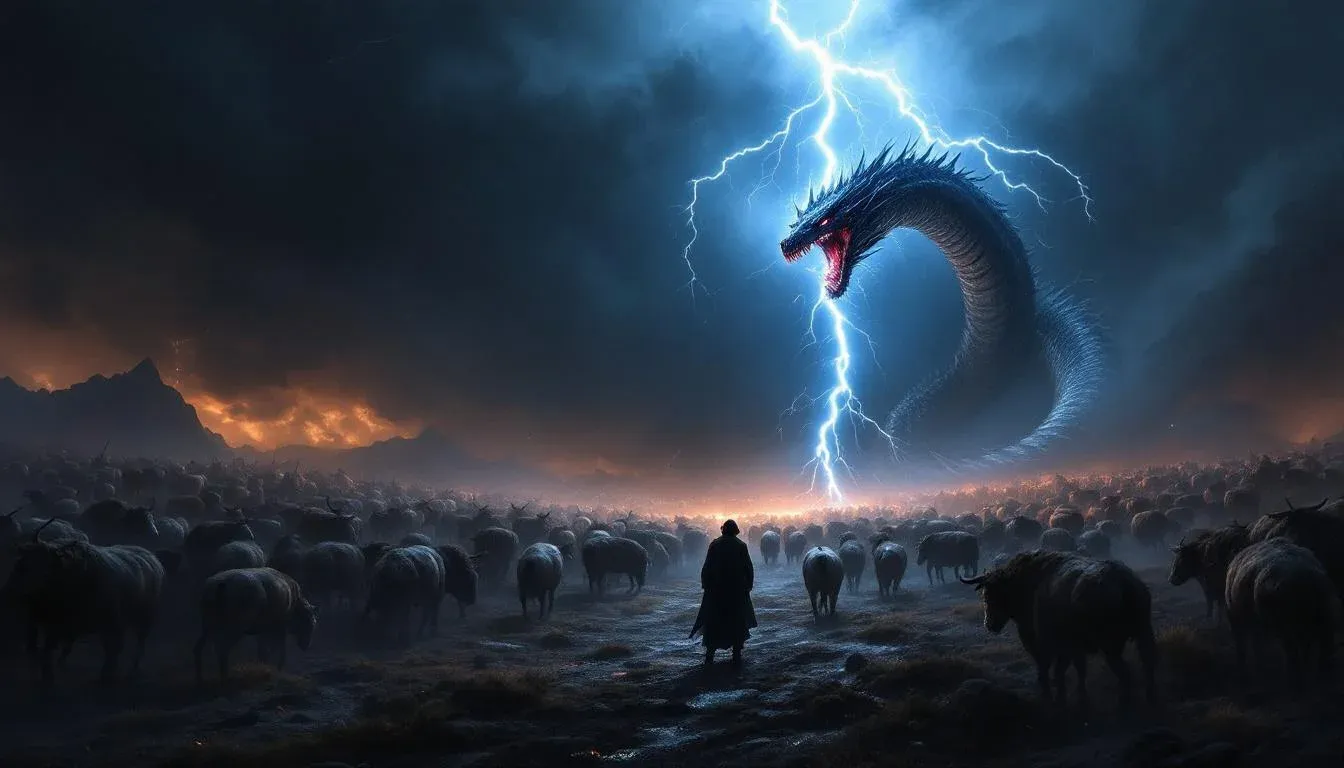
Veles, the serpent-god below, grows restless. He slithers up from the roots of the World Tree, climbing toward the crown where Perun resides among the branches. Along the way, he steals. In some versions he takes Perun's cattle — the clouds, heavy with rain, that the sky god herds across the heavens. In others he steals Perun's wife or his children. The theft is always an act of cosmic trespass: the god of the low places reaching upward, pulling what belongs to the sky down into the dark.
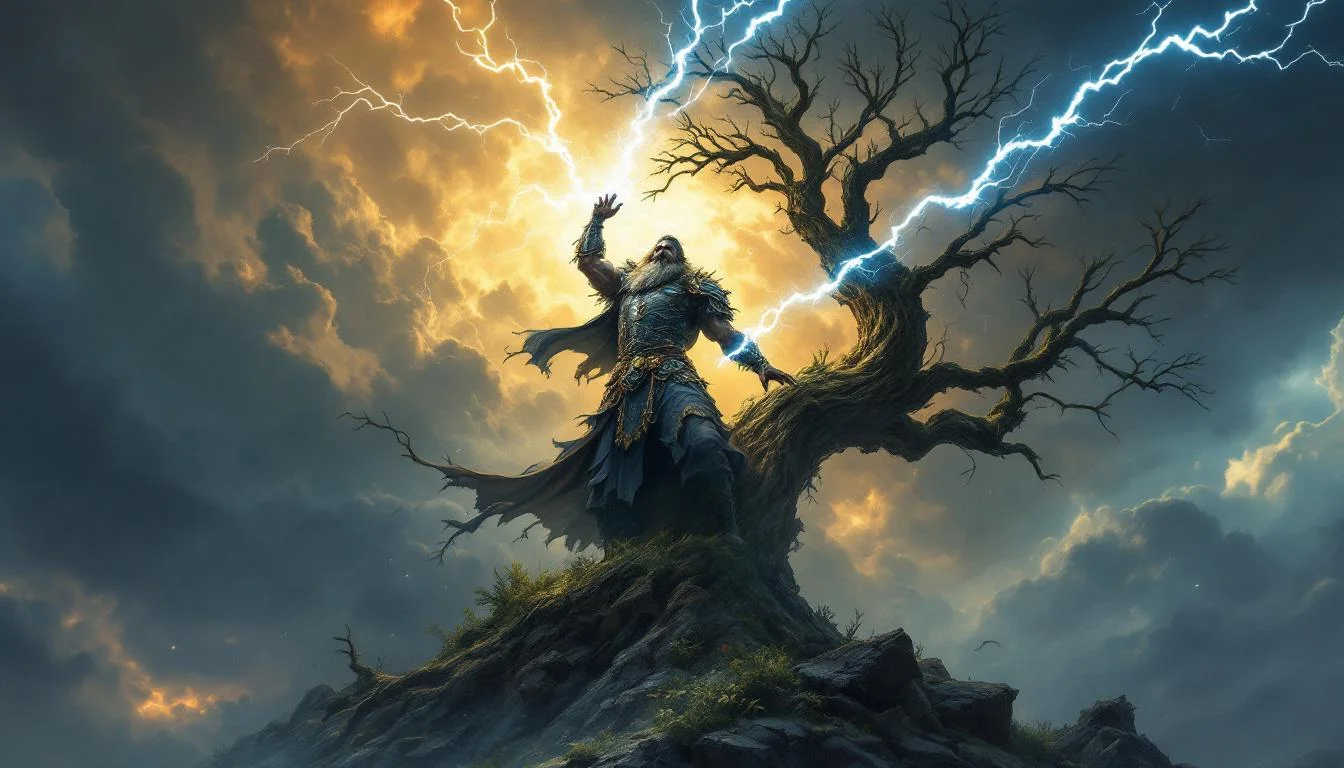
Perun responds with fury. He gathers storms, rides the clouds, and hurls lightning at Veles. The thunder is the sound of his chariot. The bolts are his weapons striking downward at the serpent who coils around the trunk of the World Tree. Veles flees. He is a shapeshifter — the most accomplished in the entire pantheon — and as he races back down toward the earth, he transforms himself to escape. He becomes a bear. A wolf. A snake. A tree. A man. He hides behind cattle, ducks under rivers, buries himself in the roots of oaks.
Eventually, Perun's lightning finds its mark. Veles is struck down — shattered, scattered, driven back beneath the earth. The stolen cattle are released. The clouds burst open. Rain falls on the parched land.
But Veles is never truly killed. He cannot be. He is the god of Nav, and Nav does not end. He retreats to the roots, licks his wounds in the wet darkness, and begins to gather his strength again. The cycle repeats — must repeat — because without the theft there is no storm, and without the storm there is no rain, and without the rain the fields die and the cattle starve. The Slavic cosmos required both gods. Perun without Veles is a tyrant ruling a cloudless, barren sky. Veles without Perun is chaos with no force to shape it into seasons.
Their war is not a battle between good and evil. It is the engine of the world.
Shapeshifter, Sorcerer, Poet: The Many Masks of Veles
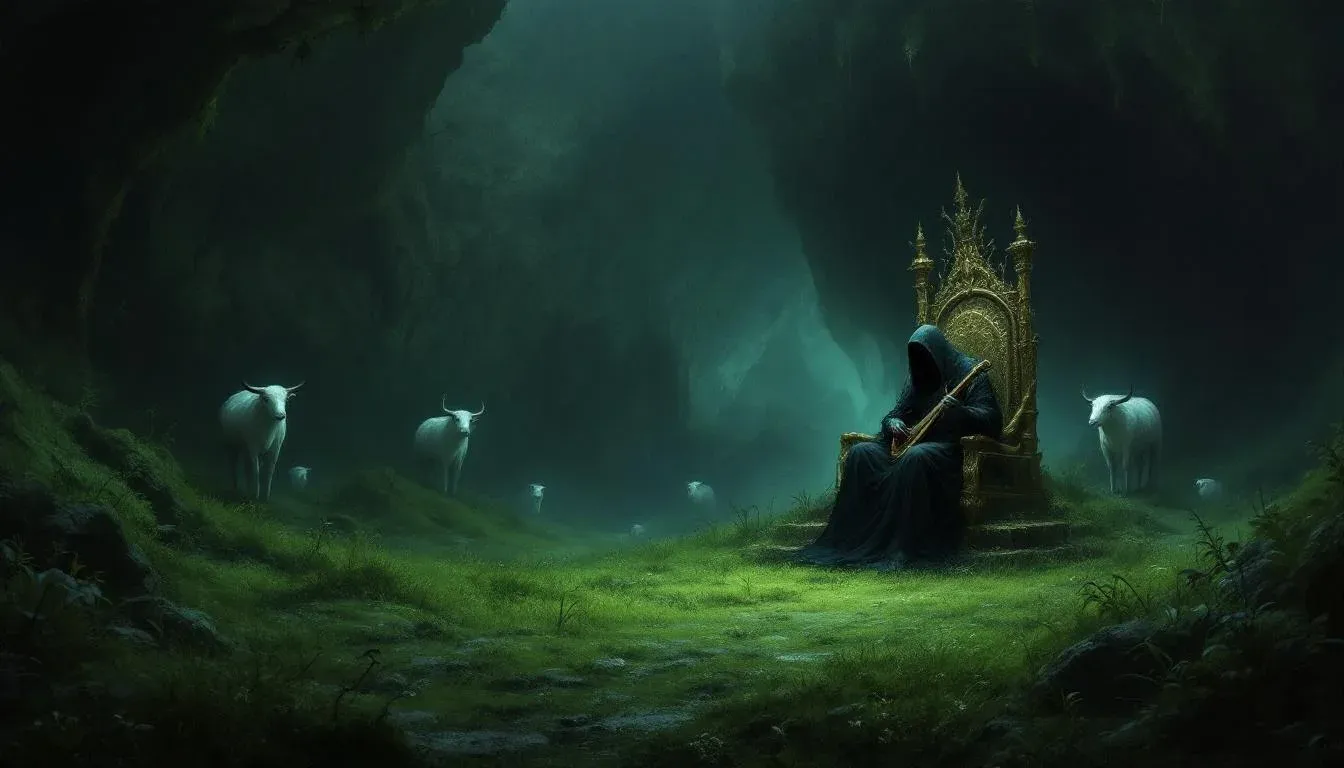
No other god in the Slavic pantheon holds so many contradictory titles. Veles is a god of death and a god of wealth. A god of cattle and a god of poetry. A god of the waters and a god of the forests. A guardian of oaths and a cosmic thief. He is the patron of sorcerers, the protector of travelling musicians, and the keeper of forbidden knowledge. If Mokosh weaves the fate of the living and Perun enforces the law of the sky, Veles governs everything that operates outside those structures — the liminal, the marginal, the spaces between.
His connection to music and poetry runs deep through Indo-European tradition. The Old Slavic author of the Tale of Igor's Campaign — the greatest literary work of medieval Rus — calls the mythical bard Boyan "the grandson of Veles." This is not a genealogical statement. It is a theological one. To say that the poet descends from Veles is to say that poetry itself originates in the underworld, in the realm of the dead, in the hidden knowledge that only the god of the deep places can unlock.
This makes Veles something close to an Orpheus figure — or rather, Orpheus is something close to a Veles figure, since the Slavic tradition is at least as old. In wedding ceremonies of northern Croatia that survived into the 20th century, the bridegroom was required to spill wine on the ground before the musicians would play — an offering poured into the earth, toward the roots, toward the god who made music possible.
His animal forms tell the same story of boundary-crossing. The bear — ruler of the forest, creature of caves and winter sleep, an animal that walks between death and waking. The serpent — dweller in holes, guardian of underground treasure, a creature that sheds its skin and is reborn. The wolf — the predator at the edge of the village, neither tame nor entirely wild. Every animal associated with Veles is a creature of thresholds, of transitions, of the spaces where one world bleeds into another.
The Afterlife of a God: Saint Blaise and the Christian Mask
When Christianity swept through the Slavic lands in the 10th and 11th centuries, the old gods did not simply vanish. They went underground — which, for Veles, was merely going home.
The process was systematic. Perun was absorbed into the cult of the Prophet Elijah, who rode a fiery chariot across the sky and commanded storms. Mokosh became Saint Paraskeva, patroness of spinning and women's work. And Veles — the cattle god, the guardian of herds, the deity whose very name echoed through the Slavic word for "wool" — became Saint Blaise. Or, as Eastern Slavs called him, Saint Vlasiy.
The phonetic similarity was convenient. Veles — Vlasiy. Close enough to make the substitution seamless. But the connection went deeper than sound. Saint Blaise of Sebastea, an Armenian bishop martyred in the 4th century, was already venerated in Western Christianity as a patron of wool combers and livestock. When Slavic missionaries needed a Christian replacement for the cattle god, Blaise was waiting.
In Yaroslavl, the first church erected on the site of Veles's pagan shrine was dedicated to Saint Vlasiy. In Novgorod, the same substitution occurred. Across the Russian north, the feast day of Saint Vlasiy — February 11 by the old calendar — became a day when cattle were blessed, when farmers brought livestock to church doors, when the boundary between the pagan and the Christian blurred so thoroughly that no one could say where one ended and the other began.
The god had not died. He had shapeshifted one final time.
Why Veles Matters: The God Who Refuses to Be Simple
Every mythology needs a figure like Veles — a deity who holds the contradictions that the other gods cannot contain. Perun is the sky, clear and violent. Chernobog, if he ever truly existed, is abstract darkness. But Veles is the wet earth and everything in it: the dead and the seeds, the gold and the rot, the music and the silence. He is the god of the places where life turns into death and death turns back into life — the compost, the cave, the riverbed, the root system of the old oak where offerings were poured into the ground.
He is also, perhaps, the most honest god in the pantheon. The Slavic cosmos does not pretend that order can exist without chaos, that the sky can function without the underworld, that rain can fall without first being stolen. The storm myth makes this explicit: Perun needs Veles. The theft is not a catastrophe — it is a mechanism. The god of the deep places is not the enemy of the world. He is the engine beneath it, turning in the dark, keeping everything alive by refusing to stay where he has been put.
Koschei the Deathless may carry echoes of his myth — the gaunt undying figure hoarding treasure in the dark. The serpents of a hundred folk tales may wear his scales. Every time a Slavic farmer left the last sheaf of grain uncut in the field, every time a poet invoked the name of Boyan, every time lightning split an oak and a villager said "Perun is hunting the snake," the old god stirred in the roots beneath them.
He is still there. The deepest gods always are.