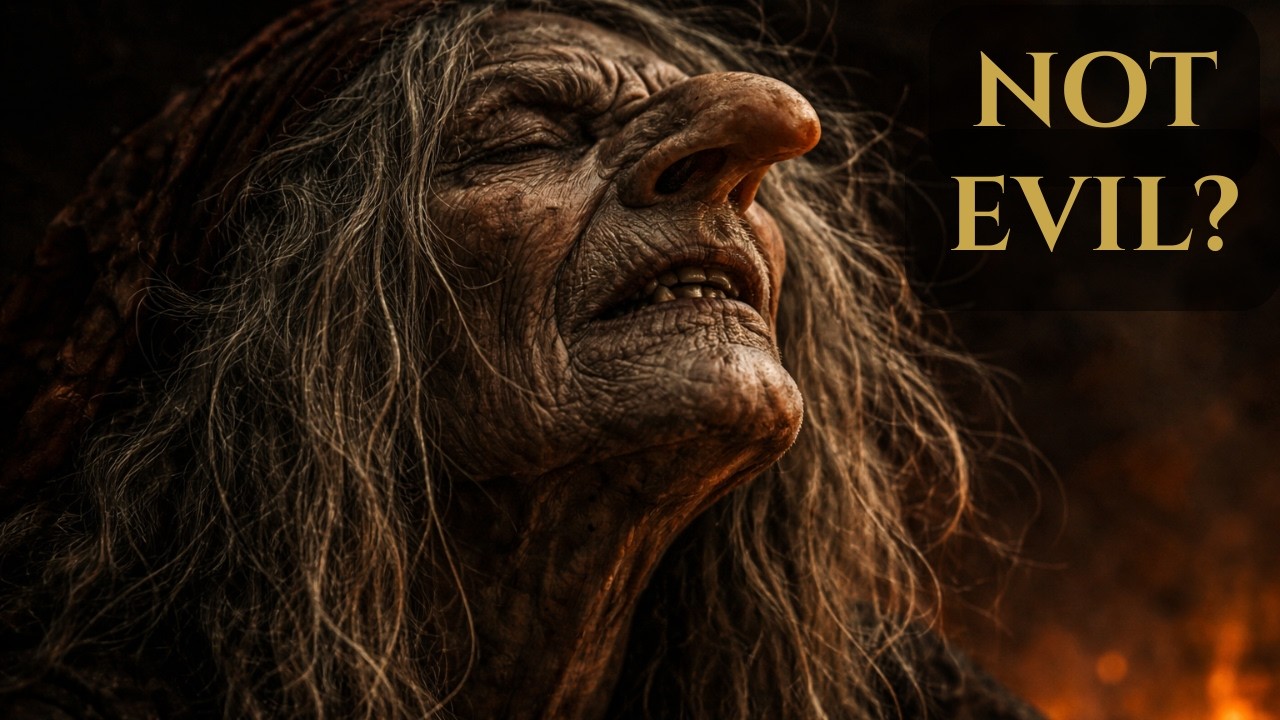
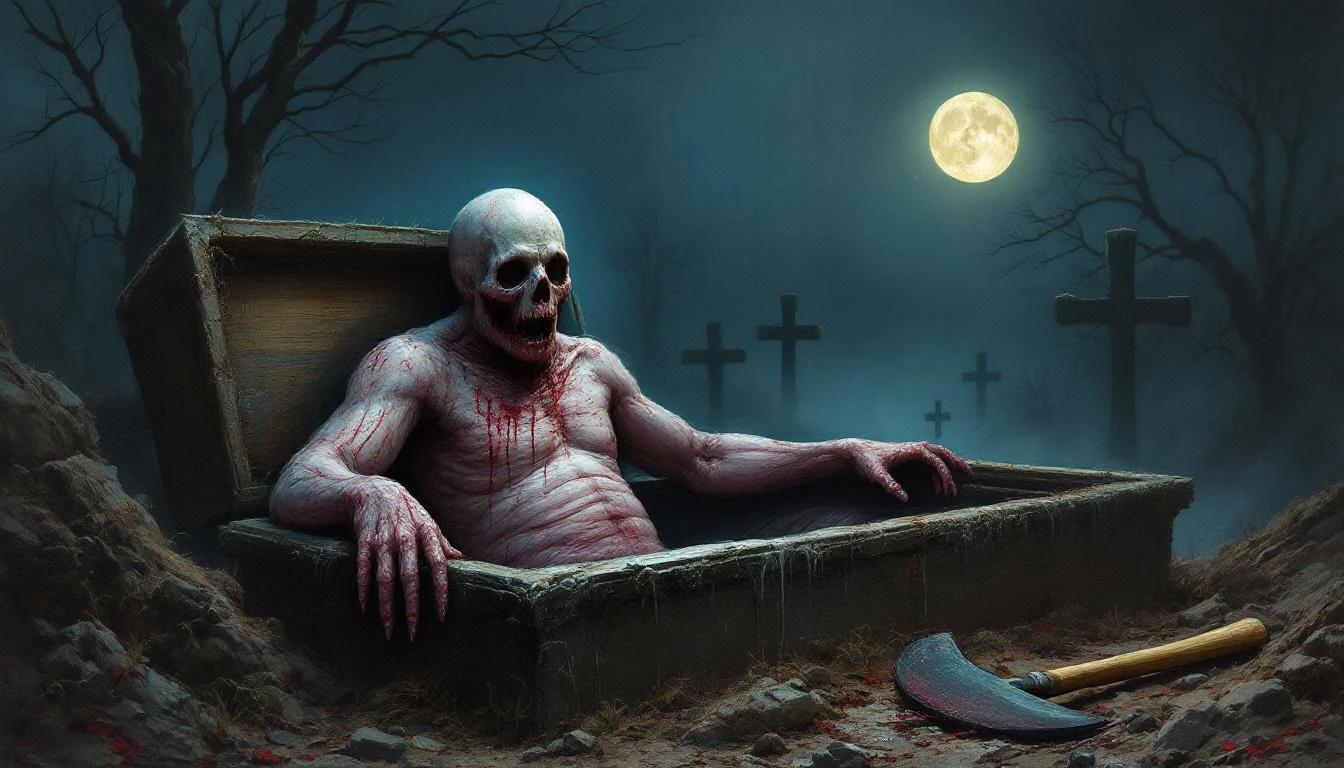
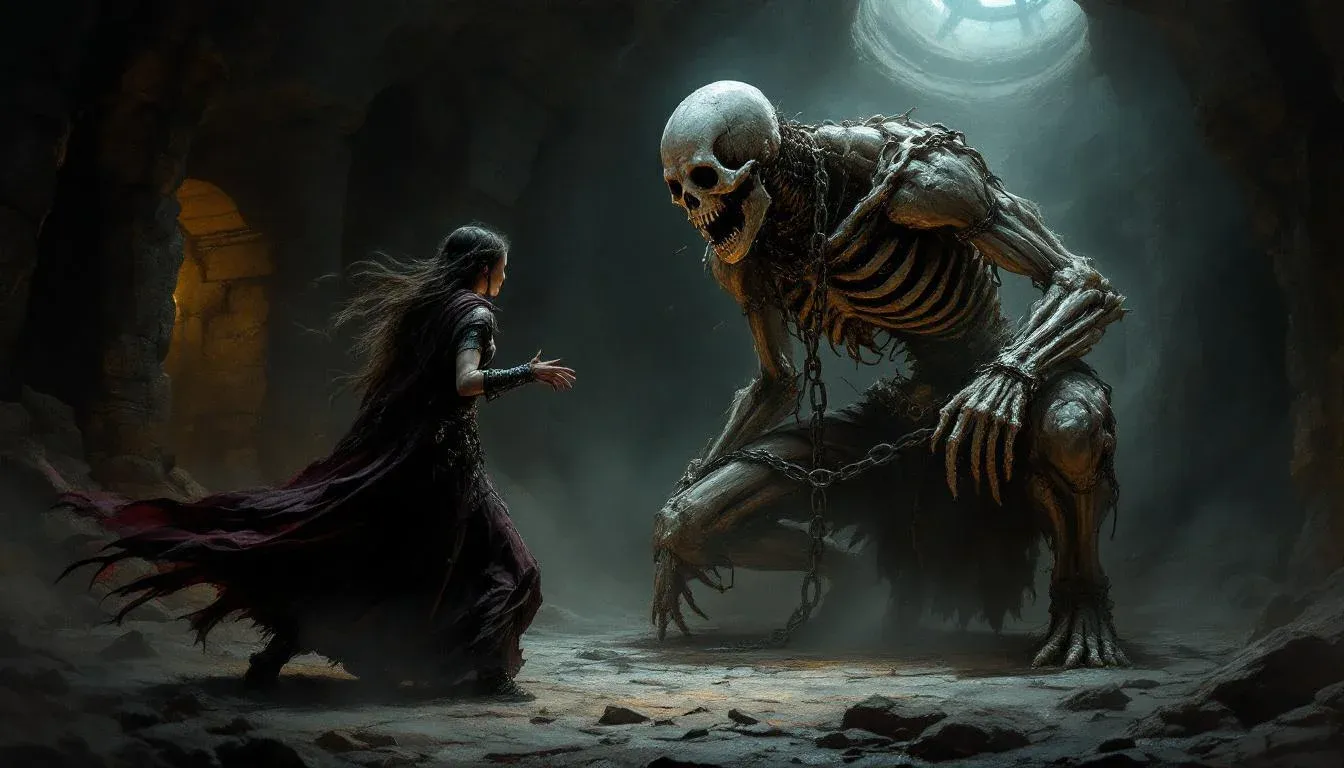
There is an old man who cannot die. He has been alive so long that his flesh has withered to nothing, leaving only bone and sinew stretched tight across a frame that should have crumbled to dust centuries ago. His name is Koschei — Koschei the Deathless — and across the lands of Eastern Europe, no figure in Slavic folklore casts a longer shadow.
He is not a ghost. He is not a demon. He is something worse: a man who found a way to separate himself from death and lock it away where no one could reach it. His story is one of obsession, cruelty, and a kind of immortality that looks nothing like a blessing.
The Bone King: Origins and Etymology of Koschei
The very name Koschei carries the stench of the grave. Most scholars trace it to the Common Slavic word kost, meaning "bone" — a fitting label for a creature described as little more than a skeleton draped in papery skin. Vladimir Dahl, the great 19th-century lexicographer, connected it to kastit ("to defile, to harm"), noting that the word was reshaped from kost, meaning a man exhausted by excessive thinness. In the oldest East Slavic chronicles, the word koshchei also appears as a Turkic loan meaning "slave" or "captive" — a detail that gains eerie significance when you learn how many tales begin with Koschei chained in a dungeon.
His full title in Russian is Koschei Bessmertny — Koschei the Immortal, or more accurately, Koschei the Deathless. The distinction matters. He is not simply hard to kill. He has externalized his own mortality, hidden it beyond the reach of swords and spells. Some folklorists see in him a distorted memory of Veles, the pre-Christian Slavic god of the underworld, cattle, and sorcery. Others point to Khan Konchak, the 12th-century Polovtsian warlord whose uncanny longevity and ruthlessness may have seeded the legend. Whatever his origins, by the time Alexander Afanasyev began collecting Russian fairy tales in the 1850s, Koschei had become the definitive villain of East Slavic storytelling — a gaunt, ancient terror who abducts brides, hoards gold, and rides a horse that outruns the wind.
How Koschei Hid His Death: The Needle in the Egg
This is the detail that has echoed through centuries of storytelling and into modern fantasy — the reason Voldemort's Horcruxes feel strangely familiar to anyone raised on Slavic tales.
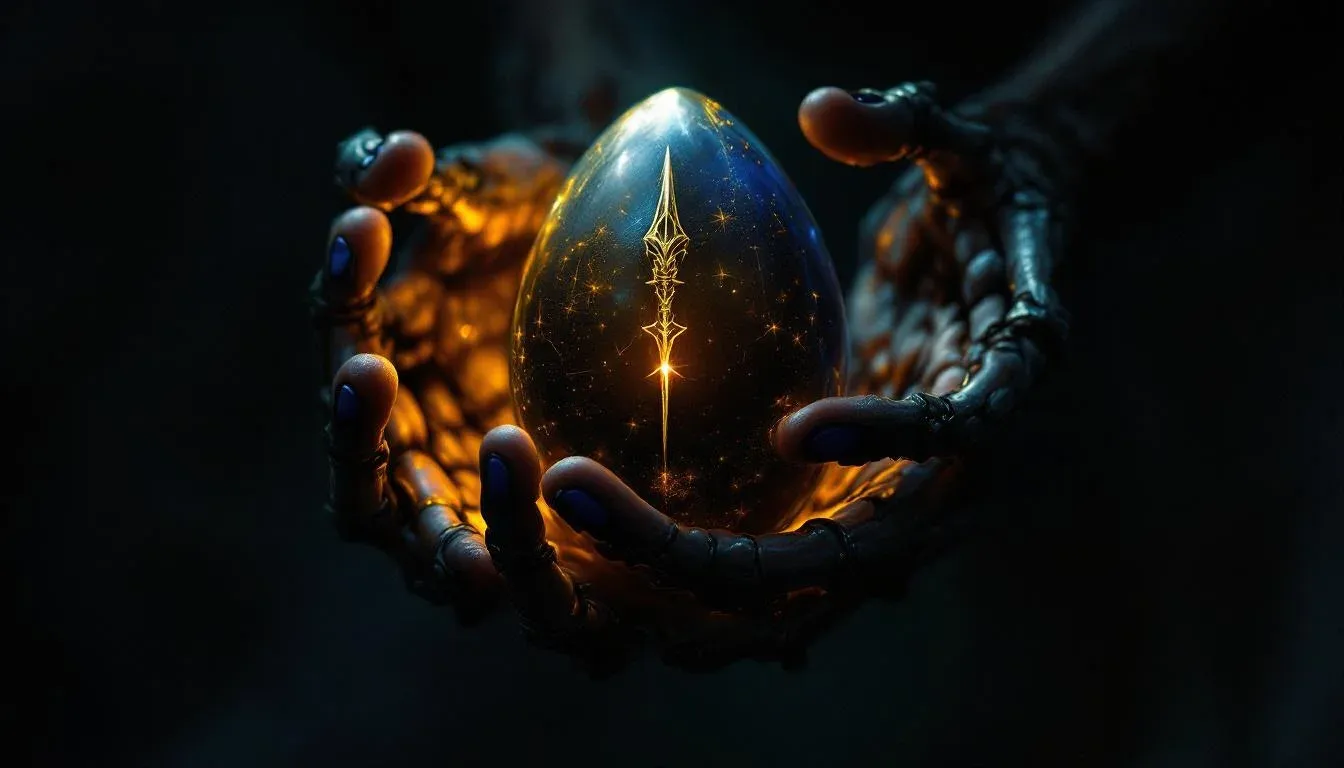
The deathless sorcerer cannot be slain because his death does not reside inside his body. He has removed it and concealed it within a nesting sequence of containers, each one guarded by the next. As Baba Yaga reveals in The Frog Princess: "His death is at the point of a needle. The needle is in an egg; the egg is in a duck; the duck is in a hare; the hare is in a stone casket; the casket is at the top of a tall oak tree that Koschei guards as the apple of his eye."
In other versions, that oak tree stands on the mythical island of Buyan, far out in the ocean-sea — the same Buyan where the winds are born and the red sun rests at night. The chest is sometimes iron, sometimes crystal, sometimes bound in chains. But the structure is always the same: layer upon layer of protection, organic and inorganic, living and dead, each one more difficult to breach than the last.
The symbolism runs deep. The egg is a universal symbol of creation and the soul in Slavic cosmology. The duck and hare are creatures of liminality — the duck moves between water and sky, the hare between forest and field, both associated with boundary-crossing and the spirit world. The oak is the sacred tree of Perun, god of thunder, the axis between upper and lower worlds. To reach the death of Koschei, a hero must pass through every layer of existence.
And here lies the cruel genius of the spell: anyone who possesses the egg holds power over the sorcerer. When the egg is tossed about, his body is flung in agony. When the needle is snapped, Koschei dies. He traded vulnerability for distance — his death is safe only as long as it stays hidden.
Marya Morevna and the Twelve Chains
The most famous tale featuring Koschei the Deathless is Marya Morevna, collected by Afanasyev and later retold by Andrew Lang in The Red Fairy Book. It is a story about the price of curiosity and the strange mercy of giving water to your enemy.
Ivan Tsarevich, a young prince, marries the warrior princess Marya Morevna — herself a figure of power, a woman who rides to war and keeps dangerous things locked away. Before leaving for battle, she gives Ivan one command: do not open the door to the cellar. Naturally, he opens it. Behind that door, chained with twelve iron chains, hangs a withered, half-dead creature: Koschei, who has been imprisoned there for ten years.
"Have pity upon me and give me to drink! Ten years long have I been here in torment, neither eating nor drinking; my throat is utterly dried up."
Ivan, moved by pity or perhaps by the sheer horror of what he sees, brings water. One bucket. Koschei drinks and begs for more. A second bucket. The chains groan. A third bucket — and the sorcerer's strength floods back into his wasted frame. He shatters all twelve chains at once, tears through the ceiling like a storm, and vanishes into the sky carrying Marya Morevna with him.
Three times Ivan rides after Koschei. Three times the immortal sorcerer catches him, and three times — out of contempt or twisted gratitude for the water — he lets Ivan live, warning: no sword, no arrow, no lance can touch him. Only the last time does Koschei lose patience, and he cuts Ivan to pieces, stuffs the remains in a barrel, and throws it into the sea.
The Ride to Baba Yaga: How Ivan Found a Horse Fast Enough
Ivan's brothers-in-law — three sorcerers married to his sisters, each able to take the form of a falcon, an eagle, and a raven — retrieve the barrel and restore him to life with the water of life and death. But they deliver a warning: Koschei rides a magical horse that no ordinary steed can outrun. To rescue Marya Morevna, Ivan must obtain an equally powerful mount. And there is only one place to find such a horse: in the stables of Baba Yaga.
The journey to Baba Yaga's domain is itself a passage through death. Her hut stands on chicken legs beyond the edge of the known world, ringed by a fence of human bones topped with skulls. She sets Ivan three impossible tasks — to herd her mares for three days without losing a single one. The mares scatter to the ends of the earth, but the animals Ivan showed kindness to along his journey repay the debt: bees, birds, and sea creatures drive the mares back each evening.
When Ivan finally steals the finest foal from Baba Yaga's herd and raises it on meadow dew, he rides against the deathless sorcerer for the last time. This time, his horse is faster. This time, dark magic is not enough. Ivan strikes down Koschei, burns his body on a pyre, and scatters the ashes to the wind.
Koschei in the Wider Slavic World
The legend of Koschei does not belong to Russia alone. Variants of his legend surface across Ukraine, Belarus, Poland, and the Czech lands, though the details shift from region to region. In some Ukrainian tellings, he is less a sorcerer and more a force of winter itself — a frost-king who locks the earth in ice and hoards the warmth of spring inside his palace. The folklorist Lilia Alekseeva argues that Koschei may be one form of Karachun, an ancient Slavic demon of death and the winter solstice, a wintertime deity who personifies the end of all things.
In The Frog Princess (Tsarevna-Lyagushka), another tale from Afanasyev's collection, Koschei appears as the captor of Vasilisa the Wise — a woman of extraordinary magical skill whom he has imprisoned out of jealousy and possessiveness. It is a reminder that Koschei's evil is not abstract. It is intimate. He does not seek to destroy the world. He seeks to own specific people, to lock beauty and youth in his tower while he sits on his pile of cursed gold, neither fully alive nor fully dead.
His presence in Slavic culture extends far beyond the fairy tale page. The 1945 Soviet film Kashchey the Immortal, directed by Alexander Rou, brought him to cinema during the final months of World War II — a barely veiled allegory in which Koschei stood for fascism and the hero's victory over death represented the resilience of the Slavic peoples. Decades later, Catherynne M. Valente's novel Deathless (2011) reimagined the legend in revolutionary Leningrad, weaving the deathless king into a story about love, power, and the Russian 20th century.
And then there is Voldemort. Rowling's dark lord with his soul split into seven Horcruxes is the most visible modern echo of the Koschei archetype. The core mechanic is identical: remove your mortality from your body, hide it in objects, and become unkillable — until someone patient and brave enough traces the chain back to its source. The needle came before the diary. The egg came before the locket. Slavic folklore invented the concept of the phylactery villain a thousand years before Hogwarts.
Why Koschei Matters
Strip away the magic and the fairy tale trappings, and what remains is a story about the cost of refusing to die. Koschei achieves immortality, but look at what it buys him: a body of bones, a life of kidnapping and hoarding, an existence defined entirely by the fear of the one thing he cannot outrun. He is not powerful in any meaningful sense. He is afraid. Every chain on that chest, every layer between him and the needle, is another lock on a door built from terror.
The Slavic storytellers understood something that modern fantasy often misses: immortality is not the opposite of death. It is the opposite of life. Koschei the Deathless sits alone in his fortress with his stolen bride and his cursed gold, and he is the loneliest figure in all of Slavic mythology. He has defeated death and gained nothing.
That is why the old tales insist on the specific details — the needle, the egg, the duck, the hare, the chest, the oak, the island of Buyan. Each layer is a meditation on what it means to hide from the thing that makes us human. And each time a hero cracks open another shell, reaches deeper into the nesting darkness, they are doing something more radical than slaying a monster. They are restoring the natural order. They are returning death to a creature that has forgotten it needs to die.
Koschei the Deathless is not just a villain. He is a warning — told in a hundred versions, across a thousand years, around fires that have long since gone cold — about what happens when you love your own survival more than anything else in the world.