Before there were churches on the hills of Kyiv, there were oaks. Ancient, split-crowned oaks scorched by lightning and blackened by fire, standing alone on high ground where the wind never stopped. The Slavs did not build temples to their highest god. They did not need to. Every thunderstorm was his temple. Every bolt that cracked the summer sky was his voice.
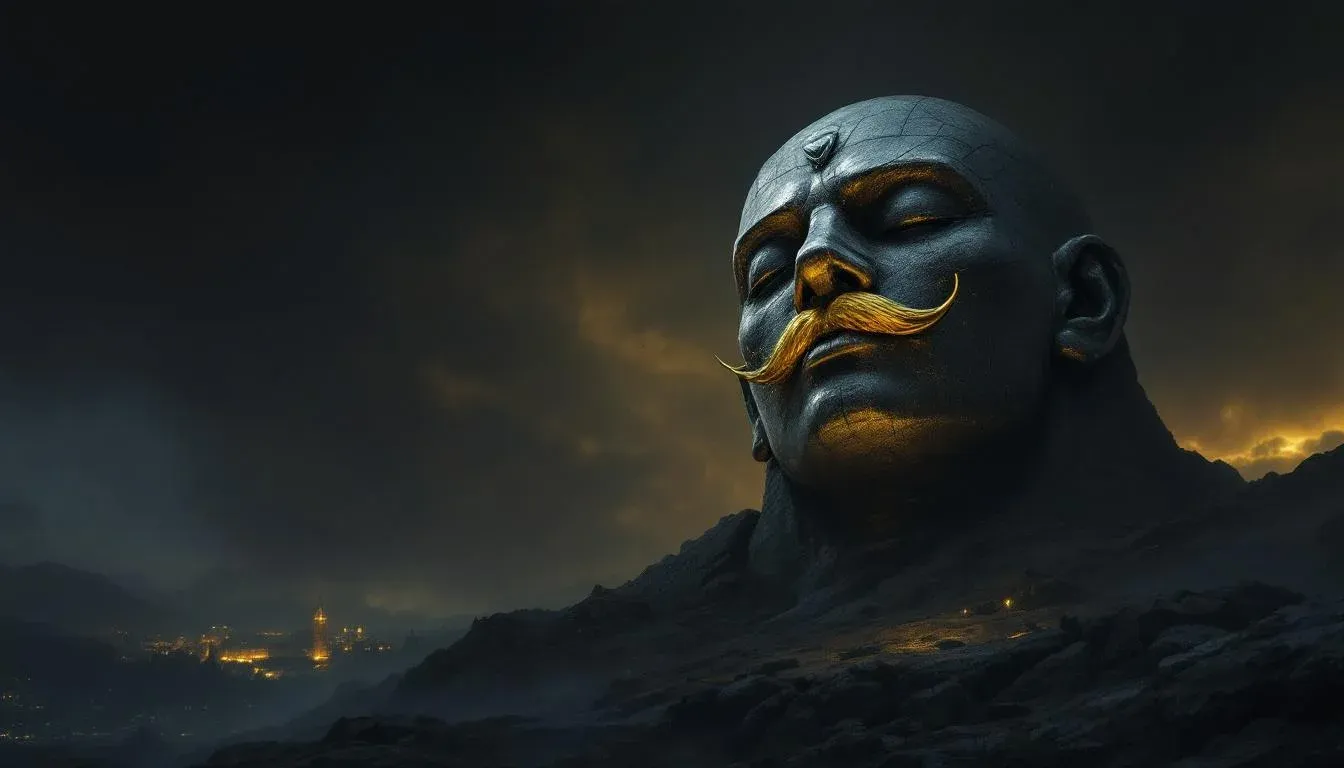
His name was Perun. He was the lord of the storm, the wielder of the thunderbolt, the judge of men and the enemy of everything that crawled in darkness. For centuries he stood at the top of the Slavic pantheon — feared by warriors, sworn upon by princes, carved in wood with a silver head and a golden mustache. And then, in a single act of political theater, his idol was tied to a horse's tail and dragged down a hill into the river.
But killing a god is harder than drowning a statue.
The God on the Hill
Perun occupied the highest position among the Slavic gods — not merely the strongest, but the supreme authority. His domain was the sky itself: thunder, lightning, rain, storms, and the enforcement of oaths and cosmic law. He was the god warriors called upon before battle and the god princes invoked when signing treaties. The earliest written mention appears in the sixth-century Byzantine historian Procopius of Caesarea, who noted that the Slavs worshipped a god who was "the maker of lightning and the lord of all."
His appearance, as recorded in later sources and reconstructed by scholars such as Roman Jakobson and Vyacheslav Ivanov, was that of a powerful man with a copper or red beard, silver hair, and a golden mustache. He rode across the sky in a chariot pulled by a goat — a detail that will sound familiar to anyone who knows Norse mythology. He carried weapons made of stone and fire: axes, arrows, and a great hammer or mace, any of which could become lightning when hurled from the heavens.
His sacred tree was the oak. His sacred day was Thursday. His flower was the iris. And the places where lightning struck the ground were considered holy — the stones found there, called thunderstones, were believed to be fragments of his weapons, driven into the earth and slowly working their way back toward the sky over a cycle of seven years.
The Eternal War: Perun and Veles
No myth defines Perun more completely than his eternal battle with Veles, the god of the underworld, cattle, water, and sorcery. If Perun ruled everything above — the sky, the mountaintops, the dry upper branches of the world tree — then Veles ruled everything below: the roots, the waters, the wet earth, the realm of the dead. They were not simply rivals. They were the two poles of existence, and their conflict was the engine that kept the world turning.
The myth, reconstructed by Ivanov and Toporov from scattered folk tales and comparative Indo-European scholarship, follows a pattern. Veles, taking the form of a great serpent or dragon, slithers up from beneath the roots of the world tree. He steals something precious — Perun's cattle, his wife, or in some versions his son — and carries it back into the underworld. Perun, enraged, pursues the serpent across the sky, hurling thunderbolts. Veles hides behind trees, behind rocks, behind water, behind anything he can find. The chase splits the sky open. Rain pours down. Lightning cracks against stone.
In the end, Perun strikes Veles down and drives him back beneath the earth. The stolen waters — for Veles hoards moisture the way a dragon hoards gold — are released. Rain falls on dry fields. The world is renewed.
Until Veles rises again. Because he always rises again. He sheds his serpent skin like a season turning, and the whole cycle begins once more.
This is not a story of good versus evil, though later Christian interpreters tried to make it one. It is a story of order against chaos, sky against earth, the dry season against the wet. The Slavs understood something that monotheism often forgets: the world needs both poles. Without Veles, there is no rain. Without Perun, there is no order. The storm is not a disaster — it is the mechanism by which balance is restored.
Vladimir's Pantheon: A God Made Political
In 980 AD, something unusual happened. Prince Vladimir Sviatoslavich of Kyiv, seeking to consolidate power over the fractious East Slavic tribes, attempted to create a unified state religion. He ordered the construction of a hilltop shrine outside his palace, overlooking the Dnieper River, and erected wooden idols of six gods. The Primary Chronicle — the oldest surviving East Slavic historical text, compiled around 1113 — records the moment with rare specificity.
And Vladimir began to rule alone in Kyiv, and he set up idols on the hill outside the castle courtyard: one for Perun, carved of wood, with a silver head and a golden mustache, and others for Khors, Dazhbog, Stribog, Simargl, and Mokosh. And they offered sacrifices to them, calling them gods, and brought their sons and daughters and sacrificed them to devils.
Six gods. But the order is deliberate. Perun stands first, and he alone receives a physical description — silver head, golden mustache. This was not mere worship. It was propaganda. Vladimir was telling every tribe in his domain: my god stands above yours. Mokosh, goddess of the earth and women's fate, was included — but last. Khors and Dazhbog, solar deities worshipped by different tribal groups, were folded into the hierarchy beneath the thunder god. Even Svarog, the sky-smith and father of gods in some traditions, was absent from this political pantheon — perhaps because his worship competed too directly with Perun's supremacy.
The pantheon lasted eight years.
The Drowning of a God
In 988 AD, Vladimir converted to Byzantine Christianity. The reasons were as much diplomatic as spiritual — a marriage alliance with the Byzantine Emperor's sister, access to the wealth and legitimacy of Constantinople, the unifying power of a book-religion with priests and laws and a single story. Whatever his motives, the consequences for Perun were swift and spectacular.
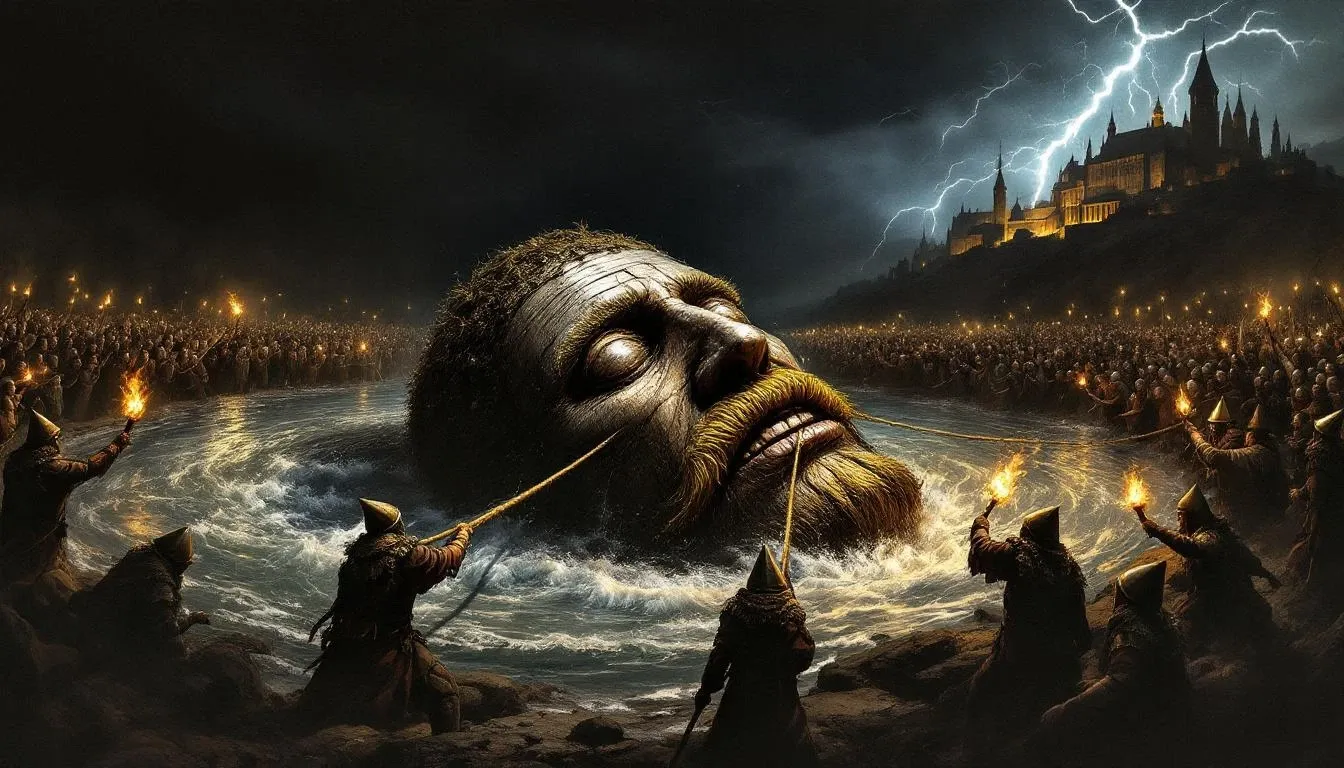
The Primary Chronicle describes the destruction with an almost cinematic attention to humiliation. Vladimir ordered the idols torn down. Some were chopped to pieces. Some were burned. But Perun received special treatment. His idol was bound to a horse's tail and dragged from the hilltop shrine down Borichev descent to the river. Twelve men beat the wooden god with sticks as it scraped along the dirt — not because the wood could feel pain, but because the people watching needed to see their god degraded, needed to understand that the old power was broken.
The idol was thrown into the Dnieper. And then — a detail that reveals how deeply Perun was feared even by those destroying him — Vladimir posted men along the riverbank with orders to push the idol back out into the current if it washed ashore. They would not let the god find land. He had to be carried away, out of the territory, past the rapids, gone.
In Novgorod, the parallel destruction was even more dramatic. Archbishop Ioakim ordered Perun's idol thrown into the Volkhov River. According to the Novgorod First Chronicle, the wooden god floated against the current and a voice was heard from the water: "Here is something for you, people of Novgorod, in memory of me." A stick flew from the river onto the bridge. For centuries afterward, local boys would gather on that bridge on certain days and beat each other with clubs — a ritual the Church could never fully suppress, though it tried.
The Indo-European Bloodline
Perun did not emerge from nowhere. He belongs to one of the oldest and most widespread divine archetypes in human civilization: the Proto-Indo-European thunder god, reconstructed by linguists as *Perkwunos — "the Striker," or perhaps "the Lord of Oaks."
The family resemblance is unmistakable. Norse Thor rides a chariot pulled by goats, carries a hammer called Mjolnir, and battles the world-serpent Jormungandr. Lithuanian Perkunas drives a stone chariot, hurls axes, and fights a subterranean serpent. Vedic Indra wields the vajra thunderbolt and slays the cosmic dragon Vritra to release the waters. Greek Zeus, king of the gods, rules from a mountaintop and throws lightning at the serpentine Typhon. Even the Baltic Latvian Perkons carries a weapon whose name — milna — is cognate with Mjolnir.
The linguistic chain is direct. Proto-Indo-European perkwu- means "oak" or "to strike." From this root: Latin quercus (oak), Lithuanian Perkunas, Latvian Perkons, Old Prussian Percunis, and Slavic Perun. These are not borrowed names. They are inherited, carried across millennia by migrating peoples who forgot they had ever been one nation but never forgot that thunder meant a god was angry.
Perun's battle with the serpent Veles mirrors Thor's struggle with Jormungandr, Indra's slaying of Vritra, and Zeus's war against Typhon with such precision that the parallel cannot be coincidence. It is the same myth, told in a thousand languages across five thousand years, surviving every migration, every conquest, every conversion. The storm god fights the chaos serpent. The waters are released. The world is made new. This is the oldest story the Indo-European peoples know.
A God in Hiding: Perun After Christianity
The churches went up. The idols came down. But Perun did not die — he changed his name.
Across the Slavic world, from Serbia to Russia to Poland, Perun's attributes were quietly transferred to the Prophet Elijah — Ilya in the East Slavic tradition. The fit was almost too convenient. Elijah, in the Book of Kings, ascends to heaven in a chariot of fire. He calls down fire from the sky to consume a sacrifice. He controls rain, withholding it for three years as punishment and then releasing it in a downpour. For Slavic peasants who had spent generations praying to Perun for rain, the transition required almost no mental adjustment. The saint rode a fiery chariot across the sky and controlled the weather. Same god, new paperwork.
Ilya's Day — celebrated on August 2 in the Orthodox calendar — became one of the most important folk holidays in rural Russia and Ukraine. Peasants believed that on this day, it was dangerous to work in the fields because Elijah was riding his chariot across the sky and might strike you with lightning. Swimming was forbidden because Veles — now hiding under the name of the Devil — was lurking in the water. The folk prohibitions tracked exactly onto the old Perun-Veles mythology: the sky god rages, the chthonic serpent hides below, and mortals stay out of the crossfire.
Why Perun Still Matters
Strip away the silver and gold. Forget the politics of Vladimir, the theological arguments of missionaries, the centuries of suppression. What remains is the core image: a man standing on a hilltop in a storm, watching lightning crack the darkness open, and understanding — not believing, understanding — that something vast and violent and necessary was happening above him.
Perun was not a comfort. He was not a god you prayed to for gentle mercies. He was the god of consequences — of oaths kept and oaths broken, of order maintained through overwhelming force. He was the thunder that followed the lightning, arriving too late to warn you but right on time to remind you that the world had rules.
The Slavic peoples who worshipped him lived in a world of dense forests, unpredictable rivers, and long winters where survival depended on understanding the forces that could destroy you. Chernobog may or may not have existed. Veles was clever and dangerous. But Perun was absolute. When the sky split open and the rain came down in sheets and the oak tree on the hill exploded into white fire, there was no ambiguity. That was Perun. That was the law.
They threw his idol in the river. They beat it with sticks. They posted guards to make sure he did not come back.
He came back anyway. He always comes back. That is what thunder does.