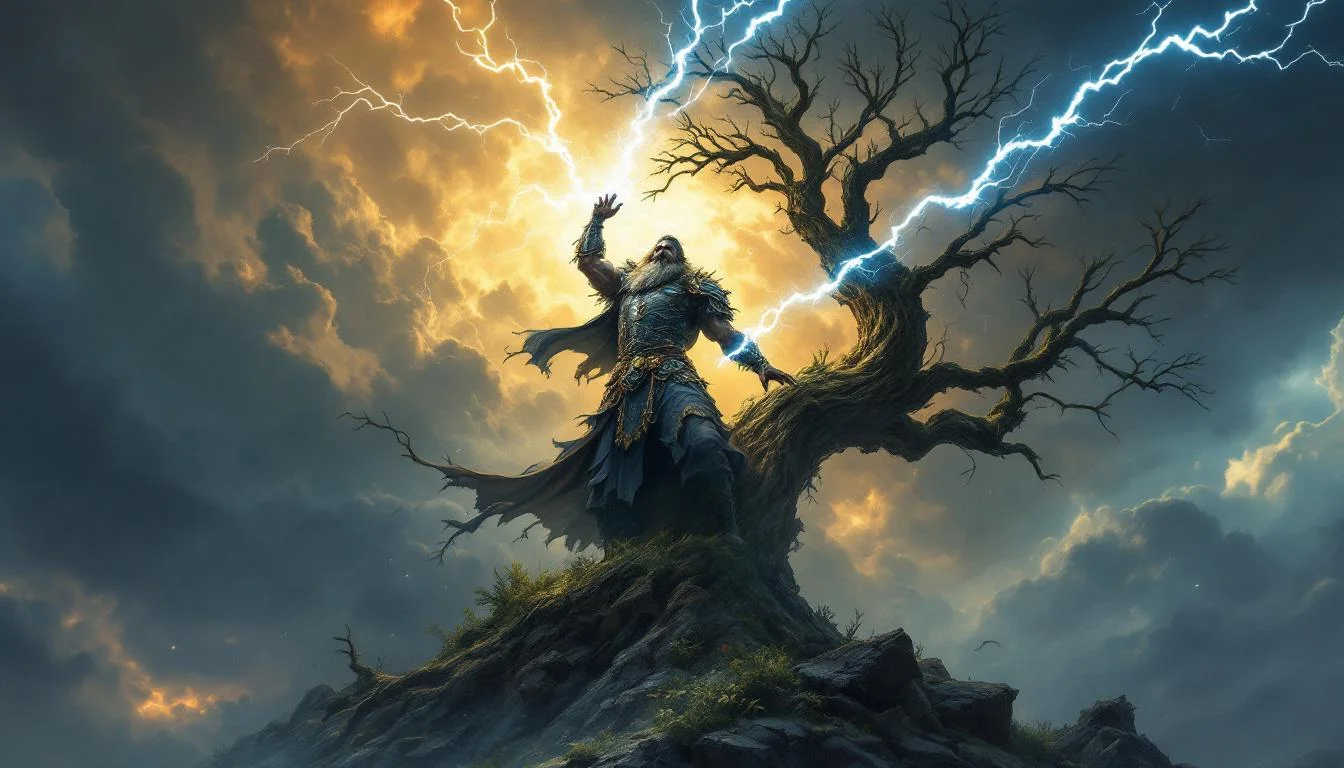
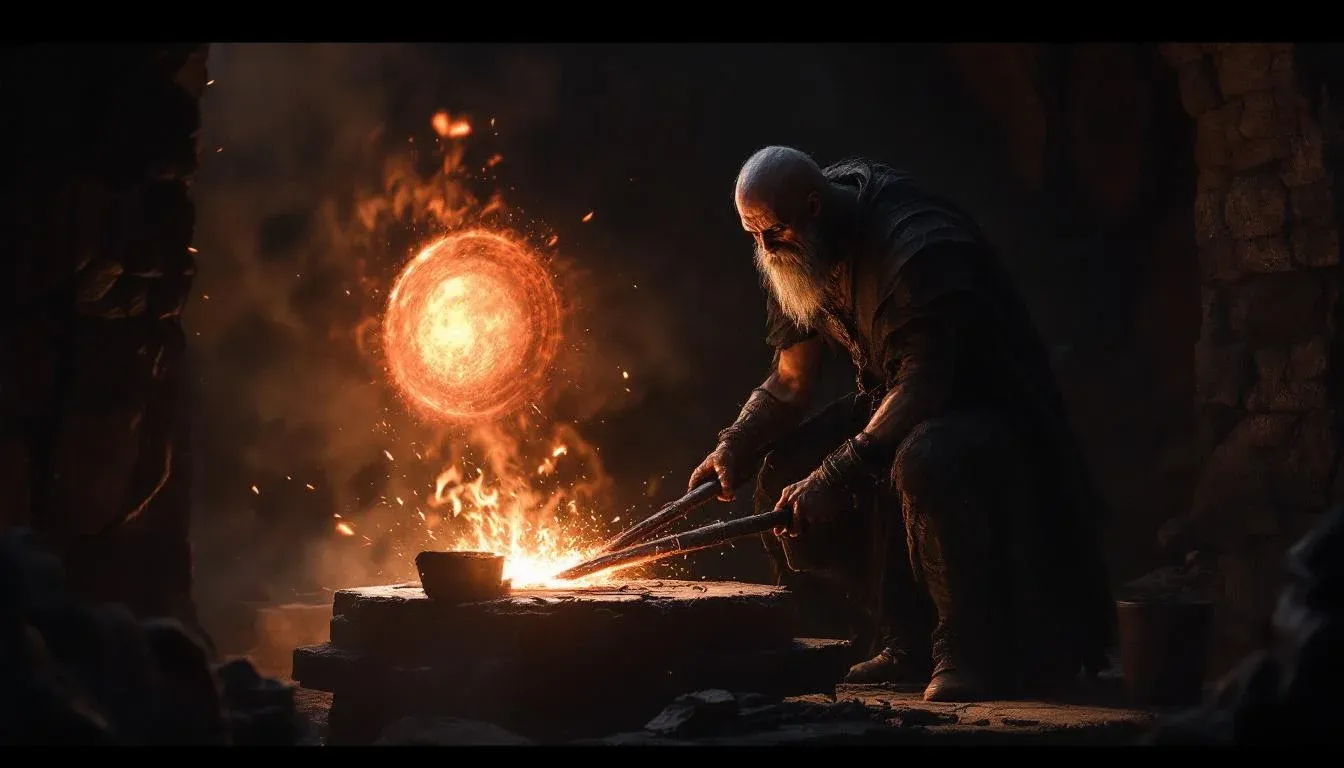
Somewhere above the world there was a forge. Not a forge built of stone and clay, the kind village blacksmiths hunched over with their leather aprons and tired arms, but something older and vaster — a forge where the sky itself was the ceiling and the stars were sparks thrown from the anvil. At this forge stood an old man with white hair and arms strong enough to shape the sun. His hammer rang across the heavens, and the sound of it was thunder before thunder had a name.
His name was Svarog. He was the celestial smith, the sky father, the god who forged the world's light and then — in an act no Greek or Norse deity ever managed — stepped aside and let his sons carry it forward. Every other supreme god clings to power. Svarog handed the sky to his children and walked back to his anvil. That tells you almost everything you need to know about him.
The Only Source: A Chronicle and a Gloss
Here is the uncomfortable truth about Svarog: nearly everything we know about him comes from a single document. Not a saga, not a hymn cycle, not a temple inscription — a footnote. A gloss scribbled into the margins of a Byzantine chronicle.
The document is the Slavic translation of the Chronographia of John Malalas, a sixth-century Byzantine historian whose rambling account of world history was popular enough to be translated into Old Church Slavonic and incorporated into the Hypatian Codex — one of the oldest surviving manuscripts of the Primary Chronicle (Povest' vremennykh let), the foundational text of East Slavic history. Under the entry for the year 1114, a Slavic scribe did what scribes do: he found a Greek god in the text and swapped in the local equivalent.
Where Malalas wrote about Hephaestus — the Greek smith god, lame and brilliant, cuckolded by Aphrodite and respected by none of the Olympians except when they needed weapons — the Slavic translator wrote Svarog. Where Malalas wrote about Helios, the sun, the translator wrote Dazhbog, and called him Svarog's son.
And after him Svarog reigned his son, named the Sun, whom they call Dazhbog... During the reign of this Svarog, tongs fell from the sky, and people began to forge weapons, for before that they beat one another with clubs and stones. That same Svarog established laws, that one man should have one wife and one woman one husband, and whoever violated this he ordered thrown into a fiery furnace. For this reason he was called Svarog. And after him reigned his son, the Sun, called Dazhbog.
That is almost the entire textual basis for Svarog. One passage, layered onto a Greek original, filtered through a Christian scribe's understanding of pagan religion. But notice what it contains, even in its brevity. Three extraordinary claims: Svarog is the Slavic Hephaestus — a divine smith. Tongs fell from the sky during his reign, and humanity learned metalworking. And he instituted monogamous marriage, punishing violators with fire. Those are not throwaway details. They describe a god who gave civilization its tools, its laws, and its moral order.
The Name and What It Burns
The etymology of Svarog has been debated almost as fiercely as his mythology. The oldest interpretation links his name to the Sanskrit svar — "radiance," "sky," "sun" — and by extension to svarga, the Vedic heaven. If true, this would make Svarog the embodiment of the bright sky itself, a celestial ruler whose name carried echoes of Indo-Iranian sun worship across thousands of miles.
Modern linguistics has largely rejected it. Aleksander Bruckner demonstrated that the vowel patterns do not match: Sanskrit svarga cannot produce Old East Slavic Svarogǔ through any regular sound change. Borrowing from the Avestan hvar ("light of the sky") would yield Slavic *xvor-, not svar-. The phonetics do not work.
The etymology that modern scholars prefer is less glamorous but more grounded. Proto-Slavic *sъvarъ breaks into the prefix *sъ- ("one's own," or an intensifier) and the stem *varъ — "heat," "fire," from the Proto-Indo-European root *wār- meaning "warmth." The same root survives in the Old East Slavic verb svariti — "to forge at high temperature" — and in modern Russian svarka (welding) and svarshchik (welder). Svarog, at his linguistic core, is not "the bright sky." He is "the one who forges with fire." The celestial welder. The god whose name sounds like the hiss of hot metal meeting water.
This native Slavic etymology anchors Svarog firmly in the world of craft and creation rather than abstract solar theology. He is not the sky — he is the smith who works at the sky's forge. The distinction is everything.
The Celestial Forge: What Svarog Made
If Perun was the god who enforced the law of the sky, Svarog was the god who built the sky in the first place. The traditions vary by region — Svarog's worship was strongest among the Eastern Slavs but known across the broader Slavic world — yet certain themes recur with striking consistency.
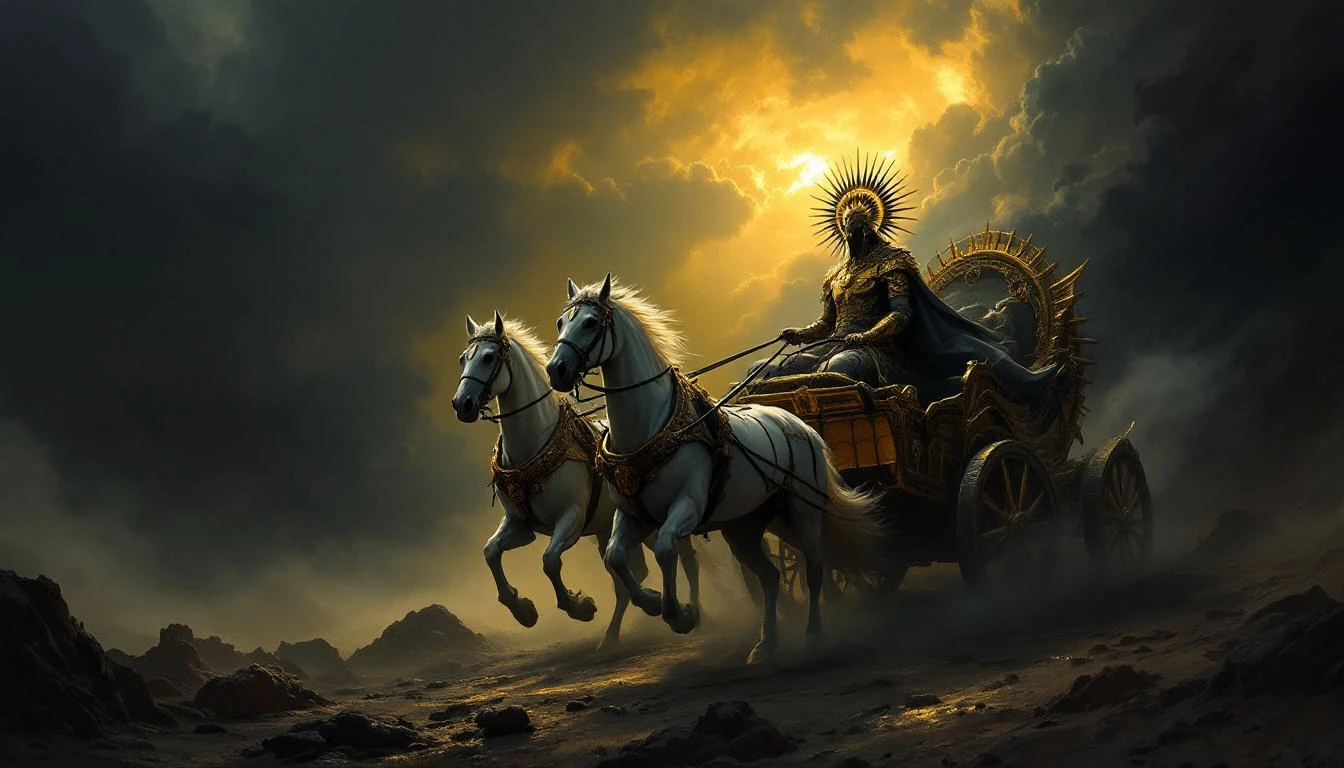
Svarog forged the sun. This is the single most persistent claim across all sources and folk traditions. He took raw fire, shaped it on his celestial anvil, and hung it in the sky. In some versions, the sun is not merely an object he crafted but his own son given physical form — Dazhbog, the "giving god," whose light and warmth sustained all life.
He forged the first plowshare. Before Svarog dropped his tongs from the sky, humanity fought with sticks and stones. After, they could shape iron — and the first thing they shaped was not a sword but a plow. This detail, embedded in the Hypatian Codex gloss, is remarkable. A war god would give weapons first. A smith god who cared about civilization gave the plow. Agriculture before conquest. Bread before blood.
He gave the law of marriage. Of all Svarog's gifts, this is the strangest and most debated. The Hypatian gloss states that Svarog ordained monogamy and punished violators by casting them into a fiery furnace. Scholars have noted the difficulty: pre-Christian Slavs practiced polygamy, and the monogamy rule fits Hephaestus (betrayed by Aphrodite's infidelity) better than any known Slavic tradition. It may be the Christian scribe projecting his own values backward. Or it may preserve something genuine — a memory of Svarog as the god who ordered not just metal and fire but human relationships.
Two Sons, Two Fires
Svarog's most important legacy was not what he forged but whom he fathered. Two sons — or perhaps one son known by two names, depending on which scholar you ask — carried his fire into the world in different forms.
Dazhbog was the fire in the sky. His name likely derives from dazh- ("to give") and bog ("god"). He was the sun itself, riding across the heavens each day. The Primary Chronicle records him among the six gods of Vladimir's official pantheon in 980 AD, listed alongside Perun and Mokosh on the hilltop shrine above the Dnieper. The Tale of Igor's Campaign calls the Russian people "Dazhbog's grandchildren" — the sun god understood not merely as a celestial body but as the divine ancestor of the Slavic ruling class.
Svarozhich was the fire on earth. His name is a patronymic — literally "son of Svarog" — and he represented the flame in the forge, the hearth fire that warmed homes, the sacred bonfire around which rituals were performed. The eleventh-century German chronicler Thietmar of Merseburg described a temple to Svarozhich (whom he called Zuarasici) among the Slavic Rethra tribe. The temple contained golden and silver images of gods, and a perpetual fire burned within it. The Slavs consulted Svarozhich's flame for divination — reading the future in the way the fire moved, the way it consumed offerings, the way it flickered against the temple walls at night.
The Polish scholar Aleksander Gieysztor proposed an elegant framework for this family of fire: Svarog was celestial fire — the original spark that lit everything else. Perun was atmospheric fire — lightning, the bolt that splits the sky. Dazhbog was solar fire — the sun, the steady light that governs the day. And Svarozhich was terrestrial fire — the hearth, the forge, the bonfire. Four forms of fire, four layers of the cosmos, all descending from one god's anvil.
Whether Dazhbog and Svarozhich were truly separate deities or different aspects of the same divine figure remains an open question. The medieval Sermon of Saint John Chrysostom names both in the same list, which some scholars take as evidence they were distinct. Others argue the scribe was simply being thorough. What matters is the underlying idea: fire is not one thing. It is a family. And the father of that family forged the first spark.
The Retirement of a God
Here is where Svarog departs most dramatically from every other supreme deity in world mythology. Zeus never abdicates. Odin schemes to delay Ragnarok precisely because he refuses to yield power. But Svarog stepped down.
The Hypatian gloss states it plainly: "After him reigned his son, the Sun, called Dazhbog." The father forged the light and then passed it on. He did not die — gods do not die in Slavic mythology, they change and recede. He moved from the center of the sky to the back of the forge. The hammer kept ringing, but the throne was empty.
Scholars of comparative mythology call this the deus otiosus — the "retired god" who builds the world and then withdraws. The concept appears in African, Siberian, and Native American mythologies. But in the Slavic context, Svarog's retirement carries particular weight. It is not neglect or exhaustion. It is succession. He built the forge, made the tools, lit the fire, and trusted his sons to carry it.
By the time Prince Vladimir erected his hilltop pantheon in 980, Svarog was already absent. Perun stood at the top. Dazhbog was there, representing his father's solar legacy. But Svarog himself — the old smith, the original sky father — was conspicuously missing. He had already handed over the keys.
The Forge That Never Went Cold
If Svarog withdrew, his son Svarozhich did not. The cult of sacred fire persisted among the Slavs with remarkable tenacity, resisting Christianity for centuries.
Thietmar of Merseburg's account of the Rethra temple, written around 1012 AD, describes a sacred fire that was never allowed to die. The priests tended it as a living connection to the divine — Svarozhich dwelling among them in the only form a fire god could take. Among the Eastern Slavs, every household hearth carried the same sacred weight. When a new house was built, fire was carried from an older hearth to light the new one, maintaining an unbroken chain of flame that symbolically connected every home back to Svarog's forge. When the fire went out, it was not merely an inconvenience. It was an omen.
The winter solstice was especially significant. In Eastern Slavic traditions, the longest night marked the rebirth of the celestial fire. Rituals included bringing parts of the plow into the house — echoing Svarog's gift of the plowshare — singing carols, and feeding the hearth with offerings of bread and honey. The sun, Svarog's son, was struggling. The sacred fire, his other son, needed to be fed. Between the two flames, the world would survive the darkness.
The Slavic Hephaestus — and What He Was Not
The Hypatian scribe equated Svarog with Hephaestus, and the comparison captures something real. Both are smith gods. Both are associated with fire, tools, and creation. Both occupy the role of craftsman among warriors — the god who makes things rather than the god who breaks them.
But Hephaestus is a tragic figure — lame, mocked, betrayed by his wife, brilliant but diminished. Svarog carries no such stigma. He is the eldest of the gods, the first creator, the father of the sun. Where Hephaestus serves the Olympian hierarchy from below, Svarog founded the cosmic hierarchy from above. The Greek smith works for the sky god. The Slavic smith is the sky god.
The claim that Svarog fathered the sun has no parallel in Greek mythology — Helios is not Hephaestus's son. This detail almost certainly belongs to the Slavic layer of the text, a genuine fragment of pre-Christian theology preserved inside a Christian manuscript by a scribe who may not have fully understood what he was recording. Svarog was not the Slavic Hephaestus. He was something larger — closer to the Finnish Ilmarinen, who forged the sky in the Kalevala, or the Vedic Tvashtr, divine craftsman of the gods. A creator who happened to use a hammer instead of words.
What Remains
Svarog left no temples for archaeologists to excavate. No scriptures, no priesthood, no pilgrimage sites. What he left was more diffuse and more durable: the idea that the world was made, not born. That someone shaped it with skill and intention. That the tools of civilization — the plow, the forge, the law — were not human inventions but divine gifts, dropped from the sky by a god who knew what his people would need.
In the modern Rodnovery movement — the revival of Slavic paganism across Russia, Ukraine, Poland, and the broader diaspora — Svarog has been restored to his position as supreme creator. Practitioners honor him alongside Perun, Mokosh, and Dazhbog, tending bonfires and offering bread to the flames in rituals that echo, however imperfectly, the practices condemned by medieval scribes a thousand years ago.
The Russian language itself remembers him. Every time a welder strikes an arc and the metal glows white — svarka, welding, from the same root as Svarog — the old god's name is spoken without anyone knowing it. He built the language the same way he built the sun: by shaping raw material into something useful, then stepping back to let it work on its own.
The forge never went cold. The smith just stopped standing where you could see him.