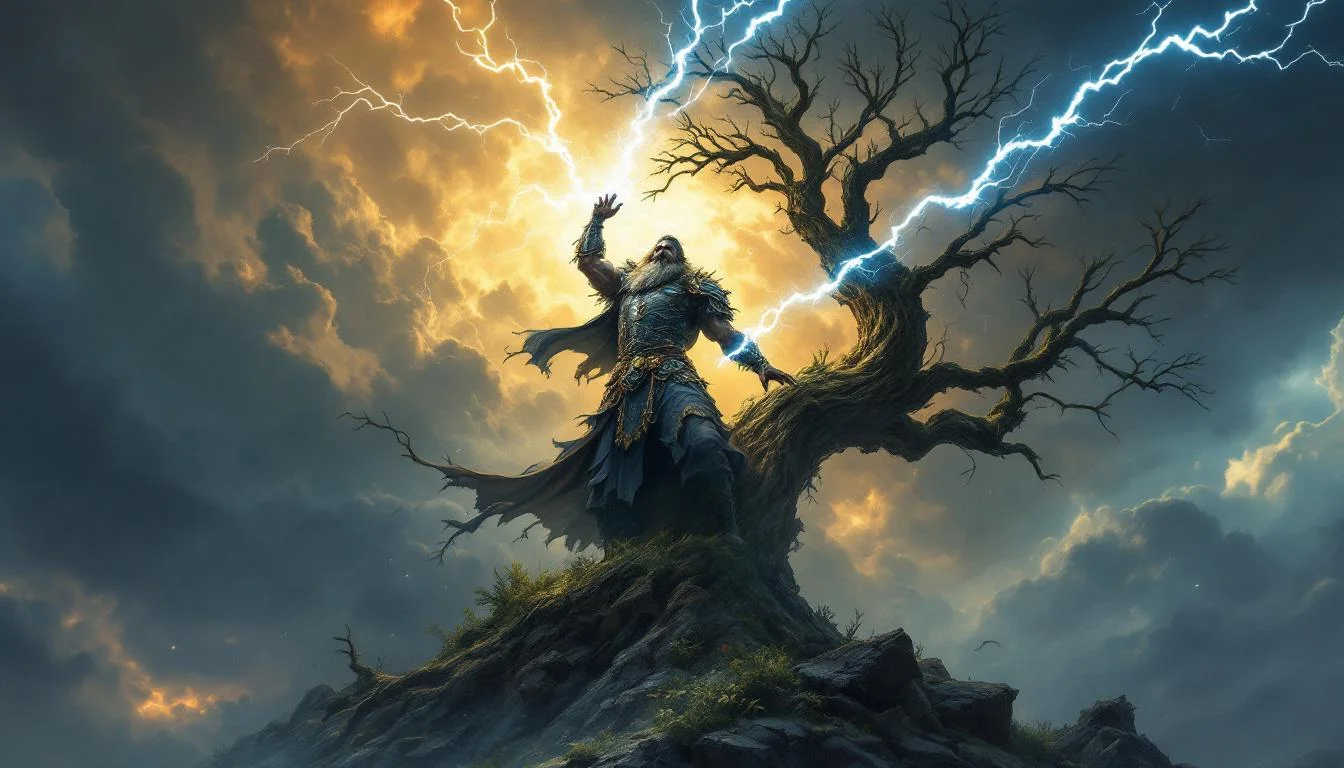
In the year 980, Prince Vladimir of Kiev ordered six idols erected on a hill outside his palace. Five were male gods. The sixth was Mokosh — the only goddess in a pantheon built for a warrior state, standing among thunder gods and solar deities as if she had always been there and intended to stay.
Eight years later, Vladimir converted to Christianity. He had the idols torn down. Perun was lashed to a horse's tail and dragged to the Dnieper. The others were smashed or burned. The old faith, officially, was over.
But Mokosh did not leave. She changed her clothes, took a saint's name, and kept showing up in villages for another nine hundred years. No other Slavic deity pulled that off.
The Name That Tells You Everything
The etymological root of her name is Proto-Slavic *mok-, meaning "wet" or "moist." Vladimir Toporov and Vyacheslav Ivanov — two of the most rigorous scholars in Slavic comparative mythology — called this derivation "indisputable." She is, at the most fundamental linguistic level, She Who Is Wet.
This sounds peculiar until you remember what moisture meant to agrarian Slavic communities. Rain fed the crops. Springs supplied villages. Rivers defined trade routes and tribal boundaries. Wetness was not a quality — it was the difference between survival and famine. Calling your chief goddess "the moist one" was not quaint. It was deadly serious.
Some scholars, notably Boris Rybakov, proposed an alternative reading: Makosh, parsed as Ma-kosh, "Mother of Fate" (from kosh, meaning lot or portion). The idea is attractive, and you will see it repeated across popular sources. But mainstream academia has not accepted it. The mok- etymology holds.
What matters is that both readings point in the same direction — toward a deity who controlled the fundamental forces women depended on: water, fertility, the portion of good fortune allotted to each household. She was the goddess of things that kept people alive.
One Goddess Among Five Gods
The Primary Chronicle — the earliest surviving East Slavic historical text, compiled in the early twelfth century — records Vladimir's pantheon with deceptive simplicity:
"And he placed idols on the hill outside the palace: a Perun in wood with a silver head and a gold moustache, and Khors Dazhbog, and Stribog, and Simargl, and Mokosh."
That is the entire passage. No description of Mokosh. No explanation of her role. Just her name, listed last, after the thunder god Perun, the solar deities Khors and Dazhbog, the wind god Stribog, and the enigmatic Simargl.
Historians have spent decades arguing about what this list means. Was the order hierarchical? Was Mokosh lesser or simply different? Was she added by a later chronicler filling gaps?
The most persuasive interpretation is also the simplest: Mokosh was the established mother goddess of the Eastern Slavs, and Vladimir could not build a credible state religion without her. You could unify warrior cults around Perun. You could borrow solar imagery from steppe peoples. But you could not tell half the population — the half that spun the wool, wove the cloth, birthed the children, and tended the fields — that their goddess did not count.
She was not an afterthought. She was a political necessity.
What She Governed
Mokosh was not a single-domain deity. Her influence spread across overlapping spheres, all connected to women's lives and the sustaining forces of the natural world.
Spinning and Weaving
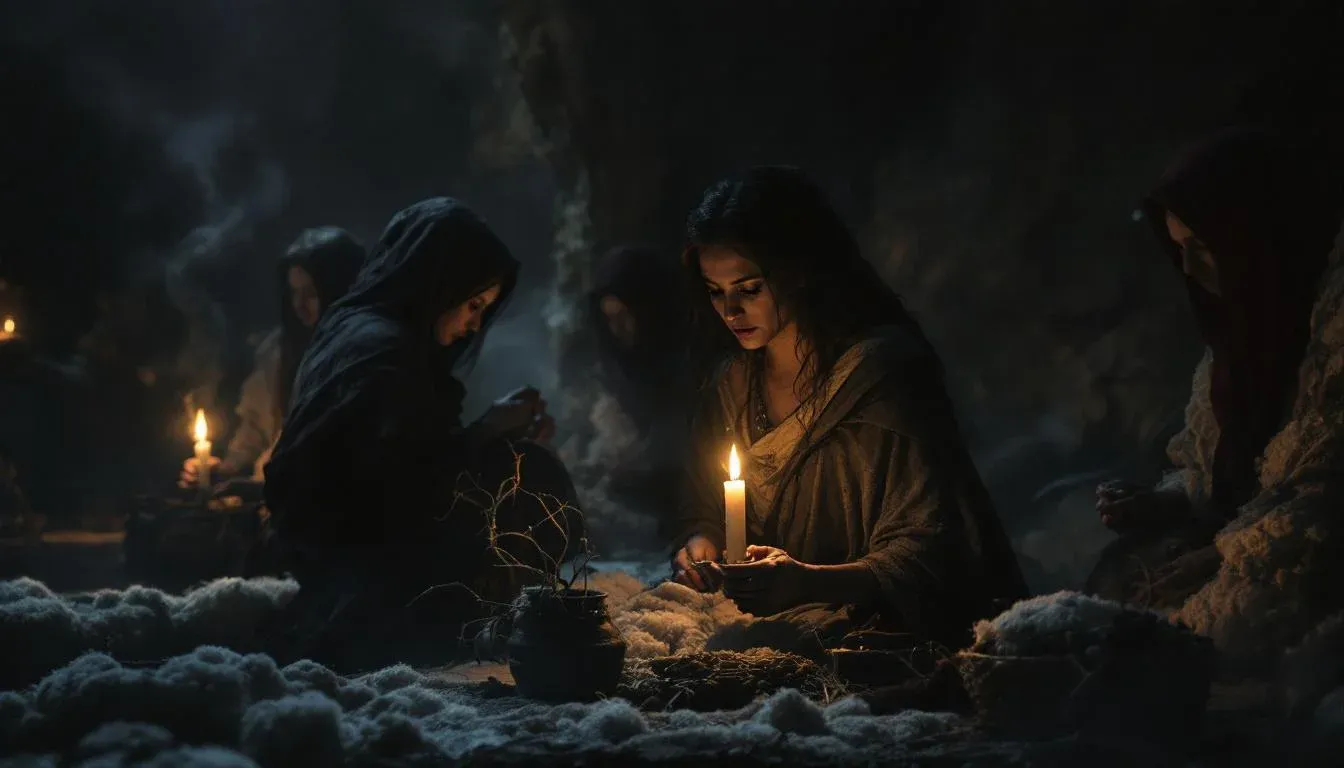
This was her most distinctive attribute. Ethnographic records from the nineteenth-century Russian North describe Mokosha (or Mokusha) as a tall woman with a large head and long arms who spins flax at night and shears sheep while households sleep. Women who left their spinning unfinished or failed to say a prayer over their work risked finding it tangled by morning — Mokosha's handiwork.
The symbolism ran deeper than domestic labor. In Slavic folk belief, spinning thread was a metaphor for spinning fate. The goddess who controlled the spindle controlled the thread of life itself. Some scholars, particularly Michał Łuczyński, have drawn parallels to the Baltic goddess Laima, who likewise governed both weaving and destiny.
Moisture and Fertility
As "She Who Is Wet," Mokosh governed rain, springs, and the moisture that made fields fertile. Her connection to water was not symbolic — it was ritualistic. Offerings to Mokosh involved dropping hanks of spun wool into wells or leaving woven cloth and embroidered linens near water sources. The sick — paralytics, the blind, the deaf — brought offerings of flax, wool, and sheep to standing stones associated with her cult, stones that received veneration into the twentieth century.
Women's Fate and Protection
Mokosh watched over women in childbirth, protected marriages, and guarded household prosperity. She was the deity women turned to for matters men's gods did not address — the health of children, the success of the harvest, the portion of luck that would fall to the family in the coming year.

Mokosh and Mat Zemlya
One of the most important connections in Slavic religious thought is between Mokosh and Mati Syra Zemlya — "Mother Moist Earth," the personified earth goddess who appears across East Slavic folklore, bylinas, and zagovory (incantations).
Mat Zemlya was not a statue or an icon. She was the ground itself. Oaths were made binding by touching the earth. Sins were confessed into a hole dug in the soil. The dying whispered their final words to the ground, and the earth was expected to listen.
Most researchers consider Mokosh to be the named, personified form of this same principle — the earth-as-mother given a face, a name, and a place in the official pantheon. Where Mat Zemlya was worshipped without human likeness, Mokosh gave the moist earth a mythology.
This is why she proved so difficult to eradicate. You cannot burn down the earth. You cannot throw a river into the Dnieper.
The Survival: Saint Paraskeva Friday
When Christianity arrived in Kievan Rus after 988, the Church faced a problem with Mokosh that it did not face with Perun or Veles. You could recast a thunder god as the prophet Elijah riding his chariot across the sky. You could demonize a cattle god into a devil figure. But Mokosh governed daily domestic life — spinning, weaving, childbearing, water — and the women who venerated her were not going to stop.
The solution was syncretism. Mokosh's attributes, her sacred day, and her ritual prohibitions were absorbed into the cult of Saint Paraskeva-Pyatnitsa — Paraskeva Friday.
The parallels were almost suspiciously precise:
- Paraskeva is venerated on Fridays. Mokosh's sacred day was Friday.
- Paraskeva is associated with water, springs, and wells. Mokosh governed moisture.
- Paraskeva is the patroness of women's domestic work. Mokosh protected spinning and weaving.
- Paraskeva's feast involves taboos against women's handiwork. Mokosh demanded the same.
- October 28 — Paraskeva's feast day — falls within the annual period of flax preparation, exactly when Mokosh's cult was most active.
The rite was called mokrida — a word that may derive directly from Mokosh's name. Women brought offerings of flax, wool, thread, and woven cloth to churches and roadside shrines of Paraskeva, performing nearly identical rituals to those their great-grandmothers had performed at Mokosh's sacred stones.
Some scholars have pushed back on this identification. Later studies noted that Paraskeva's associations with spinning and water have Christian roots of their own and may not require a pagan explanation. The debate continues.
But the folk evidence is stubborn. In northern Russian villages, the figure of Mokosha persisted as a household spirit — shearing sheep at night, punishing lazy spinners, arriving uninvited in the women's quarters — alongside, not instead of, Paraskeva veneration. The two coexisted for centuries.
The Geography of Memory
Place names confirm that Mokosh was not a local curiosity confined to Kiev. Her name is embedded in the landscape across the Slavic world:
- Mokošín — a Czech village attested since the eleventh century
- Mokoszyn and Mokosznica — Polish localities
- Mokosica — a settlement near Dubrovnik, Croatia
- Muuks/Mukus — a Polabian (extinct West Slavic) toponym recorded in 1310
- Mobschatz — near Dresden, Germany, named Mococize in a 1091 document
This distribution — from the Adriatic to the Elbe, from Bohemia to the White Sea — indicates a Proto-Slavic deity, not a late Kievan addition. Mokosh was old. She predated Vladimir's political games by centuries, possibly millennia.
Why She Lasted
Every Slavic deity suffered after Christianization. Perun was cut down. Veles was demonized. The solar gods faded into folk memory. Even Lada, often cited as another goddess, remains an academic controversy — some scholars doubt she existed as a deity at all.
Mokosh survived because her domain was ungovernable.
You could destroy a wooden idol. You could not destroy the act of spinning wool on a winter night. You could forbid sacrifices at standing stones. You could not forbid a woman from whispering to the earth during a difficult birth. You could rename Friday after a Christian saint. You could not stop the prohibition against spinning on that day from meaning exactly what it had always meant.
Mokosh endured because she was woven into the rhythms of daily life — the turning of the spindle, the drawing of water, the pressing of hands against the soil. Her worship was not a spectacle performed on a hill. It was muscle memory.
The Church understood this, which is why it chose absorption over destruction. And in that absorption, Mokosh achieved something no other Slavic deity managed: she made Christianity carry her forward.
The woman at the well, leaving a scrap of linen for Saint Paraskeva in 1850, was performing a ritual older than the Cyrillic alphabet. She may not have known the name Mokosh. But Mokosh was there — in the water, in the wool, in the turning of the wheel, as she had always been.
The moist goddess does not burn.