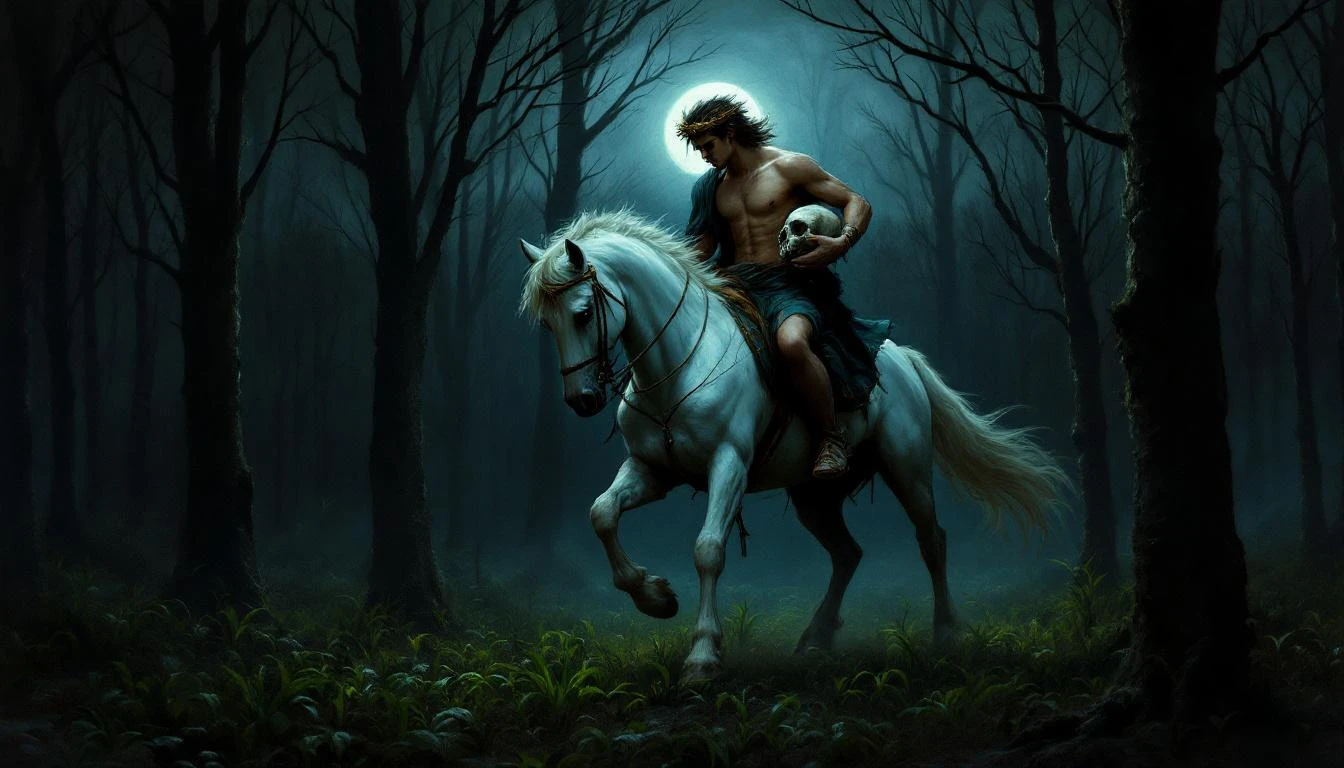
Every pantheon needs a goddess of love. The Greeks had Aphrodite. The Norse had Freyja. The Slavs, we are told, had Lada — the radiant patroness of spring, beauty, marriage, and fertile harvests, whose name echoed across a thousand villages from the Vistula to the Volga in songs sung at weddings and bonfires and the first ploughing of spring fields.
There is only one problem. She may never have existed.
Not in the way Chernobog may never have existed — propped up by a single paragraph from a hostile observer. Lada's case is stranger and, in some ways, more unsettling. There are hundreds of references to her name across centuries of Slavic and Baltic folk tradition. The word appears in wedding songs from Ukraine, ritual chants from Poland, polyphonic hymns from Lithuania. It saturates the folklore. And the dominant scholarly position, held by the majority of Slavists for over a century, is that every single one of those references is a misunderstanding. That "lada" was never a goddess at all. That it was a word — a refrain, a term of endearment, a rhythmic filler — and that medieval monks, poorly understanding the languages of the people they were trying to convert, heard it and mistook it for the name of a god.
This is the story of how a syllable became a deity, how a deity became a controversy, and how a controversy tells us more about the fragility of Slavic religious memory than any temple ever could.
The First Written Trace: A Priest Issues a Warning
The earliest known written mention of Lada appears around 1405 to 1412, in the Gniezno Sermons of Lucas of Wielki Koźmin, a Polish clergyman who was deeply unhappy about what his parishioners were doing during spring festivals.
For a man is not saved in the name of Lado, Jassa, Quia, Nyia, but in the name of Jesus Christ... Not Lada, not Jassa, not Nija, which are the names of idols worshipped here in Poland, as some chronicles of Poles testify.
This is the foundation stone. A clergyman denouncing pagan names — Lado, Lada, Jassa, Nyia — that he claims are being invoked during seasonal celebrations. He offers no description of these idols, no account of their temples, no mythology, no rituals beyond the vague condemnation of "indecent" spring performances. He simply lists names and tells his flock to stop saying them.
Half a century later, the Polish chronicler Jan Długosz attempted something more ambitious. In his monumental Annales seu Cronicae Incliti Regni Poloniae (1455), he mapped the Slavic gods onto the Roman pantheon through what scholars call interpretatio romana. And here is where things get strange: Długosz compared Lada not to Venus or Diana, but to Mars — the god of war. "Mars they called Lyada," he wrote, assigning a love goddess a war god's portfolio.
Later writers scrambled to fix Długosz's puzzling equation. Maciej Miechowita reinterpreted Lada as a counterpart to the Greek Leda — mother of Castor and Pollux — and identified her as the mother of Lel and Polel, two figures he extracted from the Polish folk refrain "Łada, Łada, Ileli." From a song people were singing in the fields, Miechowita constructed a divine family tree.
The pattern is clear even at this early stage: educated men hearing unfamiliar words in peasant songs, and building theology out of their confusion.

The Refrain Problem
To understand why scholars fight about Lada, you need to understand what Slavic folk songs actually sound like.
Across the Slavic world, ritual songs — particularly those associated with spring, weddings, and the agricultural cycle — are structured around refrains. These refrains are not narrative. They do not tell stories. They are rhythmic, musical, often semantically empty: sounds that fill the space between verses, that give singers a place to breathe, that hold the melody together like mortar between bricks.
In Ukrainian wedding songs, the refrain "oy lado, lado" appears with the regularity of a heartbeat. In the famous circle-dance song A my proso seyali — "And we sowed millet" — the word surfaces between verses about planting and courtship. In Polish sobótkowe songs for the summer solstice, "Łado, Łado" punctuates verses about bonfires and flower wreaths. In Lithuanian sutartinės — the haunting polyphonic songs unique to Baltic tradition — lado appears in contexts ranging from weddings to military chants to songs about nature.
The question that has consumed scholars for over a century is brutally simple: when a Ukrainian bride's friends sang "oy lado, lado" at her wedding, were they invoking a goddess — or just singing a song?
This is the crux of Alexander Brückner's demolition.
Brückner's Wrecking Ball
Aleksander Brückner was a Polish linguist and literary historian of formidable reputation and even more formidable confidence. In the late 19th and early 20th centuries, he systematically attacked the authenticity of several deities in the Polish-Slavic pantheon, and Lada was among his primary targets.
His argument was surgical. The word lada, Brückner demonstrated, existed across all Slavic languages as a common noun meaning "beloved, spouse, consort." It appeared in the Tale of Igor's Campaign, that enigmatic 12th-century East Slavic epic, as a term for a wife. It appeared in medieval Czech texts as a word for a young woman. It was not exotic. It was not rare. It was the Slavic equivalent of "darling" or "sweetheart."
When medieval chroniclers like Lucas of Wielki Koźmin heard Slavic peasants singing songs with "lado, lada" in the refrains, Brückner argued, they made a catastrophic interpretive error. These were foreign-educated clerics with imperfect command of local vernacular. They heard a word they did not fully understand, repeated with emotional intensity in what looked like pagan ceremonies, and concluded it must be the name of a deity. Then they wrote it down in their sermons and chronicles as such. And then later writers, building on those chronicles, elaborated — adding attributes, inventing family relationships, constructing a mythology for a goddess who was, in reality, a refrain.
Alexander Potebnja, the great Ukrainian philologist, had arrived at a similar conclusion decades earlier: the word appeared exclusively in spring and wedding songs, and there were "no grounds to consider this word as a remnant of the old goddess." Max Vasmer, the etymologist of Slavic languages, agreed. Oleg Trubachyov, the leading 20th-century authority on Proto-Slavic vocabulary, agreed.
The consensus was devastating and nearly unanimous. Lada was not a goddess. She was a ghost — conjured from the gap between what peasants sang and what monks understood.

Rybakov's Last Stand
Nearly unanimous is not unanimous. And the dissenting voice belonged to one of the most influential — and most polarizing — figures in Soviet-era Slavic studies: Boris Rybakov.
Rybakov was an archaeologist and historian who dedicated his career to demonstrating that pre-Christian Slavic religion was a complex, sophisticated system rather than the primitive superstition described by Christian observers. In his monumental Yazychestvo drevnikh slavyan (Paganism of the Ancient Slavs, 1981), he mounted a full defence of Lada's authenticity.
His argument operated on several levels. Linguistically, he noted that the root lad- was uniquely charged with meaning — not just "harmony" but a deep-structural concept of cosmic order that could plausibly have been personified. Comparatively, he drew parallels between Lada and the Greek Leda (mother of the divine twins) and Demeter (goddess of agricultural fertility), arguing for an Indo-European prototype that survived independently in the Slavic branch. Archaeologically, he identified one of the four female figures on the Zbruch idol — a 10th-century stone pillar found in a Ukrainian river, the most significant piece of Slavic religious sculpture ever discovered — as Lada, recognising her by the ring she holds in her right hand, a symbol of marriage and covenant.
Rybakov also proposed that Lada and her alleged daughter Lelya were identical to the Rozhanitsy — the birth-goddesses mentioned in medieval Russian sources as the target of particularly stubborn and persistent pagan devotion. He dismissed "Lado" as merely the vocative case of lada — a grammatical form, not a separate male deity.
It was a bold construction. It was also the last serious scholarly defence Lada would receive. Rybakov's broader methodology — his willingness to fill gaps in the evidence with comparative speculation, his tendency to see pre-Christian sophistication where other scholars saw ambiguity — has drawn sharp criticism from subsequent generations of Slavists. His Lada exists in a meticulously argued framework that rests, ultimately, on the same fragile foundation: folk songs whose meaning is genuinely uncertain.
The Phantom Gods
In 2019, historians Judith Kalik and Alexander Uchitel published Slavic Gods and Heroes, a radical reassessment of the entire Slavic pantheon. Their conclusion about Lada was merciless: she was a "phantom god."
Their argument extended Brückner's logic to its full implications. The Polish pantheon, they proposed, was substantially invented in the 15th century by Jan Długosz, who modelled it on the Kievan pantheon described in the Primary Chronicle — which itself was a political construction by Prince Vladimir. Długosz needed gods to fill his Roman template, so he scavenged names from folk songs, place names, and seasonal customs. Lada was harvested from wedding refrains. Dziewanna was lifted from a plant name. Marzanna came from a straw effigy burned at spring festivals. None of them were deities in any pre-Christian sense. They were artefacts of chroniclers constructing a past that suited their narrative needs.
The "phantom gods" thesis is not universally accepted — some scholars find it overly reductive — but it represents the logical terminus of over a century of scepticism. If Brückner pulled the rug from under Lada, Kalik and Uchitel set fire to the floor.
But the Songs Keep Singing
Here is what makes Lada's case genuinely haunting, as opposed to merely academic: the counter-evidence is not some obscure inscription or a single contested passage. It is an entire continent of song.
"Lado" and "lada" appear in the folk traditions of Poles, Ukrainians, Russians, Belarusians, Czechs, Serbs, Croatians — and, crucially, Lithuanians and Latvians. The Baltic connection matters enormously, because Lithuanian and Latvian traditions developed independently from the Slavic ones after the two language families diverged thousands of years ago. If "lado" were merely a meaningless refrain invented in one Slavic dialect and then spread, how did it end up in Lithuanian polyphonic songs with a similar ritual context?
In some parts of Russia, the end of winter was celebrated by the burning of straw, accompanied by dancing around bonfires and the singing of songs "in honour of Lado or Lada." In Ukraine, the word survives embedded in the language itself: laduvaty in Volhynia means "to conduct a wedding." In Transcarpathia, ladkanky are wedding songs. Ladkaty means "to sing wedding songs." These are not archaic curiosities — they are living linguistic fossils suggesting that lad- was once inseparable from the concept of marriage as a sacred act.
The Lithuanian ethnologist Norbertas Vėlius studied the lado refrain in Baltic sutartinės and concluded it consistently referenced young people — particularly girls on the threshold of adulthood — rather than divine beings. But his colleague Bronislava Kerbelytė proposed that lado functioned as specialised ritual vocabulary connected to the hand-clasping gesture (lygti — "to agree, to negotiate") performed during weddings and seasonal celebrations. Not a goddess, perhaps. But not nothing, either. Something that lived in the space between ordinary language and sacred speech — a word that meant more in a ritual context than it did in conversation.
The Goddess-Shaped Hole
Consider the pantheon without Lada. Mokosh governs fate, spinning, moisture — the sustaining forces. Perun commands thunder. Veles rules the underworld and cattle. Yarilo embodies the explosive, sexualized energy of spring growth. There are gods of the sun, gods of the wind, gods of the hearth.
But where is love? Where is the force that pulls two people together, that makes a wedding something more than a property transaction, that transforms a household from an economic unit into a family? Every Indo-European tradition has this figure. The Greeks have Aphrodite. The Norse have Freyja. The Romans have Venus. The Hindus have Rati. The absence of a Slavic love deity in the "debunked" version of the pantheon is not proof that one existed — but it is conspicuous.
Rybakov understood this. His critics understood it too, which is why they worked so hard to explain it away. The standard response is that Mokosh absorbed these functions, or that love and marriage were governed by unnamed household spirits rather than major deities, or that we simply do not have enough evidence to fill the gap. All of which may be true. But the gap remains, shaped suspiciously like the goddess the songs keep naming.
Between the Refrain and the Divine
The most honest position on Lada is one that satisfies nobody. She cannot be confidently placed in the pre-Christian Slavic pantheon because every early source that names her is either a hostile clergyman's denunciation or a chronicler's interpretatio romana, both genres with documented track records of fabrication and error. But she cannot be confidently dismissed, either, because the word that carries her name is woven so deeply into the ritual fabric of Slavic and Baltic cultures that calling it a meaningless refrain requires its own act of faith.
What we can say is this: for centuries, across thousands of kilometres and dozens of distinct cultural traditions, Slavic and Baltic peoples sang a word at their weddings and spring festivals that sounded like a name. They sang it when brides left their fathers' homes. They sang it when the snow melted and the first ploughing began. They sang it around fires on Kupala Night, the oldest and wildest celebration in the Slavic calendar. Whether they were invoking a goddess, addressing a beloved, or simply giving voice to the inarticulate force that makes spring feel like a promise — we do not know. The monks who recorded the word did not understand it. The scholars who analysed it cannot agree. The singers who sang it left no commentaries.
What remains is the sound itself: lada, lado — rising from fields and riverbanks and wedding feasts, carried by voices that have been silent for centuries but whose echo still disturbs the footnotes of academic journals and the lyrics of folk songs that grandmothers teach to grandchildren who will never know what the word once meant, if it ever meant anything more than itself.
Perhaps that is enough. Perhaps the most powerful deities are the ones who exist in the space between a word and a name — who live not in temples or chronicles but in the moment when a song catches in your throat and you feel, without being able to explain why, that you are not singing alone.