On the night of June 23, in a village somewhere in the Slavic heartland, a bonfire burns high enough to throw shadows across the river. Young men haul logs and dry brush into a pile the size of a cart. Girls thread wildflowers into wreaths with fingers stained green from herb-gathering. The air smells of smoke and mugwort and the particular electric sweetness that comes before a summer storm. Somewhere in the forest, a fern that has never flowered in the history of the earth is about to bloom — or so the oldest woman in the village insists, the way her mother insisted, the way her grandmother insisted before her, going back to a time when no one in these lands had heard the name of Christ.
This is Kupala Night. It is the oldest, wildest, most dangerous celebration in the Slavic calendar — a night of fire and water, of purification and divination, of love-matches and witch-hunts, of sacred herbs picked by moonlight and demons driven off by smoke. It has survived the conversion of the Slavic peoples to Christianity, the condemnations of Orthodox priests, the forced secularization of the Soviet era, and the relentless flattening of folk traditions into tourist festivals with souvenir wreaths. It survives because something in the human animal responds to the summer solstice with an urgency that no amount of civilization can fully domesticate.
The Name and the Date
The word "Kupala" comes from the Proto-Slavic kǫpati — "to bathe." The name is older than Christianity in the Slavic lands. When Orthodox missionaries arrived, they grafted the feast of the Nativity of St. John the Baptist onto the existing solstice celebration, producing the hybrid name "Ivan Kupala" — Ivan for John, Kupala for the bathing ritual that no amount of theological rebranding could suppress. The attachment of a Christian saint's name to a pagan bonfire festival was not a triumph of the Church. It was an admission of defeat. The Slavs were going to light their fires regardless. The missionaries decided it was better to bless what they could not prevent.
The date depends on the calendar. Western Slavs — Poles, Czechs, Slovaks — and, since 2023, Ukrainians celebrate on the astronomical solstice window, the night of June 23 to 24. Eastern Slavs who follow the Julian calendar — traditionally Russians and Belarusians — mark it on July 6 to 7. The earliest written reference to Kupala in the East Slavic lands dates to 1262, in the Hypatian Chronicle. But the celebration is far older. The method of kindling the bonfire — by friction, using a wooden drill spun between the palms against a dry log — is a technique that predates metallurgy. The Belarusians preserved this "need-fire" method into the early 20th century.
Fire: The Central Act
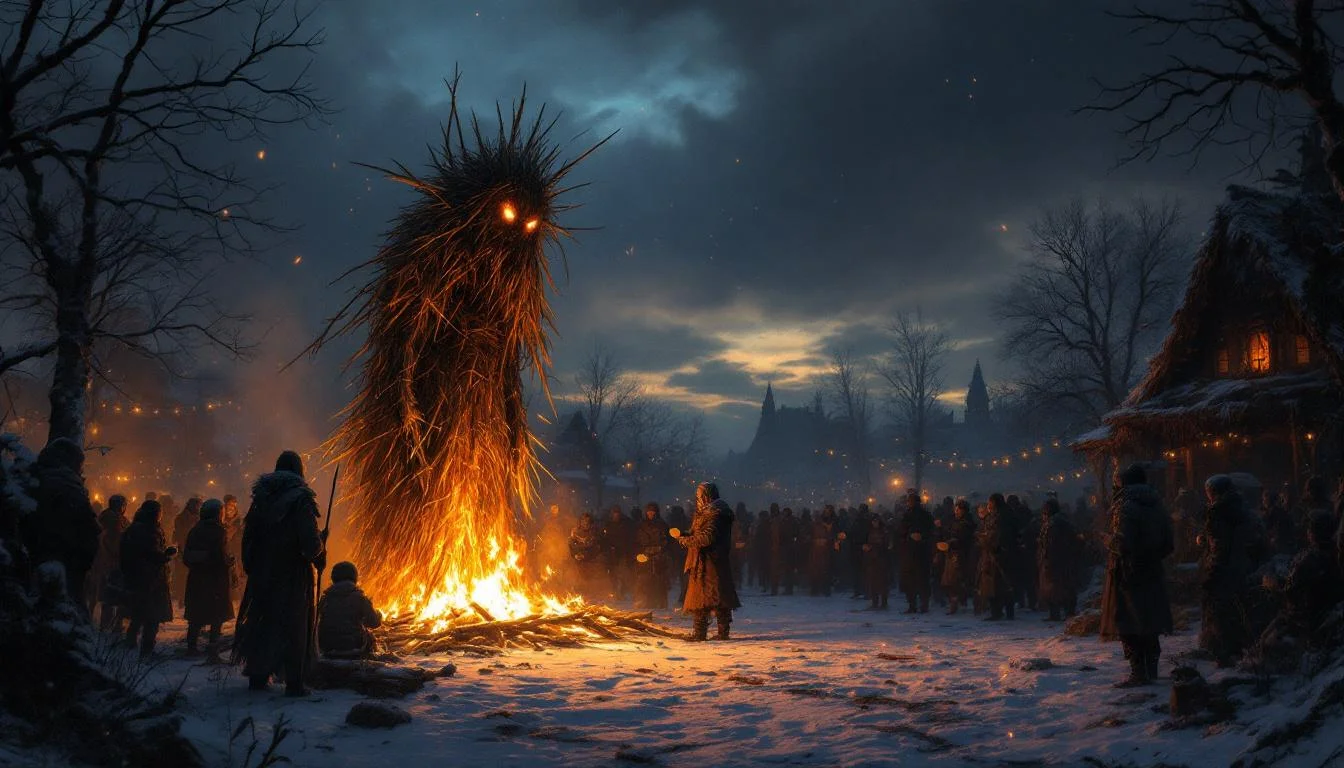
The bonfire is the heart of Kupala Night. Everything radiates outward from it. The fire is not decorative. It is not ambiance. It is a technology of purification, and the act of jumping over it is the most important ritual of the evening.
The logic is old and direct: fire destroys impurity. To leap through the flames is to burn away sickness, misfortune, the taint of evil spirits, the accumulated spiritual grime of the past year. The higher you jump, the greater your luck. Couples who jump together, holding hands, test the strength of their bond — if they clear the fire without letting go, their love will endure. If their hands separate mid-leap, the relationship is doomed. The village watches. The village remembers.
The 17th-century Hustyn Chronicle describes the scene: "children of both sexes gather and make wreaths... they leap over the fire." Hegumen Pamphil of the Yelizarov Convent, writing in 1505, called the celebrations "pagan games" driven by "devilish and obscene" songs, accompanied by "drums and flutes" and "terrible cries." The bonfire was a rival altar, and the body passing through its flames was performing a sacrament that predated baptism by millennia.
In Belarus, the bonfire was built around a central pole topped with a wheel — sometimes a cart wheel, sometimes a barrel hoop wrapped in straw. When the fire caught and the wheel blazed overhead, it became a burning sun on a world-tree axis. In some villages, a horse skull was mounted on the pole. A column of fire crowned by a burning skull, visible from neighboring fields, marking the center of a night when the boundaries between the human world and everything else became dangerously thin.
Water: The Second Element
If fire purifies from above, water purifies from below. Kupala Night is the one night of the year when bathing in open water is not merely permitted but required. Before sunset on Kupala Eve, everyone bathed — in the banya in northern Russia, in rivers and lakes in the south. Kupala water healed. It washed away not just dirt but spiritual contamination: the evil eye, curses laid by enemies, the residue of contact with the unclean dead.
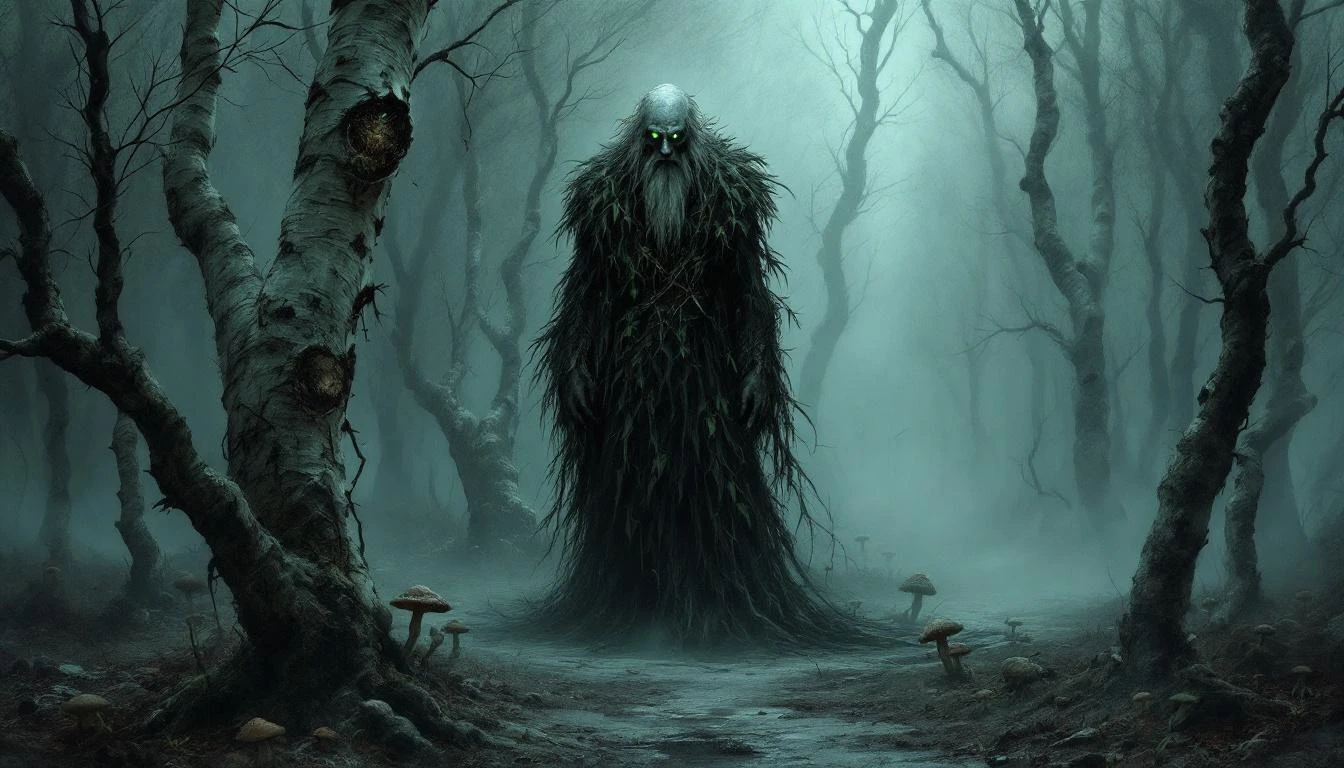
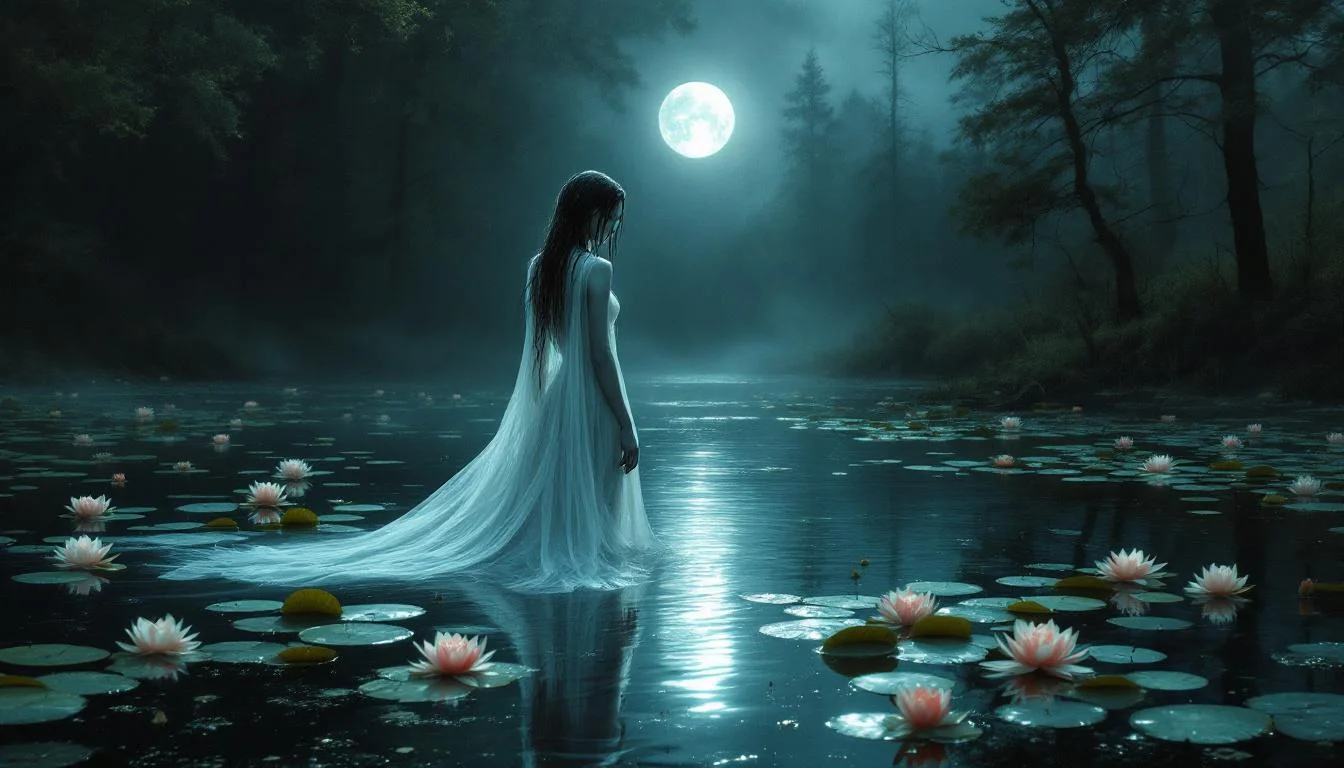
But the water was also dangerous, because the water belonged to spirits. The Rusalka — the drowned maiden, the restless female dead — lived in these rivers all year, and Kupala Night fell close to Rusalka Week, the period when rusalki left their waters and wandered freely through fields and forests. The overlap was not coincidental. Girls leaped through the bonfire so that, as the folk formula had it, "rusalki will not attack and come during the year." The flames were a barrier. What the water gave, the fire defended against.
The Wreath on the Water
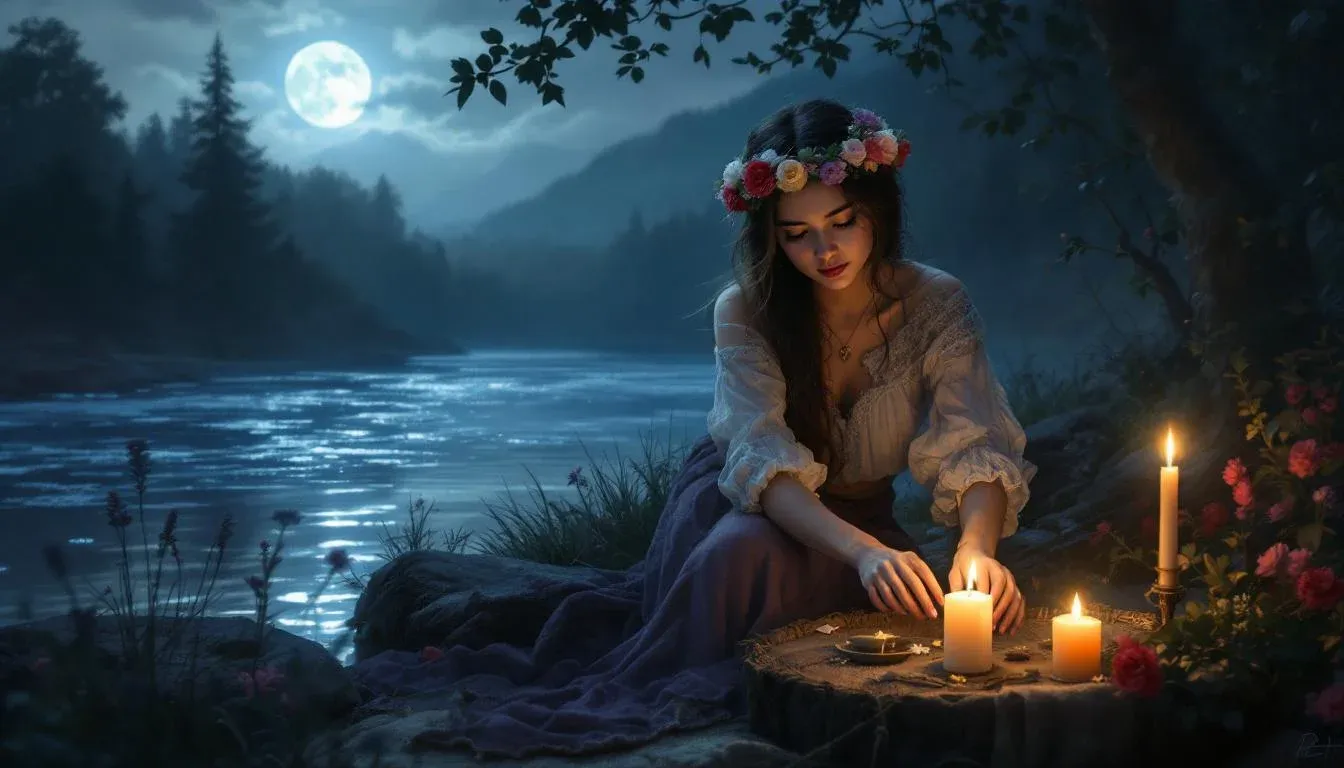
After the bonfire, after the bathing, came the divination. Unmarried girls carried wreaths woven from wildflowers and herbs — periwinkle, basil, geranium, fern fronds, roses, oak and birch twigs — down to the riverbank. They set the wreaths on the water, sometimes with a lit candle pressed into the center, and watched.
A wreath that floated far downstream, candle still burning, promised marriage within the year. A wreath that circled aimlessly near the bank meant another year of waiting. A wreath that sank meant misfortune — illness, poverty, or death. The girls stood on the bank and watched their futures drift away from them in the dark, and the river, indifferent to their hopes, carried some wreaths to the opposite shore and swallowed others whole.
In the Polesia region, the prettiest girl in the village was chosen as dzevko-kupalo — the Kupala maiden — and she distributed the wreaths. Fresh, green garlands predicted happy marriages. Dry or wilting ones foretold misery. The wreath divination is one of the few Kupala rituals that survived almost intact into the 21st century. At modern festivals in Ukraine and Belarus, the wreath-floating still happens. Women who do not believe in water spirits still set their wreaths on the river and watch. The rational mind knows it means nothing. The older mind, the one that remembers the fire, is not so sure.
The Fern Flower: A Treasure That Does Not Exist
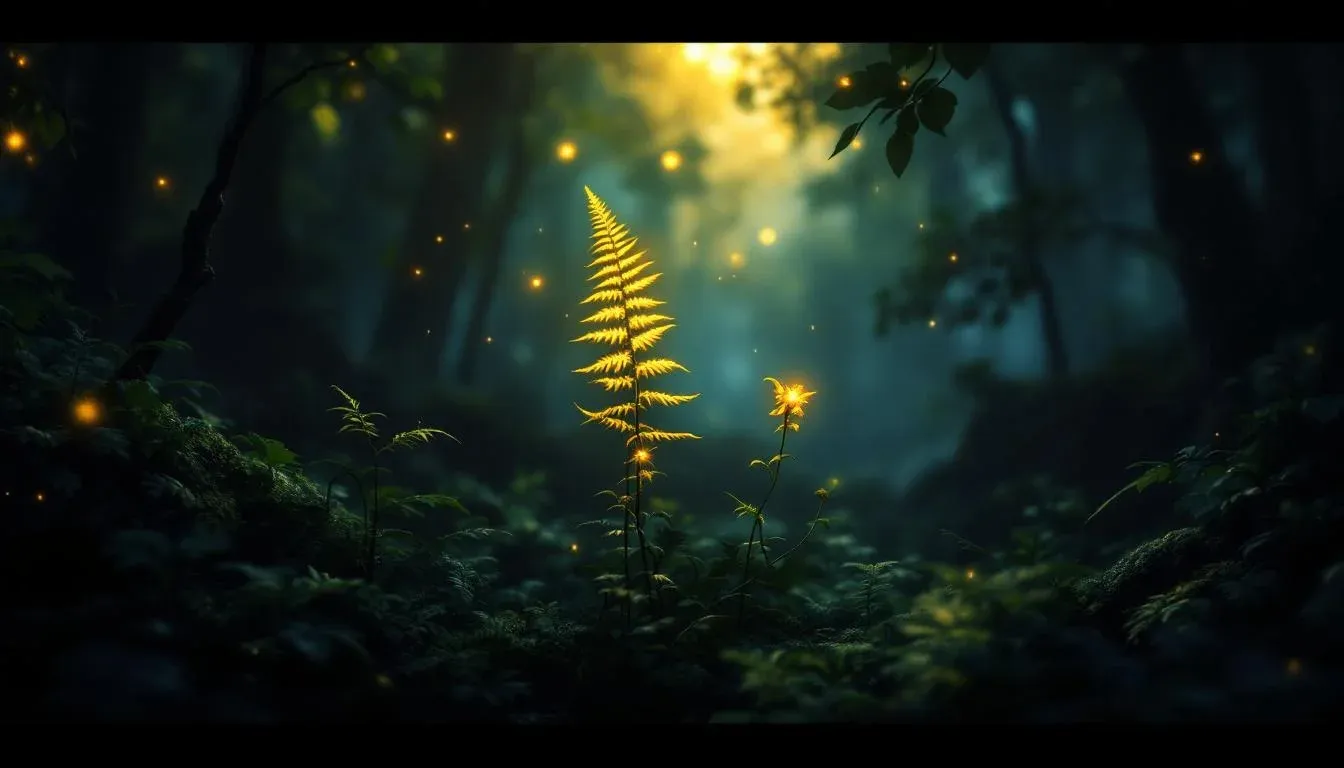
The most famous element of Kupala Night is the search for the fern flower — tsvit paporoti in Ukrainian, kwiat paproci in Polish. According to legend, ferns bloom exactly once a year, at midnight on Kupala Night, in the deepest part of the forest, far from any human settlement, in a place where no dog's bark and no rooster's crow can be heard. The flower burns with a light of its own — golden, or red, or blue depending on the tradition — and it blooms for only minutes before vanishing. Whoever plucks it gains extraordinary powers: the ability to find buried treasure, to understand the speech of animals, to see through illusions, to command demons.
There is a problem with this legend. Ferns do not flower. They are among the oldest plants on earth, predating flowering plants by roughly 200 million years, and they reproduce by spores, not seeds. The entire tradition rests on a botanical impossibility, and the Slavs knew it. That was the point. The fern flower represented the unattainable — the treasure that exists only in the gap between desire and reality, the reward that is always deeper in the forest, always blooming in the place you have not yet reached.
The search was real, even if the flower was not. Young couples went into the woods on Kupala Night, ostensibly to look for the bloom, and what they found was each other. In Ukrainian and Polish traditions, if a young man returned from the woods wearing the girl's wreath, they were considered betrothed. The Church despised this custom with particular intensity, because it bypassed ecclesiastical authority over marriage entirely. The forest, not the priest, sealed the union.
But the legend had a darker side. The fern flower was guarded by spirits — demons, witches, unclean forces — who would do anything to prevent a mortal from taking it. Nikolai Gogol, in his 1830 story "The Eve of Ivan Kupala," turned the fern flower into an instrument of damnation. His Cossack hero Petro finds the flower with a witch's help, but the treasure it unlocks demands the murder of an innocent child. Petro commits the act, obtains the gold, and is destroyed by it.
A small flower bud appeared, turned crimson as though soaked in blood, and began to tremble as if it were alive. It grew bigger, bigger still, blazing like a coal. A tiny star burst open, and with a faint crack, the flower bloomed, spilling light like fire over everything around it.
Herbs, Witches, and the Spirits at the Gate
The fern flower was the most dramatic botanical quest of the night, but far from the only one. Herbs gathered on the summer solstice carried maximum healing potency — charged by the sun at its peak and the earth at its most fertile. Women collected St. John's wort, mugwort, yarrow, and wormwood before dawn, whispering special prayers — zagovory — over each plant as it was cut. Wormwood held special status as the herb that witches feared: people wore it at their waist when jumping over the bonfire and hung it above doorways. The ivan-da-marya flower, with its yellow petals and purple bracts, embodied the holiday's fire-and-water duality — folk etymology explained it as twin siblings transformed by the gods into a single bloom.
Kupala Night was a crisis point in the calendar. Every spirit in the Slavic bestiary was believed to be at peak power: the Rusalka in her river, the Vodyanoy in his millpond, Leshy in his forest, the domovoy in the rafters. Witches flew. The dead stirred. Villagers hammered aspen stakes into their yards, nailed nettles above stable doors, jammed knives and thorny branches into window frames, and scattered hemp flowers across thresholds. The village became a fortress of improvised talismans, bristling with sharp edges and bitter herbs, aimed at keeping out whatever the solstice set loose.
This was the paradox of Kupala Night. It was the most joyful, the most erotic, the most unrestrained night in the Slavic year — and simultaneously the most dangerous. The joy and the danger were not separate. They were the same thing. The fire that purified could also burn. The water that healed could also drown. The forest that sheltered lovers also sheltered demons. The solstice taught that ecstasy and peril are twins, and that both reached their maximum intensity at the pivot point of the year.
What Survives
The Orthodox Church fought Kupala Night for centuries and lost. The Stoglav Synod of 1551 condemned "Hellenic devilish practices" at the solstice celebrations. As late as 2013, the Russian Orthodox Church successfully petitioned to ban Kupala Night in Rossoshansky District — a gesture that revealed how alive the tradition remained, not how dead it was.
In modern Ukraine, Kupala Night has become something between a living tradition and a cultural event. There are bonfires — controlled, supervised, permitted. There are wreaths sold at stalls and woven in workshops. In Belarus, Kupalle remains one of the most widely observed folk holidays, especially in rural areas where the old customs never fully died. In Slavic Rodnovery communities, where practitioners reconstruct pre-Christian religion, Kupala is observed as a sacred rite, not a heritage event. For them, the fire is not a symbol. It is a fire. And what it burns away is real.
The fern flower has never been found. No one has ever returned from the forest clutching a glowing bloom, claiming the gift of understanding animal speech or seeing buried gold. But every year, on the shortest night, people go looking. They walk into the dark woods with flashlights instead of torches, laughing at themselves for doing it, not quite able to explain why they went.
Something blooms out there in the impossible dark. Something that cannot exist and will not stop being sought. The fern flower is the oldest trick the solstice plays on the human mind: the promise that if you go far enough into the night, you will find what the daylight world has always denied you.
It has never worked. People keep going anyway.
That is the real ritual. That is what survives.