Somewhere in a river in Ukraine, in the early hours before dawn, a young woman's body drifts facedown through the reeds. She was not old. She was not sick. Perhaps she was betrayed by a lover. Perhaps she was pregnant and unwed and the village made its judgment clear. Perhaps she simply walked into the water one night because the world above it had become unbearable. The current takes her downstream, past the willows, past the place where women wash linen, past the spot where children swim in summer. By morning, someone will find her. By evening, she will be buried without full rites — because the Church does not grant its blessings to those who die this way.
And then, according to Slavic belief older than any church, she will come back.
Not as a ghost. Not as a memory. As a rusalka.
What a Rusalka Actually Is
The first thing to understand about the rusalka is what she is not. She is not a mermaid. She has no fish tail, no seashell crown, no interest in combing her hair on a rock while singing to passing sailors. The Western mermaid — descended from Greek sirens, Phoenician sea goddesses, and Hans Christian Andersen's sentimental imagination — is a creature of the open ocean, half woman, half fish, tragic in a decorative sort of way. The rusalka is something else entirely.
A rusalka is the restless dead.
She is the spirit of a woman who died before her time — by drowning, by violence, by suicide, by the particular cruelty of dying in childbirth without baptism for mother or infant. In the taxonomy of Slavic folk belief, she belongs to the category of zaloshnye pokoyniki — the "unclean dead," those whose manner of death excluded them from the proper cycle of burial, mourning, and release. They cannot move on. They are trapped between the living world and whatever waits beyond it, and their existence in that space is neither peaceful nor kind.
The rusalka has legs, not a tail. She walks. She runs. She dances in meadows and climbs birch trees and wanders through rye fields at night. Water is her domain, yes — rivers, lakes, marshes, the fog that rises off still ponds — but she is not confined to it. This is a critical distinction. The mermaid is bound to the sea. The rusalka moves between worlds: water, forest, field. She goes where the living go, because she was once one of them, and part of her has not accepted that this is no longer true.
In northern Russia, she was called loskotukha — "she who tickles." In Ukraine, the forest-dwelling variant was known as mavka, a spectral figure whose back was hollow, exposing her ribs and organs like an open wound. In Belarus, rusalki were associated less with water than with grain fields, where they hid among the stalks and could be heard laughing on still nights. Every region shaped the rusalka differently, but the foundation remained the same across the entire Slavic world: she is a woman who was failed in life, and death did not improve her situation.
The Unclean Dead and the Church's Hand
To understand why rusalki exist in Slavic mythology, you need to understand what Christianity did to them.
Before the conversion of the Slavic peoples — a process that began in the 9th century and ground on for hundreds of years — the spirits that would later be called rusalki were not considered evil. The great Soviet folklorist Vladimir Propp argued persuasively that the original rusalka was a benevolent figure tied to fertility and the agricultural cycle. She emerged from the water in spring, walked through the fields, and where her wet feet touched the soil, the crops grew strong. She was a spirit of moisture, of rain, of the life that water brings to the earth. Villages did not fear her. They honored her. They left offerings of bread and linen at the river's edge and welcomed her annual return as a sign that the growing season had begun.
Then came Orthodox Christianity, and with it a rigid new framework for classifying the dead. The baptized dead — those who had lived within the Church's sacraments and died properly — were clean. They could be mourned, prayed for, and trusted to rest. But the unbaptized dead — stillborn infants, suicides, murder victims, women who died in childbirth before receiving last rites, anyone who drowned without confession — these were unclean. Their souls could not ascend. They were stuck, and the Church offered no mechanism for their release.
The rusalka landed squarely in this category of theological refuse. The old fertility spirit was rewritten as a damned soul, a warning about the consequences of dying outside the Church's grace. The young woman who drowned herself became not a tragic figure deserving compassion but a spiritual contaminant — dangerous, polluting, hungry for the life she had been denied. The message was clear and efficient: stay within the Church, receive its sacraments, die in the proper order, or end up like her.
This was not a subtle transformation. The word "rusalka" itself likely entered common Slavic usage around the 17th century, derived from rusaliya — a term that passed through Old Church Slavonic from the Greek rhousalia and ultimately from the Latin rosalia, a Roman feast of roses honoring the dead. The Church absorbed the old pagan festival, renamed it, and reassigned its meaning. What had once been a celebration of returning spring spirits became a week of danger and prohibition — a time when the unclean dead walked and the living had to protect themselves.
How a Rusalka Kills
The rusalka does not attack like a predator. She does not leap from the water with bared teeth. Her method is more intimate than that, and more disturbing.
She lures. She appears at the water's edge on moonlit nights — pale, beautiful, her long hair loose and unbraided in the manner of an unmarried Slavic woman. She sings, or laughs, or simply stands there, silent and luminous, until curiosity or desire draws a man closer. In some accounts, she calls the victim by name. In others, she dances in a circle with other rusalki, and the music is so hypnotic that anyone who hears it feels compelled to join.
Once the victim is close enough, the rusalka seizes him. She drags him into the water and holds him under until he drowns. Or — in the variant that gave the northern Russian rusalka her name — she tickles him to death. This is not a joke, though it sounds like one. The loskotukha, the tickling rusalka, would catch a young man and tickle him without stopping, laughing hysterically as he laughed and gasped and convulsed, until his body gave out from exhaustion and oxygen deprivation and his laughter turned into the silence of cardiac arrest.
There is something uniquely horrifying about death by forced laughter. It inverts everything we associate with joy. The victim dies with a smile on his face and terror in his eyes, and the rusalka dies all over again in the act — because every killing is a reenactment of her own end, a compulsive repetition of the violence that made her what she is.
The rusalka's victims were not random. Folklore consistently specifies young men — the age group most likely to have been the lovers, seducers, or betrayers who drove a living woman to the river in the first place. The rusalka's violence is not mindless. It is targeted. It is revenge enacted not against the specific man who wronged her, but against the entire category of men who could have. Every drowned boy is a stand-in for the one who never came to save her.
The rusalka is not a demon in the Christian sense. She is a dead woman who has not been properly mourned. Her anger is the anger of the forgotten. She kills because she has not been given permission to rest.

Rusalka Week: When the Dead Walk the Fields
The most dangerous period in the Slavic folk calendar was Rusal'naia nedelya — Rusalka Week, also called Green Week or Trinity Week. It fell in late May or early June, coinciding with the seventh week after Easter, and it was the one time of year when the boundary between the rusalka's world and the human world dissolved almost entirely.
During Rusalka Week, the rusalki were believed to leave the water. They climbed out of rivers and lakes and wandered freely through the countryside — swinging from birch branches at night, dancing in meadows, running through rye fields, braiding wildflowers into their hair. Witnesses claimed to hear their laughter carried on the wind after midnight, high and clear and wrong somehow, like the sound of joy produced by something that no longer understood what joy meant.
The prohibitions during this week were absolute. No swimming. No bathing in rivers. No washing clothes in open water. No walking alone near the riverbank after dark. Women did not leave their hair unbraided, because loose hair might be mistaken for a rusalka's — or worse, might attract one. Children were kept indoors. Livestock was blessed with holy water and kept away from ponds.
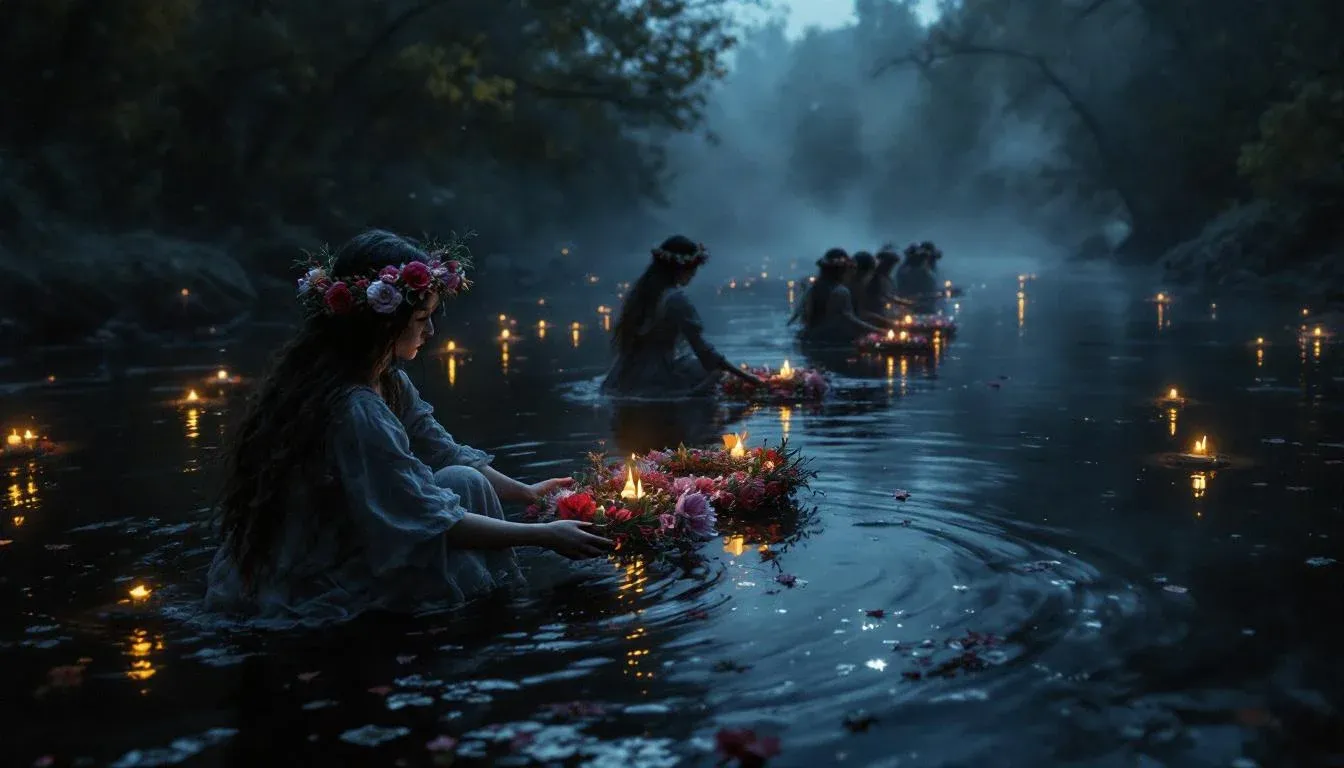
But Rusalka Week was not purely about fear. It was also the last echo of the old agricultural rites that predated Christianity. Villagers decorated their homes with birch branches and green garlands — hence the name "Green Week." In Ukraine, women performed kumuvannia, a ritual of symbolic godmotherhood conducted through exchanges of kerchiefs and coral jewelry among the birch trees. Offerings were left at the water's edge: bread, honey, pancakes, garlands of flowers, sometimes pieces of linen cloth. These were not gifts to appease a monster. They were offerings to a dead woman — an acknowledgment that she had once been someone's daughter, someone's sister, and that even in her undead fury, she deserved to be remembered.
The end of Rusalka Week was marked by a ceremony of expulsion. In some regions, villagers constructed an effigy of a rusalka from straw, dressed it in women's clothing, carried it in procession to the edge of the village, and burned it or threw it into the river. In others, a young girl was chosen to play the rusalka — crowned with birch leaves, led through the streets, and ceremonially "driven out" past the boundary of the settlement. The ritual was half funeral, half exorcism: a way of acknowledging the dead and then firmly sending them back where they belonged.
The Rusalka and the Vodyanoy: A Hierarchy of Water
The rusalka did not rule her waters alone. In the ecology of Slavic water spirits, she existed alongside — and often beneath — the Vodyanoy, the male water demon who controlled rivers, lakes, and millponds with a proprietor's jealousy.
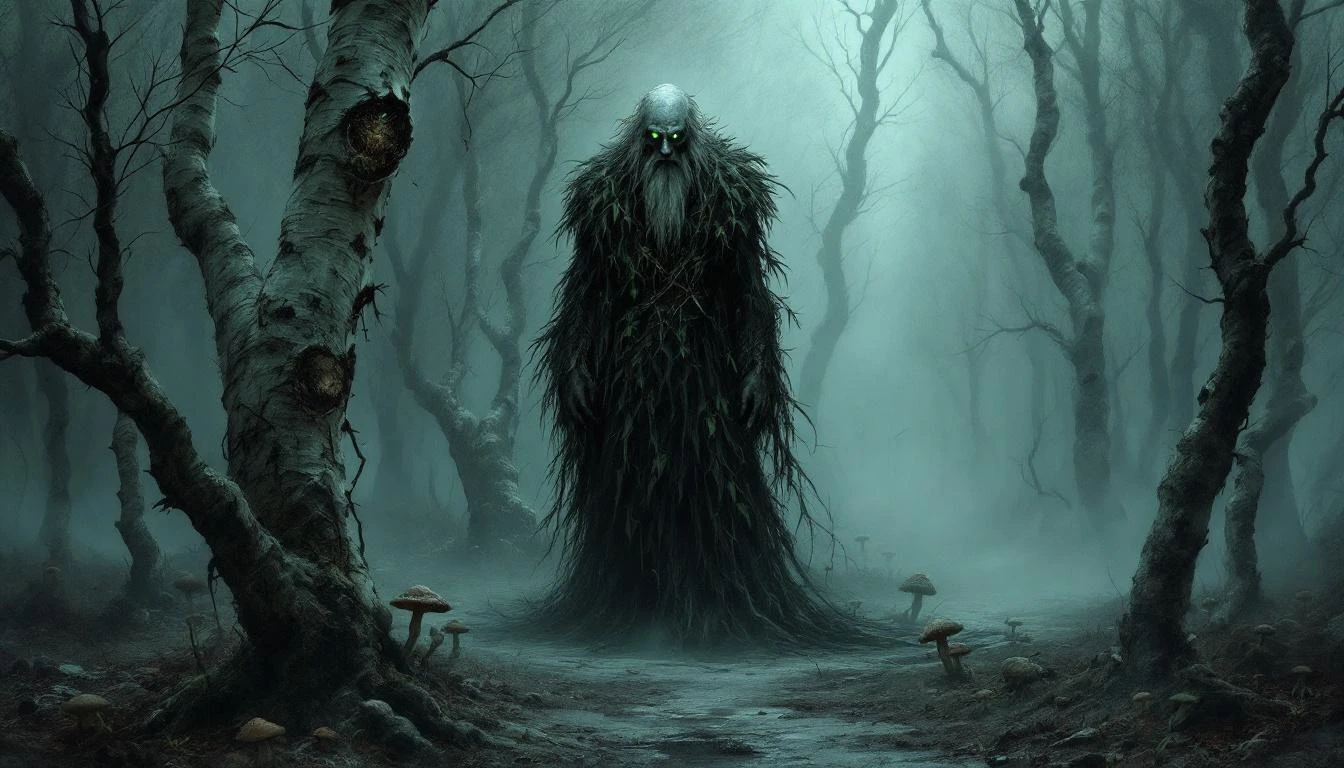
The Vodyanoy was old, ugly, and powerful — a bloated figure covered in mud and algae, sometimes described with fish scales or frog-like features, ruling from the deepest, darkest parts of the riverbed. He drowned millers, fishermen, and anyone foolish enough to swim at midnight. And in many folk traditions, the rusalki were understood to be his servants, his wives, or his property. The Vodyanoy collected drowned women the way a feudal lord collected serfs. The rusalki danced and sang at his command, lured victims to his domain, and existed in a state of supernatural bondage that mirrored the social bondage many of them had suffered in life.
This dynamic reveals something uncomfortable about the rusalka myth. Even in death, even as a fearsome spirit capable of killing grown men with her bare hands, the drowned woman remained subordinate to a male figure. The folklore gave her power — terrifying, lethal power — but it did not give her freedom. She traded one form of captivity for another. The village that failed her was replaced by the Vodyanoy's underwater court, and the patriarchal structure that drove her to the river persisted even beneath its surface.
The connection between rusalki and other forest spirits was looser but still present. Leshy, the lord of the forest, generally kept to his trees and left the waterways to the Vodyanoy. But during Rusalka Week, when the drowned maidens wandered into the woods and fields, their territories overlapped. Folk tales occasionally describe encounters between rusalki and Leshy — sometimes hostile, sometimes collaborative, always unpredictable. On Kupala Night, the great midsummer festival of fire and water, all boundaries dissolved, and the rusalki, the Vodyanoy, Leshy, and even Baba Yaga in her chicken-legged hut were all believed to be at the peak of their power.
Dvořák's Rusalka and the Romantic Betrayal
In 1901, the Czech composer Antonín Dvořák premiered an opera called Rusalka at the National Theatre in Prague. The libretto, written by Jaroslav Kvapil, drew on Karel Jaromír Erben's fairy tales and blended the Slavic rusalka myth with elements of Friedrich de la Motte Fouqué's Undine and Hans Christian Andersen's The Little Mermaid. The result was something that pleased opera audiences enormously and distorted the original folklore almost beyond recognition.
Dvořák's Rusalka is a water nymph who falls in love with a human prince and sacrifices her voice to a witch in exchange for human form. The prince betrays her. She is cursed. She returns to the water, damned to lure men to their deaths for eternity. The famous aria "Song to the Moon" — Měsíčku na nebi hlubokém — is one of the most performed pieces in the soprano repertoire, achingly beautiful, dripping with longing for a love that was never reciprocated.
It is magnificent art. It is also a lie, or at least a very selective truth. Dvořák and Kvapil took the rusalka — a spirit born from systemic violence against women, from drowning and abandonment and the Church's refusal to mourn them — and turned her into a lovesick girl who suffers because a man did not love her back. The opera strips the rusalka of her rage, her agency, and her terrifying power. It makes her sympathetic by making her passive. She does not tickle anyone to death. She does not drag men screaming into the river. She pines. She weeps. She waits.
This is the version of the rusalka that most of the Western world knows, and it has done more damage to the original myth than centuries of Christian reinterpretation. At least the Church acknowledged that the rusalka was dangerous. The Romantic tradition made her decorative.
The Rusalka Who Will Not Leave
The rusalka has survived every attempt to tame her. Christianity turned her into a warning. Romanticism turned her into a heroine. Modern pop culture keeps trying to turn her into a mermaid with legs, a Slavic Ariel, a tragic beauty waiting for true love's kiss to set her free.
None of it sticks. The original rusalka — the drowned girl with water in her lungs and fury in her dead eyes, laughing as she pulls you under — persists in the folklore because she speaks to something that no reinterpretation can neutralize. She is the consequence of a world that destroys women and then refuses to bury them properly. She is the dead who were not mourned, the wronged who were not avenged, the forgotten who refuse to be forgotten.
In the villages of Ukraine, Belarus, and Russia, people stopped believing in rusalki in any literal sense sometime in the 20th century. But the rituals lasted longer than the belief. Green branches on doorways at Pentecost. A reluctance to swim in certain rivers in early June. Grandmothers warning children to stay away from the water at dusk — not because of rusalki, they would say, but just because. Because the water is cold. Because the current is strong. Because you never know.
And somewhere in every river, in every lake where a woman once walked in and never walked out, the rusalka waits. Not for love. Not for rescue. For acknowledgment. For someone to stand at the water's edge and say her name and admit what happened to her and mean it.
She has been waiting for a very long time. She is patient. The dead always are.