There is an old Russian saying that gets repeated in villages along the Volga, the Dnieper, and every slow brown river that winds through the birch forests of eastern Europe: ne pleskaysya posle polunochi — do not splash after midnight. The children who hear it understand the surface meaning. The water is cold. The current is strong. You cannot see what is beneath you in the dark. But the adults who say it know the older, truer reason. After midnight, the river does not belong to you. It belongs to him. The old man at the bottom. The one with the green beard and the bloated belly and the long memory for those who forgot to pay their respects.
His name is Vodyanoy — vodyanoi, the Water One — and he has been drowning the careless, the arrogant, and the unlucky since long before anyone thought to build a church on the riverbank.
What Lives at the Bottom
The Vodyanoy is the master spirit of inland waters in Slavic folk belief. Rivers, lakes, marshes, millponds, deep wells, whirlpools — any body of fresh water deep enough to hide a body is a potential domain. He is not a god in the way that Perun or Veles were gods. He is something lower and older and closer to the ground: a khozain, a proprietor, a landlord of the deep. Every fish in his stretch of river belongs to him. Every reed, every waterlogged tree trunk, every pocket of still black water where the current stalls and things accumulate — these are his property, and he knows when someone takes without asking.
The word vodyanoy comes from voda (вода) — water. The name is a title, not a personal identity: he is the Water One, the way Leshy is the Forest One and Domovoy is the House One. Across the Slavic world, he wears different names — vodnik in Czech and Slovak, wodnik in Polish, vodeni mož in Slovene — but the fundamental character is the same everywhere. He is territorial, easily offended, capable of generosity toward those who respect him, and absolutely lethal toward those who do not.
In the ethnographic records compiled by Alexander Afanasyev in the mid-19th century, the Vodyanoy appears not as a fairy tale villain but as a practical reality of rural life. Peasants discussed him with the same flat certainty they used when talking about the weather or the tax collector. He was the reason a fisherman poured the first measure of his catch back into the river. He was the reason a miller kept a black rooster in the millhouse. He was the explanation when a strong swimmer went under in calm water and did not come back up.
The Face in the Water
The Vodyanoy's appearance is one of the most vivid and repulsive in all of Slavic demonology. Unlike the Rusalka, who retains the beauty of the drowned girl she once was, the Vodyanoy makes no effort to be attractive. He is grotesque by nature and by choice.
The most common description across Russian, Ukrainian, and Belarusian folklore presents him as an old man — enormously fat, naked or dressed in rags of river weed, with a pot belly that hangs over a belt woven from rushes. His skin is the grey-green of something that has been submerged for a very long time: not the green of living things but the green of decay, of algae on a drowned log, of the slime that coats stones in still water. His fingers are webbed. His eyes bulge like a frog's. His beard is long and tangled with pondweed, and it is green — vividly, unnaturally green, the color of water that has gone bad.
In some accounts, he has a fish tail instead of legs. In others, he has legs but they are covered in scales. His feet leave wet prints on dry ground. His hair drips constantly, and wherever he sits, a puddle forms. He smells of river mud and rotting fish and the particular cold sweetness of water that has been standing too long.
But here is the detail that elevates the Vodyanoy from merely ugly to genuinely uncanny: he ages and rejuvenates with the moon. When the moon is full, he appears young — or at least younger, his beard dark green, his body vigorous, his grip strong. As the moon wanes, he decays. His beard turns white. His skin loosens. His movements slow. By the new moon, he is ancient, barely able to stir from the mud at the bottom of his pool. Then the cycle begins again. He is immortal, but his immortality is not static. It pulses. It breathes with the tides of the sky, and anyone who watches the moon knows exactly how dangerous the Vodyanoy is on any given night.
He is also a shapeshifter. He can appear as a large fish — a pike or a catfish, the ambush predators of Slavic rivers. He can take the form of a floating log, a clump of reeds, a shadow beneath the surface that looks like nothing until it moves. In some West Slavic traditions, the Vodyanoy could disguise himself as a well-dressed man in a green coat, indistinguishable from a human except for one tell: the left side of his coat was always wet, and water dripped steadily from his left pocket. Anyone observant enough to notice this had approximately three seconds to run.
The Miller's Bargain
Of all the relationships the Vodyanoy maintained with the human world, none was more intimate — or more corrupt — than his bond with the miller.
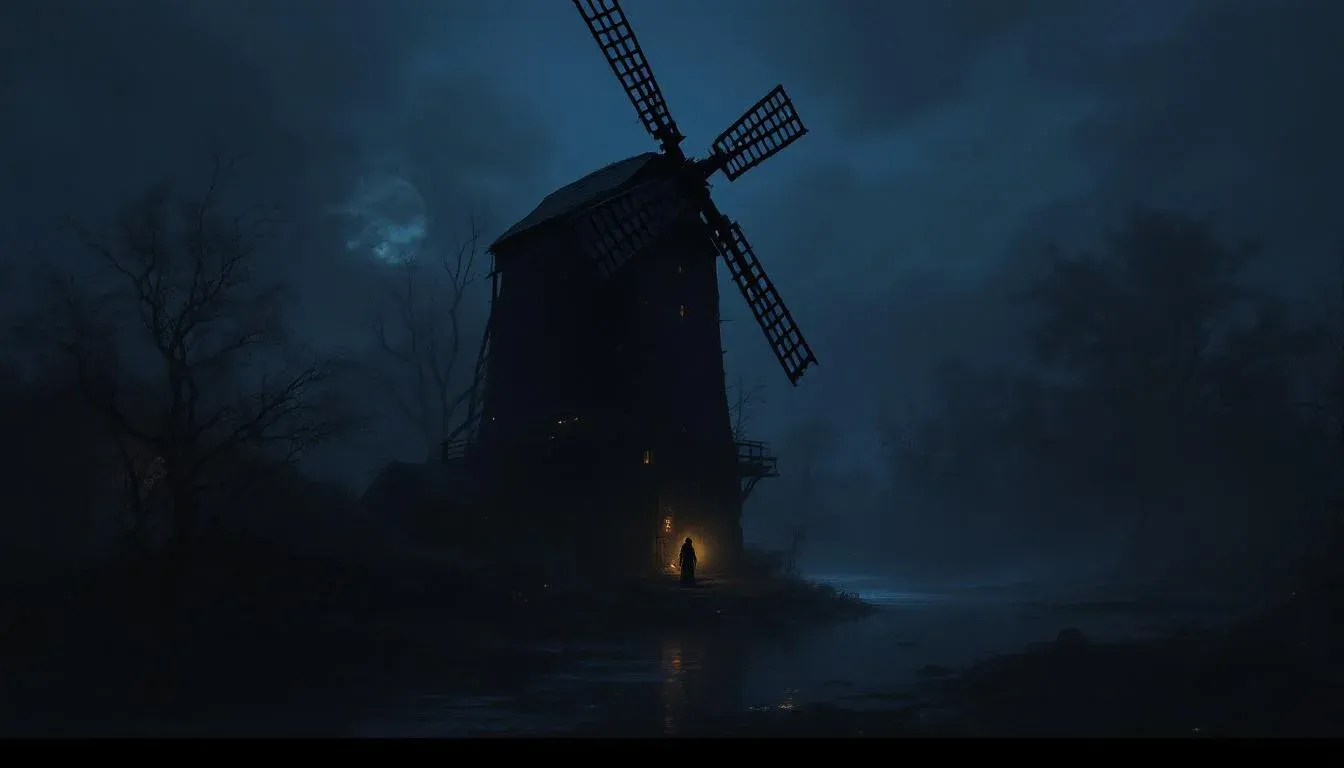
Watermills, by their nature, sit at the intersection of human industry and the Vodyanoy's domain. The millpond is dammed water, controlled water, water that has been redirected from its natural course to serve human purposes. This is, from the Vodyanoy's perspective, an act of territorial aggression. The dam disrupts his river. The wheel churns his water. The miller profits from what belongs to the Water One. And so an arrangement must be made.
Across the entire Slavic world, millers were understood to be in a pact with the Vodyanoy. The terms varied by region, but the structure was consistent: the miller provided offerings — and the Vodyanoy allowed the mill to operate. If the offerings stopped, the Vodyanoy broke the dam, flooded the mill, jammed the wheel, or drowned the miller outright. The relationship was not worship. It was extortion, dressed up in ritual.
The offerings were specific and dark. Black animals were preferred: a black rooster buried under the mill's threshold during construction, a black pig thrown into the millpond at the start of each season, a black goat slaughtered at the water's edge on particular feast days. In Belarus, millers kept black cats and black roosters inside the millhouse at all times — living talismans that signaled to the Vodyanoy that the pact was being honored. Some accounts describe more elaborate sacrifices: a horse with its mane braided with ribbons, led into the water and released to drown. The first swarm of bees in spring, packed in moss and sunk into the pond. Bread, salt, and vodka left at the water's edge after dark.
And then there were the whispered stories — never confirmed, always circulating — about millers who offered something more valuable than livestock. A traveler who stopped at a mill and was never seen leaving. A beggar invited to rest by the water. A child. These were the stories that gave millers their reputation as men who had sold something essential about themselves in exchange for the Vodyanoy's favor. The mill wheel turned, the grain was ground, the miller prospered — and somewhere at the bottom of the millpond, the Vodyanoy collected his payment.
This was not a marginal belief. Millers occupied a genuinely ambiguous social position in Slavic villages. They were necessary — everyone needed flour — but they were not trusted. They worked at the edge of the settlement, near the water, in a building that made noise all night. They were wealthy by peasant standards, and their wealth came from a machine that required the cooperation of a malevolent spirit. The mill was a liminal space, a border crossing between the human world and the Vodyanoy's, and the miller was the border guard who had made his own private deal with the other side.
The Drowner's Methods
The Vodyanoy kills primarily by drowning, but he is not crude about it. He does not simply reach up and pull people under — though he can, and does, when provoked. His preferred method is more patient than that.
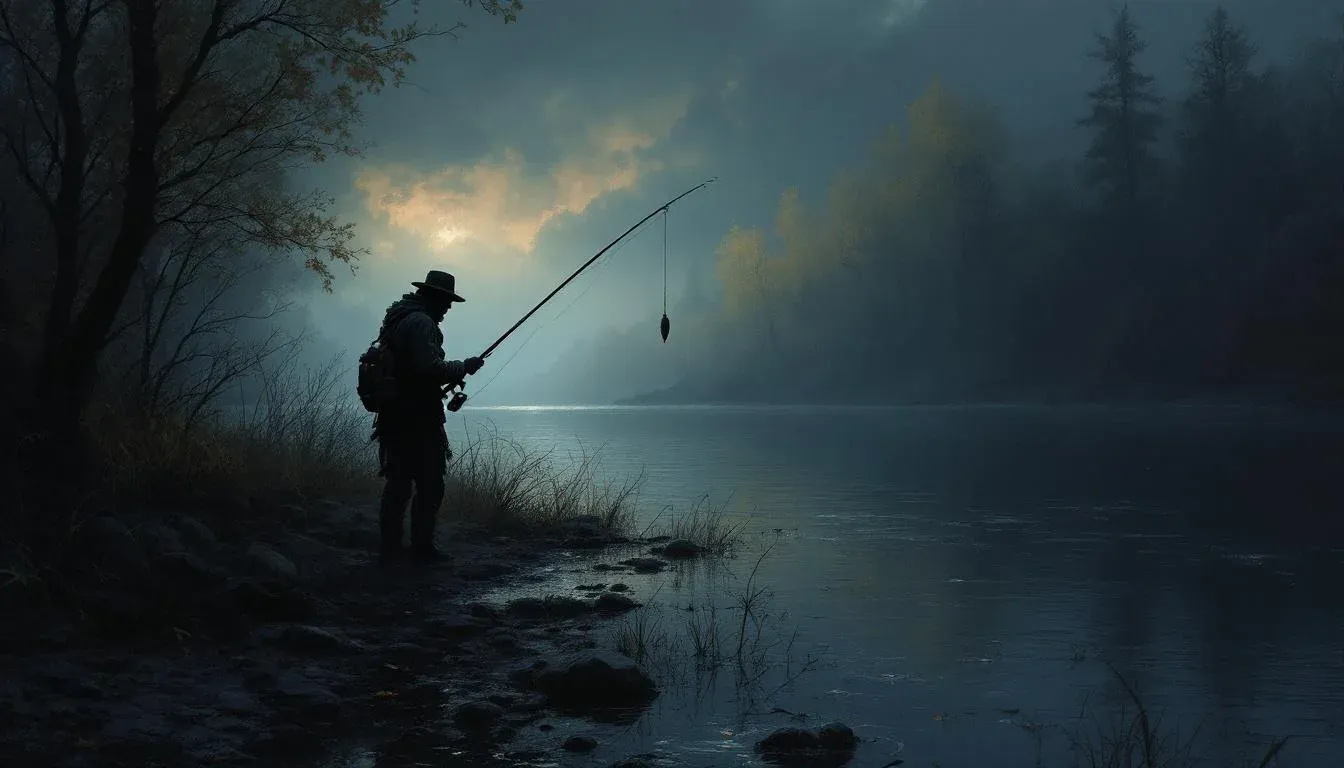
He waits for violations. Swimming at noon — the boundary hour when the Vodyanoy's power peaks — is an invitation. Swimming after midnight is worse. Bathing without making the sign of the cross first. Boasting about one's swimming ability within earshot of the water. Fishing without offering the first catch back to the river. Building near the water without the proper sacrifices. Any of these transgressions gives the Vodyanoy license to act.
When he does act, the water itself becomes his weapon. A cramp that seizes a swimmer's leg in deep water. A sudden current where there was none before. An undertow that pulls a wading child off the shallow shelf and into the drop-off. Weeds that tangle around an ankle. A log that rolls under a swimmer's hand when they reach for it. The Vodyanoy does not need to show himself. He operates through the water, using its physics as camouflage. Every drowning that could not be explained by witnesses — he was a strong swimmer, the water was calm, we don't understand what happened — was understood as the Vodyanoy's work.
When angered beyond mere hunger, the Vodyanoy escalated. He broke dams. He flooded fields. He sent water surging over riverbanks in the middle of the night, filling cellars and drowning livestock. He jammed mill wheels and cracked their axles. He drove fish away from a fisherman's nets for an entire season, reducing a family to starvation. He was not merely a predator. He was a force of economic destruction, capable of ruining livelihoods with the casual malice of a landlord evicting a tenant.
The vodyanoy demands tribute from all who use his waters. The fisherman who does not return the first fish to the river will catch nothing for a year. The miller who neglects the sacrifice will find his wheel broken and his pond dry. The swimmer who enters the water without permission will not leave it.
The Souls in Porcelain Cups
One of the most disturbing details in the Vodyanoy's mythology comes from the Czech and Slovak tradition, where the water spirit — known as the vodnik — is described as a collector of souls.
When the vodnik drowns a person, he traps their soul. Not metaphorically. Physically. The soul is captured and sealed inside a small porcelain cup with a fitted lid, and the cup is placed on a shelf in the vodnik's underwater dwelling. These cups are his most prized possessions. Among vodniks, wealth is measured not in gold or territory but in the number of soul-cups on display. A vodnik with a hundred cups is a figure of status. One with a dozen is considered poor.
The souls inside the cups are not destroyed. They exist in a state of suspension — aware, perhaps, but unable to move or speak or escape. If a cup is opened — by accident, by a brave human who raids the vodnik's lair, by the intervention of a saint — the soul is released and can ascend to heaven or return to the body (if the body has been recovered in time). But the vodnik guards his collection jealously. He counts his cups the way a miser counts coins, and the loss of even one drives him into a fury.
This image — rows of delicate porcelain cups, each containing a trapped human consciousness, arranged neatly on shelves in a dark underwater room — is one of the most genuinely horrifying concepts in Slavic folklore. It transforms drowning from a moment of violence into an eternity of captivity. The drowned person does not simply die. They are collected. They become inventory.
The Vodyanoy and the Rusalka: His Servants, His Wives
The Vodyanoy does not live alone. In the ecology of Slavic water spirits, he sits at the top of a hierarchy, and beneath him — always beneath — are the rusalki.
The relationship between the Vodyanoy and the rusalki is described with remarkable consistency across Russian, Ukrainian, and Belarusian folklore. The rusalki are his servants, his wives, or both. They are the spirits of drowned women — girls who died by suicide, by violence, by the specific cruelty of dying unbaptized — and the Vodyanoy claims them upon their death the way a feudal lord claims the labor of his serfs. They dance at his command, lure victims to his domain, and maintain the underwater court where he holds his power.
Afanasyev recorded that the Vodyanoy "espouses water-nymphs or drowned and unhappy girls who have been cursed by their fathers or mothers." The word "espouses" does a great deal of work in that sentence. It implies a ceremony, a bond, a relationship with structure. But the structure is captivity. The rusalki do not choose the Vodyanoy. They are assigned to him by the mechanics of their death. A woman drowns, her soul becomes unclean by the standards of the Church, and she enters the Vodyanoy's household as property. Whatever autonomy the rusalka possesses — her ability to wander during Rusalka Week, her terrifying power to lure and kill — exists within the constraints of the Vodyanoy's authority.
The Vodyanoy was also said to take a special wife — the vodyanitsa — described as a beautiful green-haired maiden who managed his underwater palace and served as a kind of consort. Whether the vodyanitsa was a distinct entity or simply the highest-ranking rusalka in the Vodyanoy's collection depends on which village you asked. The distinction mattered less than the underlying structure: male spirit rules, female spirits serve. The underwater world replicated the power dynamics of the world above it with brutal precision.
How to Survive Him
Slavic folklore is nothing if not practical. For every spirit that kills, there is a protocol for survival. The Vodyanoy's rules are strict but learnable, and the people who lived beside his waters knew them the way they knew which mushrooms were poisonous and which fields flooded in spring.
Do not swim at forbidden times. Noon and midnight are the Vodyanoy's hours. Swimming during these times is a direct provocation. The period between sunset and sunrise is dangerous in general. Dawn and the early morning hours are safest — the Vodyanoy sleeps deepest when the sun is strong.
Make the sign of the cross before entering water. This was adopted after Christianization, layered onto older protective rituals. The cross marks the swimmer as someone under divine protection, which may or may not deter a Vodyanoy but at least signals that you are not entering his domain carelessly.
Offer the first catch. A fisherman who keeps his entire haul has stolen from the Vodyanoy. Returning the first fish — or pouring a measure of melted butter or oil into the water — acknowledges the Vodyanoy's ownership and buys a season of tolerance.
Never boast near water. Declaring yourself a strong swimmer, mocking the depth of a river, or expressing contempt for the old beliefs within earshot of the waterline is treated as a challenge. The Vodyanoy accepts challenges.
Carry iron or a cross. Like most Slavic spirits, the Vodyanoy is repelled by iron and by Christian symbols. A needle sewn into clothing, a knife carried in a boot, a small cross worn around the neck — these create a barrier that the Vodyanoy must overcome, and he often will not bother if easier prey is available.
Do not build near deep water without sacrifice. Any construction that touches the Vodyanoy's domain — a bridge, a mill, a dock, a bathhouse — requires an offering at the foundation. Bread and salt at minimum. A black rooster if you want to be thorough.
The fishermen and millers who lived beside the Vodyanoy's waters did not consider these rules superstitious. They considered them common sense — the same category as wearing a coat in winter or not standing under a dead tree in a storm. The Vodyanoy was a fact of their environment, as real as the river itself, and you dealt with facts by learning their rules and following them.
The Water That Does Not Forget
The Vodyanoy endured longer than most Slavic spirits in the popular imagination. Leshy faded as the forests were cut. Domovoy dimmed as wooden houses gave way to apartment blocks. But the Vodyanoy persisted, because water persists. Rivers do not get paved over. Lakes do not get subdivided into lots. The deep places remain deep, and the dark at the bottom of a millpond is the same dark it was five hundred years ago.
Even now, in the 21st century, the Vodyanoy survives as a cultural reflex. Russian parents tell children not to swim alone, not to go near the water at night, not to stray from the shallows. The words have changed — they no longer say vodyanoy, they say opasno, dangerous — but the geography of the warning is identical. Stay away from the deep part. Stay away from the mill. Stay away from the place where the current goes still and the water turns black and you cannot see the bottom.
The Vodyanoy does not need you to believe in him. He needs you to come close enough to the water's edge. He needs you to forget — for one moment, on one warm night — that the river is not yours. That it has never been yours. That something old and patient and endlessly hungry has been sitting at the bottom since before your grandmother's grandmother was born, combing its green beard with a fish bone, counting its porcelain cups, and waiting.
It is always waiting.