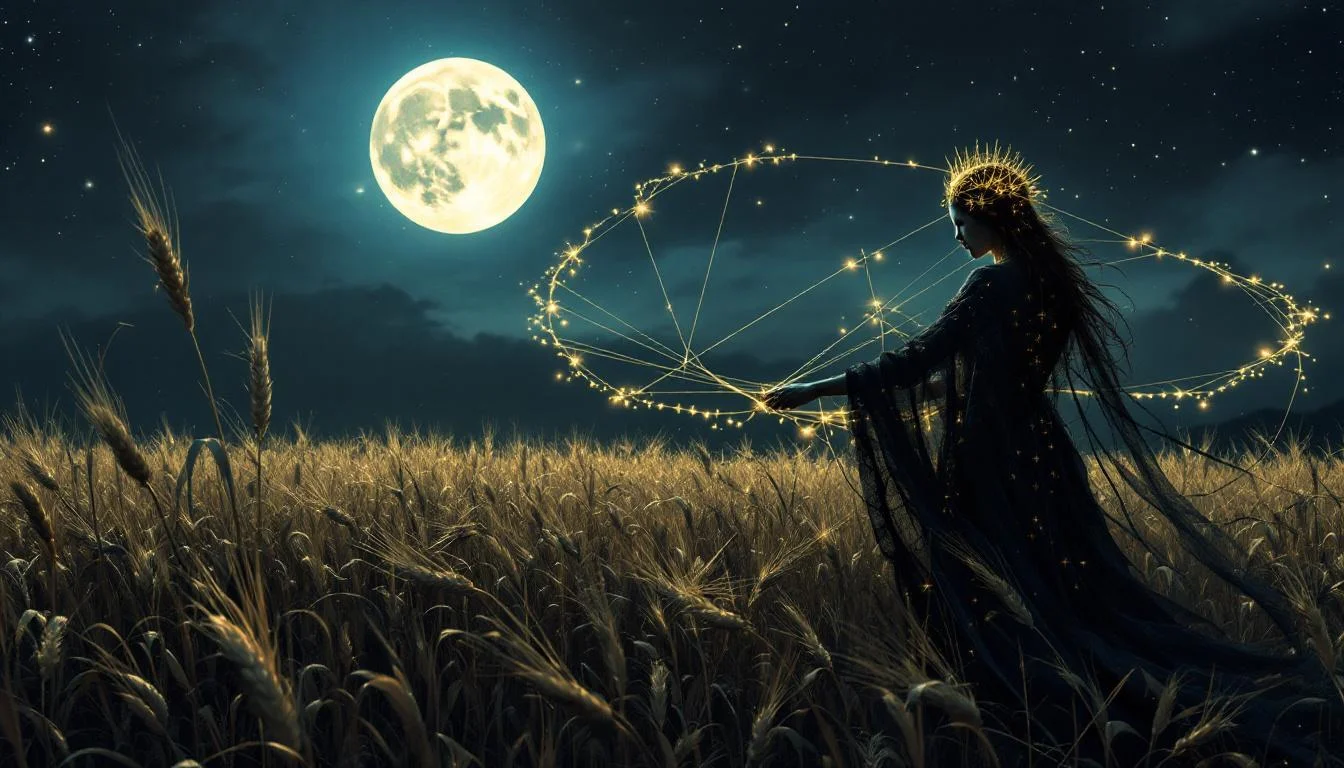
Somewhere in late April, in a village in Belarus or Serbia or the borderlands of old Poland, a girl put on men's clothing and climbed onto a white horse. The villagers placed a wreath of grain on her head and stalks of rye in her hand. Then the procession began — through the fields, past every house, along every road where the plows would soon cut the earth open.
The girl on the horse was not pretending to be a man. She was pretending to be a god. His name was Yarilo, and he had just come back from the dead.
This happened every year. It has probably been happening, in one form or another, since before the Slavs had a written word for it. Yarilo was the god who returned each spring to wake the ground, stir the blood, and set the entire living world into reckless motion. He was young, always young — beautiful, reckless, doomed. The fields turned green when he arrived. They turned brown when he left. And every summer, the women of the village dug a grave for his straw body and buried him in the dirt he had made fertile.
He is one of the strangest figures in the Slavic pantheon. Not because he is obscure — he is not — but because his entire mythological function is to arrive, seduce the world into blooming, and then be destroyed by the consequences of his own nature.
A Name That Means the Force of Spring
The etymology of Yarilo is not subtle. His name derives from the Proto-Slavic root *jarъ, a word with a semantic range broad enough to contain an entire theology. It meant "spring." It also meant "fierce," "furious," "strong," and "imbued with youthful life-force." The deeper ancestor is Proto-Indo-European *yeh₁r-, which gave rise to words for "year" and "season" — the turning of time itself.
In most Slavic languages, the root jar- survived in words that carry this double meaning of vernal energy and raw intensity. The Russian яровой (yarovoy) describes spring-sown crops — wheat, barley, oats planted after the frost breaks. The Czech jaro means simply "spring." The Serbian јар (jar) carries overtones of heat and anger. The Ukrainian ярий (yaryy) means fierce, burning, passionate.
This was not a god named after springtime as a pleasant season. He was named after the force that makes spring happen — the violent upward pressure of growth through frozen soil, the urgency of sap rising, the blind push of green shoots splitting rock. Jar- is not gentle. It is the rage of life insisting on itself after months of death.
The philologist Vyacheslav Ivanov and the mythologist Vladimir Toporov argued that this sacred youthful force — jarь — was considered divine in its own right among the pre-Christian Slavs. The god Yarilo was not a metaphor for spring. He was the personification of a specific kind of energy that the Slavic world recognized as sacred: the fierce, fertile, slightly dangerous vitality that surges through all living things when winter ends.
His name, in other words, is a verb disguised as a noun. Yarilo does not represent spring. He does spring — violently, beautifully, and without restraint.
The Proto-Slavic adjective jarъ expresses a youthful life force — fierce, growing, sacred. The deity whose name derives from this root was not the guardian of any single crop or season, but the personification of the biological energy that drives the cycle of vegetation from germination to harvest.
The God on the White Horse
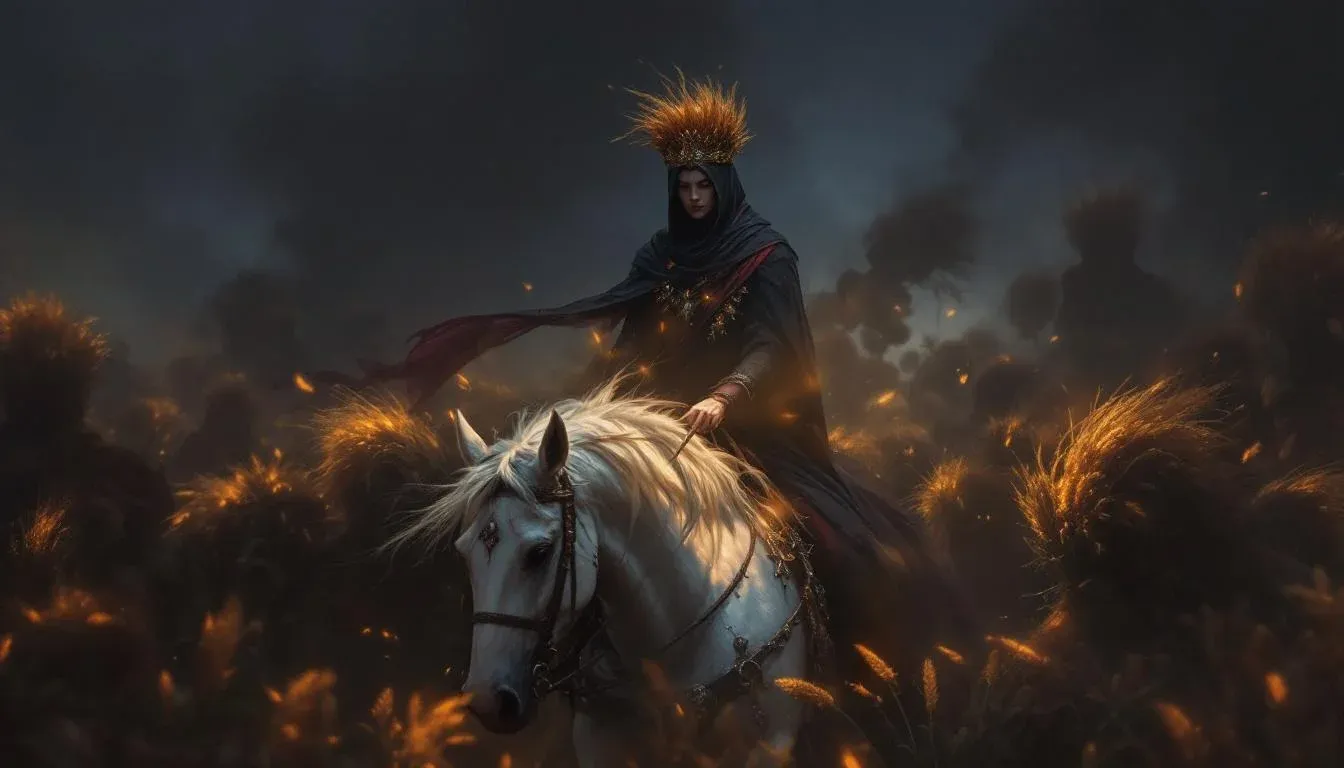
The folk rituals that preserved Yarilo's worship long after Christianity officially buried it are remarkably consistent across Slavic territory. From Belarus to Serbia, from Russia to the Carpathians, the core image is the same: a young figure on a white horse, crowned with grain, riding through the fields at the start of the growing season.
A Belarusian ethnographic text from 1846 — recorded by Pavel Shpilevsky — provides the most detailed portrait. It describes Yarilo as a young man dressed in white robes, barefoot, sitting on a white horse. In his left hand he holds stalks of rye. In his right — a human head. On his own head sits a wreath of wildflowers and spring grain.
The human head is the detail that stops you. Most retellings of Yarilo's mythology smooth it away or ignore it entirely, preferring the safer image of a flower-crowned youth. But the head was there in the folk memory, and its meaning is not difficult to reconstruct. Yarilo comes from the underworld. He was raised there, among the dead. The head he carries is the proof of where he has been — a token from Veles's kingdom, carried up into the sunlight as evidence that the boundary between death and life has been crossed.
In practice, the Yarilo processions varied by region. In some Belarusian villages, a young girl dressed in men's clothing rode the white horse. In Serbian communities, the role was given to a boy or young man decorated with green branches and leaves. In other areas, no living person played the part — instead, the villagers constructed a straw doll, dressed it, mounted it, and carried it through the fields on a pole.
What did not vary was the route: past every house, across every field, along every path where the plow would soon go. The procession was not a parade. It was an act of consecration. Wherever Yarilo passed, fertility followed. The songs sung during the procession made this explicit — they spoke of grain sprouting, cattle multiplying, young couples finding each other in the tall grass.
Son of Thunder, Raised by the Enemy
The mythological biography of Yarilo — reconstructed primarily from South Slavic folk customs and ritual songs by scholars including Ivanov, Toporov, and Radoslav Katičić — places him at the center of the Slavic cosmos's deepest conflict.
Yarilo was born a son of Perun, the god of thunder and the sky. But on the last night of winter — or the last night of February, in some tellings — the infant was stolen from his father's house. The thief was Veles, the god of the underworld, of cattle, of wealth, of the wet earth beneath the roots. Veles was Perun's eternal adversary: the serpent to his eagle, the low to his high, the dead to his living.
Veles took the child below. Yarilo grew up in the world of the dead, surrounded by roots and darkness and the slow patience of things that decompose. He learned whatever the underworld teaches its children — the secret workings of soil, the language of seeds, the mechanism by which dead matter becomes living matter again.
Each spring, Yarilo escaped. He rode his white horse up from the world beneath, through the cracks in the thawing ground, and into the living world. This was not a gentle homecoming. It was an invasion — the underworld's foster child bursting into the realm of the sky god, bringing with him all the fertile chaos of the deep earth.
This mythological structure — the child of the sky raised in the earth, returning each year to fertilize the surface world — explains why Yarilo is simultaneously a god of life and a figure haunted by death. He does not simply bring spring. He smuggles it up from below, like contraband from the kingdom of the dead.
The Marriage at Midsummer
The central myth of Yarilo's life follows the shape of the agricultural year with uncomfortable precision.
When Yarilo returns in spring, Morana — goddess of winter and death, daughter of Perun, and therefore Yarilo's own sister — is the first to notice. The courtship begins. Through ritual songs and folk customs preserved in South Slavic and East Slavic traditions, the pattern is always the same: the god of spring growth meets the goddess of cold death, and they are drawn to each other. Life reaches for death. Death reaches for life. The world tilts toward the solstice.
Their wedding takes place at midsummer — the festival that became known as Kupala Night in Eastern Slavic lands. The longest day. The shortest darkness. The moment when the balance between growth and decay tips in favor of the green world.
This sacred marriage between Yarilo and Morana was not merely a love story. It was a cosmological treaty. Yarilo — son of Perun, raised by Veles — was a living bridge between the sky and the underworld. Morana — daughter of Perun, sovereign of death — was the bridge between the living and the dead. Their union at midsummer temporarily resolved the fundamental tension of the Slavic cosmos. Sky and earth. Life and death. Perun and Veles. For one night, all the oppositions that drove the world were held together in a single bond.
The entire community felt the effects. Crops grew. Cattle fattened. Young men and women, following the mythological pattern laid out by their gods, paired off during the Kupala celebrations — leaping over bonfires, searching for fern flowers in the forest, wading into rivers at midnight. The divine marriage licensed human desire. The solstice was permission.
The Betrayal and the Killing
It did not hold. It was never going to hold.
After the harvest — after the grain was cut, after the fields gave up what Yarilo's presence had coaxed from them — the god proved unfaithful. The folk sources are rarely specific about the nature of his betrayal. Some versions suggest he simply wandered, his attention drawn to other fields, other growth, other women. Others frame it more starkly: Yarilo's power waned because the crops were cut, and a vegetation god without vegetation is a god without purpose.
Morana's response was absolute. She killed him. Or Perun killed him, avenging the dishonor done to his daughter. Or the community killed him through the symbolic act of harvesting the last sheaf — the final bundle of grain that stood for the god's body in the field.
The details varied. The structure did not. Yarilo died every autumn. His death was not accidental. It was necessary.
Without Yarilo, Morana transformed. The bride became the widow. The young goddess became an aging figure of frost and bitterness. Her grief — or her rage — expressed itself as winter. The fields froze. The rivers stopped. The world entered the long dark months under the rule of a death goddess whose husband was gone.
And then Morana, too, died. At the end of winter, her effigy was drowned and burned — the well-documented Marzanna ritual that persists in Poland and Czech lands to this day. With both gods dead, the slate was clean. And in the thawing ground, something stirred.
Yarilo climbed back on his white horse. The cycle began again.
The Funeral of Yarilo
If the spring procession celebrated Yarilo's arrival, the summer funeral marked his departure — and it was conducted with a specificity that reveals how seriously the Slavs took the death of their vegetation god.
The ritual, documented in Russian and Belarusian ethnographic sources from the eighteenth and nineteenth centuries, typically took place around the time of the summer solstice or shortly after — when the days began to shorten and the first signs of the harvest's end appeared.
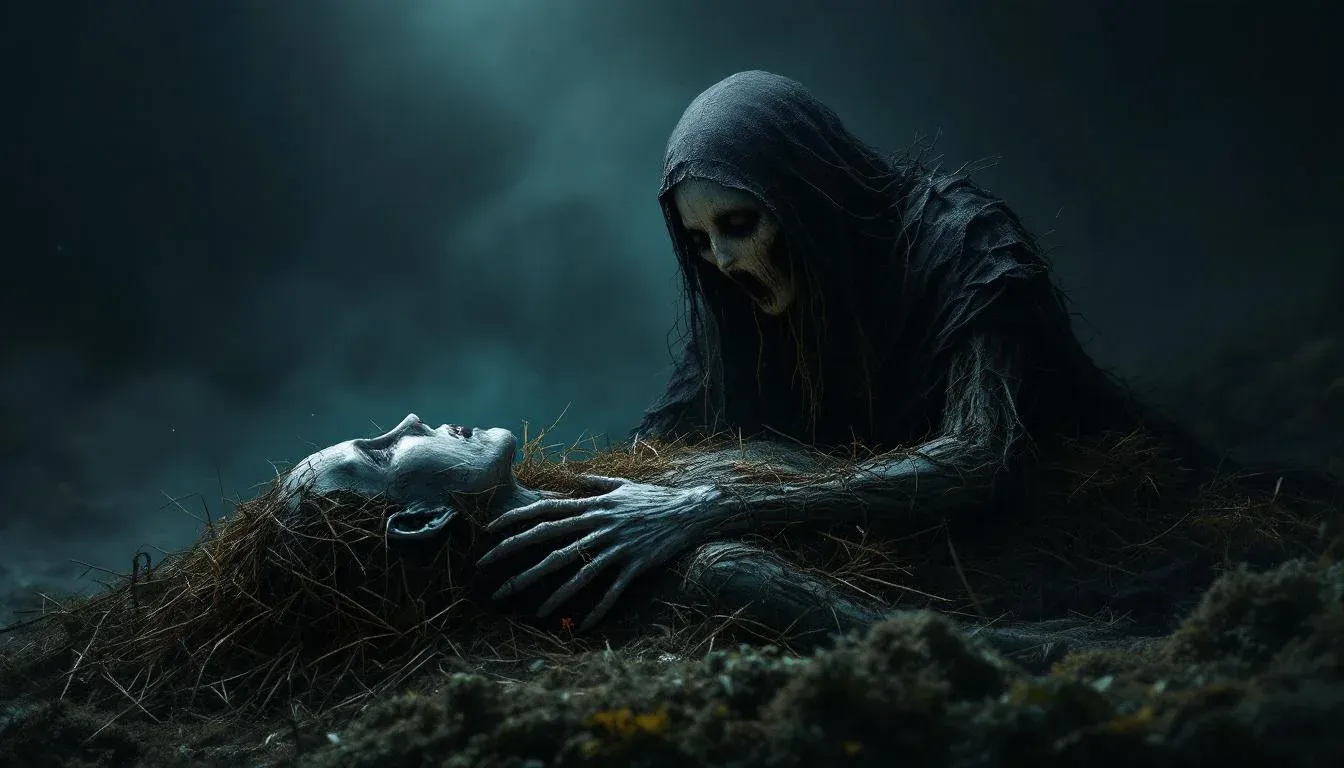
Women — specifically young married women, not maidens — constructed an effigy of Yarilo from straw. The effigy was anatomically explicit. Phallic features were sculpted with deliberate emphasis, because the entire point was that fertility itself was dying. This was not folk humor. It was theology. The god's reproductive power was the thing being mourned, and the mourners wanted everyone present to understand exactly what the world was losing.
The effigy was given a name in some regions: Kostrub or Kostroma, depending on the local tradition. It was carried through the village with loud weeping and lamentation — real or performed, the sources do not always distinguish. Songs were sung asking Yarilo to return, to climb back on his golden saddle, to ride his white horse out of the earth once more.
Then the effigy was buried. Placed into the ground — the same ground that Yarilo had made fertile — and covered with dirt. The burial site was sometimes in a field, sometimes at a crossroads, sometimes near a river. The logic was consistent: return the god to the earth so that the earth could return him next spring.
Yarilo and Kupala Night
The connection between Yarilo and Kupala Night runs deeper than the midsummer wedding myth. In the folk calendar of the Eastern Slavs, Yarilo's season ended where Kupala's began — the summer solstice was simultaneously the climax of Yarilo's power and the moment it started to decline.
The Kupala Night rituals — bonfire-leaping, river-bathing, the search for the mythical fern flower, the pairing of young men and women — were understood as enactments of the same fertile energy that Yarilo embodied. The fires were his fires. The water cleansed what his departure would leave behind. The couples who found each other in the forest were following a pattern set by a god who married his sister at the turning of the year.
In some Ukrainian and Belarusian traditions, the Kupala effigy — a figure made from branches and flowers, set on fire or thrown into water at the end of the night — was explicitly identified with Yarilo. The solstice bonfire consumed him. The river carried his ashes. The same god who had ridden in on a white horse in April was destroyed by fire and water in June.
This is why Kupala Night, despite its reputation as a celebration of love and fertility, always carried a note of mourning underneath the revelry. The bonfires were beautiful, but they were consuming something. The flowers were fragrant, but they were funeral decorations. The night celebrated the peak of life by enacting the beginning of death.
The Western Shadow: Yarovit of Wolgast
One of the few historical — as opposed to ethnographic — references to a deity who may be Yarilo comes from the western edge of the Slavic world, among the Polabian and Wendish tribes of what is now northeastern Germany.
In the twelfth century, the German bishop Otto of Bamberg conducted two missionary campaigns among the pagan Slavs of Pomerania. His biographers — Herbord and Ebo, writing shortly after Otto's death — recorded encounters with a war god called Gerovit (also written as Herovith), worshipped in the cities of Wolgast and Havelberg. The name Gerovit, when stripped of its Latin-German spelling conventions, reads as Yarovit — the jar- root followed by the Slavic suffix -vit (lord, master), the same suffix found in Svantevit and Svetovit.
A golden shield hung in Yarovit's temple in Wolgast. His priests told Otto's party that the shield must not be touched during peacetime, for it was only taken out during war. Yarovit was, in this western context, a god of military force and martial fury — the jar- root expressing its "fierce" and "furious" meanings rather than its "vernal" and "fertile" ones.
Whether Yarovit of Wolgast and Yarilo of the Eastern Slavic folk festivals are the same deity is a matter scholars have debated for over a century. The philological connection through jar- is solid. The functional overlap is partial — spring fertility and battlefield fury share the same root energy of aggressive, youthful force. But the gap between a war god with a golden shield and a barefoot boy with rye stalks is wide enough that some researchers — including Henryk Łowmiański and Stanisław Urbańczyk — have argued the identification is unsubstantiated.
What can be said with confidence is this: the jar- force — that explosive, youthful, sacred energy — was recognized as divine across the entire Slavic world, from the Elbe to the Dnieper. Whether it manifested as a god of war or a god of wheat depended on what each community needed from its gods.
The God Who Cannot Stay
Yarilo's deepest characteristic is impermanence. He is the only major Slavic deity whose entire mythological function depends on his own destruction. Perun endures. Veles endures. Mokosh endures. Even Morana, who dies every spring, returns in her full power every autumn. But Yarilo's return is always temporary. He arrives knowing he will be betrayed — or knowing he will betray. He marries knowing the marriage will end in murder. He fertilizes the fields knowing the harvest is his execution.
This makes him something rarer than a fertility god. He is a god of becoming — of the transitional moment between death and full life, between the frozen ground and the standing grain. He does not own the harvest. He is the thing that makes the harvest possible and is then consumed by it.
The Slavic communities who worshipped him understood this with a clarity that their rituals preserved. They celebrated his arrival with joy. They mourned his departure with genuine grief. They buried his effigy with anatomical honesty because what was dying was not abstract — it was the specific, physical, generative power that made the world alive. And they did all of this knowing he would return, because the whole point of Yarilo is that the force he represents — jar-, the fierce green rage of spring — cannot be permanently killed.
It can only be temporarily buried. And it always, always comes back.