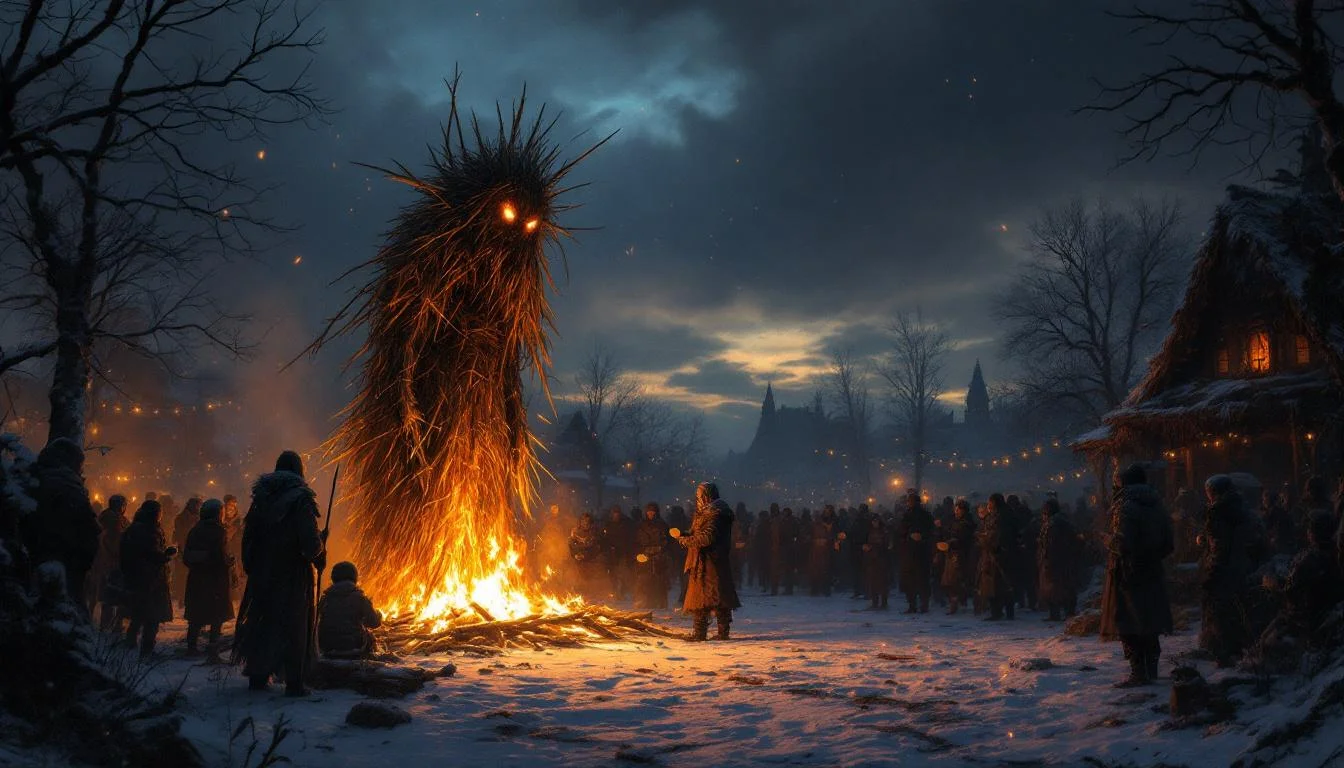
Every March, in towns and villages across Poland, schoolchildren build a figure out of straw. They dress it in rags, tie ribbons around its neck, sometimes paint a face on a cloth head. Then they march it to the nearest river and throw it in. Some groups set the figure on fire first, letting it burn on the bank before kicking the remains into the water.
The children are killing a goddess. They have been killing her for at least six hundred years — probably much longer — and neither the Catholic Church, Communist secularism, nor modern indifference has managed to stop them.
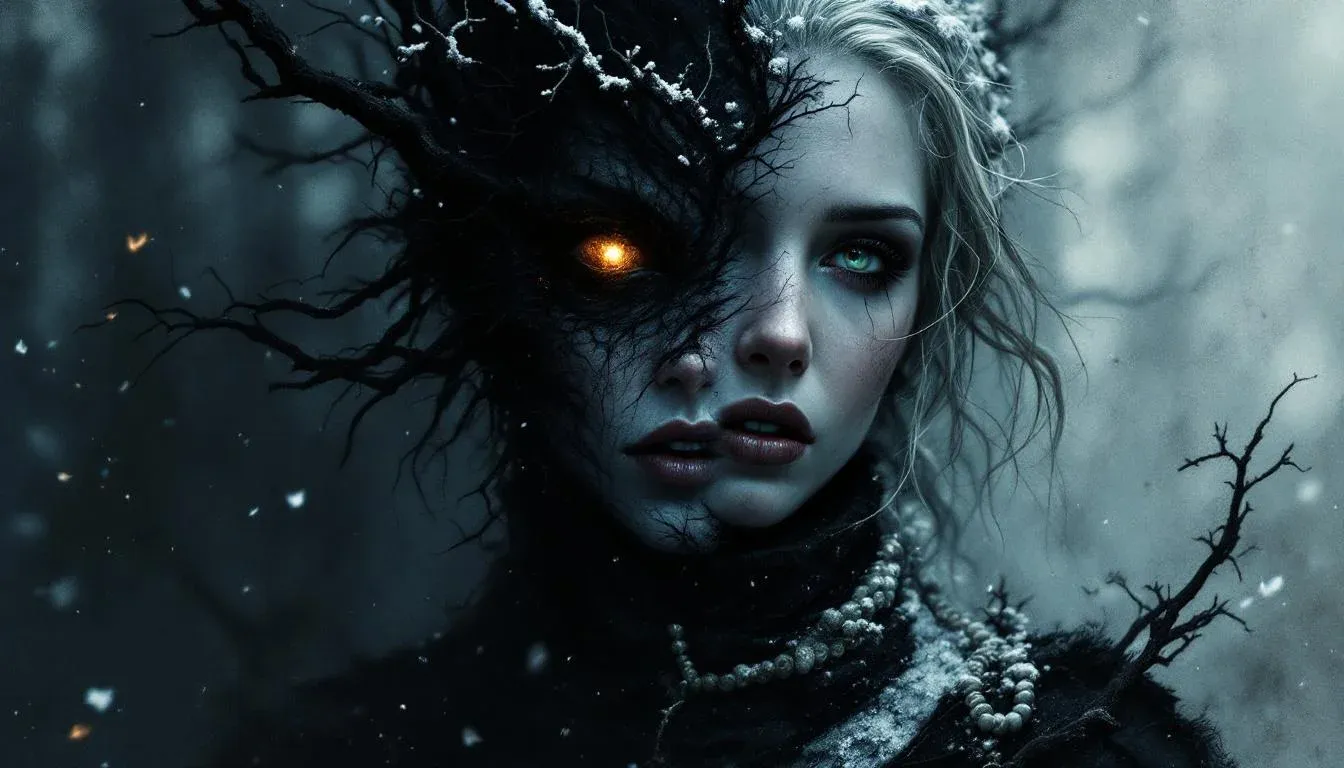
Her name is Morana. In Poland she is Marzanna. In Slovakia, Morena. In Czech lands, Morana or Smrtka. In Ukraine, Mara. In Russia, Marena. The names shift across borders, but the meaning underneath stays the same: she is winter, she is death, she is the long dark that must be destroyed so that life can return.
She is also — and this matters — the goddess who comes back every year to be destroyed again.
A Name Built From Death
The etymology is blunt. Morana's name derives from the Proto-Indo-European root *mor- / *mer-, meaning death. The same root produced Latin mors (death), Lithuanian maras (plague), Old Irish marb (dead), and Russian mor (pestilence). To speak her name is to invoke the word for dying across half the languages of Europe.
But there is a second layer. The Proto-Slavic *mara — meaning phantom, apparition, or evil spirit — gave rise to the Germanic mare, the suffocating night-demon that sits on your chest while you sleep. This is the creature buried inside the English word nightmare. The Old English mære, the Old Norse mara, the German Mahr — all descend from the same root that produced Morana.
The philologist Yeleazar Meletinsky traced the Slavonic mara into Germanic languages, arguing the borrowing occurred no later than the first century BC. If he is right, then the connection between Slavic death-goddess and Germanic night-terror is not a metaphor. It is a shared inheritance from an era before these peoples had fully separated.
Morana is not named after death. She is the word for death, given a face and a season.
What She Governed
The popular image of Morana reduces her to a winter spirit — a personification of cold that gets chased away each spring. This is not wrong, but it is incomplete. The medieval and folk sources paint a more complex figure who governed several overlapping domains.
Winter and Cold
This was her most visible role. Morana was winter in the same way that Mokosh was moisture — not as a metaphor, but as an identity. When frost killed the livestock and snow buried the roads, Morana was present. When the rivers froze and the sun hung low and pale, that was her doing. The arrival of Morana each autumn was feared, and her departure each spring was cause for public celebration.
Death and Pestilence
Beyond seasonal cold, Morana governed actual death — plague, disease, the wasting illnesses that swept through villages when food ran low in late winter. The Russian mor (mass death, pestilence) is not merely related to her name. It is her name. In folk belief, she did not simply accompany death. She brought it, carried it from house to house like a contagion.
Nightmares and the Mora
In the folk traditions of South Slavic and West Slavic peoples, the mora — a suffocating night-spirit that presses on sleepers' chests — was closely associated with or directly identified as Morana. This was not a separate creature that happened to share a name. The goddess of death and the demon of bad dreams were understood as aspects of the same force. When Morana ruled the long winter nights, nightmares ruled the sleeping world.
The Boundary Between Living and Dead
Some scholars — particularly Vyacheslav Ivanov and Vladimir Toporov — argued that Morana did not merely bring death but governed the passage between life and death itself. She stood at the threshold. This is why the thirteenth-century Czech manuscript Mater Verborum compared her to the Greek Hecate, goddess of crossroads, sorcery, and the liminal space between worlds.
The Marriage That Explains the Seasons
The most structurally complete myth involving Morana is her marriage to Jarilo — the god of spring, vegetation, and fertility. This myth, reconstructed primarily from South Slavic folk customs and ritual songs, functions as the Slavic explanation for the annual cycle of seasons.
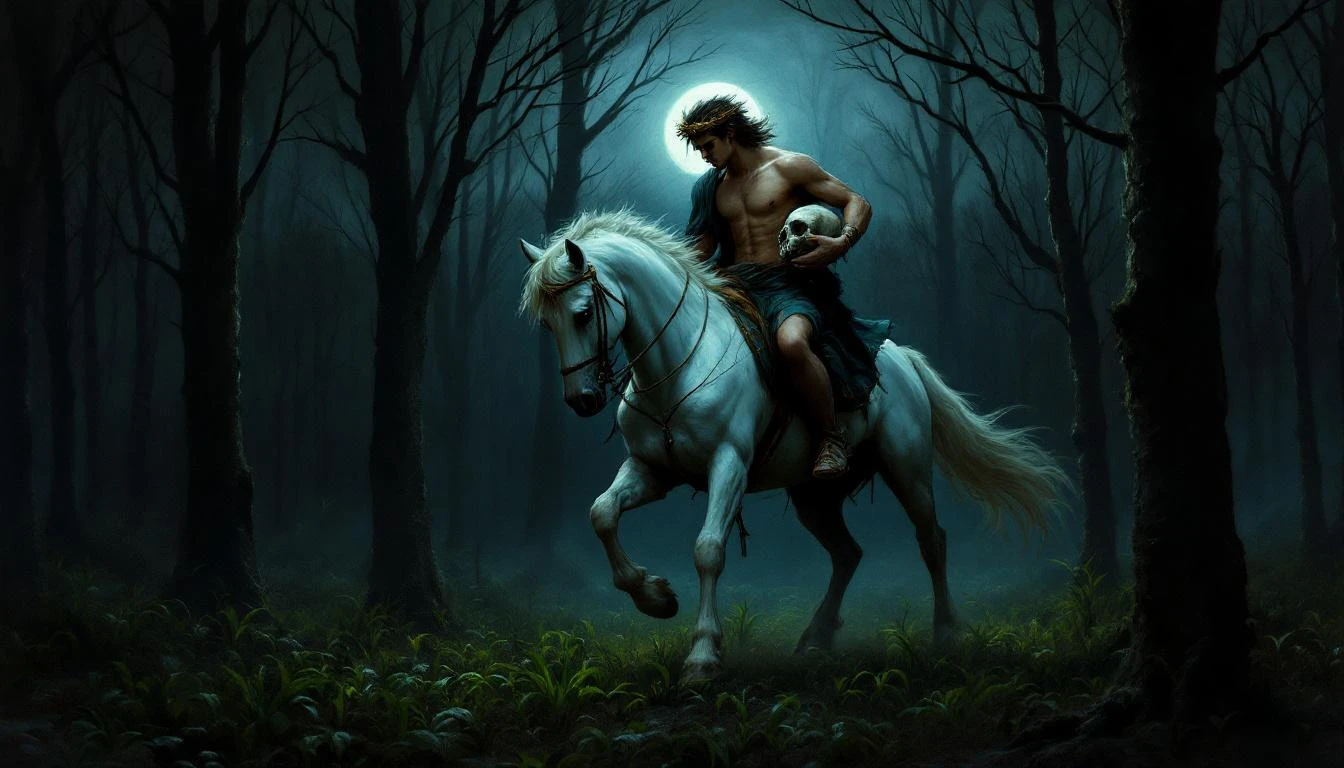
The story begins in the underworld. Jarilo, son of Perun the thunder god, is stolen as an infant by Veles, the god of the underworld and cattle. He grows up in the realm of the dead, among the roots and the darkness. When spring arrives, Jarilo returns to the world of the living, bringing vegetation and warmth with him.
Morana — who in this myth is also a daughter of Perun, making her Jarilo's sister — is the first to notice his return. They fall in love. The courtship follows established ritual patterns that Slavic communities reenacted through spring festivals: the meeting of the god of growth and the goddess of death, flirting across the boundary between winter and the green world.
Their wedding takes place at the summer solstice — the festival known today as Ivan Kupala in Eastern Slavic lands and Ivanje among the South Slavs. This sacred marriage between the god of life and the goddess of death is the moment of the year's greatest abundance. The fields are green. The days are longest. The tension between the underworld and the sky is temporarily resolved through union.
But it does not hold.
After the harvest — which the myth frames as a ritual murder of the crops — Jarilo is unfaithful. (In some versions, his infidelity is simply the natural consequence of a vegetation god whose power wanes after the grain is cut.) Morana discovers the betrayal. In retribution, she kills him — or Perun kills him — or the community kills him through the ritualized cutting of the last sheaf. The details vary. The outcome does not.
Without Jarilo, Morana transforms. The young bride becomes a bitter, aging figure — a crone of frost and fury. She is winter itself now, stripped of the softening influence of her husband's warmth. She rules the dead months with increasing cruelty until she, too, dies at the end of the year.
And then it starts again. Both are reborn. Jarilo returns from the underworld. Morana notices him. The courtship begins.
This cyclical myth explains something that a simple "winter goddess" label cannot: why the Slavs destroyed Morana's effigy each spring not with hatred but with ritual precision. They were not punishing her. They were completing the cycle. She had to die so the world could turn.
The Drowning of Marzanna
The ritual destruction of Morana's effigy is the best-documented and longest-surviving pagan custom in the Slavic world. It has been practiced continuously — despite centuries of Christian opposition — in Poland, Czech lands, Slovakia, and in modified forms across the broader Slavic territory.
How It Was Done
The traditional rite followed a strict sequence. Women and girls constructed a straw effigy dressed in white cloth, adorned with ribbons, beads, and sometimes necklaces. In some regions, the figure was life-sized. In others, smaller — a doll mounted on a pole.
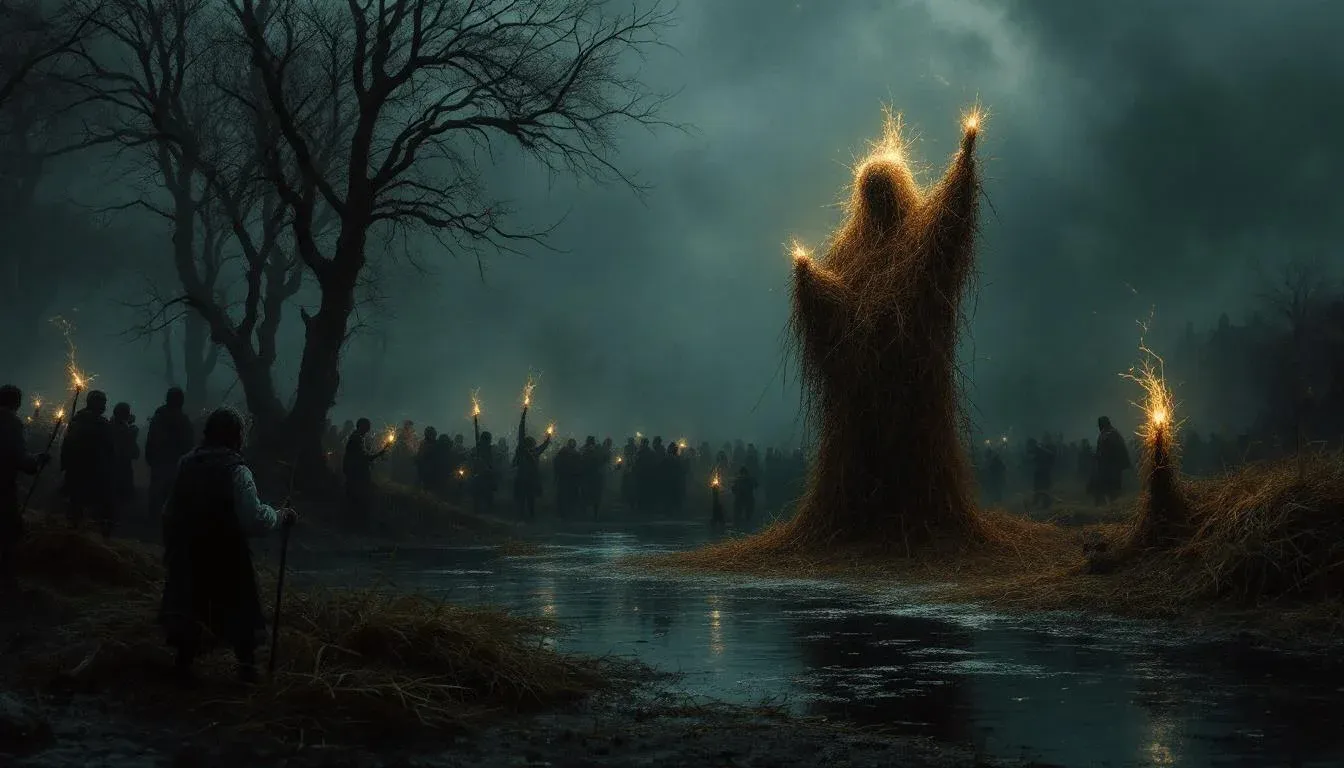
The procession began at the village edge. Children and young people carried the effigy from house to house, dipping it into every puddle and stream they passed. In their hands they held green juniper branches. At each house, they paused — the act of carrying Marzanna past every dwelling was believed to draw death and disease out of the homes and into the figure.
In the evening, the juniper twigs were lit. By torchlight, the procession moved to the river. The effigy was set on fire, and while still burning, thrown into the water.
Every piece of Marzanna had to enter the water. Every scrap of cloth, every ribbon, every ash. Nothing could be left on the bank. What remained of death had to be carried away by the current.
The Superstitions
The return journey was governed by strict taboos. You could not touch the effigy once it hit the water — your hand would wither. You could not look back toward the river — illness would follow you home. If you stumbled or fell on the way back, a relative would die within the year. The last person to return to the village would be the next to die.
These were not casual folk beliefs. They reflect a genuine terror of contamination — the understanding that Marzanna's death was a transaction, and those who handled it carelessly could be pulled into the bargain.
The Gaik: What Replaced Her
After destroying Marzanna, the procession did not return empty-handed. They carried back the gaik — a pine or spruce branch decorated with ribbons, handmade ornaments, eggshells, and spring flowers. This was the symbol of returning life, sometimes called latko (summer). Girls carried the gaik from house to house, singing and offering blessings, and were rewarded with eggs or coins.
The symmetry was deliberate. Death went out. Life came back. The river carried one away; the village welcomed the other in.
Morana and Maslenitsa
In Russia and Belarus, the direct effigy-drowning tradition did not survive in the Polish form. But its echo is unmistakable in Maslenitsa — the week-long festival of pancakes, bonfires, and excess that precedes Orthodox Lent.
The climax of Maslenitsa is the burning of a large straw effigy on the final day, Forgiveness Sunday. The official Christian explanation frames this as a farewell to winter. The older reading is more specific: the effigy is Morana. The burning is her death. The ashes scattered across the fields are not waste — they are a sacrifice to ensure the coming harvest.
Belarusian folklorist accounts make the connection explicit. The Maslenitsa effigy was understood as Morana — the goddess of death and winter. Burning her was not symbolic farewell but ritualized killing: the community participated in a necessary act of destruction that made spring possible.
People brought broken, old, or unnecessary items to the Maslenitsa bonfire — a shirt from a sick person, a worn-out tool, a scrap of cloth from a household that had suffered misfortune. Everything contaminated by winter's touch went into the flames. The fire consumed not just the goddess but the accumulated death she had brought.
The Indo-European Shadow
Morana did not exist in isolation. She belongs to a network of death-and-night figures that stretches across the Indo-European world.
The Germanic Mara — the night-riding spirit that produced the English word nightmare — shares her etymological root and her function as a bringer of nocturnal terror. The Norse tradition preserved the mara as a distinct demonic figure, a female spirit who entered bedrooms and pressed on the chests of sleepers until they could not breathe or move. Sleep paralysis, in the medieval Germanic worldview, was a visitation from the mara.
The Latin Morta — one of the Roman Parcae (Fates), responsible for cutting the thread of life — carries the same mor- root. The Greek Moros (doom, fate) descends from the reconstructed Proto-Indo-European *moros. Even the Irish Morrigan — the phantom queen of battle and death — may share distant kinship, though this connection is debated.
What emerges is not a single goddess borrowed between cultures but a Proto-Indo-European concept of death-as-female-force that each daughter culture shaped independently. The Slavs gave her a season and a husband. The Germans gave her a place on the sleeper's chest. The Romans gave her shears to cut the thread. But the root — mor-, death — is the same everywhere.
The Goddess Who Must Die
There is something unusual about Morana's position in the Slavic pantheon. Most gods are worshipped. Morana was destroyed — ritually, publicly, annually. No other Slavic deity received this treatment. Perun was honored with sacrifices. Mokosh was appeased with offerings of wool and flax. Veles was feared and propitiated. But Morana was built out of straw and set on fire.
This is not disrespect. It is a different kind of theological logic.
Morana's death was not punishment. It was function. She existed in order to die. The seasonal cycle required her destruction as surely as it required the sun's return. Without her death, there was no spring. Without her winter, there was no death to overcome. She was the necessary darkness that made the light meaningful.
This is why the ritual persisted where other pagan customs vanished. The drowning of Marzanna was not an optional observance tied to a particular priesthood or sacred site. It was woven into the agricultural calendar — into the lived reality of communities that depended on the turning of seasons for survival. You could close a temple. You could not close spring.
And so she remains. In 2026, in Polish cities and towns, on or around March 21, children will build her again. They will dress her in old clothes and carry her through the streets. They will set her on fire and throw her in the river. They will not look back.
Morana will sink. The water will carry her away. And the fields, obediently, will begin to turn green.
She will be back in November. She always is.