There is a god in Slavic mythology whose entire existence rests on a single paragraph written by a German priest who never worshipped him. One paragraph. That is all the primary evidence we have. And from that fragment, an entire mythology has been constructed — a dark twin to a god of light, a cosmic battle between good and evil, a demon on a mountain summoning the dead.
His name is Chernobog. The Black God. And the most honest thing anyone can say about him is this: we do not know if he was ever real.
The Only Source: One Priest, One Passage, One Problem
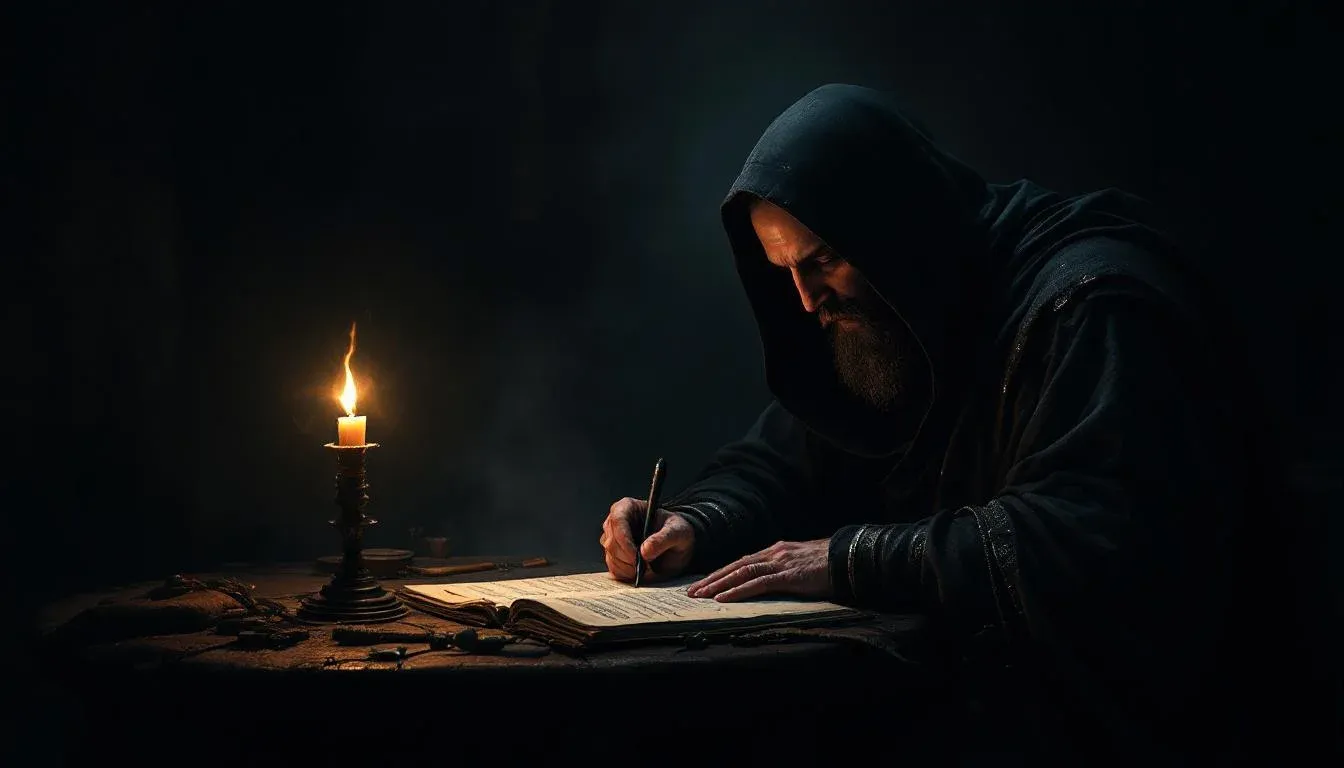
Everything we know about Chernobog from a primary historical source comes from a single document: the Chronica Slavorum, written around 1168 by Helmold of Bosau, a Saxon priest stationed in the frontier lands between Germanic Christianity and the pagan Slavic tribes of what is now northeastern Germany.
Helmold was not a sympathetic observer. He was a Christian missionary documenting the customs of people he wanted to convert. His brief mention of the Black God appears in a passage about a feast among the Wagri and Obodrite tribes — West Slavic peoples who lived in the Mecklenburg region along the Baltic coast.
The Slavs, too, have a strange conviction. At their feasts and carousals they pass about a libation bowl over which they utter words — I should not say of consecration but of execration — in the name of the gods. Of the good one, as well as of the bad one, they profess that all propitious fortune is arranged by the good god, and all adverse by the bad god. Hence, also, in their language they call the bad god Diabol, or Zcerneboch, that is, the Black God.
That is it. That is the entire foundation upon which the mythology of the slavic god of darkness has been built. No temples are described. No rituals beyond the passing of a bowl. No iconography, no priesthood, no myths, no stories. Just a Christian monk watching pagans drink and noting that they mentioned a "bad god" whose name sounded like "black god."
The Ghost of Belobog: Inventing a White Twin
If the evidence for Chernobog is thin, the evidence for his supposed counterpart Belobog is nonexistent. Helmold never mentions a "White God" by name. He refers to a "good god" in passing, but gives no Slavic name for this figure.
The name Belobog first appears centuries later, in the writings of 16th-century chroniclers who were working not from primary sources but from assumptions. The logic was simple and seductive: if there is a Black God, there must be a White God. If darkness has a name, light must have one too. The duality was clean, symmetrical, and profoundly Christian in its framing of the world as a battleground between good and evil.
This is where the story of belobog and chernobog begins to unravel as serious mythology and starts to resemble theological fan fiction. The great Slavic pantheon — Perun the thunderer, Veles the underworld serpent, Mokosh the earth mother — has deep roots in multiple sources across centuries and geographies. Chernobog has one paragraph. Belobog has none.
The Czech historian and philologist Josef Dobrovsky, writing in the late 18th century, was among the first to openly question whether the duality was authentic. He suggested that later chroniclers had projected Christian moral dualism onto a Slavic religious framework that may not have operated that way at all. Slavic religion, as far as we can reconstruct it, was not Manichaean. It did not divide the cosmos into absolute good and absolute evil. Its gods were complex, morally ambiguous, tied to forces of nature rather than moral abstractions. Veles was the lord of cattle and the dead — not evil, just chthonic. Perun threw lightning — not because he was good, but because storms happen.
The Chernobog-Belobog duality tells us more about the worldview of Christian missionaries than it does about Slavic religion.
From Chronicle to Canvas: How Disney Built a God
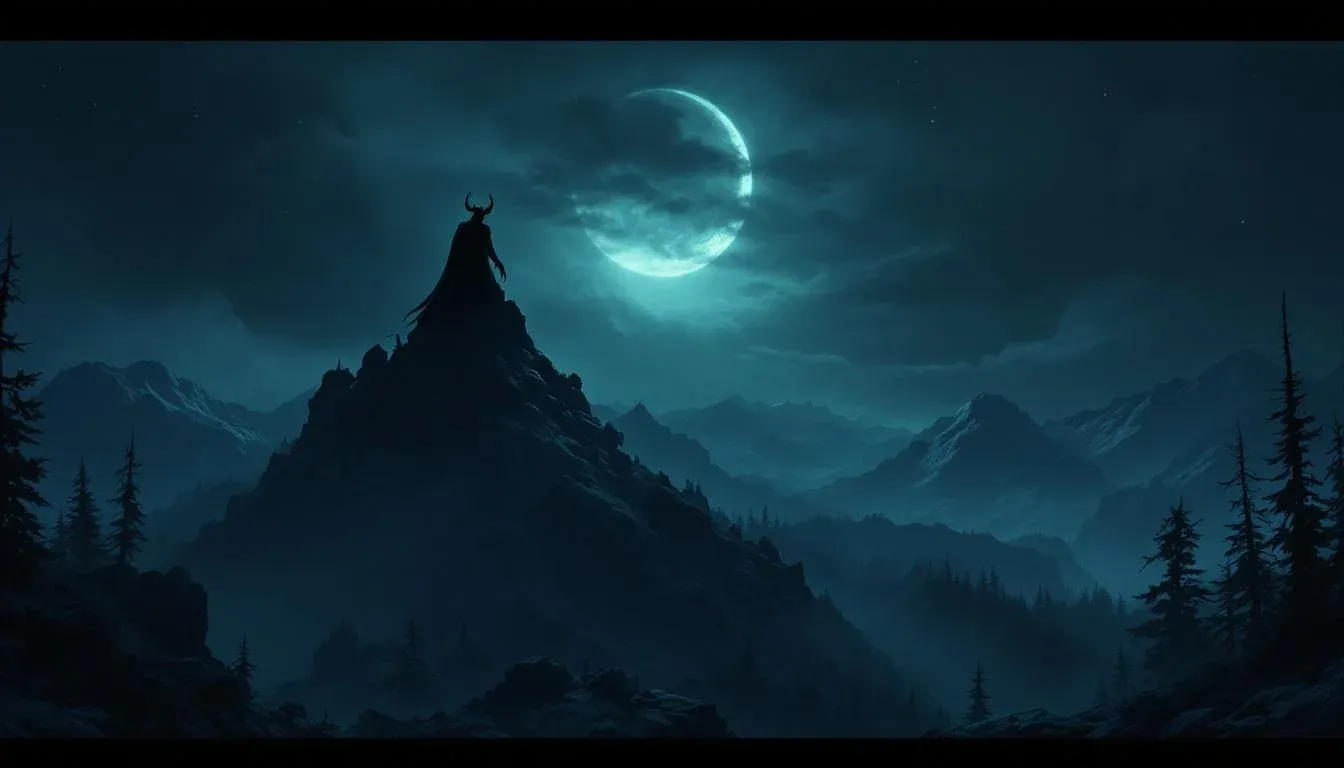
In 1940, Walt Disney released Fantasia, an experimental animated film set to classical music. The penultimate sequence — set to Modest Mussorgsky's Night on Bald Mountain — features a colossal winged demon rising from a mountaintop on Walpurgis Night, summoning spirits of the dead in a frenzy of flame and shadow.
Disney called this figure Chernabog. A slight respelling, but the intention was clear: this was the Black God of Slavic mythology, reimagined as the ultimate Disney villain.
The sequence was animated by Vladimir "Bill" Tytla, a Ukrainian-American animator whose parents had emigrated from Kyiv. Tytla brought a deeply personal understanding of Eastern European darkness to his work. His Chernabog is 64 meters tall, with wings spanning 161 meters — each wing larger than a football field. The figure moves with a theatrical, almost operatic physicality.
Disney originally brought Bela Lugosi — the Hungarian actor famous for playing Dracula — into the studio to serve as a live-action reference model. Lugosi spent a full day posing and performing for the animators. But Tytla was dissatisfied with the footage and had it scrapped, instead using sequence director Wilfred Jackson as his physical reference. Despite this, the finished Chernabog retains traces of Lugosi's exaggerated, hypnotic movement style — the slow extension of arms, the hunching of the shoulders, the predatory smile.
The result was arguably the most visually stunning sequence in the history of animation. It was also the moment when the name became forever fused with Hollywood in the public imagination. Before 1940, almost nobody outside of academic Slavic studies had heard it. After Fantasia, millions of people worldwide recognized the silhouette of the Black God on his mountain — even if everything they "knew" about him came from a cartoon.
What Disney created was not a depiction of a Slavic deity. It was a new myth entirely: a horned Satan figure drawn from Gothic horror, set to Russian music, given a Slavic name, and presented as universal evil. The actual Helmold passage describes a god toasted at a drinking feast. The chernobog disney version turned that into the lord of the dead commanding hellfire from a mountaintop.
The Book of Veles and the Neopagan Revival
In the 20th century, Chernobog received a second life from an unlikely source: a forged holy book.
The Book of Veles (Велесова книга) surfaced in the 1950s, purporting to be a pre-Christian Slavic scripture written on wooden planks. It described an elaborate pantheon, detailed rituals, and a cosmic mythology — including a prominent role for the Black God as a genuine deity of darkness locked in eternal struggle with forces of light.
The academic consensus is clear and unanimous: the Book of Veles is a 20th-century fabrication. Linguistic analysis reveals anachronisms, grammatical forms from modern languages that did not exist in the period the text claims to describe, and historical claims contradicted by archaeology. It was likely created in the Russian emigre community after World War II.
Despite this, the Slavic Native Faith movement (Rodnovery) — a neopagan revival that emerged in the late Soviet period and flourished after the fall of communism — treats the Book of Veles as scripture. For practitioners of Rodnovery, the slavic god of darkness is not a questionable figure from a single medieval passage but a fully realized deity with rituals, prayers, and cosmic significance.
This is how mythology works in practice. A German priest writes one paragraph about a drinking toast. Eight hundred years later, a forged book elevates that paragraph into theology. A neopagan movement adopts the forgery as truth. And a Disney film provides the iconography. The Chernobog that exists in popular culture today is a composite figure assembled from fragments, fabrications, and animation cells.
What Helmold Actually Saw
Let us return to that feast among the Wagri. What was actually happening when Helmold observed the Slavs passing a bowl and speaking "words of execration" in the name of a "bad god"?
Some scholars, particularly the Polish historian Aleksander Gieysztor, have argued that this was not worship at all. It was a propitiation — an attempt to ward off misfortune by acknowledging it. Many cultures have practices in which dangerous or destructive forces are named during communal gatherings, not to honor them, but to pacify them or keep them at bay.
This matters because it changes the entire framework of the question. We have been asking: "Was Chernobog a real Slavic god?" But perhaps the better question is: "Did Helmold understand what he was seeing?" A Christian monk, trained in a worldview that demands a Devil to oppose God, watches pagans acknowledge the existence of misfortune during a feast. He interprets this through his own theological lens and writes down: they have a Black God.
Neil Gaiman captured this tension brilliantly in American Gods (2001), where his character Czernobog is not a cosmic force of evil but a bitter, aging Slavic immigrant in Chicago who works in a slaughterhouse and plays checkers. Gaiman understood something the medieval chroniclers did not: that the darkness attributed to Chernobog might just be the ordinary darkness of a hard life, given a name so people could raise a glass to it and move on.
Why Chernobog Matters
The story of Chernobog is not really a story about a god. It is a story about how mythology is made.
One paragraph in a 12th-century chronicle. A dualistic framework imposed by Christian observers. A forged book adopted by modern believers. A Disney film that replaced history with spectacle. A novelist who found the human truth buried underneath all of it.
Every layer added something. Every layer distorted something. And at the center of it all sits a silence — the voice of the actual Slavic people who passed that bowl at the feast, whose own understanding of what they were doing was never recorded by anyone who shared it.
This is the tragedy of Slavic mythology as a whole. The Slavic peoples did not develop their own written tradition before Christianization. Almost everything we know about their religion comes from outsiders — German monks, Byzantine administrators, Arab travelers — who viewed it through the lens of their own beliefs. Perun survives because multiple sources mention him across centuries. Baba Yaga survives because she was embedded in oral folk tales that lasted long enough to be collected. But Chernobog? He survives because one man wrote one paragraph, and the rest of the world could not resist filling in the blanks.
That is what makes him fascinating. Not as a god of darkness — we have no idea if he ever was one — but as a mirror. Chernobog reflects whatever the observer brings to him. Christians saw the Devil. Disney saw a monster. Neopagans saw a lost deity. Gaiman saw a tired old man.
What the Slavs themselves saw, we will never know. And perhaps that mystery is the most honest darkness of all.