Here is a thought experiment. Imagine that a thousand years from now, the only surviving record of Christianity is a single sentence written by a Buddhist monk who visited Europe in the 12th century: "They worship an evil spirit they call Devil." Now imagine that, centuries later, a scholar reads this sentence and concludes: "If there was a Devil, there must also have been an Angel. Let us call him God."
That, in essence, is how Belobog was born.
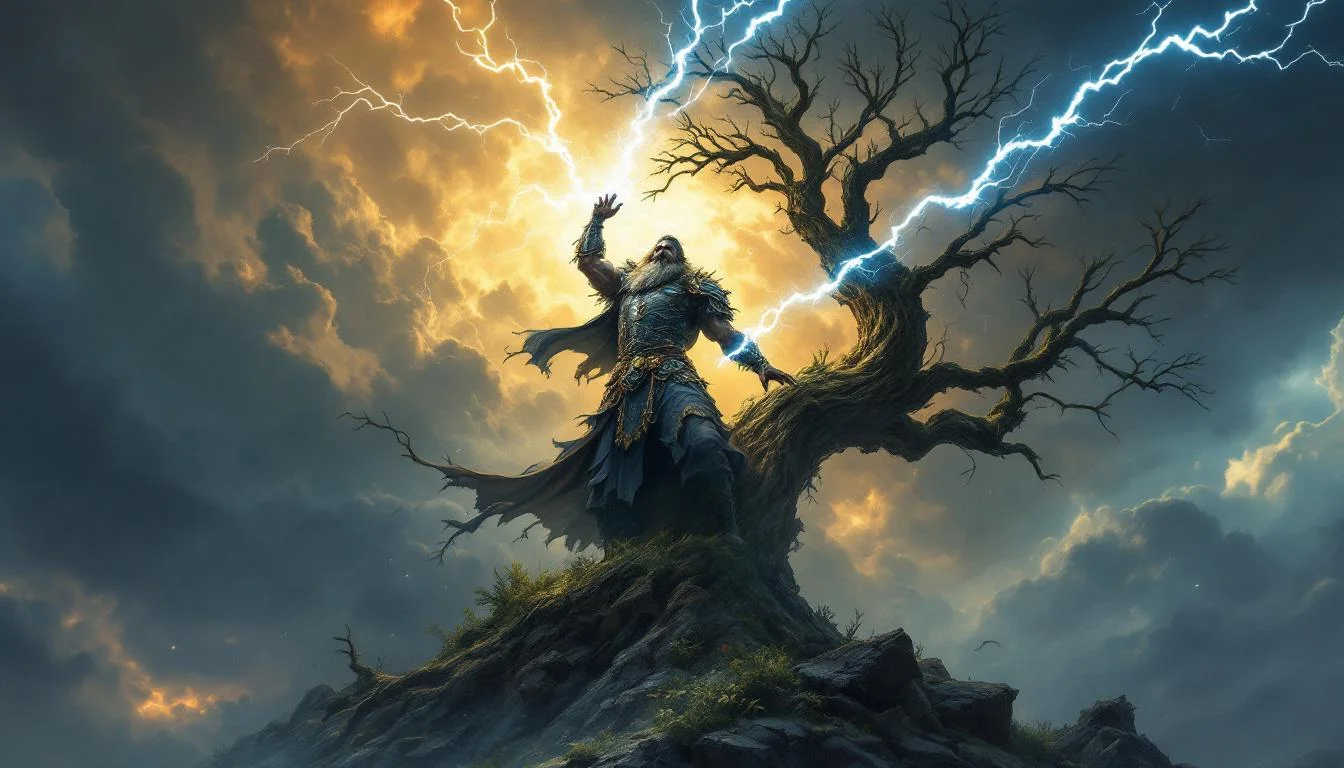
The White God of Slavic mythology is one of the most widely cited figures in popular accounts of the Slavic pantheon. He appears in encyclopedias, fantasy novels, video games, and neopagan prayer books. He is described as the radiant counterpart to Chernobog — light to his darkness, order to his chaos, the cosmic yes to the cosmic no. The duality is elegant. It is satisfying. It makes the kind of narrative sense that humans crave.
There is just one problem. There is no evidence that Belobog ever existed.
The Silence Where a God Should Be
If you have read our article on Chernobog, you know that the Black God's entire historical existence rests on a single paragraph from the Chronica Slavorum, written around 1168 by Helmold of Bosau. That passage describes a feast among the Wagri and Obodrite Slavs during which a bowl was passed and words were spoken in the name of a "good god" and a "bad god."
At their feasts and carousals they pass about a bowl over which they utter words — I should not say of consecration but of execration — in the name of the gods. Of the good one, as well as of the bad one, they profess that all propitious fortune is arranged by the good god, and all adverse by the bad god. Hence, also, in their language they call the bad god Diabol, or Zcerneboch, that is, the Black God.
Read that passage again, carefully. Helmold names the bad god: Zcerneboch. He does not name the good god. Not once. Not anywhere in the entire chronicle. He refers to a "good god" as a concept — the deity responsible for "propitious fortune" — but he gives it no Slavic name, no description, no location, no ritual, nothing. The good god is a grammatical necessity in Helmold's sentence, not a documented figure.
This is the foundation upon which Belobog was built: a pronoun.
Inventing a Name for the Nameless
The name "Belobog" — White God — does not appear in any medieval primary source. Not in Helmold. Not in Thietmar of Merseburg's chronicle, which documents the destruction of the Slavic temple at Rethra. Not in Adam of Bremen's account of northern paganism. Not in the Knytlinga Saga, which describes the Danish campaign against the Slavic temple at Arkona on Rügen and lists several deities by name — Svanteviz, Rinvit, Turupid, Puruvit, Pizamar — but never once mentions a White God.
The name surfaces for the first time in the 16th century, roughly four hundred years after Helmold wrote his chronicle and centuries after the Polabian Slavs had been forcibly Christianized. Thomas Kantzow, a Pomeranian secretary and chronicler, wrote in his Chronik von Pommern (ca. 1538) about a deity he called Bialbug — a "good god" paired with Zernebug, a "harmful god." But Kantzow was not working from surviving pagan oral tradition. He was a Renaissance-era scholar drawing on archival material, interpreting it through the theological assumptions of his time. By the 1530s, the Slavic pagans he was writing about had been dead or converted for three centuries.
The pattern continued. In the 17th and 18th centuries, various German and Polish antiquarians began constructing elaborate accounts of the Slavic pantheon, and the Belobog-Chernobog pairing became a fixture. The logic was always the same: if you have a Black God, you must have a White God. The universe demands balance. Darkness implies light. Evil implies good.
But that logic is not Slavic. It is Christian.
The Christian Mirror
The idea that the cosmos is divided into two opposing moral forces — one good, one evil — is not a universal human concept. It is a specific theological framework with roots in Zoroastrianism that entered European thought primarily through Christianity. The Christian worldview requires a Devil. Without Satan, the narrative of salvation collapses. And so when Christian observers encountered other religions, they often mapped this dualism onto what they found, whether it was there or not.
Helmold did exactly this. He watched Slavic pagans acknowledge both fortune and misfortune at a feast, and he interpreted it through his own lens: a good god and a bad god, locked in opposition. He even glossed the "bad god" as Diabol — the Devil — before giving its supposed Slavic name. The Christian framework came first. The Slavic label was attached second.
The great Polish scholar Aleksander Bruckner argued as early as the late 19th century that Chernobog was "created under the influence of Christianity" — that Helmold was not describing an authentic Slavic deity but projecting Christian demonology onto a practice he did not understand. If Bruckner was right about Chernobog, then Belobog is a projection of a projection: a white shadow cast by a black shadow that was itself an illusion.

The Prillwitz Forgery: Manufacturing Evidence
In 1771, a German pastor named Andreas Gottlieb Masch published a lavishly illustrated book about a collection of bronze figurines allegedly found near Prillwitz in Mecklenburg — the former heartland of the Polabian Slavs. The figurines, Masch claimed, were idols from the destroyed temple of Rethra, the great Slavic sacred site described by Thietmar of Merseburg. Among them was a figure identified as Belobog.
The Prillwitz idols were a sensation. Here, at last, was physical evidence for the Slavic pantheon — tangible proof that these gods had been worshipped with dedicated iconography. The collection included sixty-six illustrations of figures with runic inscriptions, each supposedly representing a different deity.
They were fakes. The entire collection was an elaborate 18th-century forgery.
Suspicions arose almost immediately, but the debate dragged on for decades. It was not until advances in metallurgical analysis in the 19th century that scholars could demonstrate conclusively that the casting techniques used on many of the figurines were modern, not medieval. Some objects in the collection may have been genuinely old artifacts — but there was no evidence connecting them to Slavic worship, and the runic inscriptions were nonsensical.
The Prillwitz affair is significant for Belobog because it illustrates how desperately scholars and antiquarians wanted the symmetrical pantheon to be real. When you already believe in a White God, you will see him in a bronze figurine. When the duality is already established in your mind, confirming evidence appears everywhere — in place names, in folk sayings, in ambiguous artifacts. This is not scholarship. It is pattern recognition running unchecked.
The Place Name Problem
Supporters of Belobog's historicity have long pointed to place names as evidence. Across the former West Slavic territories, there are hills and settlements with names that seem to contain the elements bel- (white) and bog (god): Belbog, Bielbog, Belbuk in Germany; Belbozice in the Czech Republic; Bialoboze in Poland. Czech historian Jan Peisker documented more than thirty toponyms in the West Slavic area with names combining elements of whiteness, height, and divinity.
This sounds compelling until you apply the same logic elsewhere. Slavic place names are rich with color terms — Bela Crkva (White Church), Crna Gora (Black Mountain, i.e., Montenegro), Belo Brdo (White Hill). The word bog in place names does not necessarily mean "god" in the theological sense. In Proto-Slavic, bogъ could mean "fortune," "portion," or "share" — a semantic range closer to "fate" than to "deity." A hill called Bielbog might mean "white fortune" or "bright hillock" just as easily as "white god."
Moreover, as the linguist Michał Luczyński argued in 2020, the Proto-Slavic compounds *bělъ bogъ and *čĭrnŭ bogъ may have been common descriptive phrases meaning "good fate" and "bad fate" — metaphorical expressions that existed across the Slavic-speaking world without referring to personified deities at all. Calling a place "White Fortune Hill" is not the same as building a temple to a god named Belobog.
The distinction matters enormously. One interpretation gives us a god. The other gives us an adjective.
Why We Want Dualities
There is something in the human mind that finds dualities irresistible. Light and dark. Good and evil. Order and chaos. Yin and yang. God and the Devil. We are narrative creatures, and the simplest narrative is a conflict between two opposites.
This impulse has shaped how we reconstruct the mythologies of cultures that left no written records. We look at fragments — a name here, a place name there, a single paragraph in a hostile chronicle — and we arrange them into symmetrical pairs because that is what feels right. We do this even when the evidence resists it. Especially when the evidence resists it.
The Belobog-Chernobog duality is a case study in this tendency. We have one mention of a "black god" in a 12th-century source. We have zero mentions of a "white god" in any medieval source. And yet the pairing has become one of the most recognizable features of "Slavic mythology" as popularly understood. It appears in textbooks, in Wikipedia articles, in fantasy novels, and in video games.
Neil Gaiman understood the absurdity of this better than most. In American Gods (2001), his character Czernobog is a bitter old Slavic immigrant in Chicago who kills cows in a slaughterhouse and plays checkers for the right to cave in the protagonist's skull with a hammer. At the end of the novel, as spring arrives, Czernobog begins to lighten — his hair turns white, his demeanor softens — and he becomes, or perhaps always was, Belobog. Gaiman merged the two gods into a single figure who changes with the seasons: dark in winter, light in summer. Not two gods in opposition, but one being in flux.
It is a brilliant literary choice, and it may be closer to whatever truth lies beneath Helmold's paragraph than any of the scholarly reconstructions. Perhaps the Slavs did not see the world as a war between light and darkness at all. Perhaps they saw it as a cycle — a bowl passed at a feast, a toast to fortune and misfortune alike, an acknowledgment that the same world that gives you a good harvest can also kill your cattle.
What We Actually Know
Let us be honest about what the evidence supports and what it does not.
We know that Helmold recorded a Slavic name for a "bad god" — Zcerneboch — in the 12th century. We do not know if this was a personal deity, a personified concept, or a Christian gloss on a practice Helmold misunderstood.
We know that Helmold mentioned a "good god" at the same feast. He did not give this figure a Slavic name. The name Belobog was supplied by later scholars.
We know that the Knytlinga Saga, Thietmar of Merseburg, Adam of Bremen, and every other medieval source that describes Slavic religion in detail never mentions a White God. The gods they do mention — Svantovit, Perun, Triglav, Rugievit — are complex figures who do not fit neatly into a good-evil binary.
We know that the Prillwitz idols, which included a supposed Belobog figure, were forged.
We know that the place names containing bel- and bog- can be explained linguistically without invoking a deity.
We know that the Belobog-Chernobog duality maps almost perfectly onto Christian good-evil dualism — and that the primary sources for both figures were written by Christians.
What we do not know is what the Slavs themselves believed. Their voices were never recorded by anyone who shared their worldview. And into that silence, we have projected our own need for balance, our own craving for a clean narrative, our own deep conviction that where there is darkness, light must have a name.
Belobog may be the most revealing figure in Slavic mythology — not because of what he tells us about the Slavs, but because of what he tells us about ourselves. We could not tolerate a pantheon with a Black God and no White God. We could not accept asymmetry. And so we invented one, gave him a name, forged his idol, planted his banner on hilltops, and wrote his story in books.
The White God is a mirror. And what it reflects is not ancient Slavic religion. It is the modern human need to believe that for every darkness, there is an equal and opposite light waiting to be named.