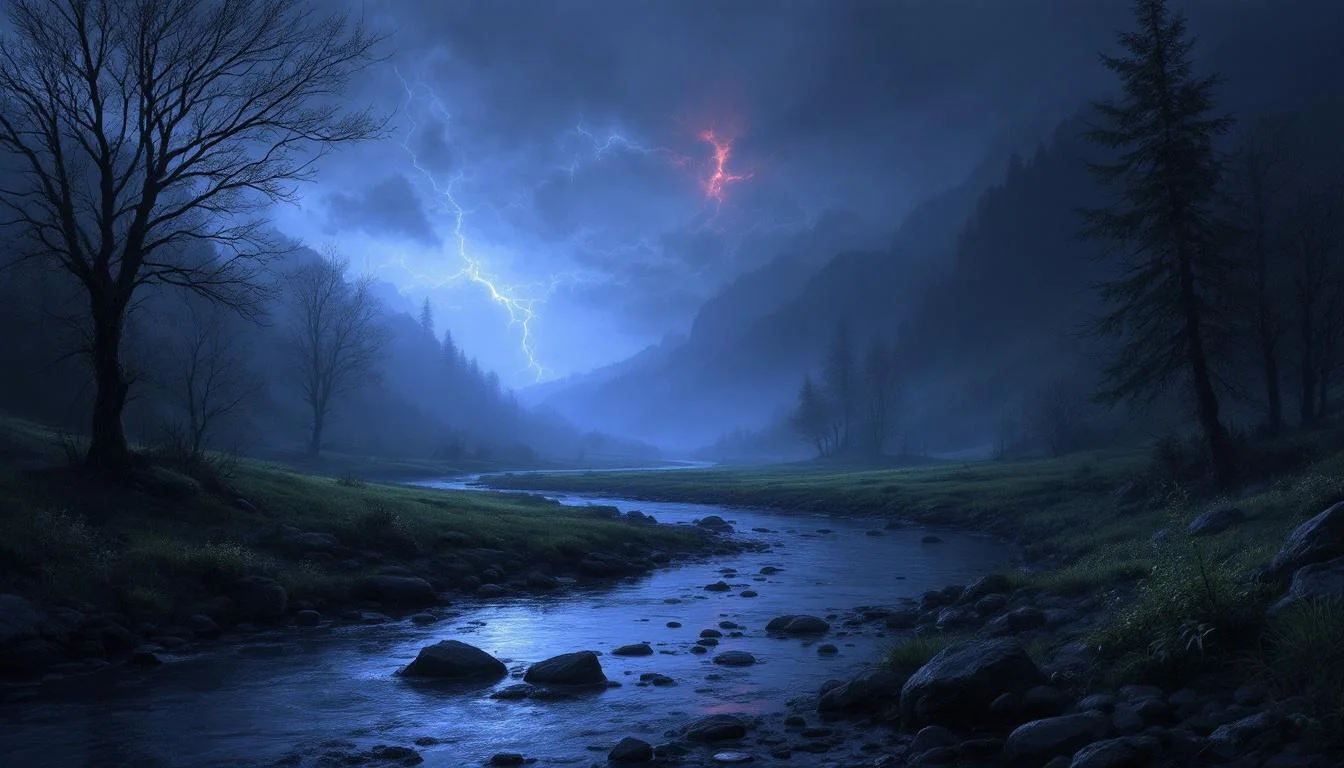
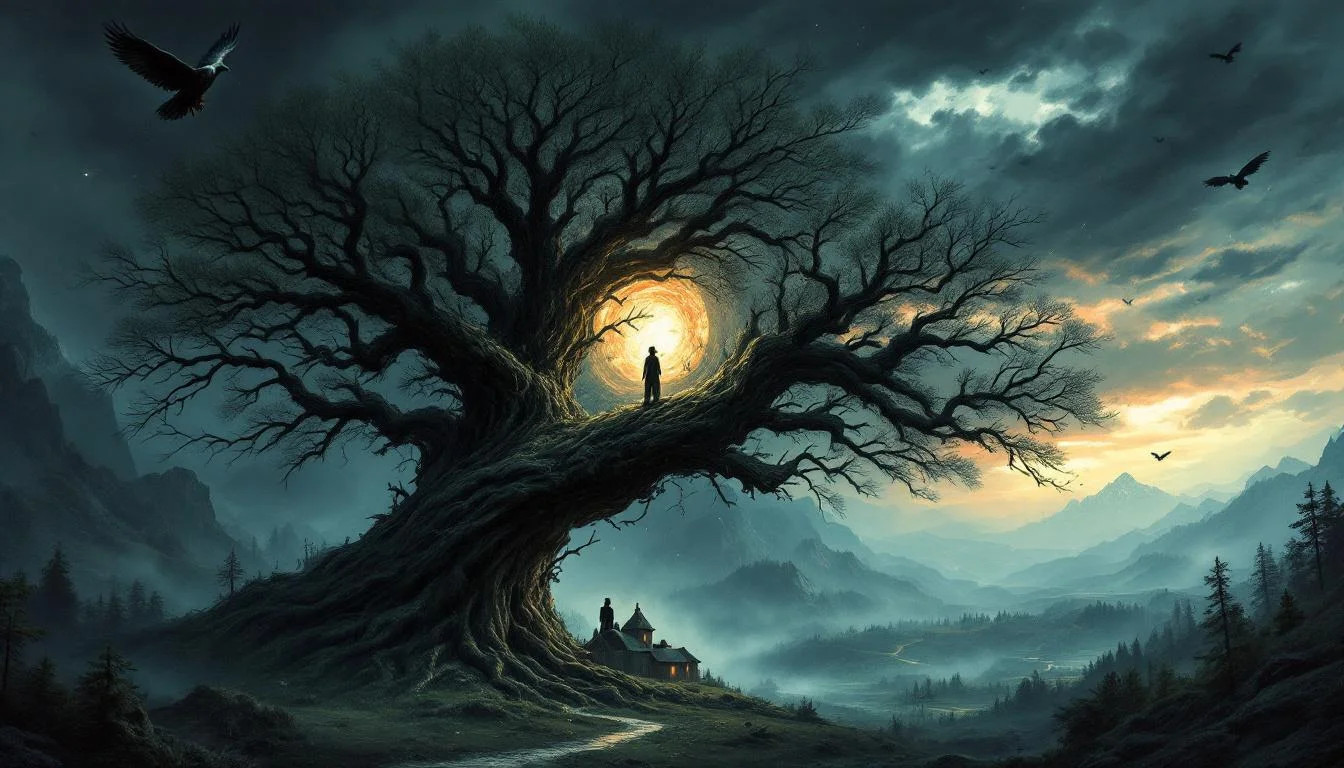
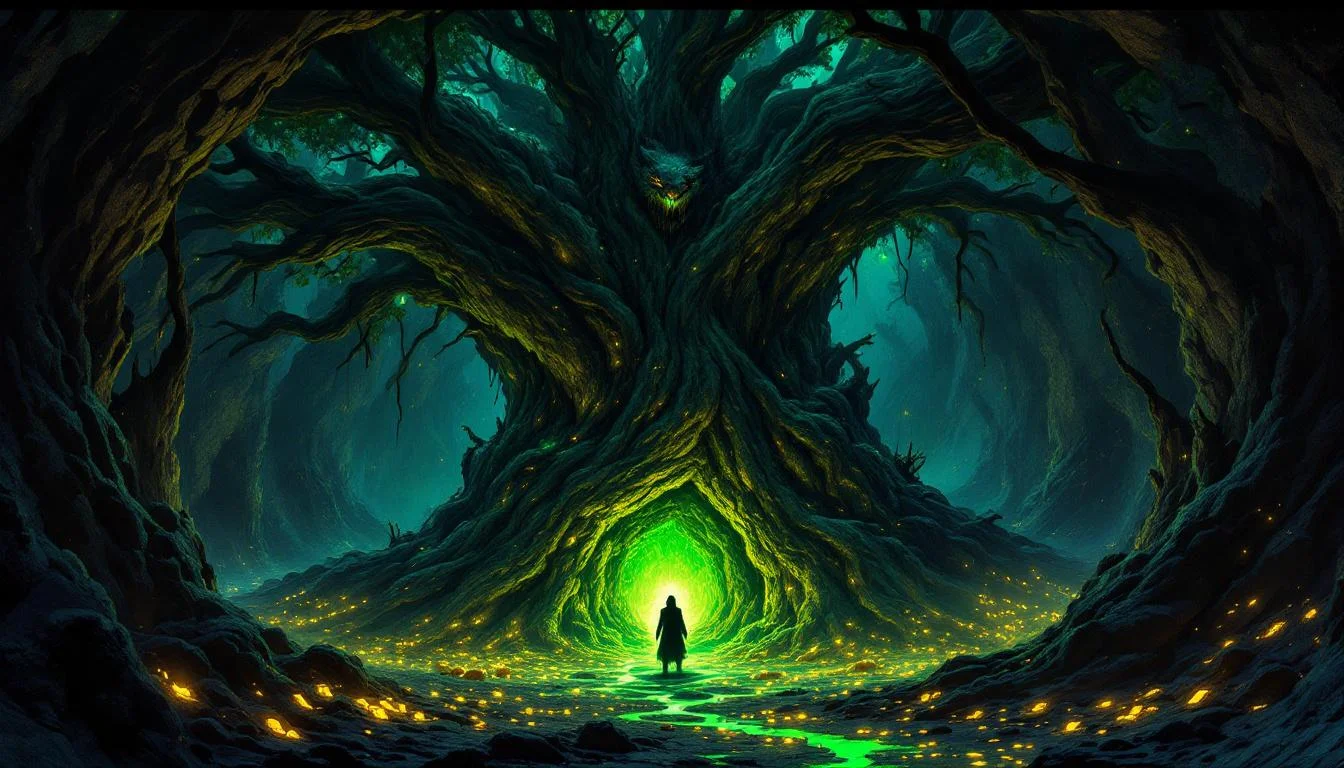
There is a river you cannot ford. It does not flow with water. It burns. The flames rise from its surface in columns of black smoke, and the stench carries for miles — a reek of sulfur and rot that gives the river its name. On this side stands the world of the living, where rye grows and dogs bark and people bury their dead facing east. On the far side is the country no traveler has ever described firsthand.
Between the two banks, a bridge.
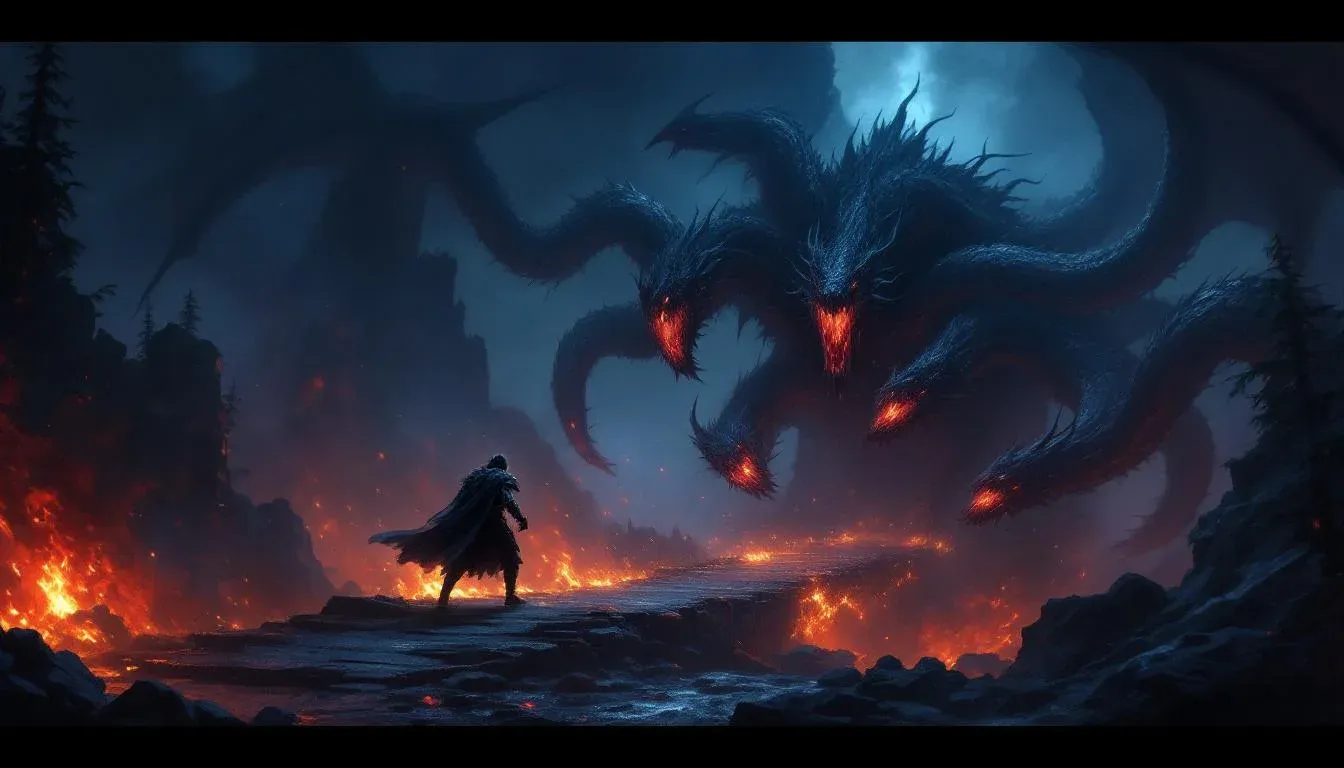
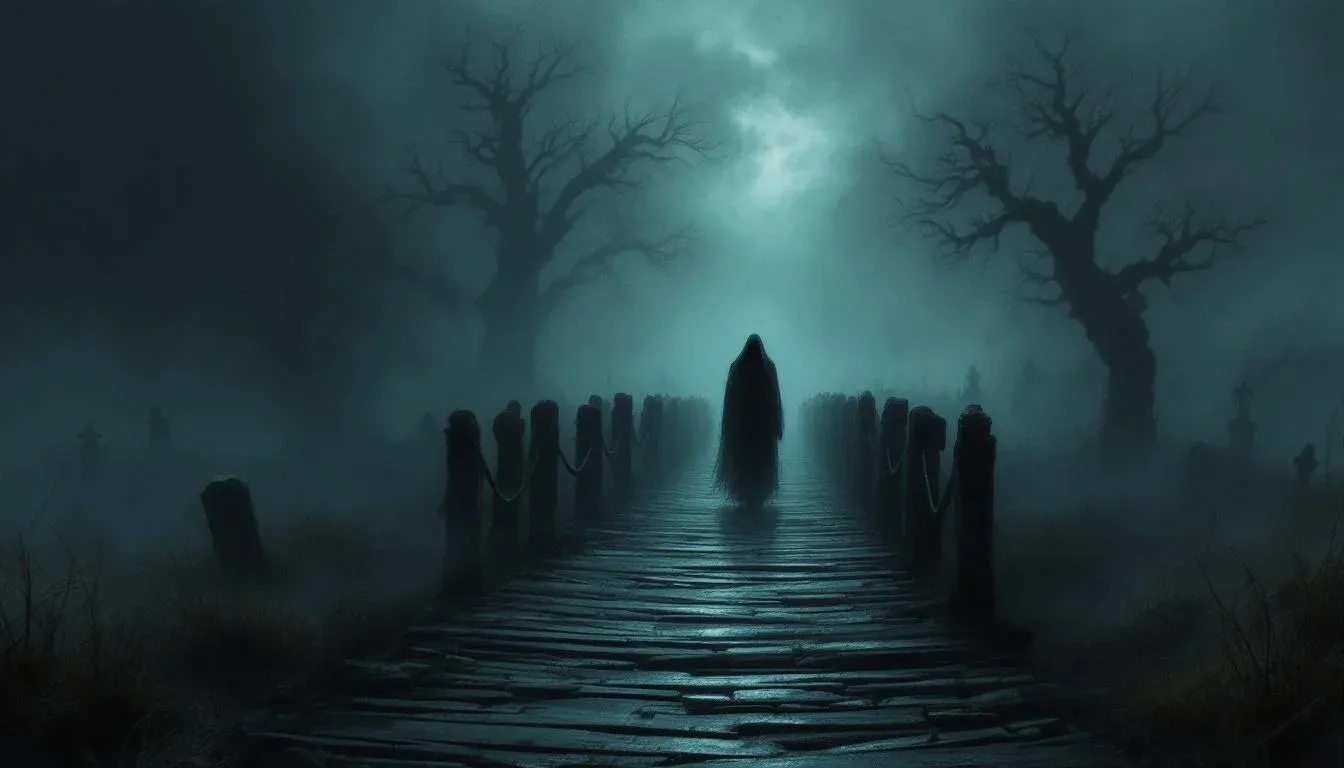
It is narrow. It glows with the heat rising from the burning current below. It is made from the wood of the kalina tree — the guelder-rose, whose clusters of berries turn the color of fresh blood every autumn. The bridge sags and creaks. Some souls cross it steadily. Others slip and fall into the fire. And at the far end, planted on the bank of the dead like a tollkeeper who has never once let anyone pass for free, a creature waits. It has more heads than it needs. It has been there since before the first funeral.
This is the Kalinov Bridge over the river Smorodina, and it is the most important piece of geography in Slavic cosmology that is not a world unto itself.
The River That Burns
The Smorodina River is the border. Every cosmology needs one — a line drawn between here and there, between the quick and the dead, between the world you know and the world you fear. The Greeks had the Styx. The Norse had Gjoll, the river beneath Helheim's gate. The Slavs had the Smorodina, and theirs was on fire.
The name comes from the Old Russian smrad — stench, reek, foulness. The Smorodina is "the Stinking One," and the stink is the stink of burning. One bylina describes it in terms that leave nothing to imagination: "The melting river is ferocious, a fierce river, the angriest one of all. Its first trickle is like a fire, another one is a spark falling, and because of the third one, the smoke is coming down in columns." This is not a river you wade across with your boots held above your head. This is a river that ends you.
In some versions of the tradition, the Smorodina is not fire but foul black water — thick, stagnant, reeking of decay. The two descriptions are not necessarily contradictory. Fire and rot are both aspects of destruction, both ways the visible world dissolves things that have finished being alive. What matters is the function: the Smorodina is the boundary between Yav and Nav, between the manifest world and the realm of the dead. It cannot be swum. It cannot be waded. It cannot be gone around. Every soul that leaves the body must eventually reach its banks and face the question of how to get across.
The answer, always, is the bridge.
The Bridge of Burning Wood
The Kalinov Bridge — Kalinov most in Russian — takes its name from the kalina, the guelder-rose (Viburnum opulus), a bush so deeply embedded in East Slavic culture that it appears in wedding songs, funeral laments, embroidery patterns, and the national symbolism of Ukraine. The kalina's berries are bitter and intensely red. They ripen in autumn, hanging in heavy clusters against leaves that have already turned crimson. The entire plant, by September, looks like it is bleeding.
The bridge itself, in the folktales, is narrow and treacherous. It glows from the heat of the Smorodina below. It bends and sways. In some tellings it is barely wide enough for a single person to cross; in others it is wide enough for a horseman, but only just. The details shift from story to story, but the essential character remains: this is a crossing that tests you. The righteous cross. The wicked fall. The bridge is not merely a road — it is a judgment.
The phrase pereyti Kalinov most — "to cross the Kalinov Bridge" — became a Russian euphemism for dying. It entered the language the same way "crossing the Styx" entered English, except the Slavic version carried a particular dread that the Greek one did not. Charon's ferry on the Styx was dark and silent, a ride in a boat across still water. The Kalinov Bridge was narrow wood over a screaming inferno, and something was waiting at the other end.
Chudo-Yudo: The Thing at the Far End
The guardian of the Kalinov Bridge goes by many names, but the most common in Russian fairy tales is Chudo-Yudo. Chudo means "wonder" or "marvel." Yudo has no clear etymology — some scholars connect it to an old word for giant or whale, others treat it as a rhyming intensifier. The compound means something like "the wonder-beast," appropriately vague for a creature that refuses to hold a single shape.
Chudo-Yudo is most often described as a many-headed dragon — a zmey with six, nine, or twelve heads depending on how far into the story you are. He can ride a horse. He can speak. He can regenerate severed heads overnight, growing them back thicker than before. In some variants he is related to Koschei the Deathless or is a son of Baba Yaga. In others he is simply native to the bridge the way a troll is native to its arch, something that has always guarded the crossing because guarding the crossing is what it does.
Every boundary in mythology needs a keeper. The Greeks had Cerberus. The Norse had the giantess Modgud on the Gjoll bridge. The Slavs had Chudo-Yudo, and his function was the same: to ensure that the border between the living and the dead was not crossed lightly, not crossed by anyone who had not earned the passage or been forced into it by death itself.
The difference is that the Slavic guardian could be fought.
The Battle on the Kalinov Bridge
The most famous story set on the Kalinov Bridge is the fairy tale "Ivan and Chudo-Yudo," recorded in dozens of variants across Russia, Belarus, and Ukraine. The skeleton is always the same.
Three brothers set out to fight Chudo-Yudo, who has been ravaging the land of the living. They make camp by the Smorodina. Each night, one brother takes the watch on the bridge.
The first two brothers fall asleep. Only Ivan — the youngest, the one nobody expects anything from — stays awake and fights. The first night, Chudo-Yudo comes with six heads. Ivan cuts them off. The second night, nine. Ivan cuts them off again. The third night, twelve heads, and this time the battle nearly kills him.
Ivan is driven into the ground up to his knees. His sword breaks. He throws his boot at the hut where his brothers sleep, finally waking them. Together they cut off the creature's fire-breathing finger — the source of his regeneration — and hurl his body into the Smorodina.
The tale does not end there. Chudo-Yudo's wife and mother-in-law pursue the brothers with shapeshifting ambushes: transforming into a well of cool water, a garden of ripe apples, a soft meadow, each temptation designed to destroy the heroes when they stop to rest. Ivan sees through every trick. He cuts each enchantment with his sword, and black blood pours from the wound.
Three nights. Three escalating battles. Three temptations on the road home. The Kalinov Bridge is the threshold, and Ivan's combat on it is a rite of passage — a young man crossing the boundary between ordinary life and something harder, tested by fire, and returning transformed.
Bridges of the Dead: Funeral Rites
The Kalinov Bridge was not only a folktale device. It penetrated actual funeral practice.
The East Slavs carried their dead to the grave along paths that often included a physical bridge or a symbolic one. In some regions, logs were laid across ditches on the path to the cemetery, forming crude bridges that the funeral procession crossed on foot. After the coffin had passed, the logs were sometimes removed or burned, severing the connection between the living and the dead so the spirit would not find its way back.
In parts of Belarus, mourners poured water on the ground beside the grave, saying they were watering Veles's meadow — preparing the underworld pastures where the dead would graze like cattle under the shepherd-god's care. The journey from the house to the grave was understood as a miniature version of the soul's journey to the Smorodina. Every funeral was a re-enactment.
Among Ukrainians, the fingernails of the deceased were carefully trimmed and placed upon their chest, for it was believed the dead would need them to construct a bridge in the other world. The passage to the afterlife was not a gift — it was a labor, and the dead arrived at the far bank with only what the living had thought to send with them.
The forty-day mourning period observed across the East Slavic world also connects to the bridge. The soul lingered in the visible world for forty days after death — sometimes as a bird, sometimes as a presence felt near the stove. On the fortieth day, the soul departed for good, following the flow of rivers to the Smorodina and crossing the Kalinov Bridge into Nav. The commemorative feast held on that day — the sorokoviny — was both a farewell and a practical measure: the family gathered to ensure the soul had been properly provisioned for the crossing and would not return, confused and hungry, to trouble the living.
The Wedding Bridge
The Kalinov Bridge appeared in an unexpected context: weddings.
In traditional Russian and Ukrainian wedding laments — songs performed by the bride and her female relatives before the ceremony — the bride described herself as crossing a bridge from one life to another. She was leaving her father's house, her mother's protection, the spirits of her family's hearth. She was entering a strange household with unfamiliar guardians. The wedding was a kind of death — the death of the maiden, the birth of the wife — and the songs made the parallel explicit.
The bride wept. This was not optional. Ritual weeping was a required element of the East Slavic wedding, and the laments drew directly on funeral imagery. She addressed her departed relatives, asking them to bless the crossing. She described the journey to her husband's house as a journey over water, over fire, over a bridge that swayed beneath her feet.
The Slavs lived inside a cosmology where every major transition — birth, marriage, death — was a crossing from one state to another, and every crossing required a bridge. The Kalinov Bridge was the archetype. It burned beneath the dead. It burned beneath the bride. The fire was the same fire: the fire of transformation, the fire that separates what you were from what you are about to become.
Styx, Bifrost, Chinvat: A Family of Crossings
The Kalinov Bridge belongs to a family. Across Indo-European mythology, the bridge between worlds recurs with a consistency that suggests a shared ancestor deep in prehistory.
The Norse Bifrost burned with fire and was guarded by Heimdall at its far end. At Ragnarok it would shatter. The Greek Styx had Charon demanding an obol from every shade. The Zoroastrian Chinvat Bridge widened for the righteous and narrowed to a knife-edge for the wicked. The Slavic bridge shares elements with all three — the fire of Bifrost, the judgment of Chinvat, the provision-for-the-dead logic of the Styx. The Slavs did not place coins in the mouths of their dead, but they placed food in the coffin, clothes on the body, trimmed nails on the chest. The dead needed provisions for the journey, regardless of whether that journey involved a boat or a bridge.
Whether these traditions influenced each other or inherited the same motif from a common Proto-Indo-European source remains debated. What is not debatable is the pattern: a narrow crossing over a terrible gap, a guardian who did not let everyone pass, and fire — always fire — below.
The Kalina: Blood on the Branch
The guelder-rose deserves its own attention, because the Slavs did not name their bridge after it by accident.
The kalina grows wild along water — which already connects it to the liminal, to boundary places, to the edges of things. Its white flowers bloom in spring, and by late summer they have given way to berries that turn a red so deep it is almost black. The berries are bitter. They pucker the mouth. They were used in folk medicine for coughs and fevers, but they were never pleasant to eat. They were endured, the way the crossing was endured.
To build the bridge to the underworld from kalina wood is to say something specific about the nature of that crossing. It is red. It is bitter. It is beautiful in the way that only final things are beautiful. The bridge is not made of stone or iron — materials of permanence. It is made of living wood from a tree that bleeds red every autumn and stands bare every winter. The Kalinov Bridge is a thing that is always in the process of dying, built over a river that is always in the process of burning. The entire image is one of transformation through destruction: the oldest idea in Slavic cosmology, the engine that drives the cycle of the three worlds.
What the Bridge Means
The Kalinov Bridge is not a place you can find on a map. The Slavic tradition left behind no scripture — only fragments carried in songs, fairy tales, and the rituals performed at gravesides by people who understood their cosmology without ever writing it down.
But the bridge encodes something true. There is a boundary. It burns. The crossing is narrow. Something guards it. You cannot go around.
Ivan on the Kalinov Bridge, driven into the earth up to his knees, his sword broken, calling for help in the dark — he is every person who has ever stood at the boundary of the unknown and wondered whether they had the strength to cross.
The Slavs built their answer from kalina wood and set it over fire. The berries were red. The crossing was bitter. On the far side, something waited that had more heads than it needed and all the time in the world.
You crossed anyway. That was the point.