A man dies in a village somewhere east of the Elbe, sometime before the priests arrive. His family does not ask whether he was good or bad. They do not weigh his deeds against a feather or consult a book of judgment. They open a window so his soul can leave the house. They set out water and bread on the sill. They watch the sky for birds.
For forty days, they believe, he is still here — drifting through the places he knew in life, lingering at the threshold, drinking the water they leave out, warming himself by the fire they keep burning. He is dead, but he has not yet gone anywhere. The journey takes time. The Slavic afterlife was not a destination you reached the moment your heart stopped. It was a road you walked, and where you ended up depended less on how you lived than on how you died.
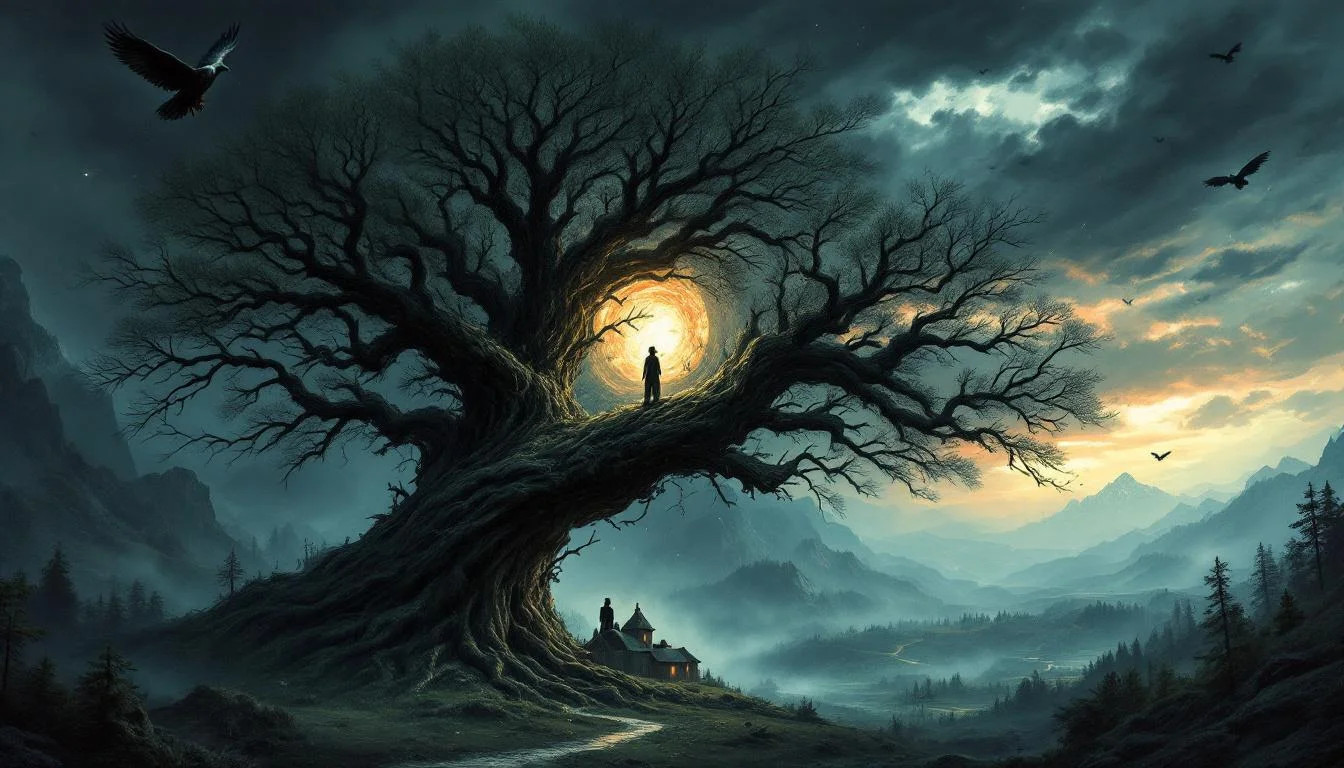
There was no heaven. There was no hell. There was Nav — the world below, the dark mirror of the living world — and there was Iriy, a green land beyond the edge of the sky where birds migrate in autumn and souls rest after the pyre burns out. Between here and there lay a river that stank of fire and a bridge that glowed red-hot, and on the far side, a god with a serpent's patience waited to receive you.
This is what the Slavs believed. Not all of them, and not all at once, and never written down in a single holy book. But the bones of it stayed consistent from the Baltic to the Balkans: death was not an ending, the dead were not gone, and the living owed them dinner.
Nav: The World Beneath
At the center of Slavic cosmology stood the Three Worlds — Prav above, Yav in the middle, Nav below. Yav was the visible world, the one you could touch and plow and bleed in. Nav was its shadow. The word itself comes from the Old Slavic navь, meaning simply "the dead."
Nav was not punishment. That distinction matters. There was no moral sorting, no weighing of souls against a standard of righteousness. Nav was where the dead went because that is where the dead belonged. It existed below the roots of the World Tree, separated from the living world by the river Smorodina — a waterway that burned with fire and stank so badly that its name literally means "stench." The only crossing was the Kalinov Bridge, a structure described in folk tales as red-hot, sometimes guarded by the three-headed dragon Zmey Gorynych.
The geography of Nav was not fixed across all Slavic traditions, but certain details recur. Some Eastern Slavic folk beliefs describe it as an endless green pasture — a meadow where souls wandered like cattle grazing. Others speak of swamps, dark forests, underground caves. Ruthenian folklore placed Veles at the center of Nav, sitting on a golden throne at the base of the Cosmic Tree, surrounded by black water, ruling the dead the way a wealthy farmer rules his herd.
This was not a place of torment. The dead in Nav existed. They continued. They could be reached, spoken to, fed — and they could reach back.
Iriy: The Paradise of Birds and Souls
But Nav was not the only destination. Alongside it — or perhaps above it, or at the far edge of the sky, depending on which village you asked — there existed a place called Iriy. Also known as Vyrai or Vyriy, this was the Slavic paradise, and its description carried a strange, beautiful logic: Iriy was where the birds went in winter.
The ancient Slavs watched the storks and swallows vanish each autumn and return each spring, and they concluded that the birds flew to a warm green land beyond the horizon — a land of eternal summer, with orchards that never stopped bearing fruit and rivers of clean water. That same land, they believed, was where the souls of the dead could go.
The relationship between Nav and Iriy is not straightforward, and scholars have debated it for decades. Some researchers treat them as two names for the same place — the underworld reimagined as a meadow or garden depending on the regional tradition. Others argue that Iriy represented a separate, older layer of belief: a solar paradise connected to sky and birds, while Nav was the chthonic underworld connected to earth and serpents. The two may have coexisted in the same communities, applied to different kinds of dead, or merged over centuries of retelling.
What is clear is that both traditions agreed on one thing: the dead did not vanish. They went somewhere real, somewhere that had geography and weather and rules.
Clean Death, Unclean Death: The Division That Mattered
If the Slavic afterlife had no moral judgment — no weighing of sins — then what determined a soul's fate? The answer was not virtue. It was the manner of death itself.
Slavic folk belief across the Balkans, Eastern Europe, and the Baltic drew a hard line between "clean" and "unclean" death. A clean death was one that came at the right time, in the right way: old age, illness that ran its course, death in battle, death after proper farewell. An unclean death was everything else — and the list was long.
Suicides. Drowning victims. Murder victims. Women who died in childbirth. Children who died unbaptized (this category grew after Christianization but likely had a pre-Christian equivalent involving unnamed infants). People struck by lightning. People who died during liminal calendar periods. Suspected sorcerers. Anyone whose body was not given proper funeral rites.
The clean dead crossed the Smorodina, passed over the Kalinov Bridge, and entered Nav or Iriy as proper ancestors. They became roditelji — the ancestral dead who watched over the family, who could be called upon for help, who returned at the appointed festival days to eat with the living.
The unclean dead — the navki, the mertviaki, the založnyje pokojniki — could not cross. They were trapped between worlds, stuck in Yav among the living, haunting the places where they died. These became the Nav Spirits of folklore: the rusalki who drowned travelers in rivers, the upyri who fed on blood, the mavki who lured men into forest bogs. The entire taxonomy of Slavic undead — which is vast and varied and deeply specific to local tradition — grows from this single root idea: if your death was wrong, your soul got stuck.
The unclean dead are people who died before their time was finished, or whose death was wrong in some way that the community recognized. These spirits cannot enter the ancestral realm and are trapped between worlds. In practice, their bodies were not always buried in consecrated cemetery ground but at liminal locations: crossroads, field margins, riverbanks, swamps.
This is why funeral rites mattered so much. A body handled correctly — cremated at dusk so the soul could follow the setting sun, or buried with grave goods and the proper laments — produced a clean ancestor. A body mishandled produced a revenant. The stakes of the funeral were not theological. They were practical. Get it wrong, and the dead person would come back, and not in a way anyone wanted.
Veles: The Shepherd of the Dead
Every afterlife needs a lord, and in the Slavic underworld, that role belonged to Veles — the god of cattle, wealth, the earth, magic, and the dead. The connection between cattle and the dead was not accidental. The Proto-Slavic word for cattle (skotъ) was also associated with wealth and property, and in the oldest layer of belief, souls in Nav were imagined as Veles's herd — grazing the green pastures of the underworld the way living cattle grazed the fields of Yav.
Veles was not a punisher. He did not torture the damned or sort the righteous. He was a keeper — a shepherd who gathered souls the way he gathered livestock, who sat at the roots of the World Tree and maintained the balance between the living world above and the dead world below. His eternal rival was Perun, the thunder god who ruled the crown of the tree, and their cosmic struggle — serpent against eagle, underworld against sky — was the engine that drove the seasons, the storms, and the cycle of death and renewal.
In some South Slavic and East Slavic folk traditions, Veles was also called the "judge of the dead," though this title may reflect later Christian influence layered onto an older, less juridical role. The pagan Veles did not judge. He received. He kept. He made sure the dead stayed where they belonged — and that the boundary between his world and Yav held firm.
When it did not hold firm, the unclean dead slipped through, and the living had problems. That was when you needed the right rituals.
The Forty Days: When the Soul Lingers
Death in the Slavic world was not instant departure. It was a slow leave-taking. For forty days after death — a number that recurs across Eastern Slavic, South Slavic, and Baltic traditions — the soul remained in Yav, wandering the places it had known in life.
During this period, the soul was believed to take the form of a bird. Families opened windows and doors so it could come and go freely. They left water on the windowsill for washing, bread for eating, a towel for drying. They kept a candle burning. In some regions, they set an extra place at the table. The dead person was still a guest in the house — an invisible one, but present, and hungry.
On the fortieth day, the soul departed for good. The family held a commemorative meal — a pomynky — and the transition was complete. The dead person was no longer a lingering presence. They were an ancestor.
This forty-day structure predates Christianity in the region, though it was later absorbed into Orthodox practice, where the fortieth-day memorial service remains a cornerstone of mourning. The pagan original likely had less to do with theology and more to do with observable decay: forty days is roughly the time it takes for a body to decompose to bone in temperate climates. When the flesh was gone, the soul was gone.
Dziady and Radonitsa: Feeding the Dead
The Slavic afterlife was not a one-way door. The dead came back — not as hauntings, but as honored guests, invited at specific times of the year through rituals that survived Christianization so thoroughly that many are still practiced today.
The most widespread of these was Dziady (literally "grandfathers" or "forefathers"), a feast for the ancestral dead observed across Poland, Belarus, Ukraine, Lithuania, and parts of Russia. Depending on the region, Dziady took place two to four times a year — most commonly in spring (around the second Tuesday after Easter, called Radonitsa in East Slavic tradition) and in autumn (the night of October 31 to November 1, later absorbed into All Saints' Day).
The ritual was specific and practical. Families prepared a feast — kutia (a sweet grain pudding made with wheat berries and honey), bread, eggs, meat, mead or vodka — and set a place at the table for the dead. The windows were opened. The bathhouse was heated so the dead could wash. Food was left on graves. In some Belarusian traditions, families poured vodka directly onto the grave earth and spoke to the dead by name, updating them on family news, asking for blessings on the crops, apologizing for any neglect.
The logic was transactional and unsentimental. The dead had power — over fertility, weather, livestock health, family fortune — and they needed to be kept happy. A neglected ancestor was a dangerous ancestor. The offerings were not symbolic gestures of grief. They were payments. The dead fed on the essence of the food, on the steam rising from the kutia, on the smell of the honey mead. In return, they kept the harvests coming and the children healthy.
In some regions, beggars were given food at Dziady celebrations and asked to pray for the dead. Scholars have interpreted this as a form of indirect feeding: the beggar eats on behalf of the ancestor, and the ancestor is satisfied. The line between charity and ritual obligation was deliberately blurred.
Cremation, Burial, and the Question of Fire
Before Christianization forced a shift toward inhumation, the dominant Slavic funeral practice was cremation. The body was placed on a pyre — sometimes in a boat, among the river-dwelling Slavs — and burned at dusk. The timing was deliberate: the setting sun was believed to be traveling toward the underworld, and the soul, released by fire, would follow the sun's path to Nav.
The fire itself was essential. A strong blaze helped the soul reach its destination. A weak or absent fire left the soul stranded. The etymology of the word vampire — a term that originated in Slavic languages — may trace back to a Proto-Indo-European compound meaning "without fire," referring to a corpse that was left unburned and therefore could not properly die. The vampire, in its oldest Slavic form, was not a gothic aristocrat in a cape. It was a funeral gone wrong.
After Christianization, cremation gave way to burial, but many of the older customs persisted in modified form. Grave goods were placed with the body. Coins were put in the mouth or hands — an echo of the Greek obol for Charon, though whether the Slavs borrowed this practice or developed it independently is debated. Food and drink were left at the graveside. The dead person was dressed in their best clothing and oriented with their feet toward the west — toward the setting sun, toward the direction of departure.
The Living and the Dead: A Porous Border
What makes the Slavic afterlife distinctive — and what separates it most sharply from the Greek and Norse traditions it is sometimes compared to — is the permeability of the border between living and dead.
In Greek mythology, the underworld was a destination. You crossed the Styx, you reached Hades, and with rare heroic exceptions, you stayed. The Norse had Valhalla for the battle-slain and Hel for the rest, and while the dead might ride out at Ragnarok, the boundary was generally firm. The Slavic model was different. The dead came and went. They visited at Dziady. They lingered for forty days after death. They appeared as birds in the yard, as dreams in the night, as cold drafts in the bathhouse. The unclean dead wandered freely, haunting crossroads and riverbanks. Even the clean dead, the proper ancestors, were expected to take an active interest in family affairs — blessing the fields, warning of danger, punishing disrespect.
This was not ancestor worship in the abstract, contemplative sense. It was ancestor management. The dead were a constituency that had to be served — fed, remembered, spoken to, appeased. Neglect them and they turned hostile. Honor them and they guaranteed prosperity. The relationship between the living and the dead was continuous, reciprocal, and fundamentally practical.
The Slavic afterlife, in the end, was not about the fate of the soul. It was about the obligations of the living. Where do Slavs go when they die? They go to Nav, to the green pastures under the roots of the World Tree, to the warm garden of Iriy where the birds fly in winter. But they also come back — at the table, at the grave, in the steam rising from the kutia — and they expect to be fed.