The other two bogatyrs fight with honor. Alyosha Popovich fights with whatever works.
He lies. He mocks. He prays for rain at tactically convenient moments. He tells a man's wife her husband is dead so he can marry her himself. He insults a dragon at a feast by comparing it to a cow that choked on slop. He is the youngest of the three great heroes of the Kievan byliny cycle, the son of a priest from Rostov, and by every account the most dangerous — not because he is the strongest, but because he is the one you cannot predict.
Where Ilya Muromets embodies the strength of the Russian land and Dobrynya Nikitich represents its educated nobility, Alyosha Popovich is something the byliny both celebrate and distrust: pure cunning. He is the hero who wins every fight and betrays every friend. The bogatyr the singers loved to perform and never quite loved. The youngest brother who gets the job done and leaves a mess behind him.
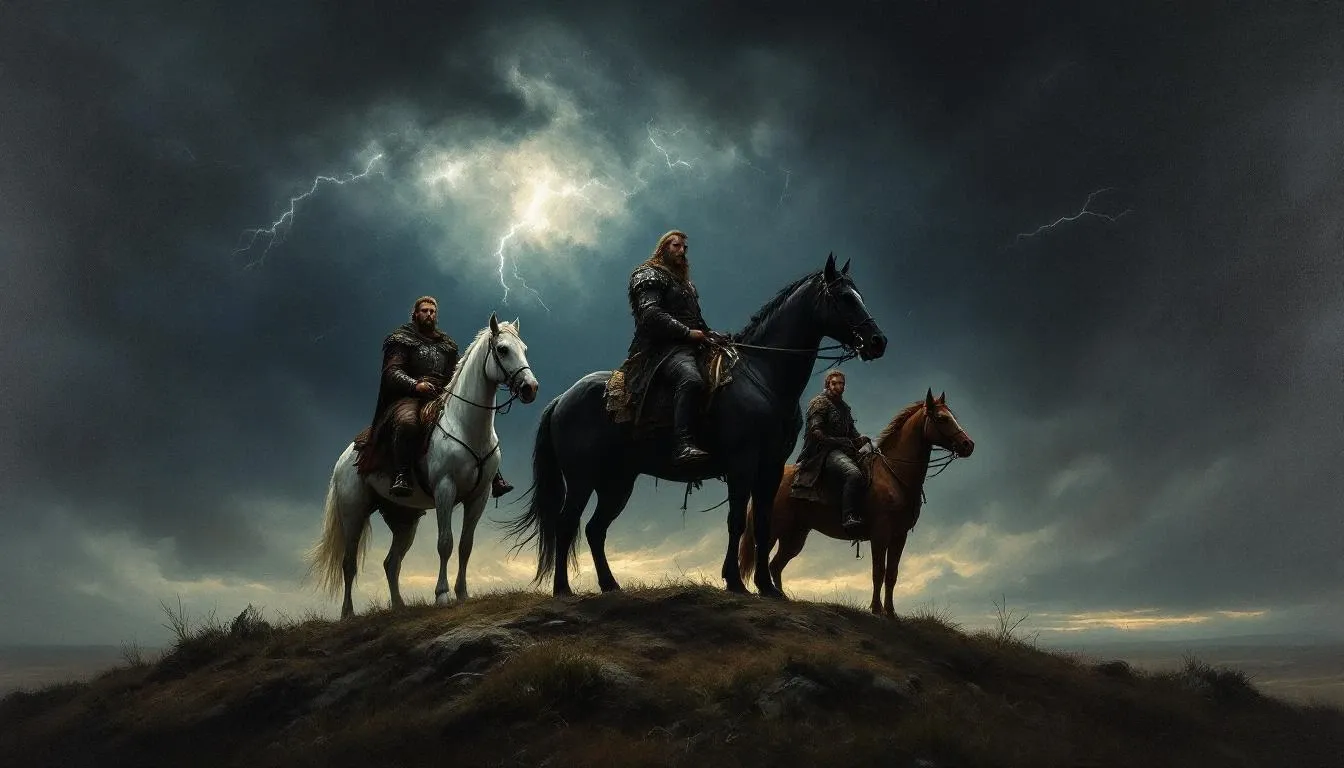
Viktor Vasnetsov knew exactly where to put him. In the 1898 painting Bogatyrs — the canvas that took eighteen years to complete and now hangs in the Tretyakov Gallery in Moscow — Alyosha sits on the right. He is smaller than the other two. His armor is lighter. He carries a bow, not a sword or a spear. His eyes are not scanning the horizon for enemies. They are glancing sideways, watching something the other two have not noticed. And there is a gusli strapped to his saddle, because Alyosha is also a musician, because of course he is — a trickster needs every tool.
The painting tells the truth the byliny have been telling for a thousand years. The three bogatyrs are not three copies of the same man. They are three answers to the same question — how do you defend a land? — and Alyosha's answer is the most uncomfortable one: by any means necessary.
The Priest's Son
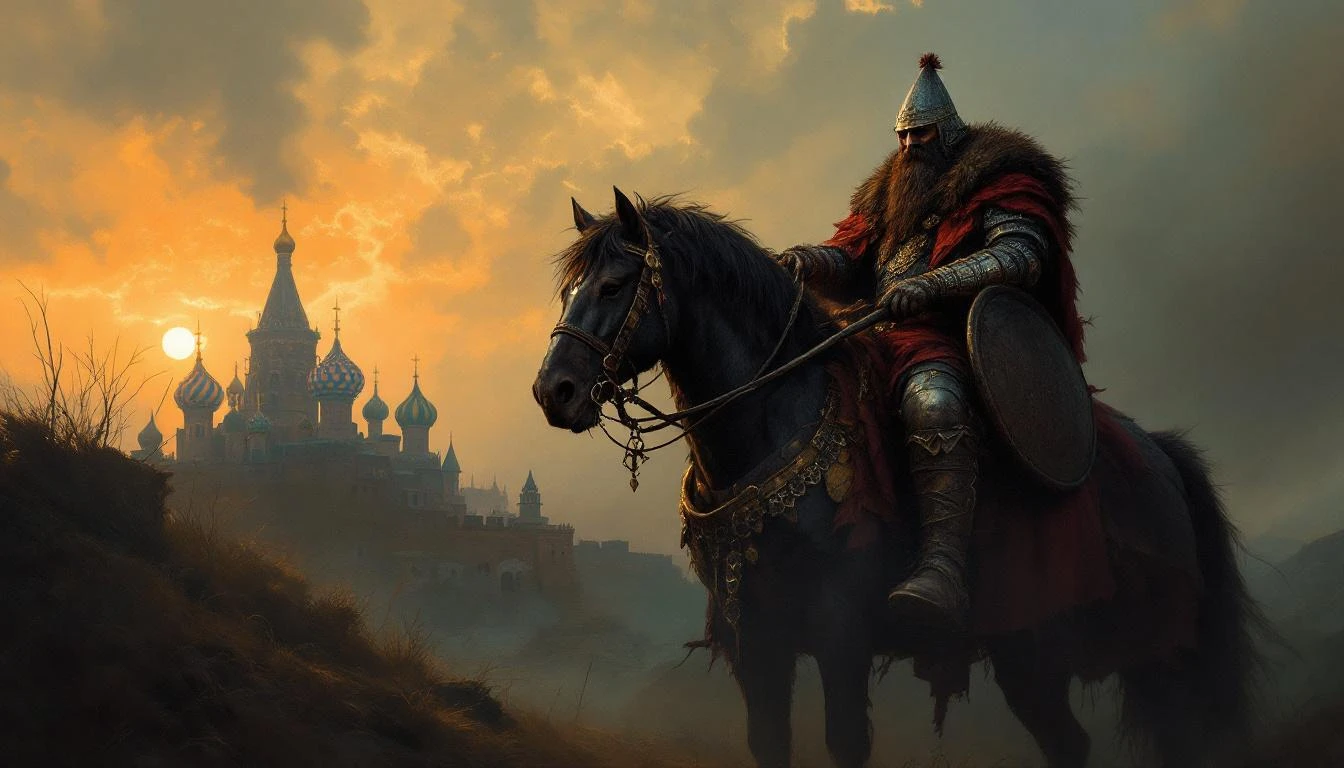
His name tells you who he is. Popovich means "priest's son" — from pop, the old Russian word for an Orthodox priest. His father is Levontiy, sometimes called Fyodor, a cathedral priest in the city of Rostov. This is not noble blood like Dobrynya's, and it is not peasant blood like Ilya's. It is something in between — the clerical class, educated men who could read Church Slavonic and knew their Scripture, but who held no land and commanded no armies.
The byliny use this origin as an explanation for everything Alyosha does. A priest's son would be literate. He would know rhetoric — the art of persuasion, of argument, of talking his way out of trouble. He would have grown up watching his father navigate the politics of the church, managing bishops and princes and wealthy parishioners, learning that a well-placed word often accomplishes more than a well-aimed sword.
But a priest's son would also carry a social stigma. In the rigid hierarchy of medieval Rus, the clergy occupied a strange position — respected for their learning, mistrusted for their ambitions, never quite belonging to the warrior aristocracy or the honest peasantry. Alyosha arrives at Prince Vladimir's court in Kyiv as an outsider. He has neither Ilya's moral authority nor Dobrynya's noble birth. What he has is his tongue, his wits, and an absolute refusal to play by anyone else's rules.
The byliny describe him as handsome, young, and bold — smely and khrabry, brave and daring. But they always add another word: khitry. Cunning. Not a compliment in Old Russian. Not exactly an insult either. A warning.
The Feast and the Dragon
The central bylina of Alyosha's cycle — his battle with Tugarin Zmeyevich — begins not on a battlefield but at a dinner table. And the weapon he reaches for first is not a sword but an insult.
Alyosha rides to Kyiv with his companion Yekim Ivanovich, a loyal retainer who serves as his squire and occasional voice of reason. They arrive at the court of Prince Vladimir and are seated at the feast. The hall is full of warriors, boyars, and courtiers. And at the place of honor, closer to the prince than any guest should sit, is Tugarin Zmeyevich.
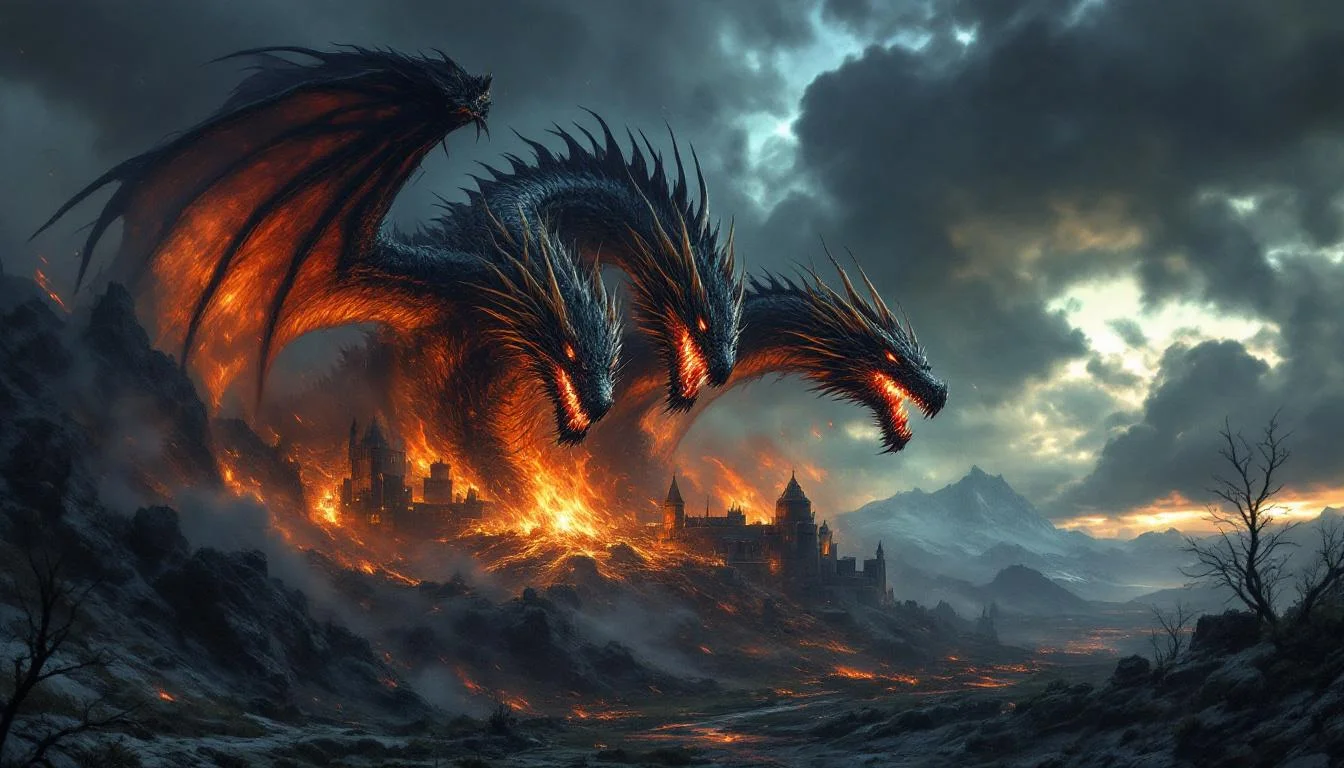
Tugarin is enormous. Some byliny describe him as a serpent in human form, others as a man with dragon blood, still others as a Tatar warrior so monstrous he might as well be a dragon. His patronymic — Zmeyevich, "son of the serpent" — marks him as something inhuman. He sprawls across the table. He grabs an entire roasted swan and swallows it in a single gulp. He tears whole loaves of bread apart with his hands. He sits so close to Princess Apraksiya, Vladimir's wife, that the byliny leave very little to the imagination about what is happening beneath the table.
Vladimir says nothing. The prince of Kyiv, the lord of all Rus, sits and watches a monster grope his wife and eat his food, and does nothing, because Tugarin is too powerful, too terrifying, too dangerous to confront.
Alyosha is not too anything.
He watches the spectacle and then speaks — loudly, so the entire hall can hear. He says his father, the priest Levontiy of Rostov, once had a cow. A greedy cow. The cow ate and ate and ate until it choked on the dregs and died. And that, Alyosha says, looking directly at Tugarin, is what happens to beasts that do not know when to stop.
The hall goes silent. Tugarin's face darkens. He picks up a knife — in some versions a dagger, in others the carving knife from the table — and hurls it at Alyosha's head. Yekim catches it in midair.
The challenge is issued. Tugarin and Alyosha will meet the next morning in the open field.
Myth Callout: The figure of Tugarin Zmeyevich likely encodes a historical memory. Scholars have connected the name "Tugarin" to the Polovtsian (Cuman) khan Tugorkan, who raided Kievan Rus in the late eleventh century and was killed in battle against Prince Vladimir Monomakh in 1096. The byliny transformed a steppe raider into a dragon-man — a common pattern in East Slavic folklore, where foreign invaders become serpents and monsters in the retelling. Tugarin sits at Vladimir's table as the Polovtsians once sat at the edges of the Kievan state — unwelcome, dangerous, and tolerated only because no one dared to challenge them.
The Battle That Was Not a Battle
The next morning reveals why Alyosha Popovich is not like the other bogatyrs.
Ilya Muromets would ride out and fight Tugarin head-on, overwhelming the creature with raw peasant strength. Dobrynya Nikitich would ride out and endure the fight for three days, refusing to yield until his skill and persistence wore the monster down. Alyosha rides out and cheats.
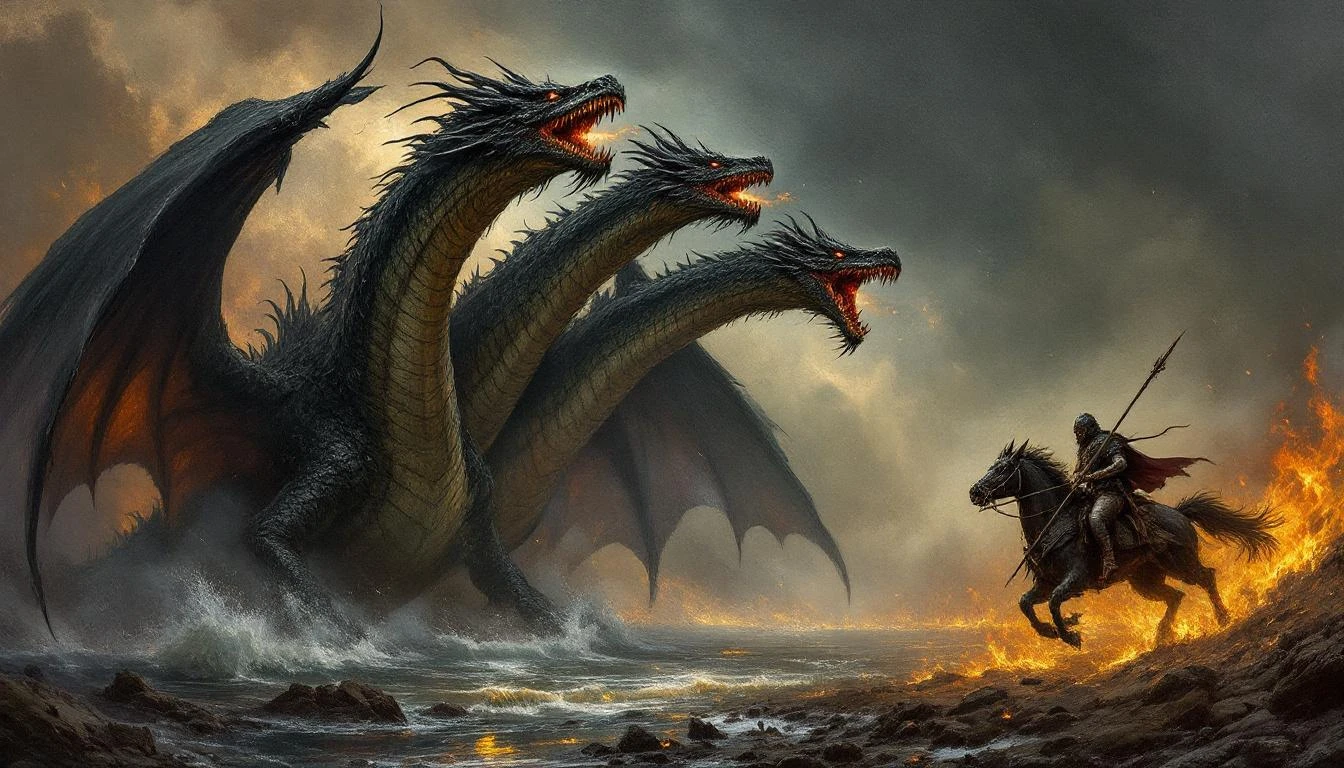
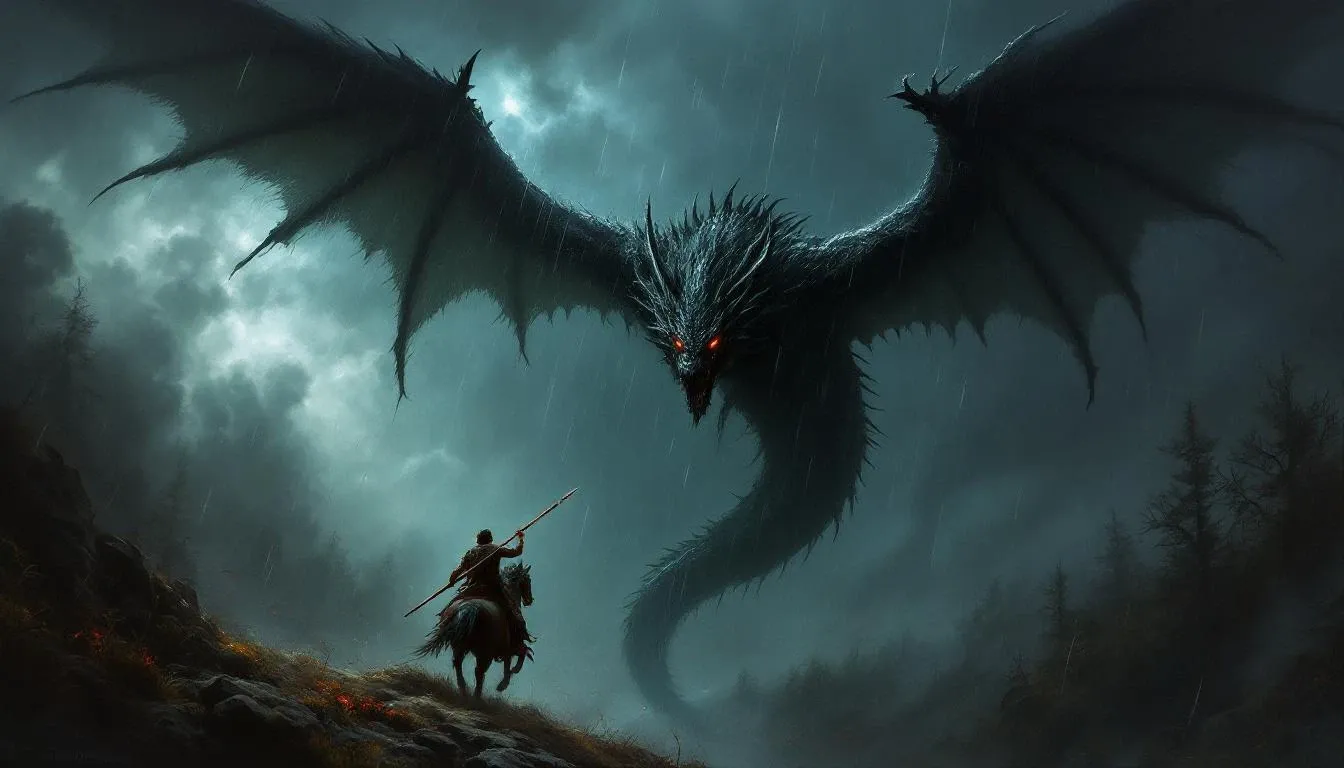
Tugarin arrives on the battlefield not on horseback but in the air. He has wings — paper wings, some versions specify, attached not to his body but to his horse, while other versions describe them as his own dragon-wings, fiery and vast. Either way, Tugarin flies. He circles above the field, raining fire from above, untouchable by sword or spear.
Alyosha does not charge. He does not brace for impact. He looks up at the flying monster and prays.
He prays to the Mother of God. He prays to the Savior. And his prayer is very specific: Send rain.
Rain comes. It soaks Tugarin's wings — whether paper or membrane, the water makes them heavy, useless. Tugarin crashes to the earth, grounded and furious, and now the fight is on level ground.
But even on level ground, Alyosha does not fight fair. In one version, he swaps clothes with a wandering pilgrim, approaching Tugarin in disguise so the monster does not recognize him. In another, he shouts at Tugarin to look behind him — There is a great host riding against you! — and when Tugarin turns his head, Alyosha strikes.
He takes Tugarin's head with a blow from a heavy walking staff — a palitsa — weighing ninety pood. The bogatyr who is supposed to be the weakest of the three, the one who fights with cunning rather than strength, swings a weapon that weighs over three thousand pounds. The byliny see no contradiction in this. Cunning does not mean weak. It means the strength is deployed differently — at the right moment, from the right angle, after the enemy has already been brought low by tricks, insults, and divinely summoned weather.
Alyosha cuts off Tugarin's head and rides back to Kyiv, throwing the head into the air and catching it on his spear, tossing it like a toy. He presents it to Prince Vladimir. The court celebrates. Alyosha has done what no other warrior dared — not by being braver or stronger, but by being cleverer and more ruthless.
The Wife He Stole
If the Tugarin bylina makes Alyosha a hero, the bylina called "Dobrynya and Alyosha" makes him something harder to admire.
Dobrynya Nikitich rides out on a long quest — some versions say six years, others twelve. Before he leaves, he tells his wife Nastasya Mikulishna to wait for him. If he does not return within the appointed time, she is free to marry another. He rides away, and the years begin to pass.
Alyosha Popovich arrives at Nastasya's door. He brings news: Dobrynya is dead. He says he saw the body in the open field — the bogatyr fallen, the ravens circling. There is no reason to wait any longer.
The news is false. Alyosha knows it is false. Dobrynya is alive, fighting somewhere beyond the borders. But Alyosha wants Nastasya, and a lie is faster than a courtship.
Under pressure from Prince Vladimir — who insists that a bogatyr's widow must remarry — Nastasya agrees to wed Alyosha. The wedding preparations begin. The feast is laid. The guests assemble.
And Dobrynya returns.
He arrives disguised as a gusli player, a wandering musician seeking admission to the wedding feast. He plays so beautifully that the entire hall weeps. Nastasya does not recognize him — he is dressed in rags, his face hidden — but something in the music undoes her. Then Dobrynya drops their wedding ring into her cup of wine, and she knows.
What happens next varies by the telling. In most versions, Dobrynya beats Alyosha severely — a thrashing the byliny present as entirely deserved. In some, Vladimir intervenes before Dobrynya can kill the younger bogatyr. In a few, Alyosha apologizes with the kind of cheerful shamelessness that defines his character: he acknowledges the lie, shrugs, and suggests they drink together instead of fighting.
The byliny do not exile Alyosha for this. They do not strip him of his status. He remains one of the three great bogatyrs, sitting in Vasnetsov's painting alongside the man whose wife he tried to steal. Because the byliny understand something about the world that fairy tales do not: you do not always get to choose your heroes. Sometimes the man who defends the land is also the man who lies to his friends. Sometimes cunning and dishonesty grow from the same root.
Source Note: The folklorist A.F. Gilferding noted in his 1871 Onega collection that singers treated the "Dobrynya and Alyosha" bylina with a particular tension. They admired Alyosha's cleverness in battle but condemned his behavior toward Dobrynya's wife. Several performers told Gilferding that Alyosha's nature was "like a knife — useful in the right hand, dangerous in the wrong one." This ambivalence — the hero who is also a scoundrel — runs through every bylina in his cycle.
The Three Who Are One
The logic of the three bogatyrs is not accidental. It is architectural.
Ilya Muromets is strength — the peasant who sat on a stove for thirty-three years and then rose to become the mightiest warrior in the land. He fights from the body. His weapon is his overwhelming physical power, and his virtue is loyalty to the land that raised him.
Dobrynya Nikitich is wisdom — the nobleman who fights dragons, plays the gusli, negotiates treaties, and endures three-day battles through sheer will. He fights from the heart. His weapon is his versatility, and his virtue is duty to the people he serves.
Alyosha Popovich is cunning — the priest's son who insults dragons at dinner, prays for tactical rainstorms, and steals his friend's wife with a well-crafted lie. He fights from the mind. His weapon is his intelligence, and his virtue — if it can be called that — is the willingness to do what the other two will not.
Together they form a complete warrior. Separately, each is incomplete. Ilya without cunning can be tricked. Dobrynya without strength can be overwhelmed. Alyosha without honor can become a villain. The byliny knew this. They never sent one bogatyr to do the work of three.
This tripartite structure echoes patterns found across Indo-European mythology — the division of society into warriors, priests, and farmers that the scholar Georges Dumezil identified in traditions from India to Scandinavia. But the Slavic version inverts expectations. The priest's son is not the holy man. He is the trickster. The peasant is not the simple laborer. He is the strongest defender. The nobleman is not the ruler. He is the servant. Each class is represented, but none behaves as its station would predict, and the byliny are richer for the disruption.
The Man Behind the Myth
Behind many bylina heroes, scholars have sought historical prototypes. Alyosha Popovich has one — or may have one — and the story of the real man is as violent as the legend.
The Nikon Chronicle, a sixteenth-century compilation of earlier Russian annals, records a warrior named Alexander Popovich — Oleshka Popovich in the diminutive — who served the princes of Rostov in the early thirteenth century. Alexander was a boyar, a member of the military aristocracy, renowned for his fighting skill and his service in the internecine wars between Russian princes.
He fought at the Battle of Lipitsa in 1216, one of the bloodiest conflicts of the princely feuds, where the forces of Novgorod and Smolensk defeated the armies of Vladimir-Suzdal. Alexander Popovich fought on the winning side and distinguished himself in combat.
Seven years later, in 1223, the Mongol armies of Subedei and Jebe swept across the steppe and met a combined force of Russian princes and Polovtsian allies at the Kalka River. It was a catastrophe. The Russian forces were routed, the princes captured, and the Mongol generals celebrated their victory by laying a wooden platform over the captured princes and feasting on top of them while the men suffocated beneath.
Alexander Popovich of Rostov died at the Kalka, along with seventy other named warriors. The chronicles record his death with the same matter-of-fact brutality they give to all the fallen: a name, a city of origin, a battle, and silence.
Whether the bylina hero inspired the chronicle warrior or the chronicle warrior inspired the bylina hero remains a question scholars have not settled. The direction of influence is unclear — chronicles sometimes borrowed from oral poetry, and oral poetry sometimes borrowed from chronicles. What is certain is that the name Popovich, the city of Rostov, and the association with a priest's family connect the two figures across eight centuries of retelling.
The Animated Afterlife
In 2004, Melnitsa Animation Studio released Alyosha Popovich i Tugarin Zmey, a feature-length animated film that reimagined the youngest bogatyr for a new generation. The film presented Alyosha as a bumbling, lovable young man from Rostov — more comic hero than epic warrior — accompanied by his girlfriend Lyubava, a talking horse named Julius, and a collection of misfit companions.
The film was a commercial success, and it launched the Tri Bogatyrya — Three Bogatyrs — franchise, which has since grown into one of the most profitable animated series in Russian cinema history, grossing over $135 million across more than a dozen films. Each of the original three films focused on one bogatyr: Alyosha in 2004, Dobrynya in 2006, Ilya in 2007. From the fourth film onward, all three appear together, united as a team in adventures that range from battling the Shamakhan Queen to traveling to Egypt.
The animated Alyosha is gentler than his bylina counterpart. The films soften his trickster edge, remove the womanizing, and replace his moral ambiguity with slapstick humor. The cow insult at the feast remains — it is too good a scene to cut — but the attempted theft of Dobrynya's wife does not survive the adaptation. The franchise needs its heroes likeable, and the real Alyosha Popovich is not always likeable.
But the core survives. He is still the one who fights with his brain. He is still the youngest, the smallest, the one who should not win but does. The animated films found what the byliny always knew: the trickster is the most entertaining hero, the one audiences want to watch, the one whose next move is never predictable.
Why the Trickster Matters
Every mythology needs its trickster. The Norse had Loki. The Greeks had Hermes and Odysseus. West Africa has Anansi. Native American traditions have Coyote. The trickster is the figure who breaks the rules that the other heroes uphold, who tests the boundaries of acceptable behavior, who shows the audience what happens when cleverness operates without moral restraint.
Alyosha Popovich is the Slavic trickster — but an unusually grounded one. He is not a god or a spirit. He is a man, a priest's son, a warrior who sits at a real prince's table in a real city. His tricks are human tricks — lies, disguises, well-timed prayers, tactical insults. He does not shapeshift or wield magic. He reads the room, finds the weakness, and exploits it.
The byliny keep him in the trio because they understand that strength and wisdom are not enough. Sometimes the enemy flies. Sometimes the enemy sits at your own table, eating your food, touching your wife, and no one dares to speak. Sometimes what the land needs is not a hero who fights fair but a hero who fights smart — a young man from Rostov with a sharp tongue, a bow instead of a sword, and a grin that means he has already figured out how to win.
The priest's son. The trickster. The youngest of three, and the one the byliny never quite trusted, and never stopped telling stories about.