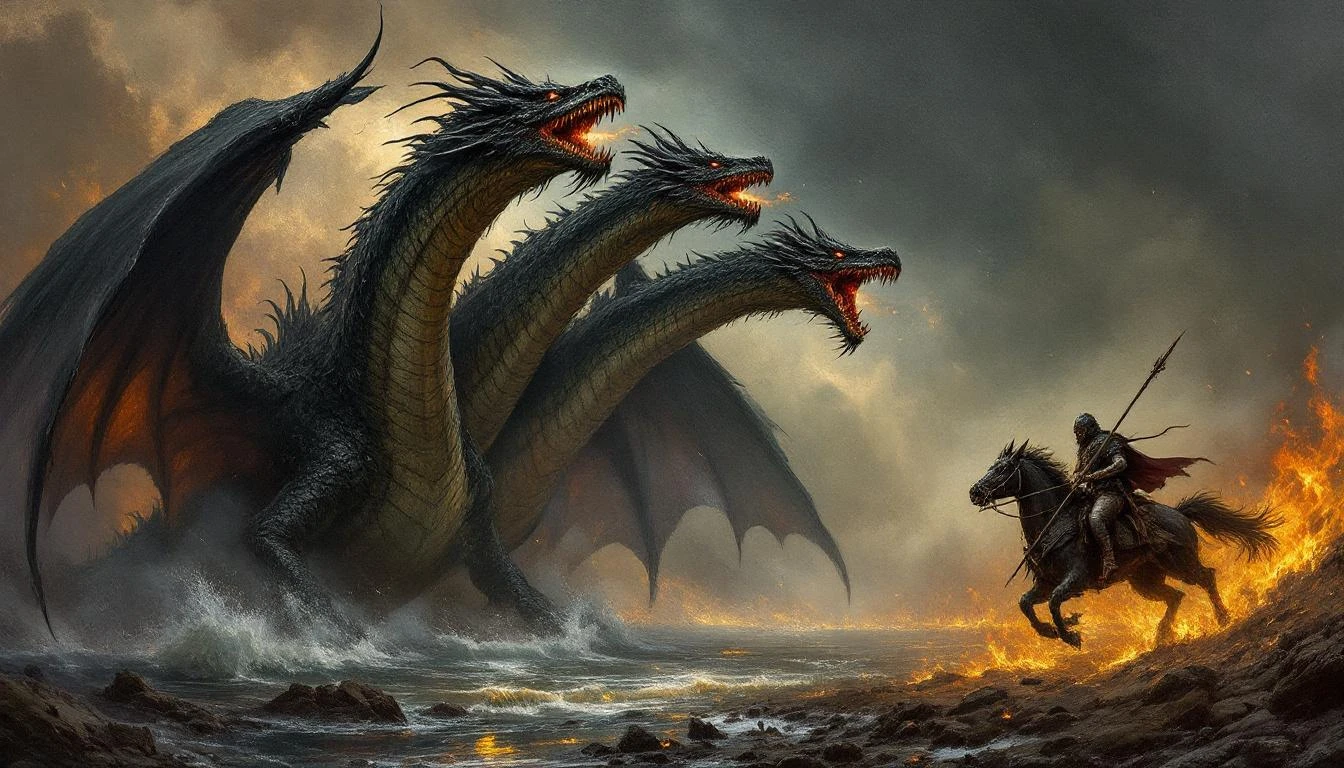
The fire comes from three mouths at once. Not one throat, not one pair of jaws — three. Each head thinks its own thoughts, speaks its own threats, and watches a different direction. You cannot sneak up on Zmey Gorynych. You cannot reason with him, either, though he will let you try. He enjoys that part.
Of all the creatures in Slavic folklore, the zmey stands apart. Not because he breathes fire — plenty of monsters do that. Not because he hoards treasure or terrorizes villages — that is standard dragon behavior worldwide. The zmey stands apart because he talks. He bargains. He seduces. He takes human form when it suits him and returns to his monstrous shape when the talking is done. In the world of East Slavic myth, the dragon is not a mindless beast waiting in a cave for a knight. He is a schemer, a politician, and occasionally a lover.
And Zmey Gorynych is the most famous of them all.
What the Name Actually Means
Let us start with the name, because it tells you more than most scholars admit.
Zmey (змей) is the masculine form of the common Slavic word for snake — zmeya (змея). But while zmeya is just a snake, zmey is something else entirely. Across the Slavic world — Russian zmey, Serbian zmaj, Polish żmij, Bulgarian zmey — the masculine form always means a dragon, a serpentine creature of supernatural power. The grammatical shift from feminine snake to masculine dragon is itself a kind of transformation, mirroring the shapeshifting nature of the creature.
Gorynych (Горыныч) is a patronymic — a name derived from the father's name, in the old Russian tradition. It comes from gora (гора), meaning "mountain." Zmey Gorynych is, literally, "Dragon, Son of the Mountain." But there is a second reading. The root gor- also appears in goret' (гореть) — "to burn." So the name carries a double meaning: the mountain-born dragon who burns everything he touches.
Both readings are correct. Both were understood by the people who told these stories around winter fires.
The Body of the Beast
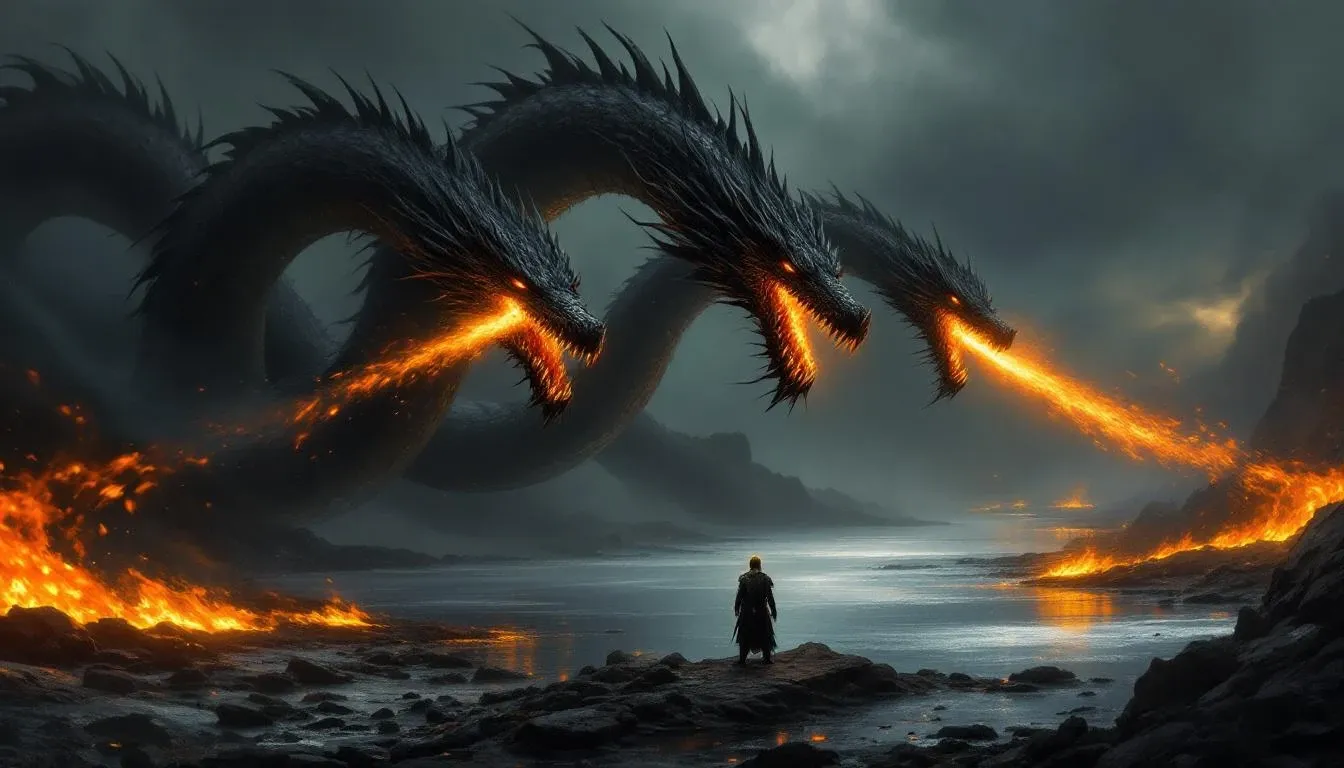
Zmey Gorynych is most often described with three heads, though the number varies across different tellings. Some byliny — the oral heroic poems of medieval Russia — give him six heads. Others say seven, nine, or twelve. The number is always odd or divisible by three, which carries ritual significance in Slavic tradition, where three is the number of completeness and the boundary between the natural and supernatural worlds.
Each head breathes fire independently. The flames are hot enough to scorch the earth black and melt iron. In some versions, the dragon can also spew poisonous smoke or boiling water — elemental forces that reflect his dominion over fire and water, the two most dangerous elements in the peasant world.
His body is massive, green-scaled, and reptilian. He walks on two powerful hind legs with small forelegs — more wyvern than Western dragon, if we must use those categories. His tail is long and strikes like a battering ram. His wings blot out the sky.
But the most dangerous feature is not the fire or the claws. It is the heads' ability to regrow. Cut one off, and it grows back — unless the stump is immediately cauterized with fire. This detail appears again and again in the byliny. The hero who fights Zmey Gorynych must not only be strong enough to sever a head but quick enough to burn the wound before a new one sprouts. Some tales say all heads must be cut off simultaneously. Others say the hero must find the one "true" head among the many — the head that holds the dragon's soul.
Myth Callout: In several Russian fairy tales (skazki), Zmey Gorynych's blood floods the battlefield after his heads are severed. The hero must stand in it for three days and three nights, sinking into the earth, before the ground finally swallows the blood and the land is cleansed.
The Dragon Who Talks
Here is where Zmey Gorynych diverges most sharply from the dragons of Western Europe.
Smaug talks, yes. Fáfnir speaks in riddles. But these are exceptions in the Western tradition, where dragons are fundamentally beasts — hoarders and destroyers, forces of nature given scales and wings. The Slavic zmey is different at a structural level. He is always intelligent. He always speaks human language. He negotiates, threatens, lies, makes treaties, and breaks them. He is not a natural disaster with teeth. He is a person — a terrible, inhuman person, but a person nonetheless.
In the bylina of Dobrynya Nikitich, Zmey Gorynych does not simply attack. He speaks. When Dobrynya first encounters him at the Puchai River, the dragon pleads for mercy and proposes a nonaggression pact: I will not raid your lands, and you will not hunt me. Dobrynya agrees. The dragon immediately breaks the deal, flies to Kiev, and kidnaps Zabava Putyatishna, the niece of Prince Vladimir.
This is not the behavior of a beast. This is the behavior of a warlord — someone who understands oaths and violates them deliberately. The zmey's villainy is not instinctive. It is chosen. And that makes him far more frightening than any mindless fire-breather.
The Dragon as Seducer
The most unsettling aspect of the zmey tradition — and the one that separates Slavic dragons from all others — is the dragon as lover.
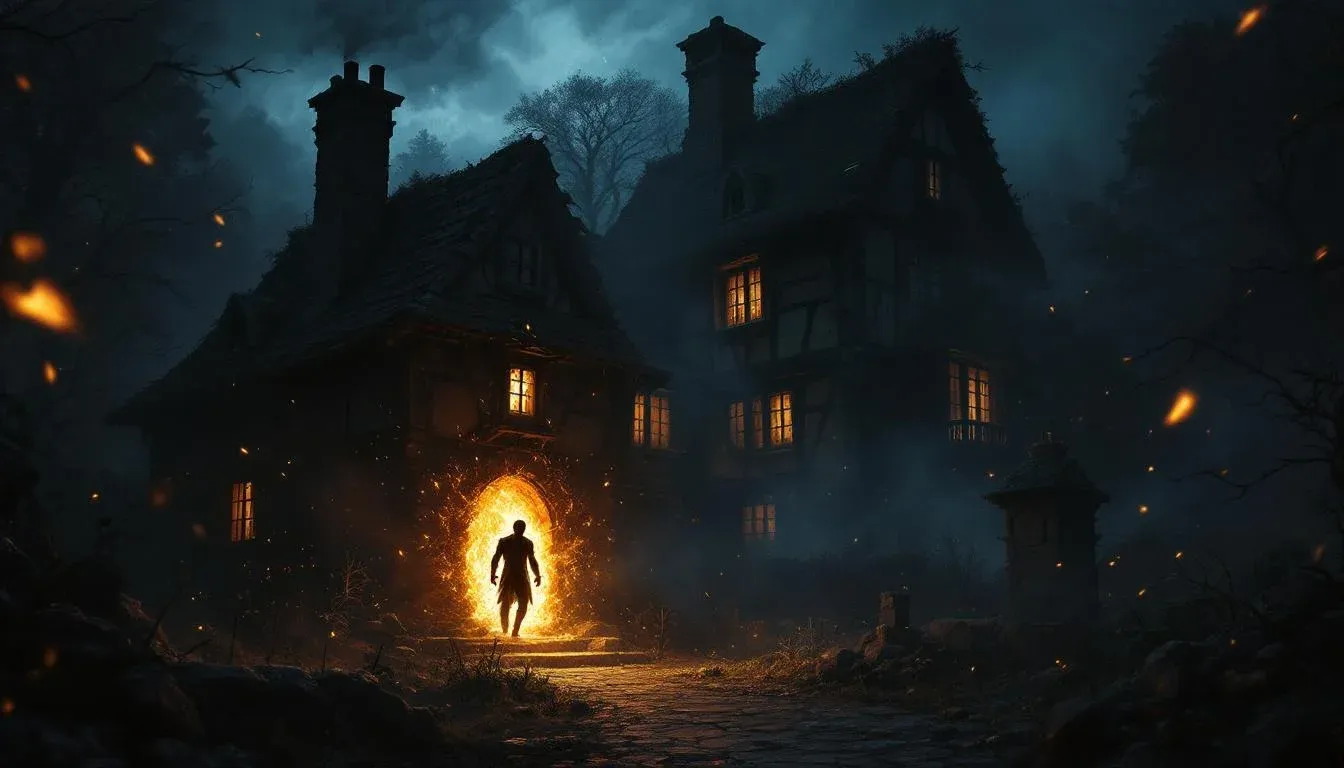
In Ukrainian and Bulgarian folklore especially, the zmey takes human form. He appears as a handsome young man, often a stranger who arrives in a village during a storm. He courts women. He seduces them. Sometimes he marries them. The relationship is real, physical, and often produces children — children who inherit supernatural strength and abilities.
These stories are not metaphors. They are told as literal events. A zmey-lover visits a woman at night, entering through the chimney in the form of a fiery serpent, then transforming into a man. The woman's family may notice something wrong — she grows pale, distant, obsessed — but by then the zmey has her in his grip. Some tales say only a specific herb or ritual can break the connection. Others say the woman must choose to reject him, which she often cannot bring herself to do.
The children of these unions — half-dragon, half-human — appear across Slavic folklore as heroes of extraordinary power. The implication is uncomfortable but consistent: the monster's blood carries strength, and that strength can serve good as well as evil.
Source Note: The folklorist Alexander Afanasyev documented numerous zmey-lover tales in his Narodnye russkie skazki (Russian Fairy Tales, 1855-1863), noting that the fiery serpent entering through the chimney was a widespread motif across all East Slavic regions.
Zmey Gorynych himself is sometimes cast in this role. He does not merely kidnap women — he desires them. His abduction of Zabava Putyatishna in the Dobrynya bylina carries undertones that the audience understood perfectly well. The princess is not being kept for ransom. She is being kept.
Dobrynya Nikitich: The Dragon-Slayer
The most famous zmey-slayer in Russian tradition is Dobrynya Nikitich, one of the three great bogatyrs (heroic warriors) of the Kievan cycle, alongside Ilya Muromets and Alyosha Popovich.
The bylina "Dobrynya and the Dragon" follows a clear pattern, but the details are vivid and specific in ways that suggest a very old oral tradition.
The First Encounter. Dobrynya's mother warns him to stay away from the Saracen Mountains, to avoid trampling young dragons, to leave Russian captives alone, and above all not to bathe in the Puchai River. Dobrynya does all four. While swimming naked and unarmed in the river, Zmey Gorynych descends from the sky. Dobrynya grabs the only weapon available — "a hat of the Greek land," a heavy traveler's cap — and beats the dragon with it until the zmey begs for peace.
The "hat of the Greek land" is one of the strangest details in Russian folklore. Scholars have argued for decades about what it represents — a Byzantine helmet, a pilgrim's cap weighted with earth from holy sites, a metaphor for Orthodox faith. No consensus exists. What matters is that Dobrynya defeats the dragon with an absurd weapon, which tells us something about the hero: he wins not through superior arms but through raw courage and improvisation.
The Broken Oath. The zmey swears not to raid Russia. Dobrynya lets him go. The dragon immediately flies to Kiev and takes Zabava Putyatishna. Prince Vladimir orders Dobrynya to bring her back — or die trying. Dobrynya's mother gives him the heirloom horse Burko and a magic silk whip from Shemakha.
The Three-Day Battle. Dobrynya rides to the Saracen Mountains and fights the dragon for three days. By the third day, he is exhausted and considers retreating. But a voice from heaven tells him: "Fight three more hours, young Dobrynya." He obeys. At the end of those three hours, the dragon falls.
Then comes the blood. So much blood pours from the dragon that the earth cannot absorb it. Dobrynya stands in the rising tide for three days. Finally, he strikes the earth with his whip or spear and commands: "Open up, Mother Earth, and swallow this serpent blood." The earth obeys.
This is not just a battle. It is a ritual of purification, where the hero must endure the contamination of the monster's death before the world can be made clean again.
The Cosmic Serpent: Zmey and the Storm Myth
Behind the fairy tales and byliny lies something older — a mythological structure that scholars call the Slavic storm myth.
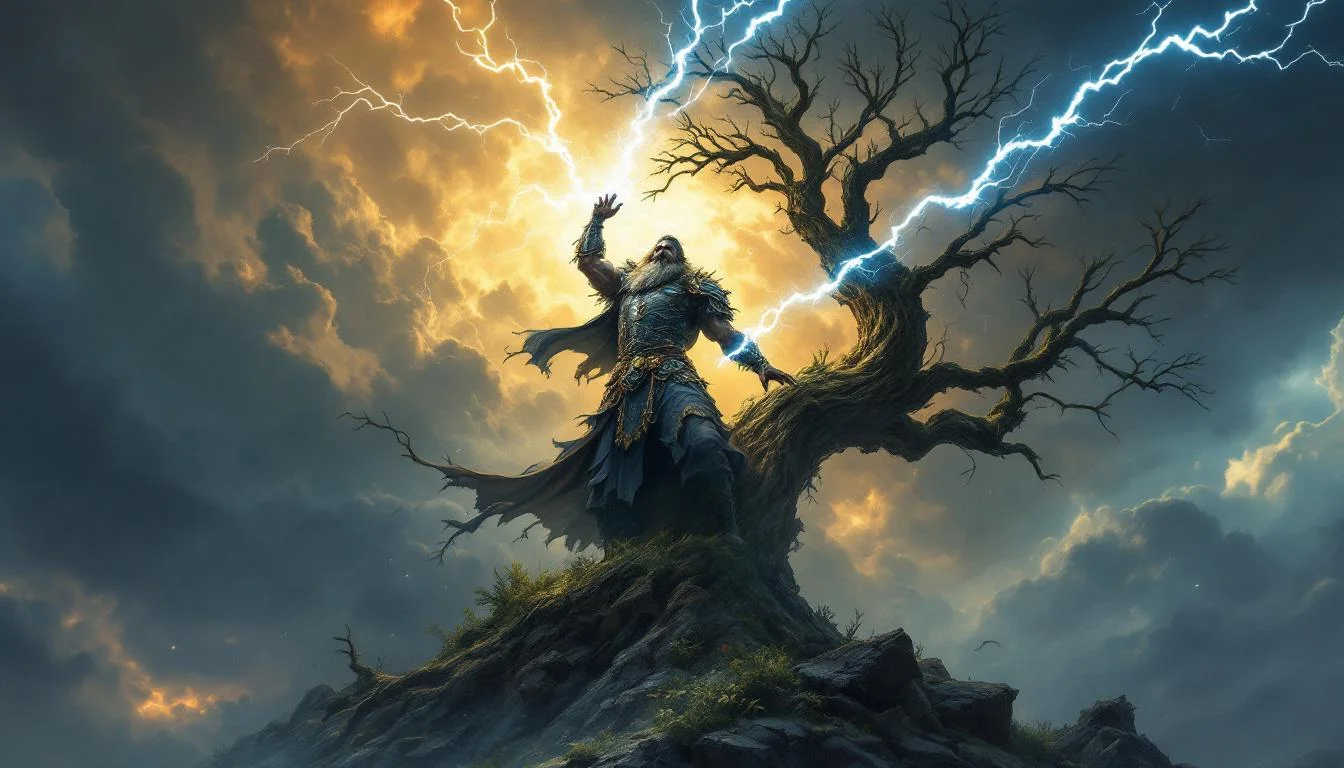
The reconstruction, proposed by the linguists Vyacheslav Ivanov and Vladimir Toporov in 1974, works like this: Perun, the thunder god of the sky, battles Veles, the serpentine god of the underworld, cattle, and water. Veles steals something — cattle, water, or Perun's wife — and hides at the base of the World Tree. Perun strikes him with lightning bolts. Veles flees, transforming into various animals and hiding behind trees, rocks, and people. Eventually Perun kills him, and rain falls — the stolen water released from the serpent's body.
This myth, if the reconstruction is correct, is the deep template behind the Dobrynya-Zmey story. The bogatyr replaces Perun. The dragon replaces Veles. The kidnapped princess replaces the stolen cattle or wife. The blood-flood that Dobrynya endures mirrors the rain released by Perun's lightning.
It should be noted that this reconstruction remains debated among modern scholars. The Polish historian Aleksander Gieysztor challenged it as early as 1982, and subsequent researchers have questioned whether Veles was truly Perun's primary cosmic opponent. But the structural parallels between the storm myth and the dragon-slaying bylina are difficult to dismiss entirely. Whether or not Zmey Gorynych is "really" Veles in disguise, the stories share a skeleton.
The zmey, in this reading, is not just a monster. He is the chaos-serpent — the force of the lower world that steals the treasures of the upper world and must be destroyed so that rain can fall, crops can grow, and order can be restored. Every time Dobrynya strikes the dragon, Perun's lightning echoes through the story.
Slavic Dragons vs. Western Dragons
If you grew up with Tolkien and Dungeons & Dragons, you have a mental image of what a dragon is: a giant lizard with wings, sitting on a pile of gold, breathing fire, and not saying much. The Slavic dragon breaks that image in almost every way.
| Feature | Western Dragon | Slavic Zmey |
|---|---|---|
| Intelligence | Varies (often bestial) | Always intelligent, always speaks |
| Shapeshifting | Rare | Common — takes human form |
| Sexual behavior | None (hoards gold, not women) | Seduces women, produces offspring |
| Number of heads | One | Three, seven, nine, twelve |
| Head regrowth | No (except Hydra, which is Greek) | Yes, unless cauterized |
| Relationship to hero | Pure antagonist | Complex — makes deals, breaks them |
| Symbolic role | Greed, destruction | Chaos, seduction, broken oaths |
The Western dragon guards treasure. The Slavic zmey takes things — women, freedom, the natural order. He is not passive. He raids, he schemes, he infiltrates. He is the outsider who crosses boundaries, which is why he must be destroyed: not because he is evil in an abstract sense, but because he violates the borders between the wild and the civilized, the inhuman and the human, the underworld and the world of the living.
This is what connects Zmey Gorynych to Koschei the Deathless — another boundary-crosser, another abductor of women, another figure who cheats death through supernatural means. The two are not the same creature, but they occupy the same narrative space. They are the forces that must be overcome before the hero can restore order and bring the stolen woman home.
Legacy
Zmey Gorynych has never stopped being part of Russian culture. He appears in Viktor Vasnetsov's famous 1918 painting, rearing over Dobrynya in a storm of fire. He is in Soviet-era animated films, reimagined as a comedic buffoon in the popular Tri Bogatyrya (Three Heroes) franchise. He decorates stamps, coins, and children's books.
But the older version — the speaking, scheming, seducing serpent of the byliny — remains the more powerful one. That zmey does not need comedy to hold your attention. He holds it the way a fire holds it: with heat, with light, and with the knowledge that if you look away, something will burn.
The three-headed dragon of the Saracen Mountains is still watching. With six eyes. From three different directions.