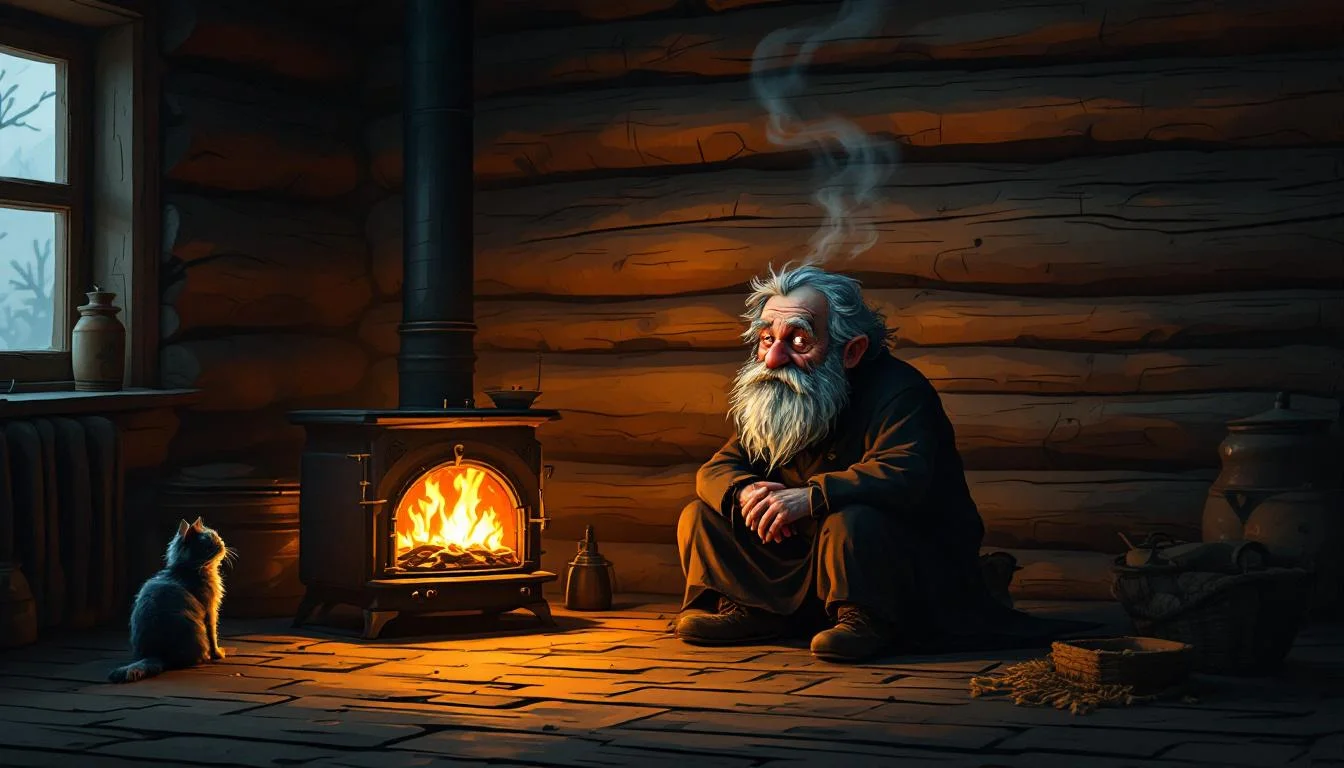
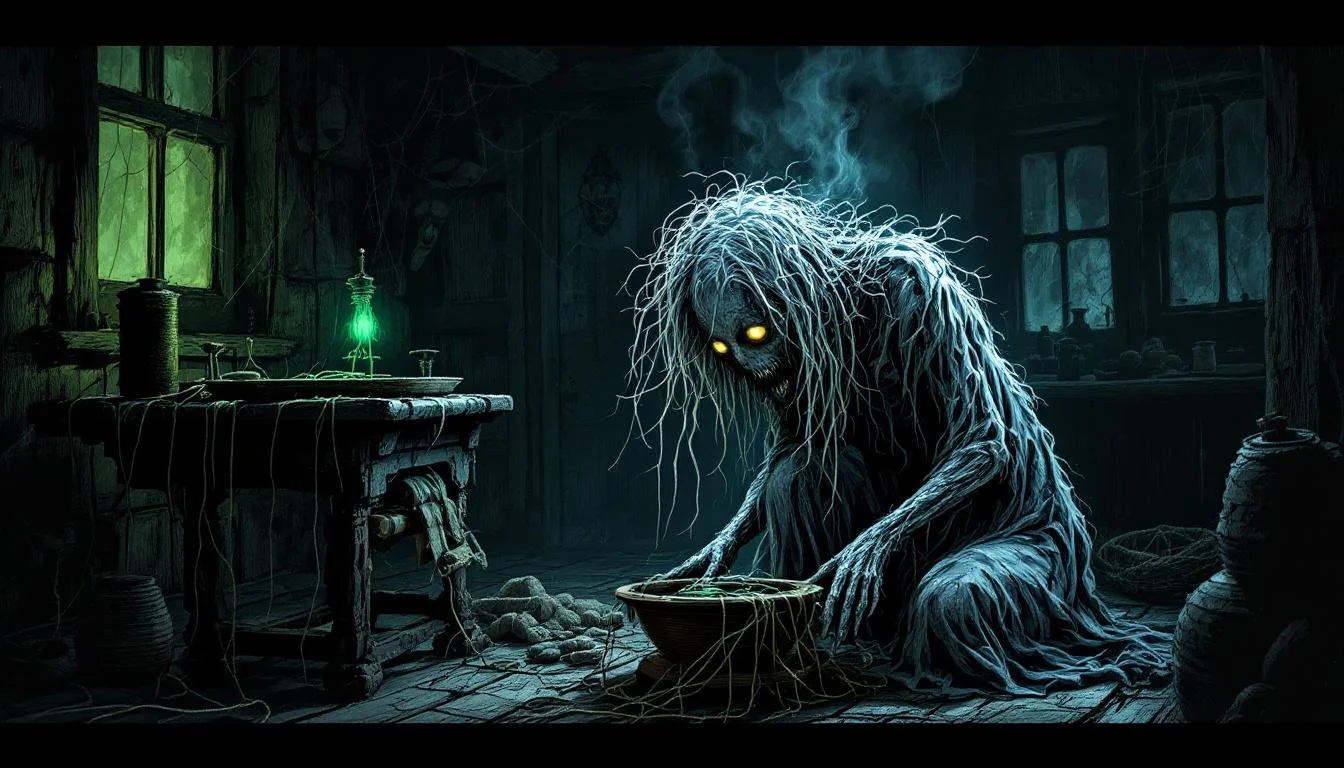
The banya stands at the edge of the yard, separate from the house, separated from the icons. There is a reason for that distance. The bathhouse is not part of the home. It belongs to something else — something that scrubs itself with your dirty water after you leave, that invites forest spirits in to share the steam, and that has strong opinions about when you are welcome and when you are trespassing.
His name is Bannik. He is the spirit of the Slavic bathhouse, and he has been waiting behind the stove since before your family built the walls around him.
In the hierarchy of Slavic household spirits, the Domovoy guards the hearth, the Kikimora haunts the spinning wheel, and Leshy rules the forest beyond the fence. The Bannik occupies a different territory entirely — the space between clean and unclean, human and otherworldly, the living and the dead. The banya is not simply a place to wash. It is the most dangerous room in the Slavic homestead.
A Naked Old Man in the Steam
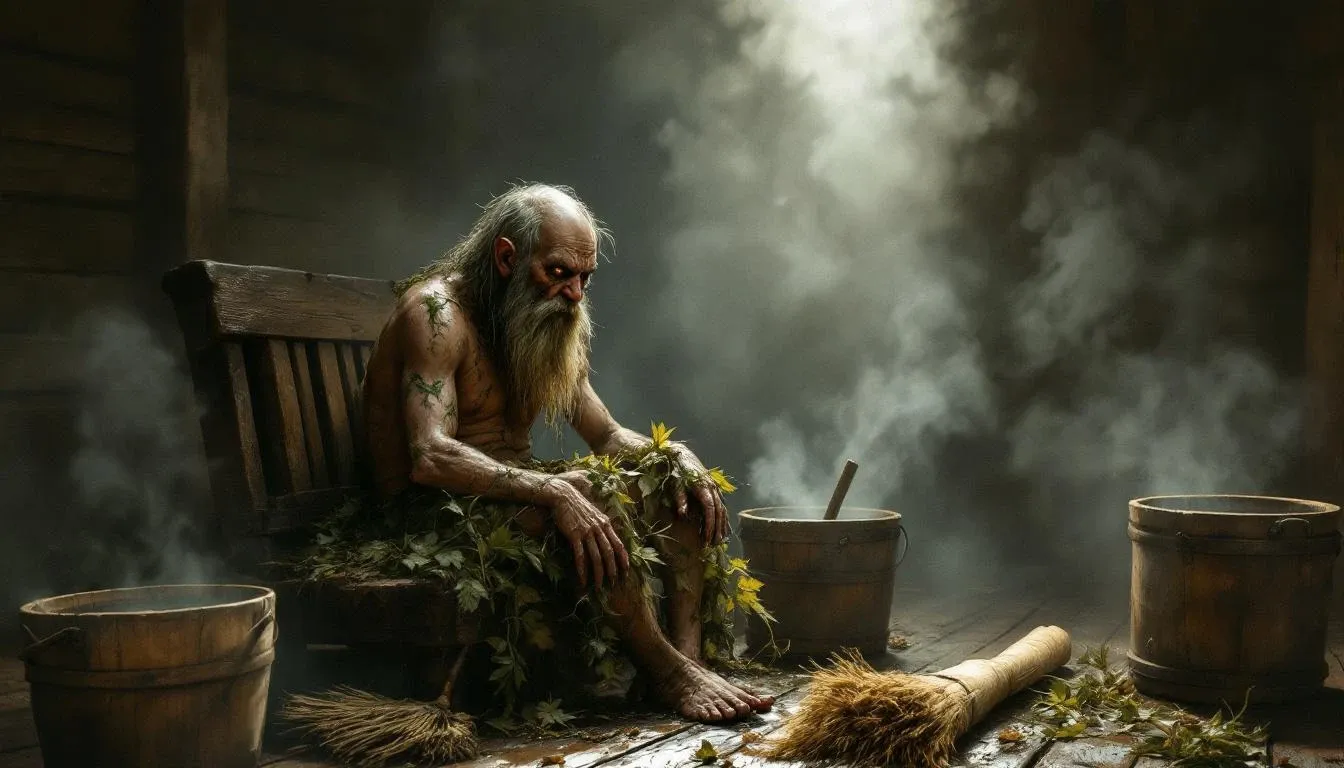
When the Bannik chooses to show himself — and he rarely does — the most common form is a small, naked old man. His body is covered in dirt and the sodden remnants of birch leaves shed from used bath brooms. His beard is long. His eyes are not kind. Some traditions describe him with long, matted hair covering his entire body; others say he appears clean only in the sense that something perpetually damp can be called clean.
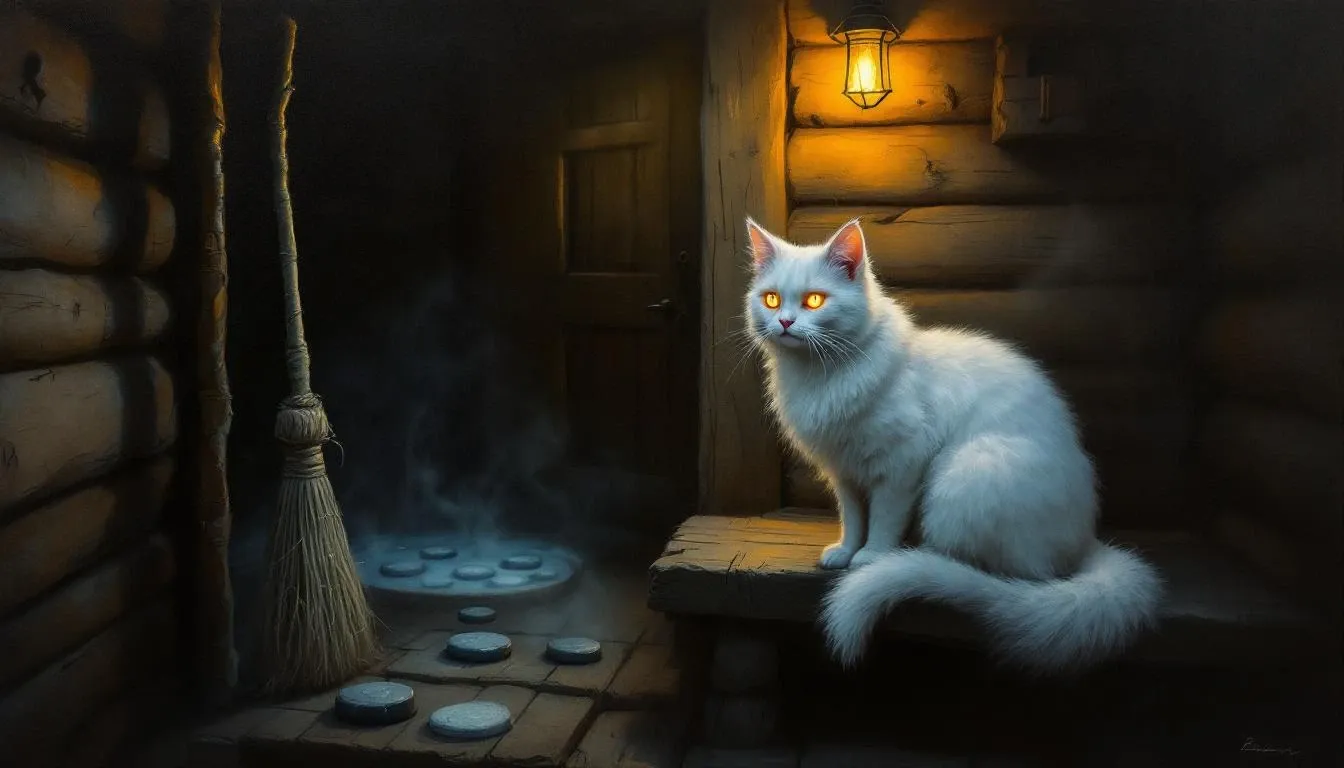
But the old man is only one face. The Bannik is a shapeshifter of considerable range. He becomes a white cat — a detail shared across Russian, Ukrainian, and Belarusian folklore. He takes the form of a white hare, a frog, a dog, even a wild boar. In some accounts, he appears as a familiar person from the village, sitting calmly on the bench as though he belongs there. The bather enters, recognizes a neighbor, and only later realizes the neighbor was at home the entire time. In the most unsettling variations, the Bannik disguises himself as a stone in the stove or a piece of coal — hiding in plain sight, watching, waiting to see whether the visitor will respect the rules.
He also has a wife. The Bannikha — known in various regions as baynitsa, baennaya matushka, or obderikha — is described as a shaggy, terrifying old woman who lurks under the top bench. She appears naked or in the form of a cat and is, if anything, less tolerant of human visitors than her husband. Together they maintain the bathhouse as their sovereign domain, a territory they share with the living only on their own terms.
The Rules of the Banya
Every culture that built bathhouses developed protocols for their use, but in Slavic tradition, the rules were not about hygiene. They were about survival.
The core rule was simple: humans bathe in shifts, and the third shift belongs to the Bannik. The exact numbering varies by region — some traditions say the fourth firing is his — but the principle is universal. After two rounds of human bathing, the bathhouse ceases to be a human space. The third steam is the Bannik's. He uses it to wash himself with the dirty water left behind by the bathers, and he invites his guests: forest spirits, demons, and the unquiet dead. Anyone who enters during this round is trespassing in a spirit's home.
The consequences of trespassing were graphically described across centuries of ethnographic records. The Bannik might scald you with boiling water flung from his bucket. He might throw heated stones from the stove at your head. He might strangle you. The most feared punishment was being "steamed to death" — zaparit' do smerti — the Bannik pressing you against the scorching stones of the upper bench and holding you there until you stopped moving. This was not metaphor. Unexplained deaths in bathhouses were attributed to the Bannik's wrath, and they were considered particularly bad omens for the entire household.
Other rules reinforced the boundaries:
No icons, no crosses. The banya was the only structure in a Slavic homestead where Christian images were forbidden. This was not an oversight. The bathhouse belonged to the nechistaya sila — the unclean force — and placing holy objects inside it would offend the Bannik and his guests. Bathers were expected to remove their crosses before entering. Some traditions held that even making the sign of the cross inside the banya was dangerous.
No bathing after dark. Nighttime belonged to the spirits entirely. Entering the banya after sunset, particularly after midnight, was asking for a confrontation with the Bannik at the height of his power.
No cursing, no fighting, no drunkenness. The Bannik punished disorder within his walls. A bather who stumbled in drunk or started an argument was marked for retaliation.
Always say goodbye. Upon leaving the banya, the proper protocol was to thank the Bannik aloud. One widespread formula involved sprinkling a wet birch broom (venik) into the four corners of the room and saying: "Bannik, o bannik, take away the dirt of our bodies, of our souls and of our minds, take away the evil, the ailments, the sorrows and the sadness." This was repeated three times, followed by a formal expression of gratitude and a backward exit through the door — never turning your back on the spirit's domain as you left.
The Prophecy at the Door
The Bannik was feared, but he was also sought out — because he could tell the future.
The most widespread divination ritual was performed during Svyatki, the Yuletide season between Christmas and Epiphany, when the boundary between the human world and the spirit world was thinnest. Young women would approach the bathhouse at midnight. They would open the door, turn their backs to the darkness inside, and lift their skirts to expose their bare skin to whatever waited within.
Then they waited for the Bannik's touch.
If a warm, soft hand stroked their back — fortune was good. A happy marriage, a prosperous year, a life of comfort. If a rough, hairy hand pressed against them — the husband would be wealthy, at least. But if cold claws raked down their exposed skin, drawing blood — the future held suffering. Misery, poverty, a cruel husband, or death.
A regional variation from central Russia added specificity to the touch: a hairy hand meant a rich groom, a bare hand meant a poor one, and a wet hand meant the future husband would be a drunkard.
These divinations were not taken lightly. The girls went in groups for protection, but only one could stand at the door at a time. Others waited at a distance, watching for signs of danger. There were stories — persistent, recurring stories across multiple regions — of girls who did not come back from the bathhouse door. The Bannik had pulled them inside.
The bathhouse was the most common site for divination among Russian peasant women. Its position at the edge of the homestead, its lack of holy protection, and its association with the unclean force made it a natural point of contact between the human world and the world of spirits. The bannik's oracle was sought with fear and reverence in equal measure.
The Liminal Space: Why the Banya Was Never Just a Bath
To understand the Bannik, you have to understand why the Slavic bathhouse was so spiritually charged. The answer lies in the concept of liminality — the quality of being on a threshold, between states, belonging fully to neither one world nor another.
The banya sat at the physical edge of the homestead — outside the fence, away from the house, often near water. It was the architectural boundary between the domestic space (protected by the Domovoy) and the wild space (ruled by Leshy and the Vodyanoy). It was a transitional structure. You entered it dirty and left clean. You entered it dressed and stripped naked inside. You entered it cold and were enveloped in heat.
This in-between quality made the banya a place of immense spiritual power — and immense spiritual danger. It was where the veil between worlds was thinnest. And it attracted the beings who thrived in thin places.
This is why women gave birth in the banya.
The connection between the bathhouse and childbirth was not about sanitation, though the steam and heat were practical advantages. It was about cosmology. Birth is the ultimate liminal event — a new soul crossing from the other world into this one. The banya, as a threshold space, was the natural site for this crossing. The Bannik was present at every birth, and folk belief held that he was not truly content until a child had been born within his walls. The newborn's first bath, given in the banya, was a ritual of enormous significance — the child's formal introduction to the spirit world that bordered the human one.
But the liminal nature of the banya cut both ways. If birth belonged there, so did death — and death in the bathhouse was the worst possible omen. A person who died in the banya was considered to have been claimed by the nechistaya sila. They could not be given a proper Christian burial in some traditions. Their soul was trapped in the Bannik's domain, condemned to join the procession of unclean spirits who bathed in the third steam.
Appeasing the Lord of Steam
Living alongside a dangerous spirit required constant diplomacy. The Bannik expected offerings, and the offerings were specific.
After each bathing session, you left behind clean water in the tub, a bar of soap, and fir branches — the materials for the Bannik's own bath. Some traditions added a slice of dark rye bread with coarse salt, the same offering given to the Domovoy, reinforcing the parallel between these domestic spirits. The offering was always accompanied by spoken thanks — never silent, always aloud, always respectful.
The most dramatic ritual of appeasement occurred when a bathhouse was rebuilt. Banyas burned down frequently — they were wooden structures filled with fire and steam, and accidental destruction was common. But a burning banya was never treated as a purely structural event. The fire meant the Bannik was angry, or that he had been driven out by a more powerful spirit. Rebuilding required a sacrifice.
A black hen was strangled — not slaughtered with a knife, but suffocated. The bird was left unplucked, its feathers intact. It was buried beneath the threshold of the new bathhouse while the builder recited incantations and bowed deeply. Then the builder backed away without turning around, just as one backs away from the banya door after a divination. The black hen was the Bannik's foundation offering — the price of his willingness to inhabit the new structure and resume his duties as its guardian.
On Chisty Chetverg — Holy Thursday, the Thursday before Easter — some households repeated a version of this sacrifice to renew their relationship with the Bannik for the coming year. The timing was deliberate: Holy Thursday was the day when, according to folk belief, all unclean spirits were at their most active and most receptive to human offerings.
The Bannik and His Kin
The Bannik did not exist in isolation. He was part of a network of Slavic domestic and nature spirits, each governing a specific domain. Understanding his relationships with these other beings reveals the architecture of the Slavic spirit world.
His closest relative was the Domovoy, the house spirit. Both were tied to specific structures, both demanded offerings, both punished disrespect. But where the Domovoy was fundamentally an ancestral spirit — the dead grandfather protecting his descendants — the Bannik had no such familial bond. He was not your ancestor. He was an independent entity who tolerated your presence in his building. The Domovoy could be moved to a new house by carrying coals from the old hearth. The Bannik could not be moved. He belonged to the structure itself, and when the banya burned, he either died with it or was reborn through the black hen sacrifice.
The Vodyanoy, the water spirit of rivers and lakes, shared the Bannik's association with water and the unclean force. In some northern Russian traditions, the Bannik and Vodyanoy were allies — the bathhouse, after all, required water, and the spirit who governed water had a claim on the space. Some folklorists have suggested that the Bannik is, in origin, a domesticated form of the Vodyanoy — a water spirit brought inside, tamed by walls and ritual, but never fully controlled.
The Kikimora, the female household spirit, represented the domestic interior just as the Bannik represented the domestic exterior. Where the Kikimora interfered with spinning and weaving — indoor women's work — the Bannik presided over washing and childbirth — activities that happened at the margins of the home, in that dangerous space where the domestic met the wild.
What Survived
The traditional Slavic banya still exists. In rural Russia, Ukraine, and Belarus, families still build separate bathhouses at the edges of their property. The practice of bathing in shifts persists. The superstition about the third steam has faded in most places, but it has not disappeared entirely — ask the right person in the right village, and they will tell you they still leave the door open after the second round, just in case.
The Bannik himself has drifted from a figure of genuine fear into a character of folklore and cultural memory. He appears in collections of fairy tales, in Slavic mythology websites, in the occasional horror story that uses the bathhouse as its setting. But the older layer — the layer where families tracked bathing shifts with real anxiety, where a girl stood at the bathhouse door at midnight and waited for something to touch her bare skin — that layer has not fully eroded.
The banya remains a liminal space. It stands at the edge. It strips you bare. And in the steam, when the room is hot enough and quiet enough and you are alone in the third round, something in the back of your mind still insists: you should not be here.
That instinct is older than you. The Bannik put it there.