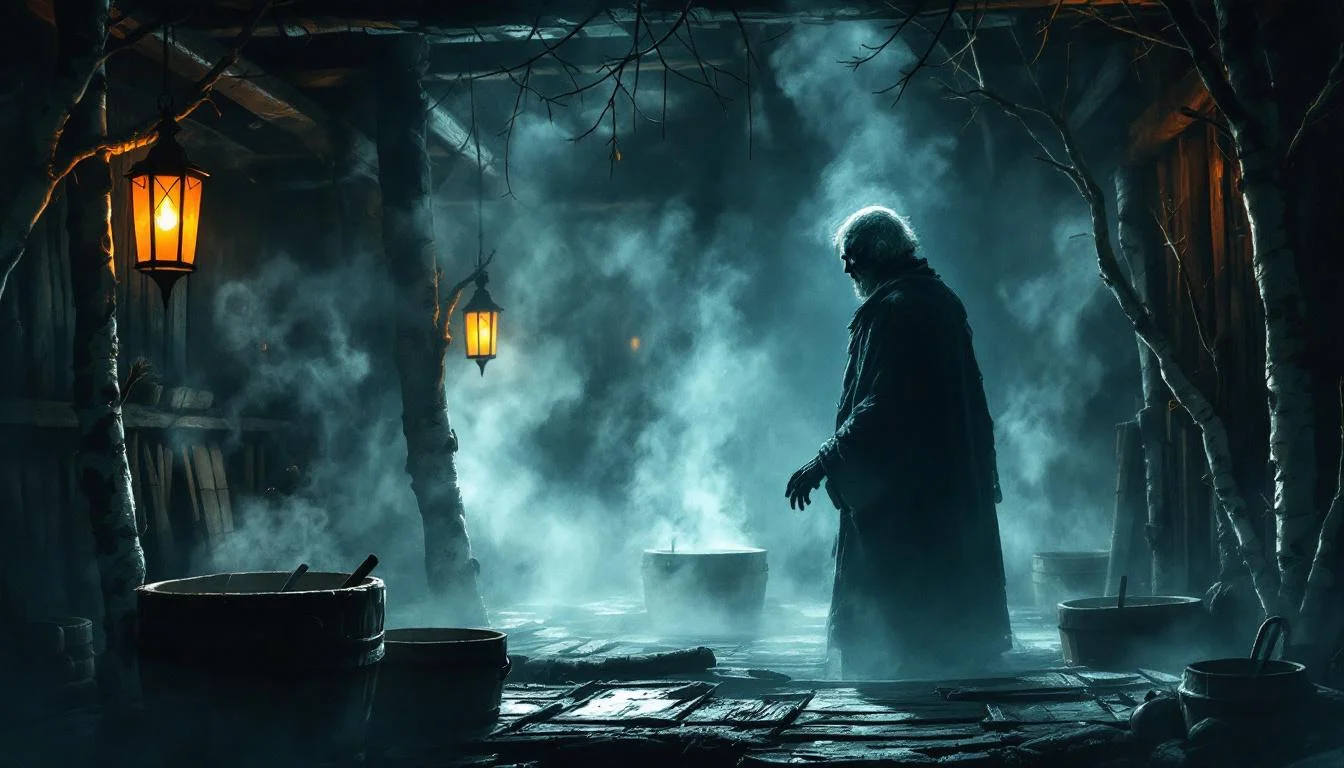
You hear the spinning wheel before you see her.
It begins past midnight — a thin, rhythmic clicking from somewhere deep in the house. Behind the stove, perhaps. Under the floorboards. In the walls. The sound of thread being drawn through a spindle by hands that should not be there, because you live alone, and no one in your household owns a spinning wheel anymore.
In the villages of Russia, Ukraine, and Belarus, that sound was a death sentence. Not a metaphor. Not an exaggeration. If the Kikimora was spinning in your house, someone under your roof was going to die. The peasant ethnography is blunt about this: if she is spinning, expect a death. The only question was whose.
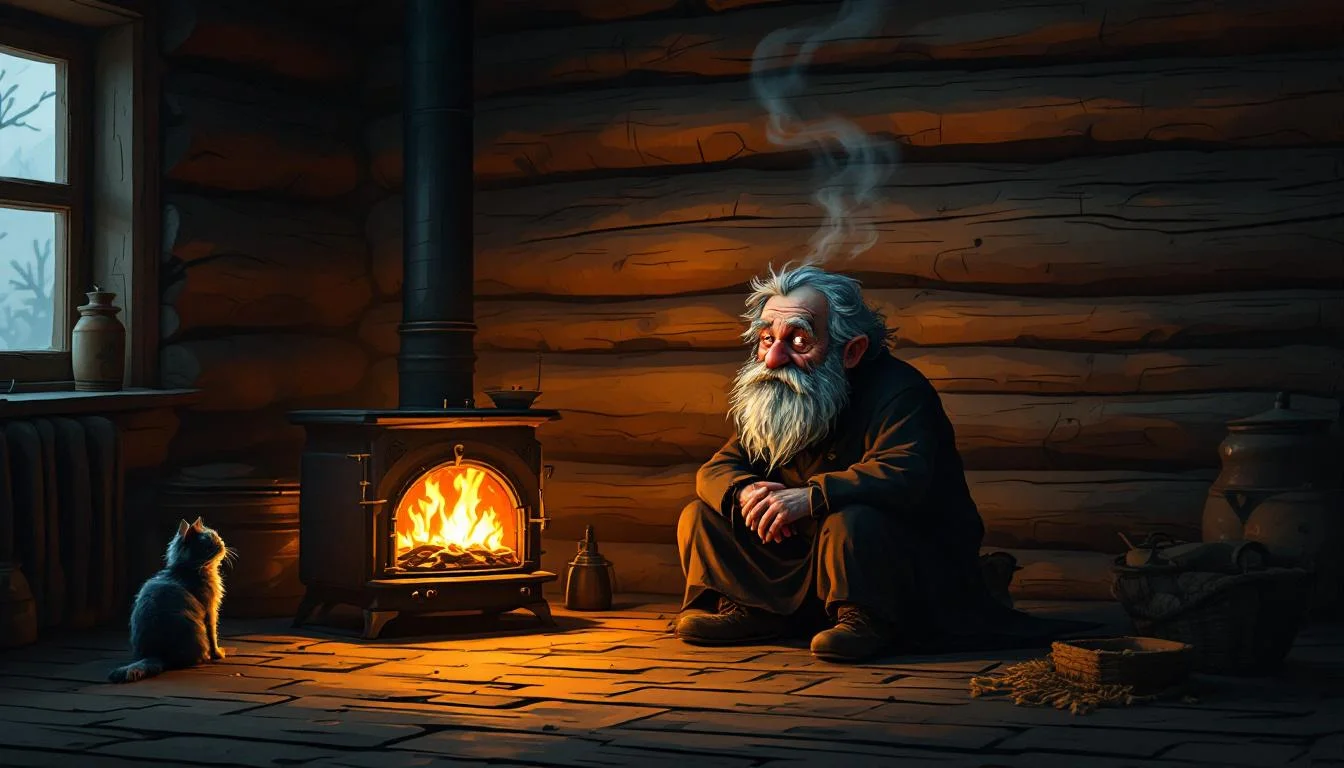
The Kikimora is the dark mirror of the Domovoy — the male guardian spirit who protects the home and watches over the family with ancestral devotion. Where the Domovoy rewards order and punishes neglect, the Kikimora is the punishment. She is what moves into a house when things have already gone wrong — when the marriage is rotten, the children are cursed, or the dead have been dishonored. She does not come to warn. She comes to stay.
What She Looks Like (When She Lets You See)
The Kikimora is almost never seen clearly, and this is part of what makes her so feared. She is a creature of peripheral vision and half-sleep — a shape in the corner of your eye that vanishes when you turn your head.
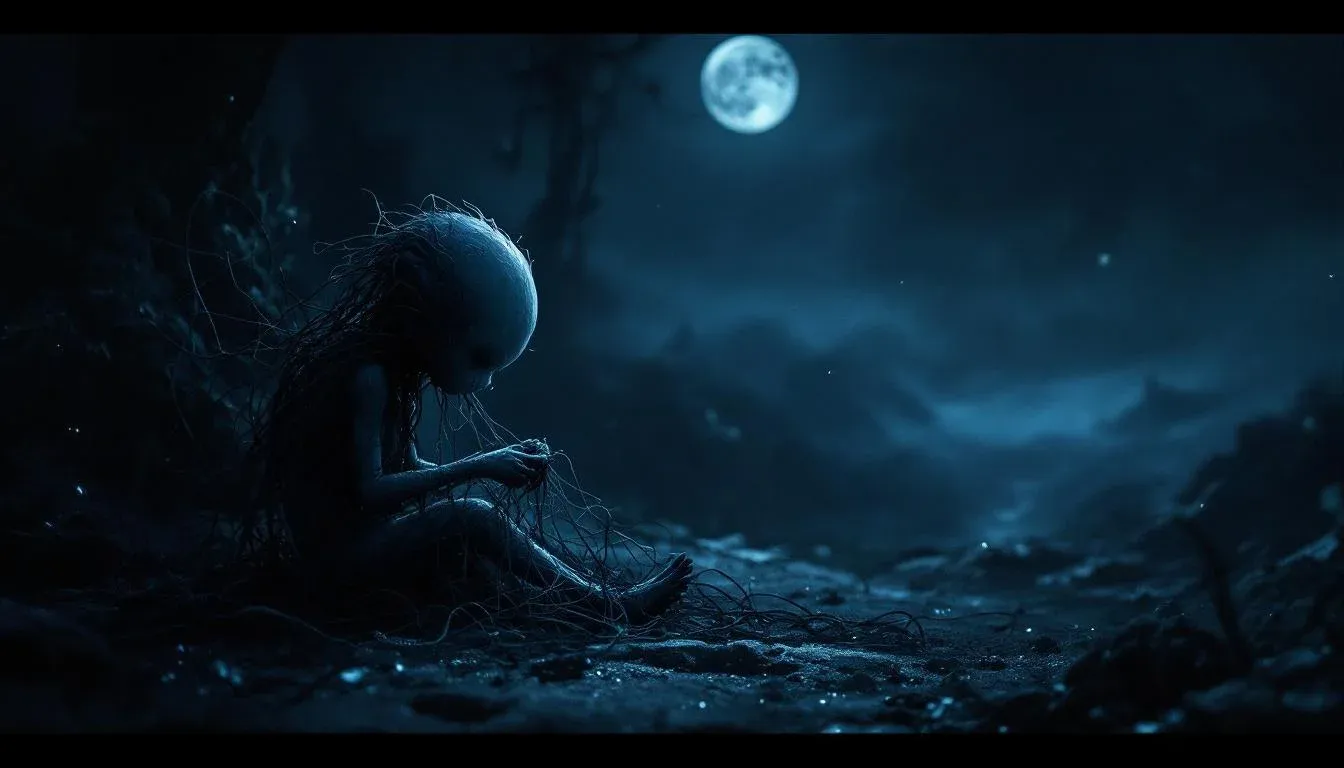
When she does reveal herself, the descriptions across centuries of East Slavic folklore converge on the same unsettling portrait. She is a tiny, emaciated old woman. Withered skin stretched over sharp bones. Long, thin arms — impossibly long, disproportionate, ending in bony fingers that never stop moving. Her hair is matted, grey or black, tangled with dust and cobwebs. Some accounts give her a beak — a chicken's beak or a duck's bill protruding from a human face, a detail that places her firmly in the uncanny territory between animal and human that Slavic spirits so often occupy.
In certain regions of northern Russia, she was said to have a dog's snout. In others, she appeared as a beautiful young woman — but only from behind. If you circled her, the beauty dissolved into something bent and hollow-eyed. This shapeshifting was never playful. Every form was designed to unsettle, to signal that something fundamentally wrong had taken residence in your home.
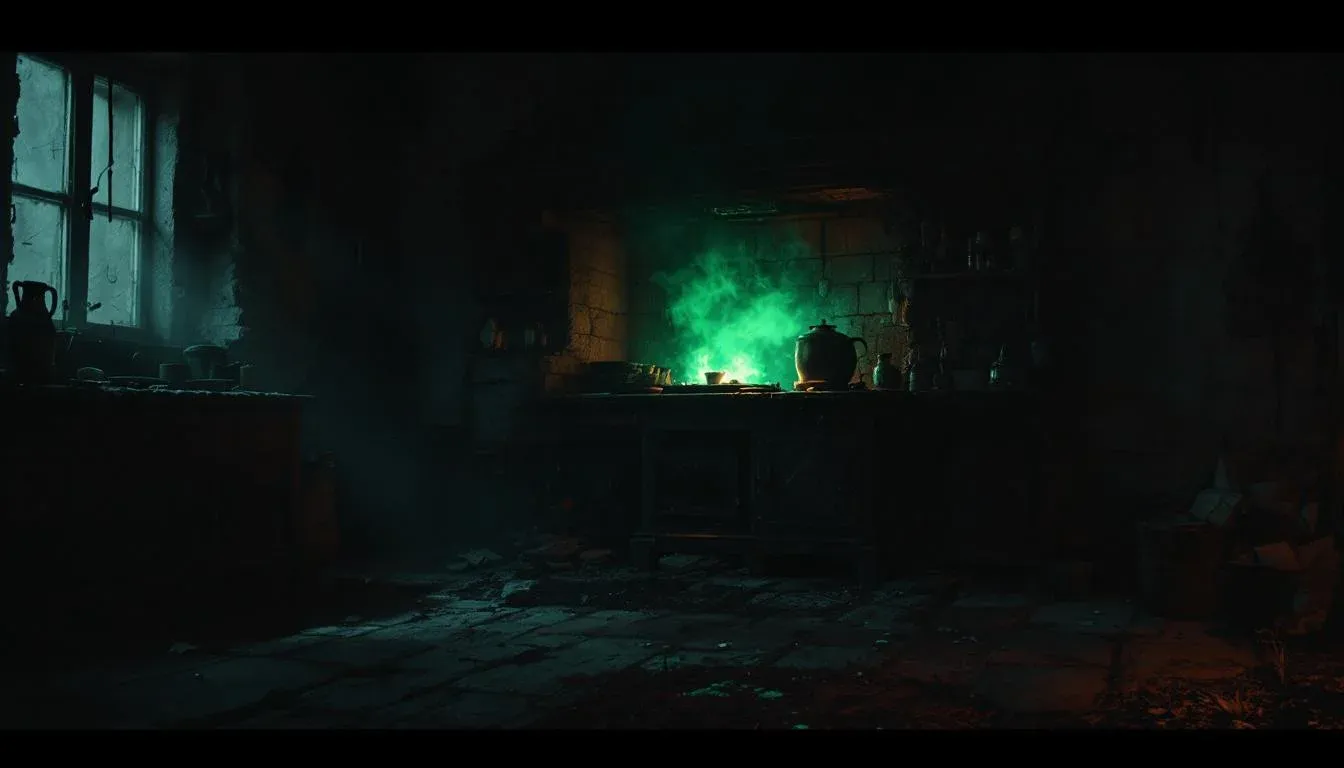
Her defining physical trait was her size. The Kikimora was small — no taller than a child, sometimes described as no bigger than a straw doll. But size is deceptive in Slavic demonology. The smaller the spirit, the harder to find. The harder to find, the harder to expel. She lived behind the stove, under the floorboards, in the spaces between walls — anywhere a human hand could not easily reach. Her domain was the hidden architecture of the house, and she knew it better than the people who built it.
Born from the Dead: The Origins of the Kikimora
The Kikimora was not born the way forest spirits or water spirits were born — from the elemental forces of nature, from the will of old gods. Her origins were human, and that is what made them terrible.
The most persistent and widespread belief held that a Kikimora was the spirit of a child who had died before baptism. In the Orthodox Christian framework that overlaid Slavic paganism after the tenth century, an unbaptized child existed in a theological void — not damned, exactly, but not saved. Not at rest. The soul had nowhere to go, so it stayed, and it changed. A stillborn child. A miscarriage buried without rites. A baby who died in the first hours of life before a priest could be summoned. These became Kikimoras.
Other accounts expanded the category. Children cursed by their own parents — a mother in a moment of rage telling her child to go to the devil, for instance — could transform into Kikimoras after death. Women who died in childbirth sometimes became them. In some northern Russian traditions, a Kikimora could also be deliberately created. A sorcerer, hired to curse a household, would bury a doll — sometimes made of rags, sometimes carved from bone — inside the walls during construction. The doll became a vessel. The spirit moved in.
This manufactured origin gave the Kikimora a particularly insidious quality among Slavic spirits. She was not merely a feature of the supernatural landscape. She could be weaponized. A neighbor with a grudge, a spurned lover, a dismissed servant — anyone with access to a sorcerer could install a Kikimora in your walls, and you might not know for years. You would simply notice that things were getting worse. The thread kept tangling. The bread would not rise. Sleep became a battle.
What She Does: Spinning, Strangling, Unraveling
The Kikimora had a limited but devastating repertoire. Everything she did was connected to domestic labor — the labor of women, specifically — twisted into something malicious.
Her primary occupation was spinning thread. She came out at night, sat at the spinning wheel or the loom, and worked. The sound carried through the house: click-click-click, the rhythmic pulse of a spindle turning in the dark. But her spinning was not productive. The thread she produced was tangled, knotted, useless. She spun kikimorinu pryazhu — "kikimora thread" — a phrase that entered the Russian language as an idiom for work done badly, labor that creates nothing but waste.
She also unraveled. A woman might spend an entire day at her loom, producing careful, even cloth — and wake in the morning to find every thread pulled apart, the fabric reduced to loose fibers scattered across the floor. The Kikimora had undone a day's work in a single night. In a subsistence household where textile production was not a hobby but a survival necessity, this was economic destruction. Ruined cloth meant ruined clothing, ruined trade goods, ruined dowries.
Beyond the loom, she attacked sleep itself. The Kikimora would creep onto a sleeper's chest in the deep hours of the night and press down. The weight was suffocating — a crushing pressure that paralyzed the body and filled the mind with vivid, horrible dreams. The sleeper could not move, could not cry out, could only lie there and endure until the spirit decided to leave. This is, of course, a textbook description of sleep paralysis, and the Kikimora was one of the primary folk explanations for it across the East Slavic world. She sat on your chest. She strangled your breath. She showed you things you would not forget.
She also pulled hair — specifically women's hair, tangling it into impossible knots while the victim slept, a behavior she shared with her counterpart the Domovoy, though the Domovoy's hair-pulling was communicative, a warning. The Kikimora's hair-pulling was pure malice.
And she tormented children. Crying at night, fevers with no apparent cause, a child's refusal to sleep in a particular room — these were attributed to the Kikimora's attention. She was drawn to children in a way that the folklore explains with grim logic: she was, after all, a dead child herself.
House Kikimora vs. Swamp Kikimora: Two Faces of the Same Fear
The folklore distinguishes between two distinct types, and confusing them is a mistake that modern retellings make constantly.
The house Kikimora — kikimora domashnyaya — is the one described above. She lives inside human dwellings, married in some traditions to the Domovoy. Her domain is the hearth, the loom, the bedroom. She is an interior spirit, bound to domestic space, and her malice is domestic in character: ruined housework, sleepless nights, family discord. A house Kikimora can sometimes be benevolent — if the household is clean, orderly, and well-managed, she may actually help with chores, watch over the chickens, finish the spinning. But this benevolent version is the exception. The Kikimora's default state is hostile.
The swamp Kikimora — kikimora bolotnaya — is a different creature entirely. She lives in marshes, bogs, and wetlands. She is married not to the Domovoy but to the Leshy, the forest spirit. Her appearance is more consistently monstrous: a tiny, skeletal figure draped in moss and marsh grass, with tangled black hair woven through with reeds and water plants. She wraps herself in bog moss like a fur coat. She can become invisible. She can take the form of a frog, a toad, a black cat, or a goose.
The swamp Kikimora does not haunt houses — she lures people into the marsh. She calls to travelers in a thin, reedy voice. She leads them off the path. She kidnaps children who wander too close to the water's edge. Her wet footprints on the floor of a house are the most terrifying diagnostic sign: they mean the exterior Kikimora has entered the domestic sphere, and the threat is no longer merely household annoyance but genuine physical danger.
The two types represented distinct anxieties. The house Kikimora embodied the fear that your home — the one space of safety in a world of forest, swamp, and open steppe — had been corrupted from within. The swamp Kikimora embodied the fear that the wilderness was coming inside, crossing the threshold, breaching the barrier between civilization and the untamed world where human rules did not apply.
The kikimora is thin as a straw, and black as soot. She cannot sit still — she spins ceaselessly through the night, but her thread is always tangled, and any cloth she weaves must be torn apart and redone. If you hear the sound of a spinning wheel after midnight, do not go to look. You will see nothing. But she will know you heard her, and from that night forward, she will not let you sleep.
How to Banish Her: Fern Root and Desperate Measures
Slavic folklore was nothing if not practical. Alongside the extensive documentation of what the Kikimora did, there existed an equally detailed pharmacopoeia of countermeasures.
The most widely cited remedy was fern root. Specifically, the root of the male fern (Dryopteris filix-mas), dried and placed behind the stove or hung near the spinning wheel. Fern occupied a powerful position in Slavic folk botany — it was the plant that supposedly bloomed once a year, on the night of Ivan Kupala, and whoever found its flower gained the ability to see hidden treasures and understand the speech of animals. The fern root's association with seeing the invisible made it a natural weapon against a spirit whose primary characteristic was concealment.
Other plant-based protections included juniper — burned as incense or hung in bundles near doorways — and branches of hawthorn, placed under the bed or above the cradle.
Domestic rituals formed a second line of defense. Keyholes were blocked with wax, paper, or small keys left turned in the lock — the Kikimora was believed to enter through keyholes, and sealing them shut cut off her access route. Brooms were placed bristle-up behind doors. A belt was draped across the bed before sleeping, creating a protective boundary the spirit could not cross.
The most fundamental remedy, however, was not botanical or ritual but behavioral. Keep a clean house. This instruction appears in virtually every ethnographic source. A well-maintained household — floors swept, dishes washed, loom in order, bread baked on schedule, children disciplined, marriage functional — was an environment the Kikimora could not tolerate. She fed on disorder. Remove the disorder, and she starved.
In the most extreme cases, when none of the above worked, the solution was to find the cursed object that had originally summoned the Kikimora. If the house had been hexed during construction — if a sorcerer had buried a doll or a bundle of rags in the walls — then the physical vessel had to be located and burned. Families tore apart walls, ripped up floorboards, dismantled stoves. Sometimes they found something. Sometimes they found nothing and burned the house anyway. The logic was brutal but internally consistent: if the corruption could not be extracted, the entire infected structure had to be destroyed.
The Witcher's Kikimora: A Name and Nothing Else
If you came to this article because of The Witcher — the books by Andrzej Sapkowski or the games by CD Projekt Red — you need to know that the creature bearing this name in that franchise has essentially nothing to do with the spirit described above.
The Witcher's kikimore is a giant insectoid — a hive-dwelling arthropod with mandibles, armored carapace, and caustic venom. It operates in castes: workers, warriors, and a queen. It lives underground or in swamps, attacks in swarms, and is vulnerable to insectoid oil and the Igni sign. It is, in every meaningful sense, a science-fiction bug colony transplanted into a fantasy setting.
Sapkowski borrowed the name. He did not borrow the mythology. The real Kikimora is not a monster you fight with a silver sword. She is an invisible presence in the walls of your own home, and what makes her terrifying is not her mandibles — she has none — but the fact that she represents the corruption of the one place where you are supposed to be safe. The Witcher's kikimore is an enemy. The folklore Kikimora is a condition. You do not slay her. You endure her, or you fix whatever brought her to you in the first place.
This is not a criticism of Sapkowski or CD Projekt Red. Slavic mythology is a deep well, and creative reinterpretation is legitimate. But if you walk away from The Witcher 3: Wild Hunt thinking you understand the Kikimora, you understand a giant spider with a borrowed passport. The real thing is smaller, quieter, and immeasurably worse.
The Kikimora in the Slavic Spiritual Household
The Kikimora makes full sense only when you place her within the wider ecosystem of Slavic household spirits. She was not an anomaly. She was a necessary counterweight.
The Domovoy represented the ideal — the well-ordered home, the honored ancestor, the family that remembered its duties. But no system of belief survives on ideals alone. There had to be a consequence for failure, a name for what happened when the system broke down. The Kikimora was that name.
She was the Domovoy inverted. Where he was hairy and warm, she was bony and cold. Where he guarded the hearth, she corrupted the loom. Where he rewarded good housekeeping with protection, she punished bad housekeeping with sleepless nights and tangled thread. Where he was the dead grandfather watching over his descendants, she was the dead child who had never been given the chance to become an ancestor at all.
In the broader taxonomy: the Bannik governed the bathhouse, the Ovinnik governed the grain barn, the Dvorovoy governed the yard. Each space had its spirit, and each spirit reflected the anxieties specific to that space. The Kikimora governed the dark hours between midnight and dawn — the time when the loom stood still, the stove cooled, the family slept, and the house was vulnerable to whatever waited in the walls.
She shares territory with Baba Yaga in one respect: both are feminine supernatural forces associated with spinning and weaving, and both represent the destructive potential of female power when it operates outside the boundaries of patriarchal order. But where Baba Yaga is a figure of the wilderness — her chicken-legged hut wanders the forest, unattached to any human family — the Kikimora is inescapably domestic. She does not roam. She infests. She is the nightmare that does not chase you through the woods but waits for you at home.
And she shares an unexpected kinship with the Striga — both are spirits born from wrongful death, from bodies that did not receive the proper rites, from the failure of the living to care for the dead. The Striga claws its way out of the grave. The Kikimora slips through the keyhole. Different methods, same grievance: you did not bury us correctly, and now you will not sleep.
She Is Still Spinning
The Kikimora has not vanished. She has adapted.
In modern Russian and Ukrainian idiom, kikimora is used to describe a slovenly, disheveled, unpleasant woman — a linguistic fossilization of the original folk belief. "Vyglyadish kak kikimora" — "you look like a kikimora" — is an insult that most speakers use without thinking about the centuries of nocturnal terror compressed into the word.
She appears in classical music. Anatoly Lyadov composed an orchestral tone poem titled Kikimora (1909), depicting her rocking in a crystal cradle at the witch's dwelling and emerging to spin through the night. The music is restless, thin, full of rattling percussion — an attempt to translate the sound of midnight spinning into orchestral language. Mussorgsky's Pictures at an Exhibition draws on the same world of Slavic domestic spirits.
She appears in video games, in novels, in metal albums. Each adaptation sands away a little more of the original. The insectoid Witcher creature. The cartoon character. The Halloween costume. None of them capture the central horror: that the Kikimora is not something that attacks from outside. She is what your home becomes when you stop taking care of it. She is neglect given form, guilt given a face, the accumulated consequence of every undone chore, every unresolved argument, every ancestor forgotten, every child unblessed.
In the old houses of the Russian countryside — the ones that still have stoves, still have looms, still have floorboards that creak in patterns no one can explain — the remedy has not changed in a thousand years. Sweep the floors. Keep the bread fresh. Honor the dead. Leave a saucer of milk by the stove for the Domovoy, and hope that his protection is enough to keep his dark counterpart at bay.
And if you hear the spinning wheel at night — do not get up to look. There is nothing there that you want to see.