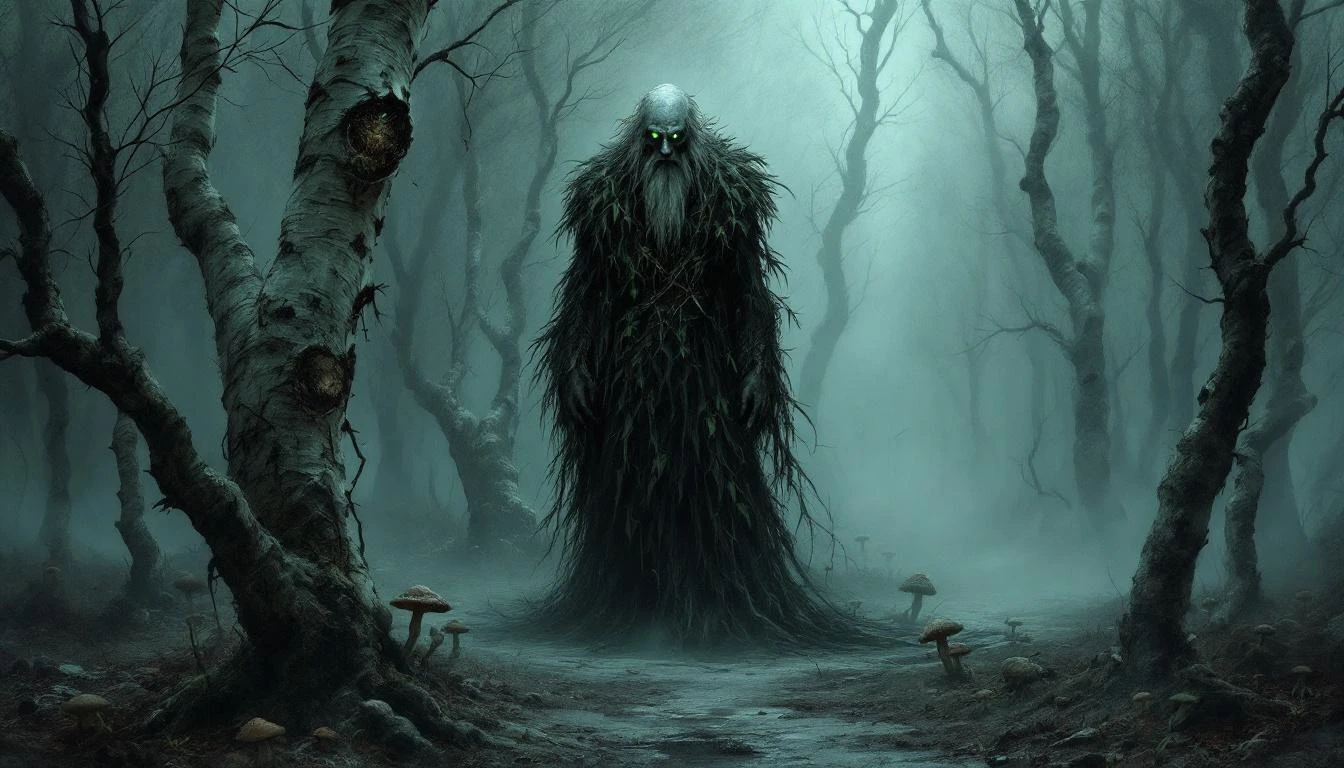
Say the word chort in any village between Prague and the Urals and watch what happens. An old woman will spit to the side. A man will mutter something under his breath and change the subject. A child will laugh. Because the chort is the strangest creature in all of Slavic demonology — a figure who is simultaneously feared as the embodiment of evil and mocked as a bumbling fool who steals the moon, loses card games to blacksmiths, and gets outwitted by peasant girls on a regular basis.
In Russian: чёрт. In Ukrainian: чорт. In Polish: czart. In Czech and Slovak: čert. Every Slavic language has the word, and every Slavic culture has the stories. He is the devil in a folk costume — hooved, horned, tailed, and completely incapable of winning a fair fight against anyone with half a brain and a bit of nerve. He is the thing that lurks at crossroads and in swamps and behind the bathhouse after dark. He is the reason your grandmother says "Chort vozmi!" — Devil take it! — when she drops a plate, invoking the same being that her own grandmother invoked, and her grandmother before that, back through a thousand years of Slavic speech to a time before the word "devil" meant anything Christian at all.
Because that is the secret of the chort. He was here before Christ arrived. And he will be here long after the last church is an empty ruin.
A Name Older Than the Bible
The etymology of chort is a doorway into pre-Christian Slavic thought, and scholars have been arguing about what lies on the other side for over a century.
The word descends from Proto-Slavic *čьrtъ, and there are at least three serious theories about where that root came from. The first connects it to *čarъ — magic, sorcery — making the chort a cognate of the Lithuanian kerėti ("to bewitch") and the Sanskrit kṛtyā, which means "female demon" or "sorceress." Under this reading, the chort was never a devil at all. He was a magical being, a creature of enchantment, something that belonged to the same semantic field as spells and hexes and the casting of lots.
The second theory derives *čьrtъ from a root meaning "to cut" or "to chop," connected to the idea of lameness or crookedness. One of the chort's most persistent folk epithets across Slavic languages is kutsyi — the lame one, the one with a shortened leg. This may be older than any of the goat-legged imagery borrowed from Greek Pan or Christian iconography: a being defined not by his evil but by his asymmetry, his wrongness, the way he walks through the world slightly off-kilter.
The third theory — and the one that opens the deepest window into the pre-Christian mind — links *čьrtъ to *čersti, meaning "to draw a line" or "to score a furrow." Under this hypothesis, the original chort was a Draughtsman of Fate — a supernatural being who drew the lines of human destiny in the earth itself. The folklorist Alexander Afanasyev concluded that the chort was originally a god of destiny who also brought death. Only later — after the missionaries came, after the baptisms and the slow grinding machinery of Christianization — did this god of fate get demoted to the rank of a common devil, his line-drawing reduced to a pitchfork, his role in the cosmic order replaced by a red suit and a set of horns.
The tragedy of the chort's name is that it contains the ghost of something immense — a deity of fate and death — wrapped in the costume of a fool.
The Body of the Devil
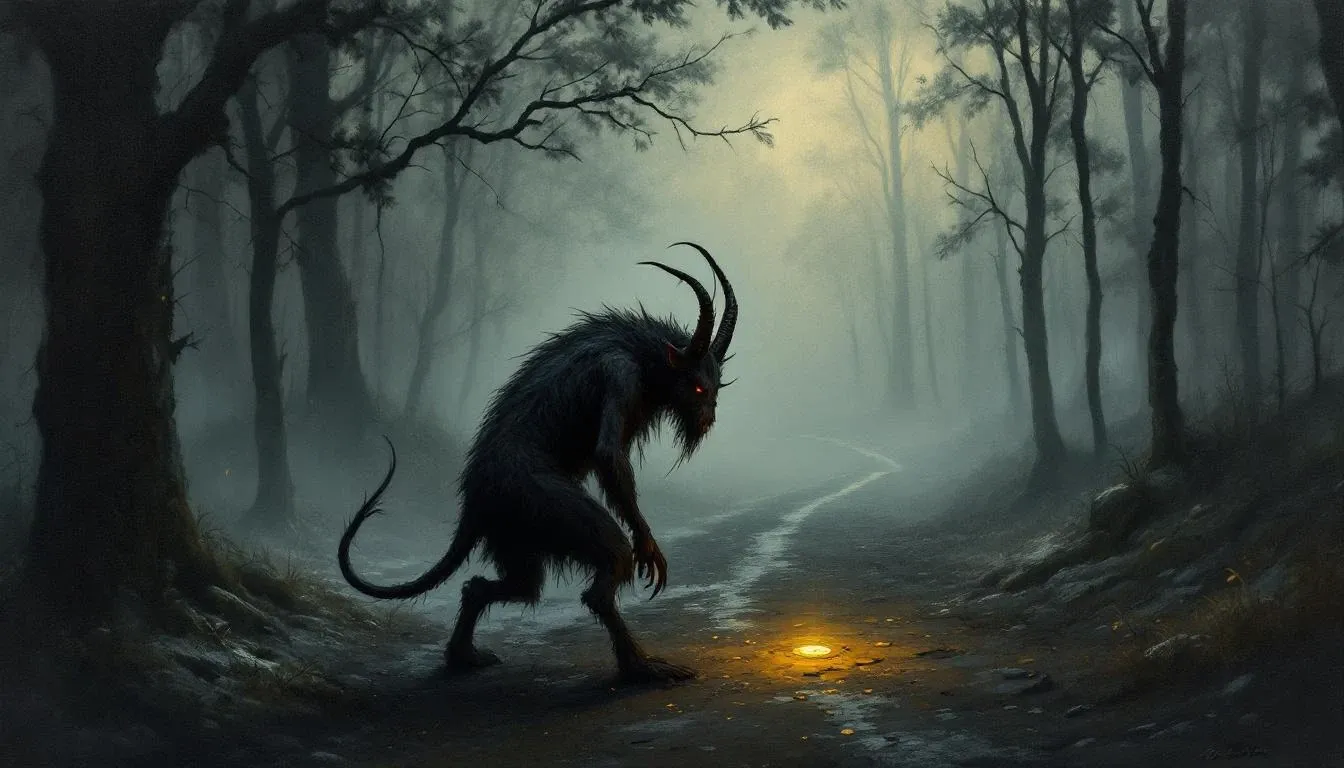
He is roughly human in shape, but wrong in every detail. He has fur — dark, coarse, the kind of fur that belongs to a goat or a wild boar. He has horns, though their size varies by region. He has a long, thin tail that he cannot fully conceal, no matter what shape he takes. His legs bend backward at the knee, like a goat's, and his feet end in hooves — or sometimes in the scaly claws of a stork or a chicken, a detail that makes him unmistakable even when disguised. He has a snout rather than a face, pointed ears, and eyes that gleam with knowing, malicious intelligence.
But the chort is a shapeshifter. He can appear as an attractive young man, a wealthy count, a traveling merchant, a huntsman in fine clothes. His disguises are always convincing enough to fool the initial glance but flawed enough for the sharp-eyed to catch: a hoof peeking out from under a trouser leg, a tail coiled beneath a coat, a faint smell of sulfur that no cologne can mask, an inexplicable aversion to crossing water or stepping onto consecrated ground.
The chort's physical form is a palimpsest — layers of different traditions written on top of one another. The hooves and horns come from Pan and the satyrs, filtered through Christian art. The shapeshifting belongs to the ancient Slavic spirit world. The lameness, the reversed knees, the wrongness — those are older than any of it. Those belong to the original being, the one who drew lines in the dirt and decided who would live and who would die.
The Chort Before Christianity
To understand what the chort was before the missionaries arrived, you need to look at the company he keeps in the mythology.
In some traditions, the chort is identified as the son of Chernobog — the Black God, the cosmic principle of darkness — and the goddess Mara (Morana), who rules death and winter. This parentage places him in the oldest stratum of Slavic cosmology: the chthonic world beneath the roots of the World Tree, the realm that Veles governs as lord of the dead, the wealthy, and the untamed.
In pre-Christian Slavic thought, darkness was not evil. It was necessary. Veles and Perun fought their eternal war not because one was good and the other wicked, but because the tension between sky and underworld, thunder and serpent, light and dark, was what kept the cosmos turning. The chort, as a child of Chernobog and Mara, belonged to this necessary darkness — not a moral category but a natural one, like winter or night.
When Christianity arrived, it flattened this cosmology. Darkness became evil. The underworld became hell. Every creature that belonged to the dark half of the Slavic universe was reclassified as a demon. The chort's connection to fate and death was forgotten. His position in the cosmic order was erased. What remained was the shape: hooves, horns, tail, sulfur.
But the folk memory was not so easily overwritten. The Slavic peasant never quite believed that the chort was pure evil. The stories kept something of the old ambiguity alive — a creature who could be tricked, bargained with, outwitted, even pitied. The pre-Christian trickster spirit survived inside the Christian costume, grinning through the mask.
Gogol's Devil: The Moon-Stealer of Dikanka
No writer captured the comic chort better than Nikolai Gogol, and no story captured him better than Christmas Eve — published in 1832 as part of the collection Evenings on a Farm Near Dikanka.
The story opens on a Ukrainian winter night, and the chort is loose. Not in the way a tiger is loose — dangerous, lethal, commanding fear. The chort is loose the way a drunk uncle is loose at a wedding: he is going to cause problems, everyone knows it, and no one is especially worried because his problems tend to be spectacular and self-defeating.
The devil grasped the moon with both hands, and making wry faces and blowing hard, he threw it from one hand to the other, like a peasant who has taken a live coal in his hand to light his pipe. At last, he hastily hid it in his pocket, and went on his way as if nothing had happened.
This is the chort at his most characteristically Slavic. He steals the moon — the actual moon, from the actual sky — and stuffs it into his pocket like a stolen apple. His motive is petty revenge: the village blacksmith Vakula has been painting unflattering pictures of the devil in the local church, and the chort intends to plunge the village into darkness so that Vakula's evening will be ruined. That is the full extent of his diabolical plan. Not damnation. Not corruption of souls. A ruined date.
What follows is one of the great comic set pieces in Russian literature. The chort conjures a snowstorm, rides through the sky on a broomstick, and does everything in his power to sabotage Vakula. And he fails. Completely. Vakula is too stubborn, too pious, and too in love to be defeated by a devil with the strategic intelligence of a barn cat. In the climax, Vakula grabs the chort by the tail, makes the sign of the cross, and rides the devil to St. Petersburg to fetch a pair of the Empress's own slippers as a gift for his beloved Oksana. The chort, terrified of the cross and unable to escape, carries the blacksmith through the sky like a donkey carrying a sack of grain.
Gogol's chort is not Satan. He is not Milton's Lucifer, magnificent in his rebellion. He is a small, vain, cowardly creature whose schemes collapse the moment they encounter a human being with even a shred of backbone. And this is not Gogol's invention — it is the folk tradition speaking through him.
Card Games at the Crossroads
But the comic chort is only half the picture. The other half is darker, and it centers on the oldest motif in chort folklore: the deal.
Across the Slavic world, stories survive of men and women who met the chort at a crossroads and struck a bargain. The pattern recalls the Western Faust legend, but the Slavic version is older and stranger. The chort does not tempt you because he serves a cosmic evil. He tempts you because tempting is what he does — it is his nature, like a fox stealing chickens or a river drowning the careless.
The deals follow a formula. The chort offers something the human desires — wealth, love, revenge, forbidden knowledge. The price is the soul, but the payment is never immediate. Instead, the chort proposes a contest, a wager, a game. And here the Slavic tradition diverges sharply from the Western one: the human can win.
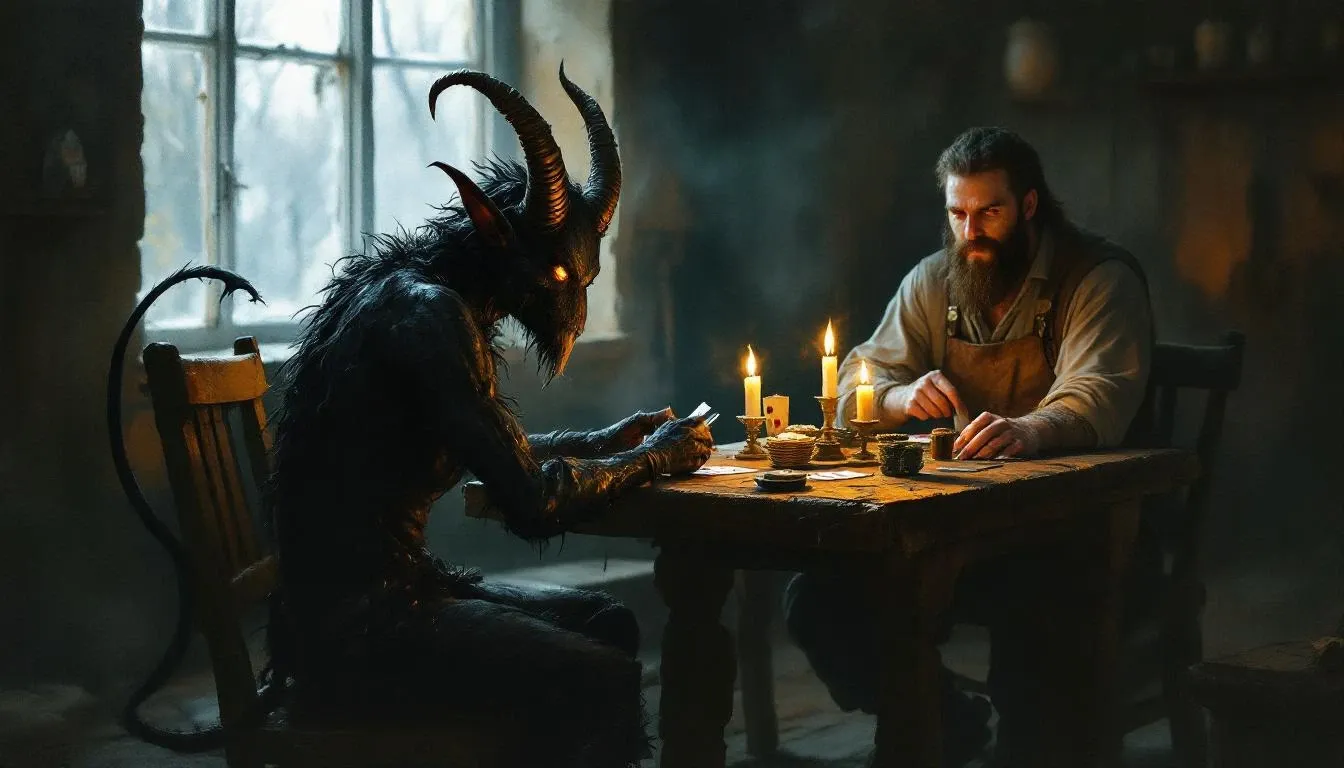
Card games are the most common vehicle. In Czech and Slovak tradition, the čert is an avid card player who cannot resist a game, and this addiction is his weakness. Beat him at durak or mariáš — keep your nerve through a night of playing against a creature whose fingers leave scorch marks on the table — and you keep your soul and whatever he has wagered. In some versions, you win the souls of others he has already claimed. The chort is a compulsive gambler who cannot walk away from a losing hand.
But those who lose are dragged off to a place the stories never describe in detail but whose nature is clear enough. The chort collects what is owed. He is, in the end, still a devil — even if he loses more often than he wins, even if his schemes are more comic than cosmic. The darkness inside him is real. It is just wrapped in a very thick layer of absurdity.
Among the Spirits
The chort does not exist alone. His closest relative in the Slavic spirit world is the Leshy — the forest lord, the shapeshifting master of the woods. In some regions the two are nearly indistinguishable: both haunt wild places, both shapeshift, both can be bargained with. The difference is territory. The Leshy belongs to the forest specifically. The chort belongs to a broader category of unclean space: crossroads, swamps, abandoned buildings, any place where the boundary between the human world and something older grows thin.
The protections against him span two religious traditions at once. The sign of the cross is the most obvious defense — Christian armor against a Christianized enemy. But the older remedies are more revealing. Iron repels him, as it repels most spirits in Slavic tradition. Running water stops him. Garlic, salt, and bread at thresholds serve as barriers. Turning your clothing inside out confuses him — sympathetic magic based on the principle that a creature of reversal can be defeated by reversing your own appearance.
And then there is the simplest protection: do not be afraid. The heroes of chort stories — Vakula the blacksmith, clever soldiers, sharp-tongued peasant women — survive not because they are holy or powerful but because they refuse to be impressed. The message, repeated across centuries of Slavic storytelling, is plain: the devil is only as big as your fear of him.
The Chort Who Survived
The chort is still alive in the Slavic world — not as a literal belief, but as a linguistic presence that saturates daily speech. Russians say "chort vozmi" the way English speakers say "damn it." Ukrainians say "a chort yoho zna" — "the devil knows" — when they mean "who knows?" He lives in proverbs, curses, jokes, and the kind of half-serious superstitions that even the most modern person cannot quite shake.
He survived Christianization. He survived Soviet atheism, which banned religion but could not ban the word chort from the Russian language. He survived the 21st century, where he appears in video games, novels, and television as a figure audiences recognize instantly — not because they have studied mythology, but because the word has never left their mouths.
Of all the creatures in the Slavic spirit world, the chort may be the most human. Not because he looks human — he does not, with his hooves and his tail and his backward knees. But because his vices are human vices. He is vain. He is greedy. He is a poor loser. He overestimates his own cleverness and underestimates everyone else's. He makes plans that fall apart at the first contact with reality. He is, in the end, a mirror — a dark, distorted, sulfur-smelling mirror in which Slavic culture has been studying its own weaknesses for a very long time.
And that is why the old woman spits when she hears his name, and the child laughs. They are both right.