Somewhere beneath a mountain that no human foot has touched, a creature shifts in its sleep. The ground heaves. Wells that were dry an hour ago begin to fill. Rivers change direction in their beds. Springs crack open in rock that has been solid since the earth was formed.
The creature is not a horse, though it has a horse's head. It is not a deer, though it walks on cloven hooves. It is not a bull, though its body carries the mass of one. A single horn — or sometimes two, depending on who is telling the story — grows from its snout. Some versions give it feathers. Others give it scales. A few insist it can fly.
This is the Indrik-Beast, and according to East Slavic spiritual verse, it is the father of every animal that walks, crawls, or swims across the earth. Not the strongest, though it is that. Not the most dangerous, though it is that too. The Indrik is the first — the original, the source, the king whose authority comes not from conquest but from the fact that it was here before everything else.
The Book That Named the Beast
The primary source for the Indrik is a text that the Russian Orthodox Church spent centuries trying to suppress. The Golubinaya Kniga — the Book of the Dove, though some scholars translate it as the Book of the Deep — is a collection of spiritual verses that circulated orally among East Slavic peasants from at least the fifteenth century onward. At least twenty versions survive, ranging from thirty lines to over nine hundred. The earliest written manuscript dates to the seventeenth century, but the oral tradition behind it is older, layered with pre-Christian Slavic cosmology dressed in biblical language just loosely enough to avoid outright heresy.
The Golubinaya Kniga takes the form of a riddle dialogue. A great book falls from the sky — forty fathoms long, twenty fathoms wide — and lands before an assembly of kings and tsars. King David (sometimes Tsar David Yesseyevich, a folk-Christian fusion of the biblical king and Slavic ruler archetypes) steps forward to read it. The assembled rulers ask him questions about the structure of the cosmos: Where does light come from? Why are there stars? What is the mother of all cities? The mother of all rivers? The mother of all stones?
And then: Who is the father of all beasts?
"The Indrik-Beast is the father of all beasts. It lives upon the Holy Mountain, upon the Holy Mountain it walks, it walks through the underground as the sun walks through the sky. When it stirs, the whole earth trembles. All the springs, all the rivers, all the lakes — they flow from beneath the beast's hoofprints."
The answer is always the same, across every recorded variant. The Indrik. It lives on or beneath the Holy Mountain — sometimes identified as Mount Tabor in the Holy Land, sometimes as a nameless mountain at the center of the world that echoes the cosmic axis found in mythologies from Scandinavia to India. It is the king of all animals. And when it moves through the earth, every body of water on the surface responds.
What the Indrik Looks Like (If You Could See It)
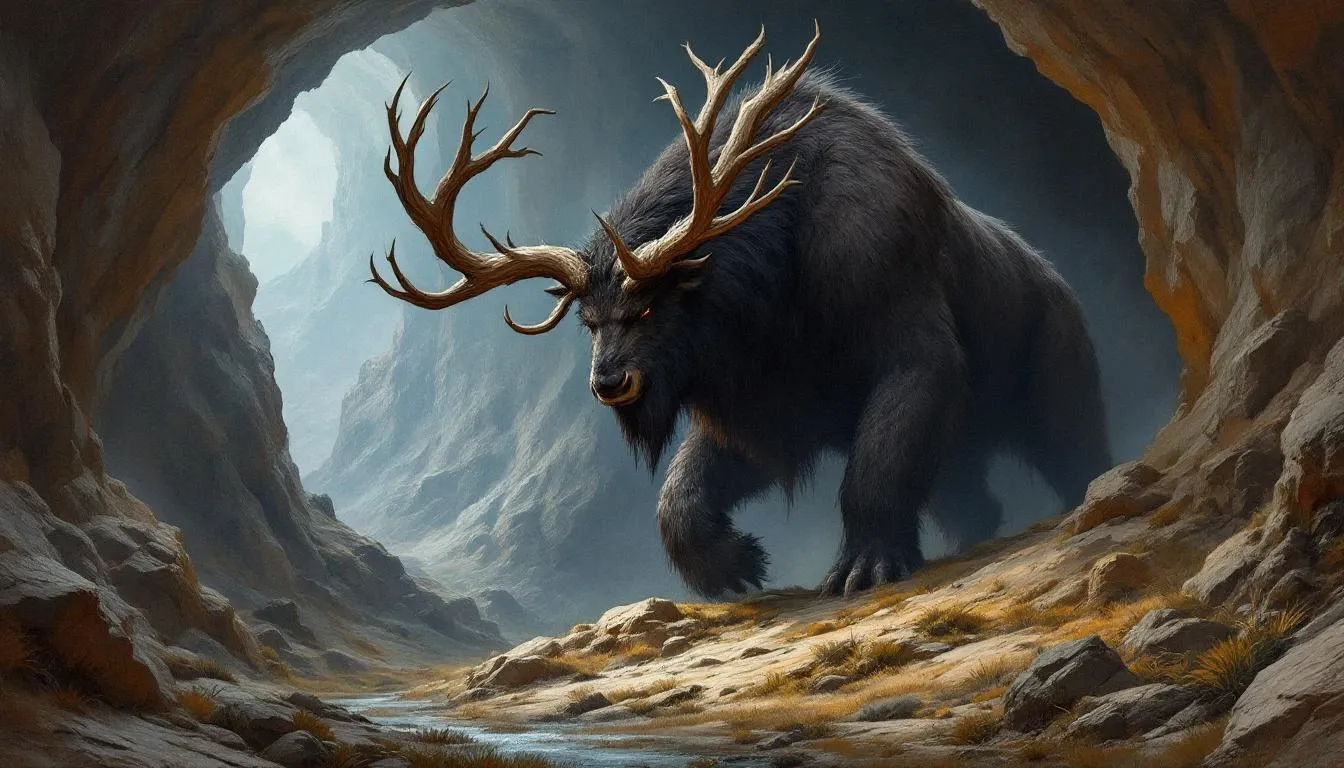
Describing the Indrik is an exercise in chimeric thinking. The creature resists a single clean image because the sources never settled on one. What they agreed on was that the Indrik was assembled from the most powerful parts of several animals, as though nature had tried to build one creature capable of ruling all the others and pulled from every available blueprint.
The body is most often described as that of a massive bull — not the domesticated kind, but something closer to the aurochs, the wild cattle that roamed European forests until the seventeenth century. The legs are a deer's: cloven-hoofed, capable of moving through mountainous and forested terrain with a grace that no bull should possess. The head belongs to a horse — long-skulled, intelligent-eyed, noble in the way that Slavic cultures have always considered horses noble.
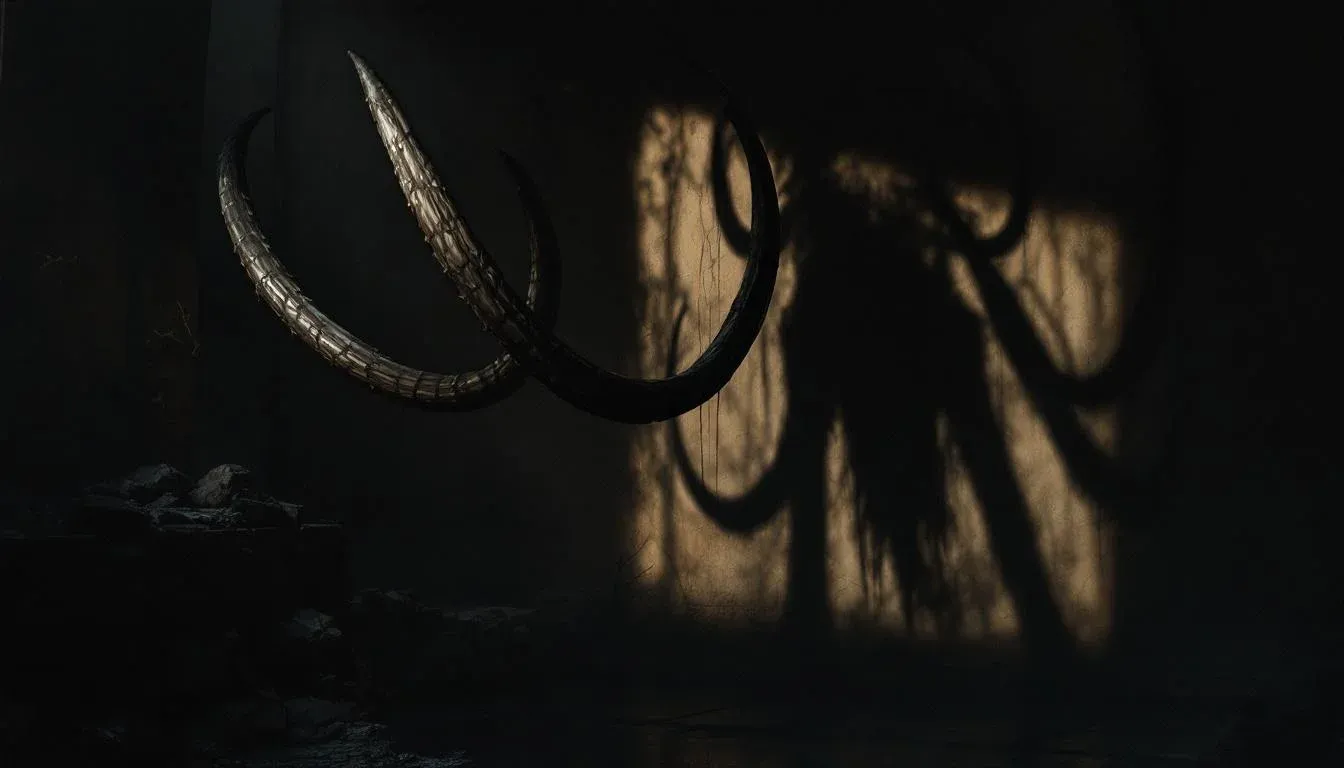
And then there is the horn. One horn, occasionally two, growing from the snout or forehead. In some tellings it is straight and sharp, a weapon capable of splitting bedrock. In others it curves slightly, spiraling upward like the horn of a narwhal — which is, not coincidentally, what most medieval Europeans believed unicorn horns actually looked like, because narwhal tusks were the physical objects most commonly sold as unicorn horns in marketplaces from Novgorod to Venice.
A few versions push the description further. Feathers appear on the body in some variants — not the full plumage of a bird, but patches of quill and down mixed in with the fur, as though the Indrik had begun transforming into something airborne and stopped partway through. Other versions credit it with wings, though the creature almost never flies in any tale. The wings, when present, seem more like a mark of divine status than a practical feature — the kind of detail you add to a creature to signal that it belongs to heaven even though it chooses to live underground.
Master of Underground Waters
The Indrik's most distinctive power is not its strength or its sovereignty over animals. It is its relationship with water.
According to the Golubinaya Kniga and the folk traditions surrounding it, the Indrik controls every subterranean water source on earth. When it walks beneath the mountains, its hooves strike the rock and split it open. Water pours through the cracks. These are the springs that feed rivers, the underground channels that fill wells, the aquifers that keep the land alive through drought. Every lake, every stream, every puddle in a forest clearing — all of it traces back, in this mythological framework, to the footsteps of a beast no one has ever seen.
This is not a metaphor the peasant communities who preserved these verses would have taken lightly. In the agricultural world of medieval and early modern Russia, water was survival. A spring drying up meant death for livestock and famine for families. The appearance of a new spring was close to miraculous. To say that all water came from a single sacred beast walking beneath the earth was to place the most essential resource in existence under divine protection — to make water not just a geological phenomenon but a gift from the king of all creatures, given freely every time it took a step.
The connection to earthquakes reinforces this. When the Indrik stirs, the earth shakes. This is not framed as destruction in the Golubinaya Kniga — it is the side effect of a creature so large and so fundamental that its smallest movement registers across the landscape. The earthquakes are not punishment. They are evidence of presence. The ground trembles because the king is awake, and when the king walks, the world feels it.
The Unicorn Problem
The word Indrik itself is a corruption. Linguists trace it to yedinorog — единорог in Russian — which translates directly to "one-horn," the standard Russian word for unicorn. Somewhere in the centuries of oral transmission, yedinorog got worn down, syllables dropped and swapped, until it became indrik or indrok — a word that sounds like a proper name rather than a description.
This etymological link has led to a long-running debate about whether the Indrik is the Slavic unicorn, a separate creature that absorbed unicorn characteristics, or something else entirely that got tangled up with unicorn lore through linguistic accident.
The Western European unicorn — the white horse with a spiral horn, symbol of purity, capturable only by a virgin — bears almost no resemblance to the Indrik. The Indrik is not white. It is not a horse. It is not associated with virginity or purity. It does not live in forests waiting to be lured into a maiden's lap. It lives underground, rules all animals by divine right, and spends its existence cracking open the earth's crust to release water. The only shared feature is the horn, and even that differs: the unicorn's horn is a symbol, the Indrik's is a tool.
What the Indrik does resemble, far more than any European unicorn, is the rhinoceros — or more precisely, the idea of a rhinoceros as described by someone who has never seen one. A massive body. Thick legs. A horn on the snout rather than the forehead. The possibility that early Slavic descriptions of the Indrik were influenced by travelers' reports of real rhinoceroses from Central Asia or India is taken seriously by several folklorists. The Silk Road trade routes passed through or near Slavic territories, and descriptions of exotic animals — garbled, exaggerated, filtered through multiple languages — were standard cargo.
But the most compelling real-world candidate for the Indrik is not the rhinoceros. It is something far older and far stranger.
The Mammoth Beneath the Mountain
In 1722, a Swedish officer named Philipp Johann Tabbert von Strahlenberg, held as a prisoner of war in Siberia, recorded something the local Khanty and Mansi peoples told him about the enormous bones that littered certain riverbeds. The bones, they said, belonged to a creature that lived underground. It was enormous. It could not survive on the surface — sunlight killed it. It moved through the earth the way a mole does, but on an unimaginable scale. When it surfaced accidentally, it died, and that was why its bones were found half-buried in riverbanks.
They were describing mammoths. Or rather, they were describing the only explanation that made sense for mammoth remains if you did not have access to paleontology. Massive bones embedded in the earth, too large for any living animal, found underground or in the walls of riverbanks — clearly, they belonged to a creature that lived beneath the surface. The Khanty word for mammoth, wes, carried the sense of an underground creature. The Yakut people called it ehe — a being of the lower world.
The Russian naturalist Sergei Usov, writing in the nineteenth century, proposed that the Indrik-Beast was, at root, a mammoth — or more precisely, a cultural memory of mammoth bones interpreted through a mythological lens. The parallels hold up under scrutiny. The Indrik lives underground. It is enormous. Its movement through the earth causes the surface to shake. It has a horn on its snout — which maps neatly onto a mammoth's tusk, curving outward from the face, especially if you are reconstructing the animal from bones alone and have no skin or muscle to guide you.
This theory does not require that East Slavic communities had direct contact with complete mammoth skeletons. Mammoth bones were found across Russia and Siberia for centuries. Ivory from mammoth tusks was a trade commodity. A single tusk, displayed in a village, combined with stories from travelers who had seen larger assemblages of bones in the east, would be enough to generate exactly the kind of composite creature the Indrik represents — enormous, underground, horned, powerful beyond reckoning.
The paleontological legacy persists in an unexpected place. In 1916, the Russian paleontologist Aleksei Borissiak named a newly discovered genus of giant hornless rhinoceros Indricotherium — directly after the Indrik-Beast. The animal, now classified as Paraceratherium, was the largest land mammal that ever lived, standing over five meters tall at the shoulder. Borissiak chose the name deliberately: a creature so massive that only the king of all beasts could serve as its namesake. The subfamily Indricotheriinae remains in use today, a permanent trace of Slavic mythology embedded in the formal taxonomy of paleontology.
The Holy Mountain and the World Tree
The Holy Mountain where the Indrik dwells connects it to one of the deepest structural features of Slavic cosmology: the vertical axis that links the three worlds.
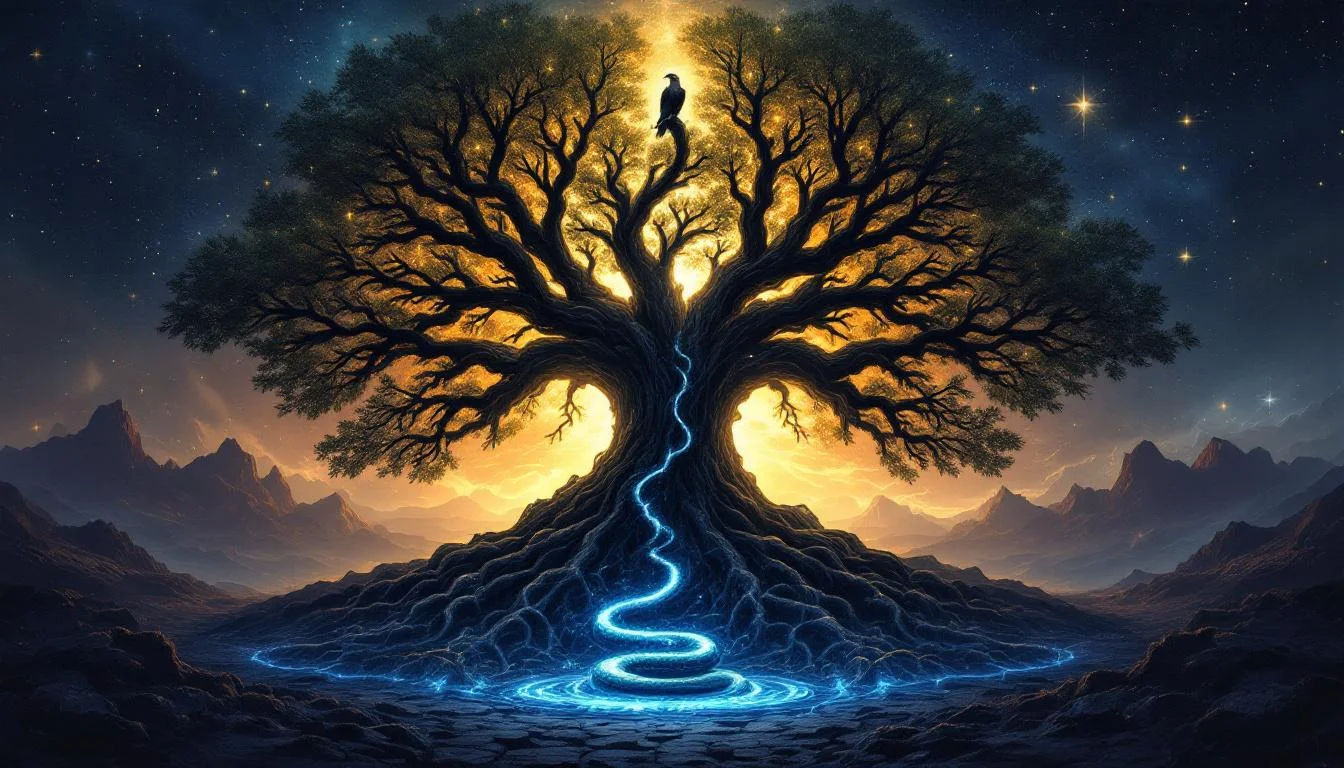
In the Slavic mythological system, the universe is organized around the World Tree — an enormous ash or oak whose crown reaches into the heavens (Prav), whose trunk stands in the mortal world (Yav), and whose roots descend into the underworld (Nav). The Holy Mountain functions as an alternative expression of this same axis. It is the point where the upper and lower worlds meet, the navel of the earth, the place where divine power is concentrated.
The Indrik's position on and beneath this mountain is significant. It does not simply live there — it moves between the surface and the underground, traversing the boundary between worlds the way the sun traverses the sky. The Golubinaya Kniga makes this comparison explicit: the Indrik walks through the underground as the sun walks through the heavens. It is a creature of the axis, a being whose natural habitat is the junction between worlds, comfortable in the depths that terrify mortals and sovereign over the surface it rarely visits.
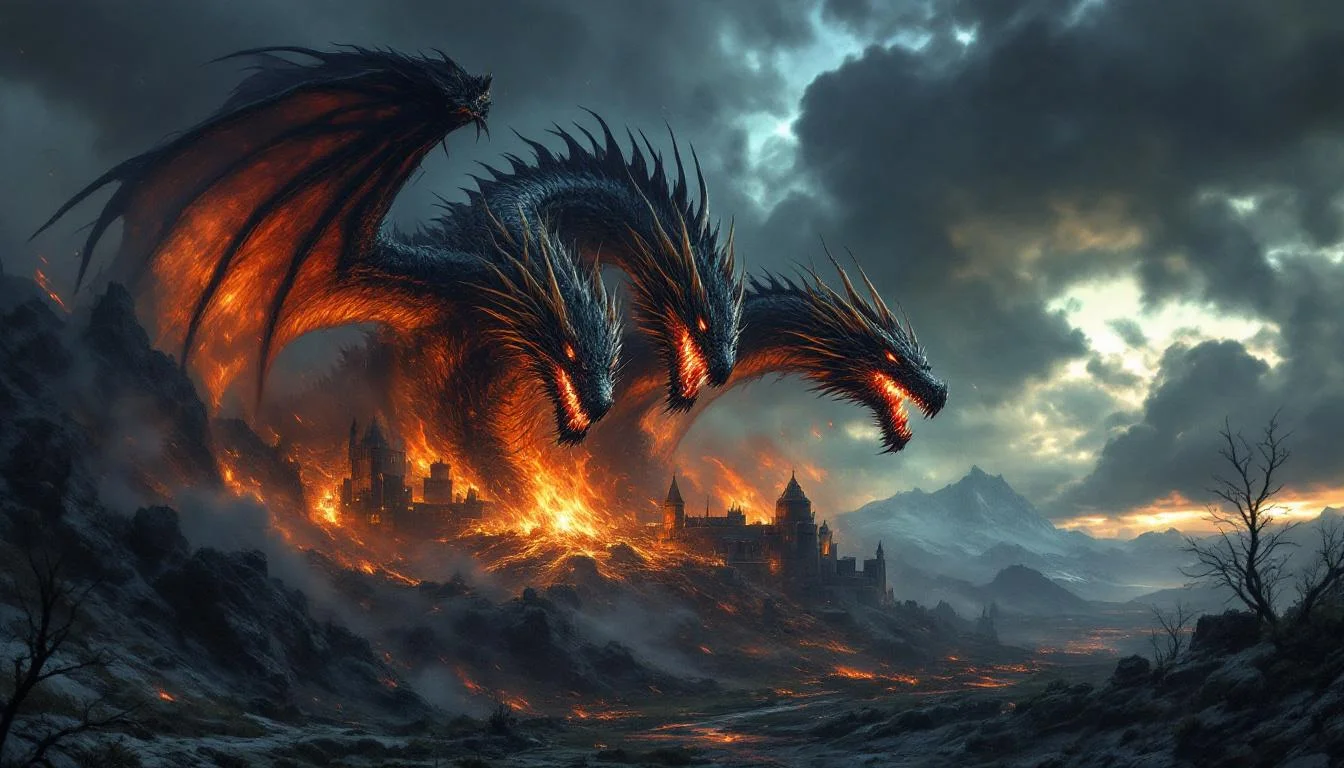
This places the Indrik in a cosmological role similar to — but distinct from — creatures like Zmey Gorynych, the multi-headed dragon that guards boundaries and hoards treasure. The Zmey is a creature of conflict, of fire and destruction, something heroes are sent to kill. The Indrik is a creature of order. It does not threaten the boundary between worlds — it maintains it. Its movement through the underground keeps the waters flowing, the earth stable, the animals alive. It is not a monster to be defeated. It is a king to be acknowledged.
Disappearing King
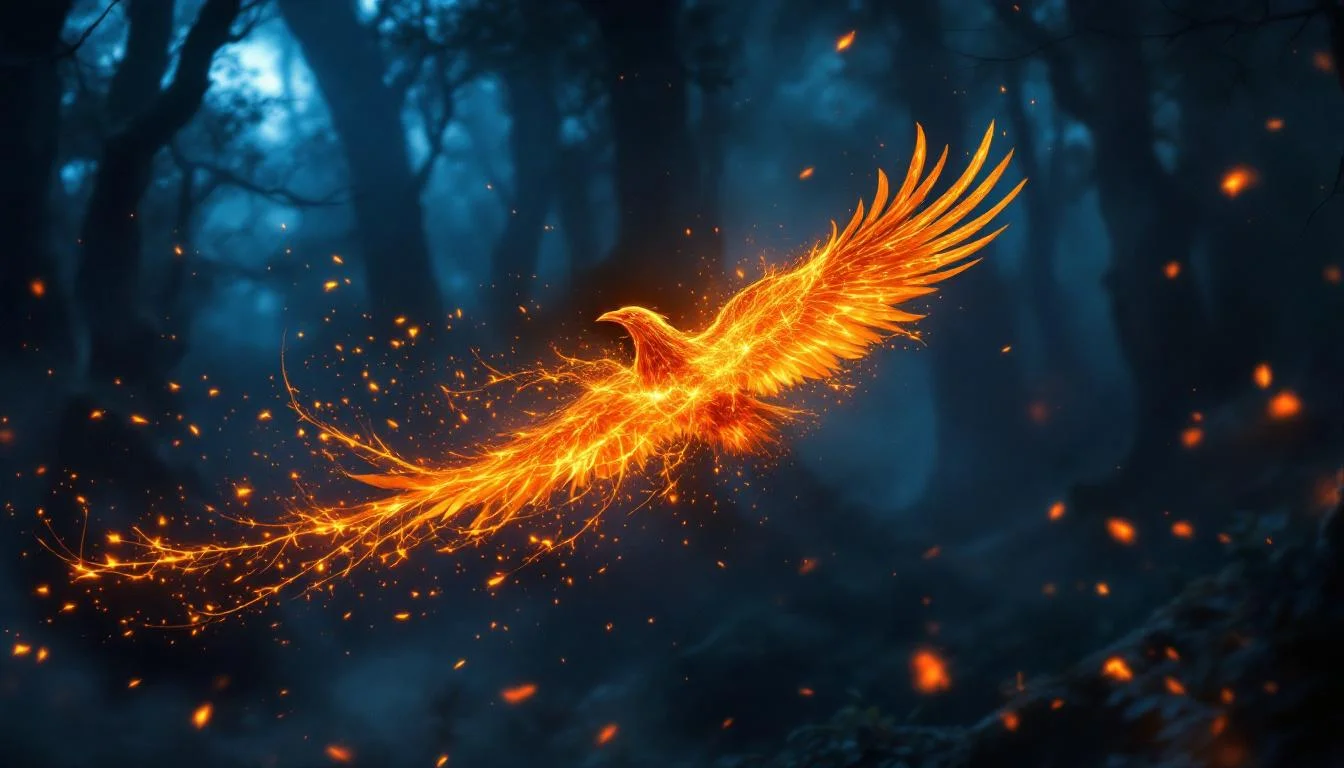
The Indrik holds a peculiar position in the broader landscape of Slavic mythology. It is declared the king of all animals in the most important cosmological text of the folk tradition — and yet it almost never appears in narrative tales. There are no great quest stories in which a hero sets out to find the Indrik, no princess rescued from its lair, no clever trick used to capture it. The Firebird has entire story cycles built around it. The Indrik has a title and a verse and then silence.
This absence is itself revealing. The Indrik belongs to the cosmological layer of Slavic thought — the stratum that explains how the world is structured, not the stratum that tells entertaining stories about heroes and villains. It shares this space with concepts like Rod (the primordial creative force), Prav and Nav (the upper and lower worlds), and the World Tree itself. These are not characters in tales. They are the architecture of reality. You do not tell stories about the foundation of a house. You build stories on top of it.
The Indrik is the foundation. It is the answer to the question "Who rules the animal kingdom?" — a question that the Golubinaya Kniga treats with the same cosmic seriousness as "Where does light come from?" and "What is the mother of all rivers?" The answer was not supposed to generate adventure narratives. It was supposed to settle something permanent about the way the world works.
And the answer is: beneath every river and spring, beneath every well and lake, there is a creature walking. It has walked there since before memory. It will walk there after everyone listening to the verse is dead. Its footsteps are the reason water exists. Its stirring is the reason the earth sometimes shakes. You cannot see it, you cannot reach it, and you should not try. It is the father of all beasts, the king of all animals, and it lives beneath the Holy Mountain where no other foot may tread.
The water in your well came from somewhere. The Indrik knows where.