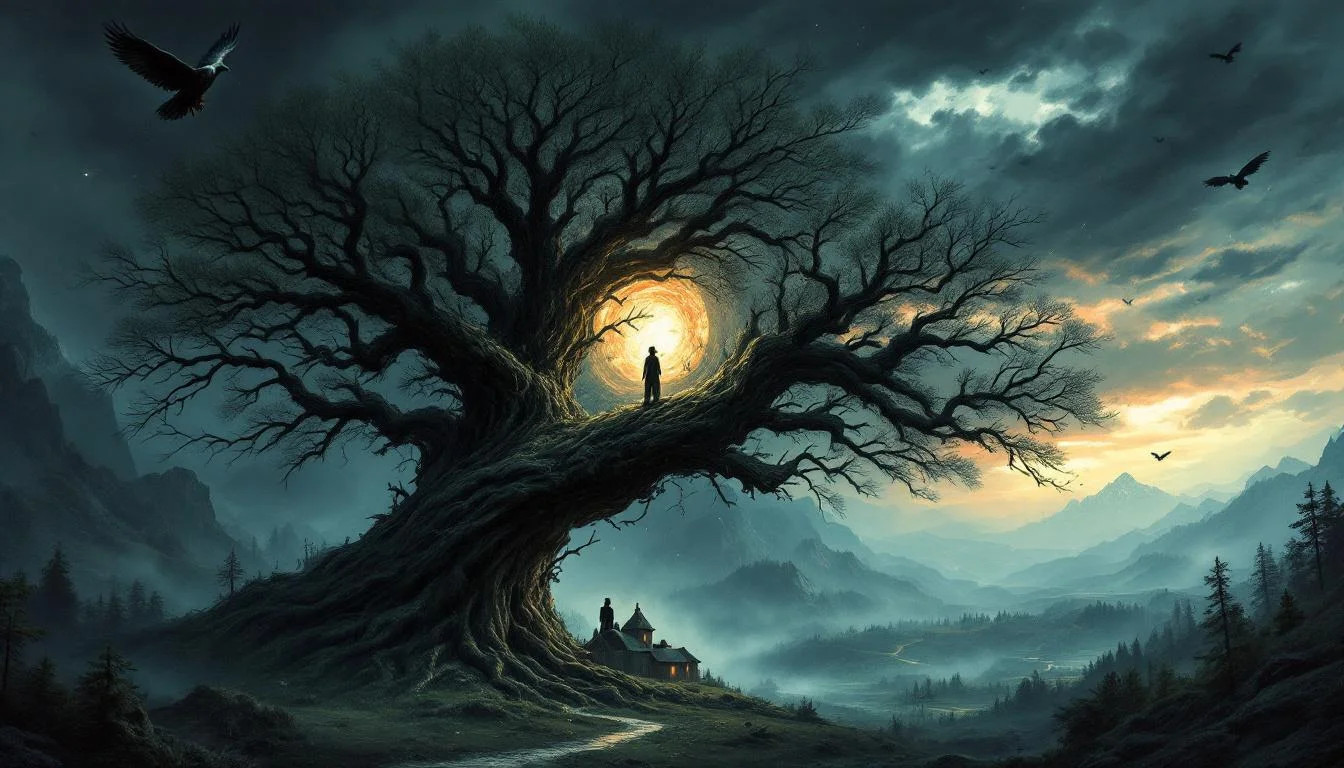
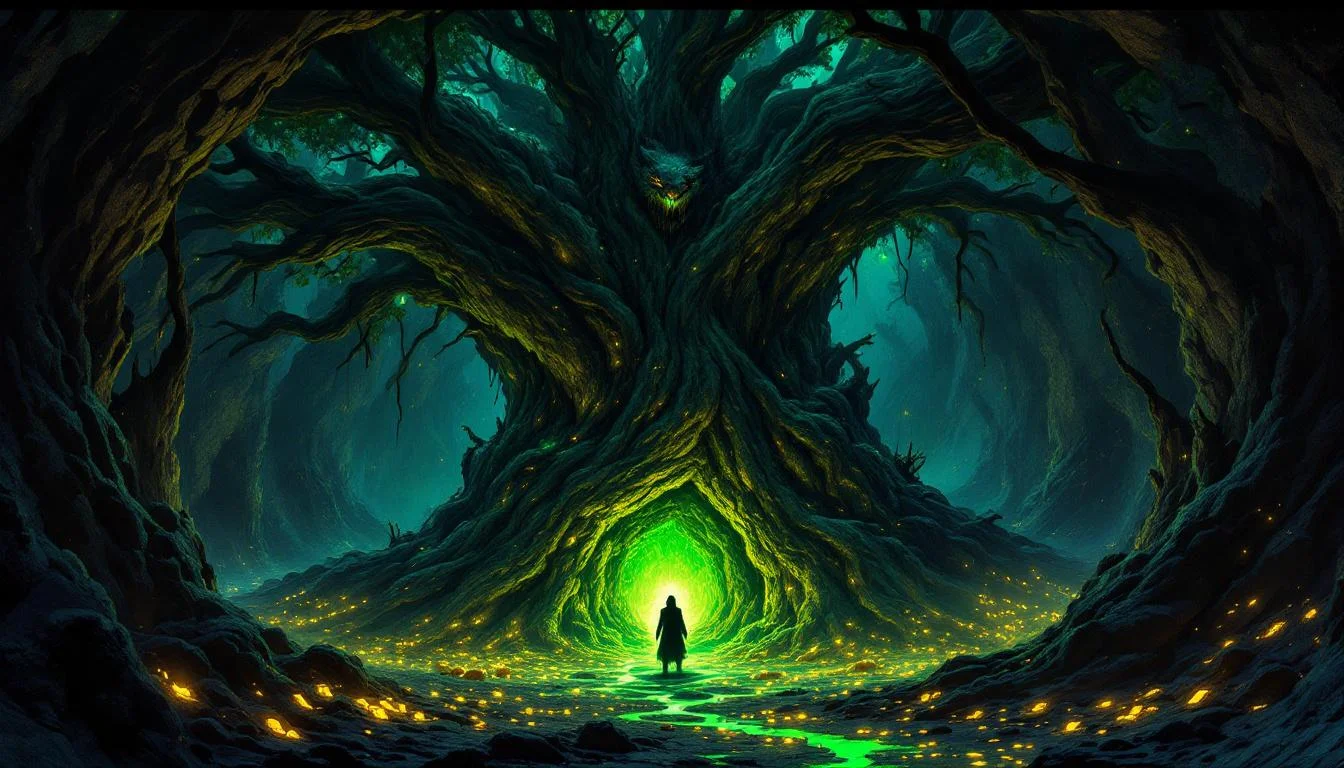
There is a tree that nobody planted. It has no sapwood ring that marks the year it started growing because it never started. It was always there. Its roots go down past rock, past water, past the memory of the earth, into a place where the dead walk slowly through wet grass and do not look up. Its trunk rises through the world where men plow and bleed and bury their children. Its branches disappear into a brightness that no mortal eye can hold — a realm where the laws of the universe sit carved in light, older than speech.
The Slavs called it the World Tree. They never agreed on a single name for it, because it was older than names. But they knew what it was made of. It was an oak — always an oak. The hardest, slowest-growing, most stubborn tree in the forest. The one that lightning strikes more than any other and that refuses to die from the blow.
Everything in the Slavic universe hung from this tree. The three realms. The gods. The dead. The living. The seasons, the storms, the harvest, the plague. If you understood the tree, you understood the structure of reality. If you did not, you were just a man standing in a field, wondering why it rained.
The Spine of the Universe
Every great cosmology needs an axis — a line that runs through the center of everything and holds the layers of existence in place. The Latin term is axis mundi, the world axis, and you find it in nearly every mythology that imagines the universe as a vertical stack of realms. The Norse had Yggdrasil. The Mesopotamians had a cosmic mountain. The Vedic Indians had Mount Meru. The Slavs had their oak.
The Slavic World Tree is the axis mundi of Eastern Europe. It connects the three worlds that make up Slavic cosmology: Yav, Nav, and Prav. The trunk occupies Yav — the middle world, the visible reality where humans live, where rivers run and grain grows and people die of ordinary things. Below, among the roots, lies Nav — the underworld, the realm of the dead, dark water, ancestral spirits, and chthonic forces that pull everything downward. Above, in the crown, stretches Prav — the upper world, the domain of celestial gods and cosmic law, the place where divine order is maintained.
This was not metaphor. The tree was not a philosophical diagram. To the Slavs, it was as real as the forest outside their settlements. When they looked at a great oak standing alone on a hill, split by lightning, they did not see a tree. They saw the shadow of the one that holds everything together.
The Oak of Perun
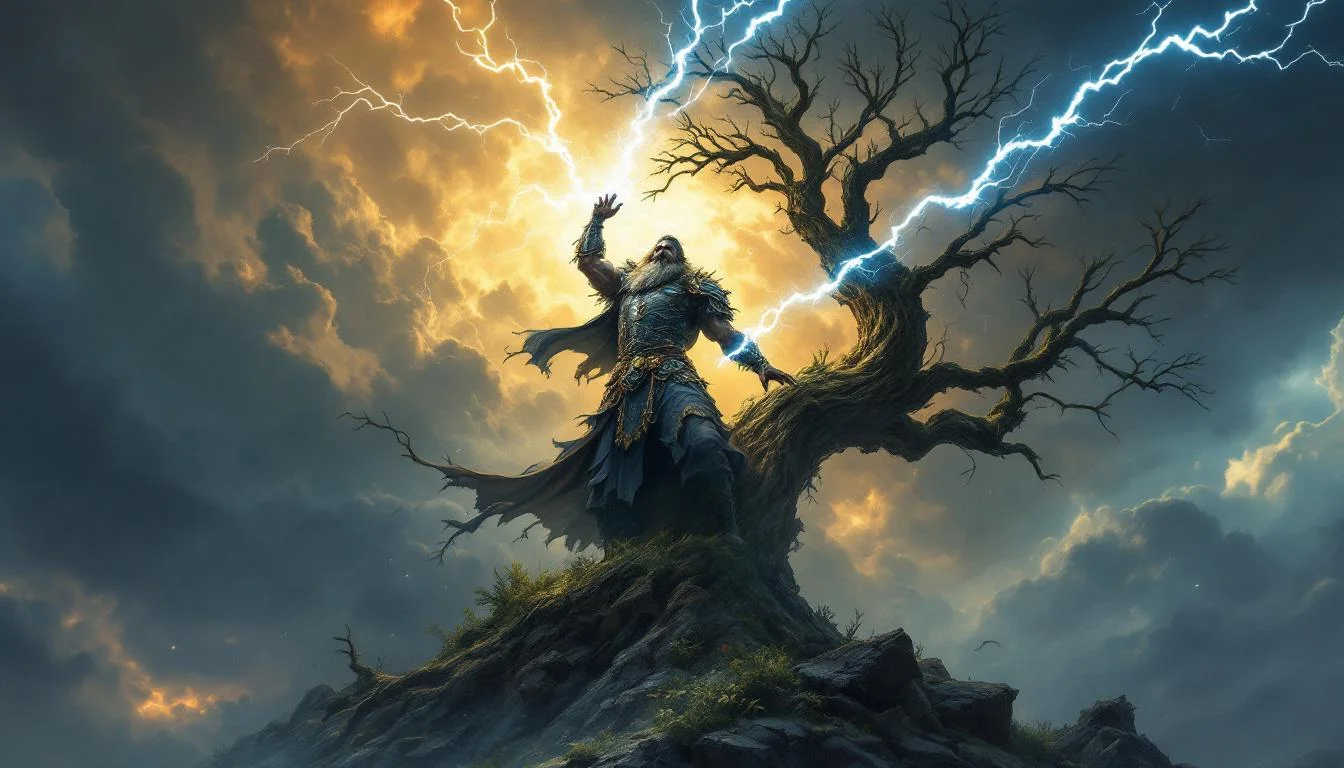
Not every tree could serve as the World Tree's earthly representative. Birches were sacred too, and lindens, and willows. But the oak held a position above all others. This was Perun's tree — the thunder god's own species, the one he chose to receive his lightning, the one he defended, the one that marked his territory on the earth.
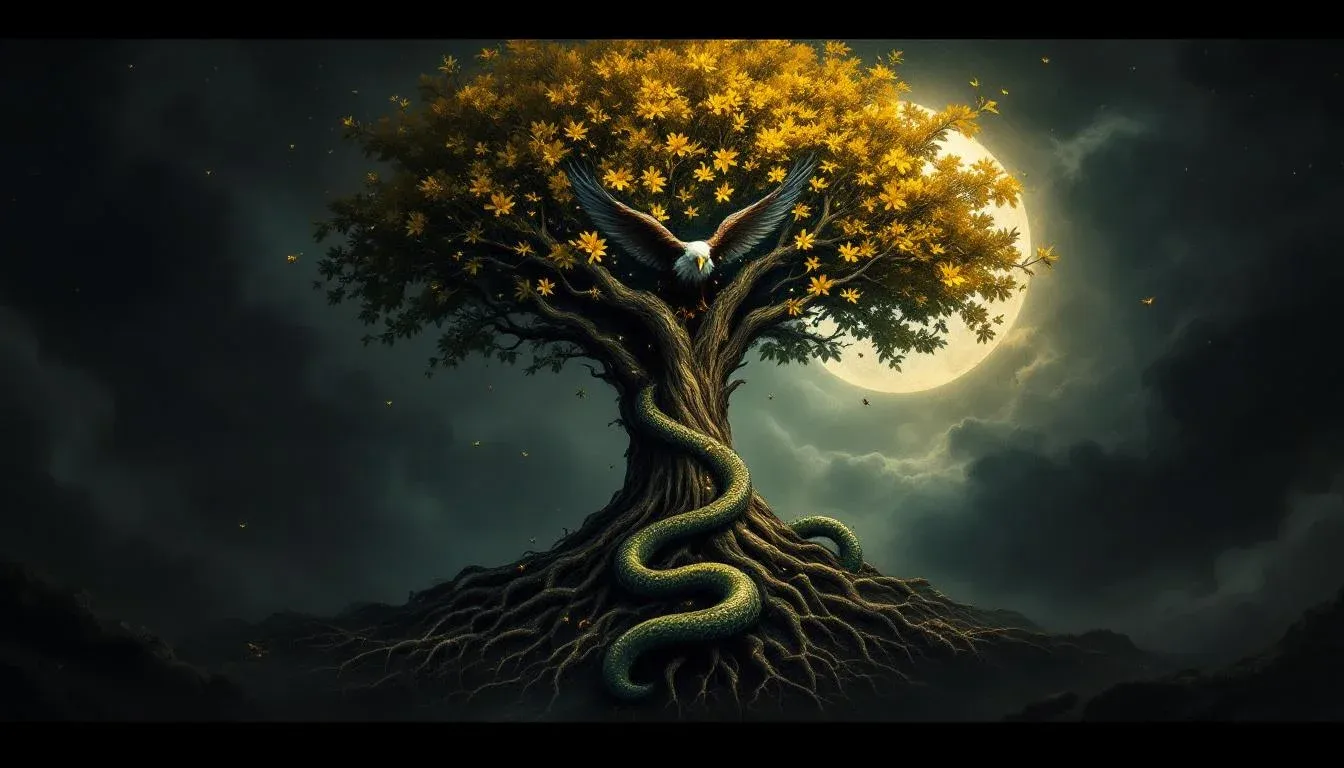
The connection between Perun and the oak was not poetic suggestion. It was structural. Perun ruled from Prav, the upper world, and his seat was the crown of the World Tree. In folk art, carved panels, and embroidery across every Slavic culture from the Balkans to the Baltic, the same image appears: a great oak with an eagle perched among its highest branches. That eagle is Perun. He sits at the top of the cosmos and looks down, watching for his enemy.
The Slavs treated living oaks with the reverence others reserved for altars. Procopius of Caesarea, writing in the sixth century, recorded that the Slavs worshipped sacred groves. Later accounts are more specific. Sacred oaks stood at the centers of ritual sites. People brought offerings — bread, grain, mead — and laid them among the roots. Oaths were sworn beneath oak branches, because an oath spoken under Perun's tree was heard by the god himself. Breaking such an oath meant inviting the thunderbolt.
The oak's role went beyond symbolism. Oaks are struck by lightning far more frequently than other trees — a fact that modern dendrology explains through their height, deep root systems, and high moisture content, all of which make them excellent conductors. The Slavs did not know the science. They knew the observation: lightning finds the oak. Therefore the oak belongs to the god of lightning. Therefore the oak is holy. The logic was airtight.
The Eagle and the Serpent
The most famous image in Slavic cosmology is the confrontation between the eagle at the top of the World Tree and the serpent coiled among its roots. This is the cosmic conflict between Perun and Veles, and it plays out vertically along the tree's trunk like a war fought on a ladder.
Perun — sky god, thunder lord, enforcer of divine order — takes the form of an eagle and perches in the crown. Veles — god of the dead, keeper of cattle and wealth, master of sorcery and shapeshifting — takes the form of a serpent or dragon and lives below, coiled among the roots in the wet darkness of Nav. Between them stretches the trunk, the middle world, the place where their war is felt as weather.
The myth, reconstructed by scholars Vyacheslav Ivanov and Vladimir Toporov from fragments preserved in folk songs, fairy tales, and ritual charms, goes roughly like this: Veles steals something that belongs to the upper world — cattle, water, sometimes a woman, sometimes the rains themselves. He drags his prize down among the roots. Perun responds with fury. He hurls thunderbolts down the trunk of the tree, splitting bark and shaking the earth. The stolen rain falls. The rivers swell. The serpent retreats deeper underground. Order is restored — until Veles steals again.
The thunder god strikes the serpent who has hidden beneath a tree, a stone, or in the water. The serpent flees, taking the form of various animals and people. The god pursues and strikes with lightning. When the serpent is struck, the waters are released and rain falls upon the earth.
This is not just a story about two gods fighting. It is a seasonal engine. Veles rising from the underworld represents winter, cold, and dormancy — the hoarding of moisture and warmth underground. Perun's assault represents the spring thunderstorms that break the grip of winter, release the rains, and make the fields green. Their eternal conflict is the cycle of the year, played out on the body of the World Tree.
The parallel with Yggdrasil is hard to miss. In Norse mythology, the dragon Nidhogg gnaws at the roots of the world ash while an eagle sits in its crown, and a squirrel named Ratatoskr runs up and down the trunk carrying insults between them. The structural similarity — eagle above, serpent below, cosmic tree in between — is not coincidence. It descends from a common Proto-Indo-European mythological framework. But the Slavic version carries its own weight. Nidhogg gnaws passively. Veles steals, schemes, and transforms. The Slavic serpent is not just a destroyer. He is a trickster, a hoarder, a god of the underworld who challenges heaven not out of malice but out of his nature. The conflict is not good against evil. It is order against wildness, sky against earth, structure against the raw chaos that feeds it.
The Stone at the Root
Beneath the World Tree, at the very base where the roots begin their descent into Nav, sits the Alatyr stone — the white stone, the stone of all stones, the navel of the earth. Russian folk charms and spiritual verses mention it constantly. It appears in healing spells, protection incantations, and the opening lines of magical formulae that were already ancient when the first collectors wrote them down in the eighteenth century.
"On the sea-ocean, on the island of Buyan, stands a great oak, and beneath the oak lies the white stone Alatyr, the father of all stones." This formula, or variants of it, appears in hundreds of recorded folk spells. The World Tree grows from Alatyr. Alatyr sits on Buyan, a mythical island in the primordial ocean — an island that appears and disappears with the tides, that exists at the center of the world and yet cannot be found by anyone who sails deliberately toward it.
From beneath the Alatyr stone flows a river of healing water that gives the whole world "food and healing," as the spiritual verses say. The stone is guarded by creatures — sometimes a wise serpent called Garafena, sometimes a mythical bird called Gagana. In some versions, the morning dawn herself rises from behind the Alatyr, and the four winds blow out from beneath it.
This layering is important: the World Tree does not simply grow from dirt. It grows from the most sacred object in creation, which itself sits on the most sacred place in creation, which itself floats on the primordial ocean that existed before the world had form. The tree's roots reach through every layer of sacred geography. When a village healer recited a charm that began "On the sea-ocean, on the island of Buyan," she was not decorating her words. She was tracing the path back to the base of the World Tree, plugging her small human spell into the power source of the cosmos.
The Tree in Cloth and Song
The World Tree did not survive only in myths told around fires. It survived in the hands of women who stitched it into fabric and the voices of people who wove it into song.
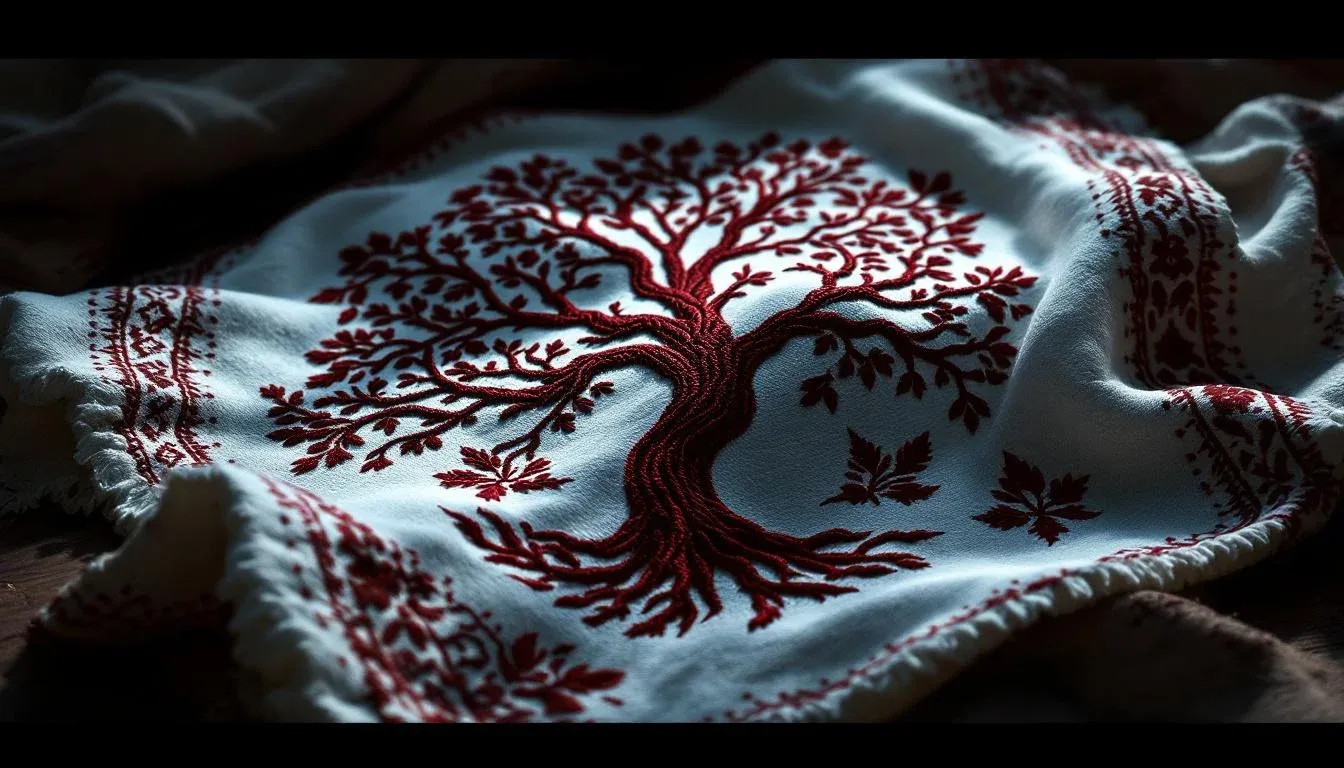
Slavic embroidery — the vyshyvanka tradition of Ukraine, the red-thread work of northern Russia, the cross-stitch patterns of Belarus and Serbia — is saturated with World Tree imagery. The motif appears as a central vertical form with symmetrical branches extending to either side, often flanked by birds, horses, or female figures. Sometimes the tree is geometric and abstract — a column of diamonds and zigzags. Sometimes it is recognizably a tree with roots, trunk, and crown. In both cases, the structure encodes the same cosmological idea: three zones stacked vertically, connected by a single axis.
These were not decorations. The embroidered World Tree appeared on ritual towels (rushnyky) used at weddings, funerals, and harvests — the three moments when the boundary between worlds was considered thinnest. A wedding rushnyk with the World Tree on it placed the new couple at the center of the cosmos. A funeral cloth guided the dead toward the roots. The tree was a map stitched in thread, and the women who made it were cartographers of the invisible.
Folk songs preserve the tree in a different register. In Russian and Ukrainian kolyadky (winter solstice carols), singers describe a golden oak or a green oak standing in the middle of the sea, with a falcon on its branch, a hive of bees in its trunk, and a beaver at its roots. The falcon represents the sky. The bees represent Yav, the living world, with its sweetness and labor. The beaver, a creature that lives between land and water, represents the boundary of Nav. The song is a compressed cosmology, sung at the darkest point of the year when the boundary between worlds was thinnest and the World Tree needed to be named aloud to remind the universe of its own structure.
Why the Tree Holds
Every mythology that lasts does so because it describes something people can feel, even when they cannot articulate it. The Slavic World Tree endures because the experience it describes is universal: the sense that reality has layers. That there is a world above us — call it fate, law, or the divine — that constrains what is possible. That there is a world below — call it the unconscious, the past, or the dead — that feeds and undermines us. And that we live in the middle, on the trunk, holding on.
The oak was the right choice for this metaphor. Not a willow, which bends. Not a birch, which peels and renews. An oak — which grows slowly, endures for centuries, stands alone on hilltops, takes the lightning strike and survives, and whose roots go as deep as its branches go high. The oak does not adapt. It persists. And persistence, in Slavic cosmology, is the highest virtue a structure can have.
The World Tree was never cut down. Christianization came and the sacred groves were felled, the idols burned, the holy oaks chopped for firewood by monks who believed they were destroying paganism. But the tree in the embroidery survived. The tree in the kolyadky survived. The tree in the healing charms survived. The formula "On the sea-ocean, on the island of Buyan, beneath the white stone Alatyr" was still being recited by village healers in the twentieth century, centuries after the missionaries had declared victory.
You cannot cut down a tree that was never planted. It was there before the axes. It will be there after.