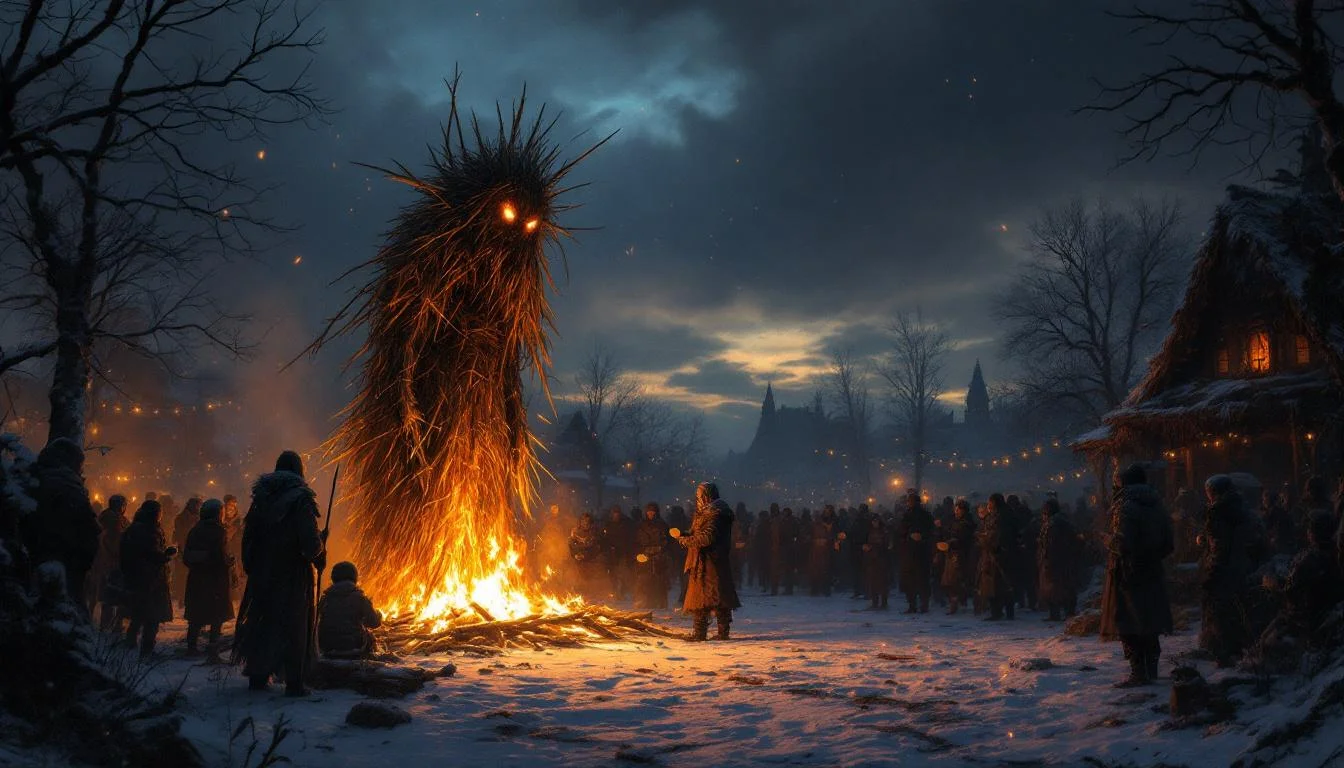
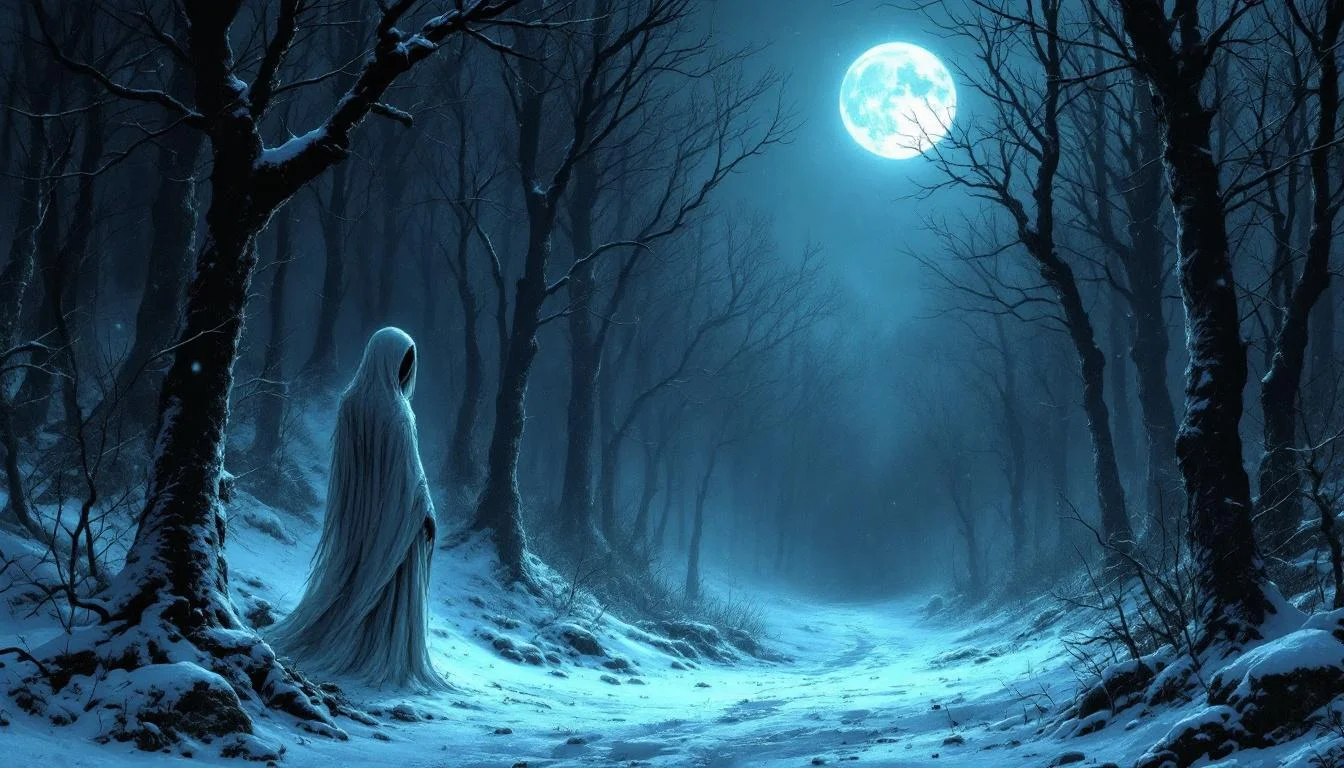
On the longest night of the year, in a village that has not yet heard of Bethlehem or Rome, a group of young men smear soot on their faces, pull sheepskin coats inside out, and strap a goat-skull mask onto the tallest among them. They light a candle inside a paper star mounted on a pole. Then they walk out into the frozen dark, their breath visible in the firelight, and begin to sing. The song is not a request. It is older than that — part blessing, part threat, part spell. The household that answers its door and gives food will be granted prosperity. The household that refuses will hear what the singers think of its stinginess, in verses that have survived a thousand years of transmission precisely because they are too sharp to forget.
This is Kolyada. Not Christmas. Not yet. Not for centuries. Kolyada is what came first — the Slavic solstice celebration that marks the death of the old sun and the birth of the new one, the annual pivot from dying light to returning light, observed across every Slavic culture from the Elbe to the Urals in forms so persistent that the Christian Church, after failing to suppress them, simply claimed them as its own.
The Name and the Argument
The word "Kolyada" — Коляда in Russian and Ukrainian, Каляда in Belarusian, Kolęda in Polish, Коледа in Bulgarian and Serbian — has provoked a scholarly argument that has been running for two centuries and shows no sign of resolution.
One camp derives it from the Latin calendae, the first day of the Roman month, which gave us "calendar." The argument runs that the word entered Slavic languages through contact with the Roman world, possibly via the Balkans, and attached itself to the winter festival because it fell near the calendae of January. The phonetic fit is clean. Polish kolęda preserves the nasal vowel of Proto-Slavic, placing it close to Old Church Slavonic usage and, by extension, to a plausible Latin borrowing.
The other camp points to the Slavic root kol-, meaning wheel or circle — the same root that gives Russian koleso (wheel) and the broader concept of the solar cycle turning through its annual circuit. In this reading, Kolyada is native: the turning of the wheel, the moment when the sun's circle reaches its lowest point and begins to climb again. Boris Rybakov, the Soviet archaeologist who spent decades reconstructing Slavic paganism from fragments, championed this interpretation, connecting Kolyada to a pre-Christian solar cult with deep roots in the Slavic agricultural calendar.
Neither side has won. Both etymologies are phonetically and semantically plausible. The truth may be that the word arrived from Latin and was immediately absorbed into existing Slavic concepts of circularity and solar return — a foreign word that sounded so much like a native one that the distinction ceased to matter within a generation.
Then there is the deity question. Was Kolyada a god? Some 19th-century Russian scholars — the Romantic nationalists, eager to populate the Slavic pantheon with figures to rival Odin and Zeus — described Kolyada as a solar deity, an infant god born at the solstice, personifying the newborn sun. Rybakov endorsed this view, cautiously. Modern scholars are less convinced. The consensus, to the extent one exists, is that Kolyada is a "pseudo-deity" — a festival name that was retroactively personified, the way English speakers might say "Old Man Winter" without believing in an actual frozen patriarch. The kolyadki songs invoke Kolyada by name, but they invoke it the way you might invoke a season: as a presence, not a person.
The debate matters less than the practice. Whatever Kolyada was or was not as a theological entity, what people did at Kolyada is documented with a consistency that makes the deity question secondary. And what they did was extraordinary.
The Shortest Day and the Longest Night
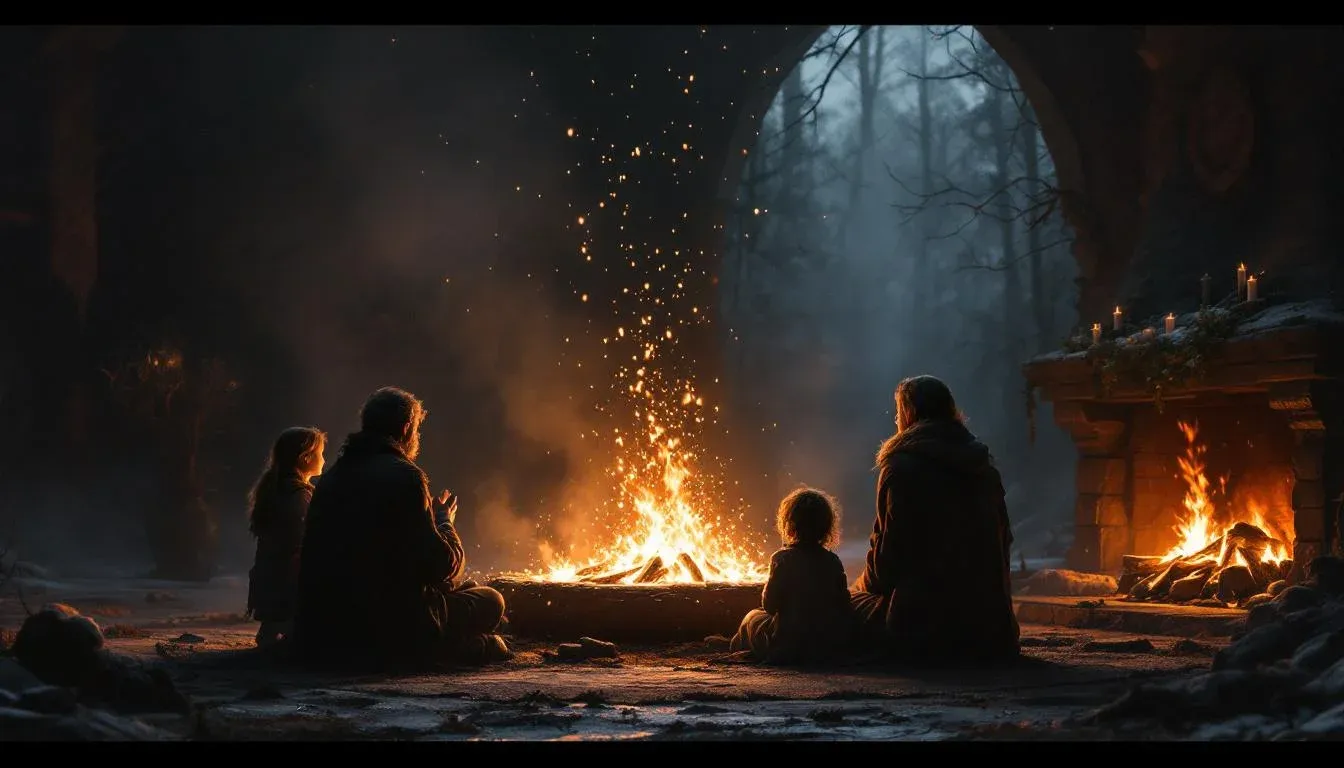
Kolyada was anchored to the winter solstice — December 21 or 22 in the modern calendar — and radiated outward from it in both directions, covering a period that different regions calculated differently but that generally lasted from the solstice through early January. This period was the hinge of the Slavic year. The sun, which had been weakening since the summer solstice at Kupala Night, reached its nadir. The days were shortest. The darkness was deepest. And then, imperceptibly at first, the light began to return.
The ancient Slavs understood this not as astronomy but as theology. The old sun had died. Morana, the goddess of winter and death, held the world in maximum grip. And out of the darkness, a new sun was being born — fragile, tiny, requiring human assistance to survive its first days. The bonfires of Kolyada were not celebratory. They were functional. Fire fed fire. Human flames helped the celestial flame grow strong enough to climb back up the sky.
The central fire ritual was the budnik — a log, usually oak, selected and prepared with care, sometimes sprinkled with grain or wine before burning. The budnik was lit on the evening of the solstice, and its behavior predicted the year to come. The further the sparks flew when the log was struck, the more abundant the harvest. In the South Slavic tradition, this became the badnjak — the Yule log that persisted so thoroughly into the Christian era that Serbian Orthodox families still burn one on Christmas Eve, having simply moved the date from the solstice to December 24 or January 6 depending on the calendar. The English Yule log tradition, often attributed to Norse influence, has a direct parallel in the Slavic badnjak, and there is good reason to think both descend from a common Proto-Indo-European solstice fire practice that predates the divergence of the Germanic and Slavic peoples.
The Koledari: Singing at the Threshold
If the budnik was the private ritual — the family gathered around its own hearth, tending its own fire — then the kolyadki were the public ritual, and they are the element of Kolyada that proved most indestructible.
Kolyadki are songs, but calling them songs understates what they were. They were incantations. The groups who performed them — koledari in the South Slavic lands, kolyadovshchiki in the East — went door to door through the village carrying a star on a pole (the new sun), often with a lit candle at its center, singing verses that combined praise for the household, blessings for the coming year, and thinly veiled demands for compensation. The format was ancient and rigid: approach the house, sing the prescribed verses, receive food and drink, move on. A household that gave generously received generous blessings. A household that refused received satirical verses so cutting that the social pressure to participate was absolute.
The kolyadki were not frivolous. In Belarus, the ethnographer Yelena Dovnar-Zapolskaya documented that the songs functioned as "incantations dedicated to chasing the old spirits away and wishes for a carefree, joyful, and bright time ahead." They addressed the cosmic situation directly: the old year is dying, darkness is at its peak, spirits are abroad, and the singing serves as a collective act of will — a community generating enough noise and light and good intention to help the sun through its crisis. The songs expressed "ancient people's ideas about creation, natural phenomena, and the structure of the world." They were folk cosmology set to music, and they were performed not for entertainment but for survival.
In Ukraine, the kolyadki tradition expanded to include the vertep — a portable puppet theater depicting the Nativity scene layered over older folk dramas, carried from house to house along with the singers. The vertep is a perfect artifact of syncretism: Christian on top, pagan underneath, the two layers so thoroughly fused that separating them is no longer possible or, arguably, meaningful.
The Mummers: Wearing the Other World
The most visually striking element of Kolyada was the costuming. The koledari did not simply walk through the village as themselves. They transformed. Sheepskin coats were turned inside out to show the fur. Faces were blackened with soot or hidden behind masks made from animal hides, bark, and straw. Horns were strapped to heads. One figure in the group was always the koza — the goat, a performer wearing a sheepskin coat and a mask topped with wheat-ear horns, who danced a specific dance that culminated in a ritual death and resurrection.
The goat's performance was not comedy. It was agricultural magic. The goat died — collapsed to the ground mid-dance — and was revived by the other performers, who sang it back to life. Death and resurrection, played out in a doorway on the longest night. The goat symbolized the grain cycle: the seed that falls into the earth, dies, and returns as new growth. Its death-and-revival mirrored the sun's own trajectory — dying at the solstice, reborn in the days that followed. The household that witnessed the goat's resurrection was receiving a promise: life will come back. The fields will grow. The dark does not last.
Other masks represented bears, wolves, storks, and figures of the dead — ancestors returning from the otherworld during the thin time between years. The purpose was double. By wearing the masks of spirits, the performers became those spirits, channeling ancestral power into the community. And by embodying the supernatural themselves, they kept the real spirits at bay — a pre-emptive occupation of the threshold between worlds. If the doorway was already full of controlled, friendly spirits, the uncontrolled ones could not get through.
Women were excluded from the main koledari processions in many regions. The masked procession was a male ritual, connected to warfare, boundary-protection, and the aggressive magic of driving off hostile forces. Women had their own Kolyada work, and it centered on the most dangerous activity of the season: divination.
Svyatki: The Dangerous Twelve Days
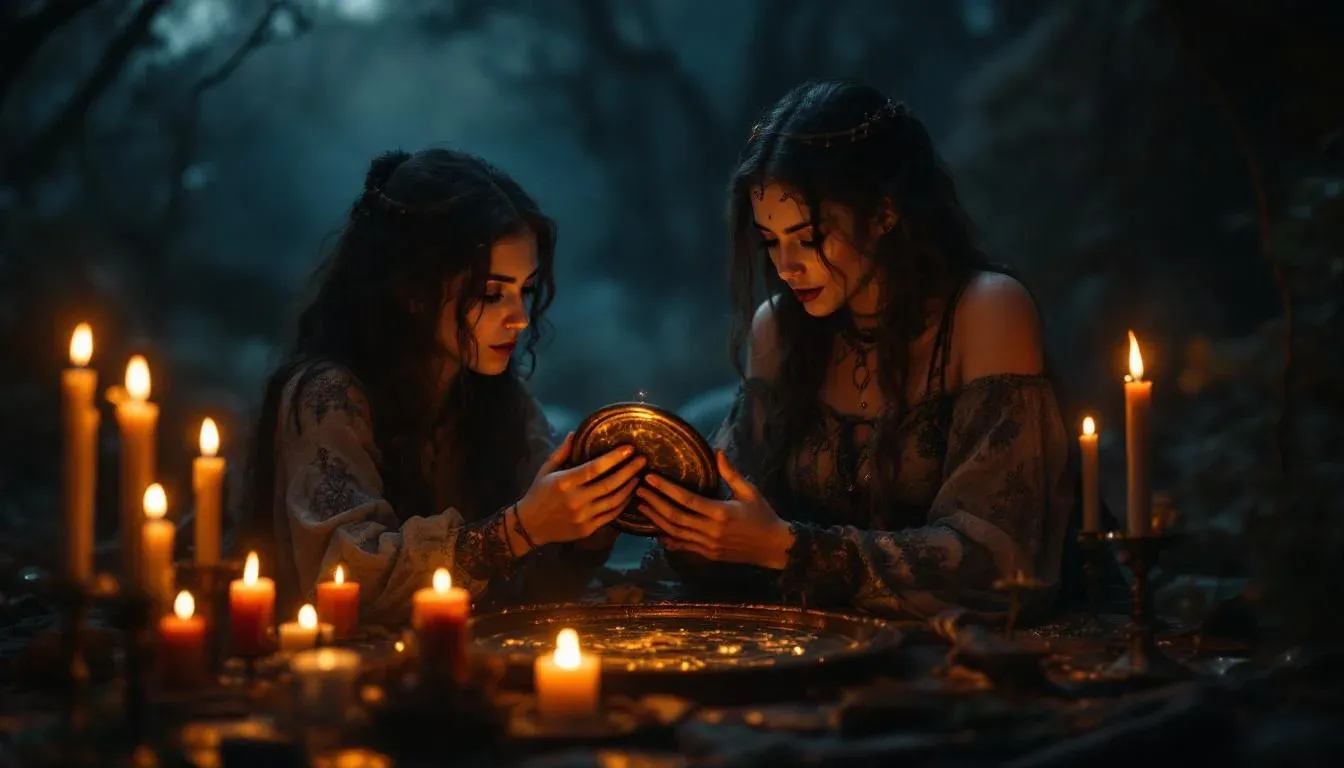
The period from the solstice through January 6 — known as Svyatki (Holy Days) in the East Slavic world — was the prime season for divination. The logic was straightforward: the boundary between the human world and the spirit world was thinnest during the sun's absence. Spirits could see the future. If you knew how to ask, they would show it to you.
Young women gathered in groups after dark — in the banya (bathhouse), in empty barns, at crossroads — and performed divination rituals of escalating intensity. The mild versions involved interpreting shapes in candle wax dripped into water, or listening for the first name spoken by a passing stranger (which would be the name of the future husband). The intermediate versions involved placing two mirrors facing each other to create an infinite corridor of reflections, then staring into the tunnel of glass until the face of the future husband appeared. The serious versions required going alone, at midnight, to a place where the dead were known to gather — a crossroads, a cemetery, the threshold of an empty house — and waiting.
These were not parlor games. The ethnographic literature records genuine terror. Women fainted, screamed, and fled. Pushkin's Eugene Onegin describes Tatyana performing Svyatki divination, and the passage reads not as quaint folk color but as psychological horror — a young woman alone in the dark, attempting to make contact with forces she cannot control.
Tatyana, crediting the lore of simple Russian folk of old, believed in dreams, in card divining, and the predictions of the moon. Omens disturbed her deeply: every object had a hidden meaning, presentiments oppressed her heart.
The fortune-telling varenyky (dumplings) were a gentler form of divination, but the stakes still felt real. Hidden inside the dumplings were tokens — a coin for wealth, a ring for marriage, a pepper for excitement, a button for improvement, a cherry stone for a baby, a bay leaf for fame. You bit into your future and chewed.
Ritual Foods: Kutya and the Ancestors
Kolyada's ritual table was built around kutya — a porridge of wheat berries, poppy seeds, dried fruit, nuts, and honey that was obligatory on the solstice evening. Kutya was funeral food. The same dish was served at wakes and memorial meals for the dead. Its presence at the Kolyada table was not accidental. The solstice feast was a meal shared with the ancestors, and kutya was their portion.
A place was set at the table for the dead. An extra bowl of kutya, a cup of uzvar (dried-fruit compote sweetened with honey), a spoon laid face-down. The family ate in the presence of its ghosts. The didukh — a decorative sheaf of wheat — was brought into the house and installed in the "beautiful corner" (the place of honor, where icons would later go), representing the grandfather spirit, the collective ancestor. The didukh stayed from the solstice until spring, a silent guest presiding over the household's winter.
The quality of the kutya was an omen. If it cooked well — plump grains, the right consistency, the honey blending smoothly — the year ahead would be good. If the batch went wrong — grains splitting, porridge scorching, honey refusing to dissolve — the year would be difficult. A truly ruined batch was not eaten but thrown out, and the household braced itself.
Beyond kutya, the solstice table included special koleda bread, bliny (pancakes), apples for health and beauty, nuts for strength and prosperity, and whatever meat and preserved foods the family could afford after the autumn slaughtering season. The feast was abundant by design. Scarcity at the solstice table predicted scarcity in the fields. You ate your way into a good harvest.
What the Church Did and Could Not Do
The Christianization of the Slavic lands — beginning with Bulgaria in the 9th century, Kievan Rus in 988, and Poland in 966 — did not end Kolyada. It relocated it. The solstice celebration was grafted onto Christmas, the caroling was rebranded as praise for the Nativity, the star on the pole became the Star of Bethlehem, and the kolyadki gradually acquired Christian verses alongside the older pagan ones. In Ukraine, songs honoring Dazhbog and Veles gave way to songs honoring Saint Nicholas and the Christ child. The melodies stayed. The door-to-door structure stayed. The goat stayed. The masks stayed. The divination stayed, despite explicit clerical condemnation.
The Church's problem was structural. Kolyada was not a single practice that could be isolated and banned. It was a system — a network of interconnected rituals (fire, song, masking, divination, feasting, ancestor veneration) that reinforced each other and filled a calendrical position that no Christian holiday could fully occupy. Christmas provided the birth narrative. It did not provide the solstice fire, the masked procession, the door-to-door incantation, or the communion with the dead. The Slavs needed those things. They kept them, wearing a thin Christian costume that fooled no one and was not, perhaps, intended to.
The result is a palimpsest. Modern Kolyada celebrations — whether on December 25, January 6, or January 7, depending on the country and the calendar — contain layers that can be peeled apart by anyone who knows what to look for. The star is Bethlehem's and also the newborn sun's. The songs praise Christ and also the turning of the wheel. The feast feeds the family and also the dead. The mummers represent Biblical figures and also the ancestral spirits who walk freely during the thin days between the old year and the new.
Maslenitsa endured because the Church adopted it. Kupala Night endured because the Church failed to suppress it. Kolyada endured because it became Christmas — not replaced by Christmas, but fused with it so thoroughly that the seam is invisible unless you know where to look. And the seam is everywhere.
What Survives
In Ukraine, kolyadky singing has been recognized by UNESCO as Intangible Cultural Heritage. Groups still go door to door on Christmas Eve, carrying the star, singing the songs, performing the vertep. In Belarus, Kalyady remains a major cultural event. In Bulgaria and North Macedonia, koledari — groups of young men in traditional costume — still process through villages on Christmas morning, singing the old songs. In Serbia, the badnjak still burns on Christmas Eve, oak logs still carried into churches and homes, sparks still interpreted as omens.
In the Slavic Rodnovery movement — the modern reconstruction of pre-Christian Slavic religion — Kolyada is observed on the astronomical solstice, stripped of Christian additions, returned to its oldest accessible form: fire, song, masks, and the birth of a sun that has no name but light.
The holiday survives because the solstice does not move. The sun still reaches its lowest point. The longest night still comes. And something in the human nervous system, deeper than theology and older than any calendar, responds to the return of light with fire, with singing, with food shared in the dark, with the irrational conviction that what we do on the threshold matters — that the songs carry weight, that the fire helps, that the dead are listening, that the wheel will turn.
It always turns. The koledari knew it would. They sang anyway, because the singing was the turning.