In a village in the Novgorod region, sometime in the late 17th century, a woman's cow stopped giving milk. The cow was healthy. It ate. It drank. But every morning the bucket came up dry, and the woman knew — with a certainty that no amount of veterinary reasoning could dislodge — that someone had done this to her. Not disease. Not drought. A person. A neighbor. Someone who knew the words.
She went to a woman at the edge of the village — old, lived alone, kept herbs drying in bundles from her ceiling beams, was known to mutter over water before giving it to the sick. The old woman listened, whispered something over a cup of well water, blew on it three times, told the first woman to sprinkle it on the cow's udder before dawn. The cow gave milk the next morning. Neither woman considered what had happened to be supernatural. It was simply how things worked.
This is Slavic magic. Not theatrical sorcery. Not sanitized neo-paganism. It was a technology — practical methods for manipulating the forces that governed illness, weather, fertility, luck, love, and death. It operated through spoken words, gathered plants, iron and salt, water and fire, and the knowledge of people who had inherited these methods across generations so deep that no one remembered when they began.
The Ones Who Know: Vedma and Vedmak
The Slavic word for witch — vedma in Russian and Ukrainian, wiedźma in Polish — comes from the Proto-Slavic root věděti, meaning "to know." A vedma was not someone who had made a pact with dark forces. She was someone who possessed knowledge. The male equivalent, vedmak (or vid'mak in Ukrainian), carried the same etymology. The English word "witch" suggests something alien and threatening. The Slavic word suggests something closer to "the one who knows what you don't."
This distinction shaped how Slavic communities understood magical practitioners. The vedma was not an outsider by definition. She could be your neighbor, your aunt, the midwife who delivered your children. What separated her from ordinary people was access to a body of inherited knowledge — the correct words to speak over an illness, the right herbs to gather on the right night, the precise gestures that activated a charm. The knowledge passed along family lines and through apprenticeship, the same way blacksmithing or weaving did.
She occupied an ambiguous social position. She was feared — because anyone who could heal could also harm, and the line between a zagovor (charm) that cured fever and one that caused it was a matter of intention, not technique. But she was also essential. When your child was sick, when your livestock were cursed, you went to the vedma. You brought her gifts — bread, cloth, sometimes money. You did not call her evil. You called her necessary.

Zagovory: The Technology of the Spoken Word
The most important tool in Slavic folk magic was the human voice. The zagovor (plural zagovory) — a spoken charm, incantation, or verbal formula — was the backbone of the entire system. The Russian word comes from the root govor ("speech"), and the Ukrainian equivalent, zamovliannia, carries the same root: mov, meaning speech. Magic, in the Slavic understanding, was fundamentally a verbal act.
A zagovor was not improvised. It was a fixed text, memorized precisely and transmitted from practitioner to practitioner with the same fidelity that monks applied to copying scripture. A mispronounced syllable, a skipped phrase, a hesitation in the wrong place — any of these could render the charm useless or turn it against the speaker.
The structure followed a pattern traced back to pre-Christian prayer forms. It began with an opening formula — often a journey narrative: "I shall rise early, I shall go out into the open field." The speaker described arriving at a sacred location — an island in the ocean, a stone on a mountain — and encountering a powerful figure. Then came the request, the command for the illness or misfortune to depart, and a locking formula: "My word is firm. My word is a lock. The key is thrown into the ocean-sea."
What makes zagovory significant is how seamlessly they absorbed Christianity. An 18th-century zagovor might begin with a pagan journey to the island of Buyan — a mythical place that appears nowhere in Christian theology — and then invoke the Virgin Mary to perform the healing. The Christian saints functioned as power sources plugged into a pre-Christian circuit board. The names changed. The mechanism did not.
The zagovor was the principal instrument of Russian folk magic, fulfilling the same role as the written spell in Western European traditions. Its power resided not in any physical medium but in the spoken word itself — precisely formulated, precisely delivered, and sealed with a verbal lock that bound the forces invoked.
Herbal Magic: What the Earth Provided
If zagovory were the software of Slavic magic, herbs were the hardware. A healing charm was spoken over a prepared herb, or while gathering it, or while administering it to the patient. Words without herbs lacked material force. Herbs without words lacked direction. The system required both.
The most potent herbs were gathered on Kupala Night — the summer solstice — when the earth's fertility was believed to charge every growing thing with maximum magical potency. Women went out before dawn, barefoot, whispering zagovory over each plant as they cut it. St. John's wort (zveroboy, literally "animal-killer" in Russian) drove off evil spirits and healed wounds. Mugwort (chernobylnik) protected against witchcraft — worn at the waist when jumping over the Kupala bonfire. Wormwood (polyn) was the supreme defensive herb — hung over doorways, stuffed into pillows, scattered at thresholds to block the entry of demons. Yarrow, lovage, fern fronds, and periwinkle each had specific applications, and the knowledge was local and granular.
The fern flower — the tsvetok paporotnika — occupied a special place. Ferns do not flower. Every botanist knows this. Every Slavic peasant knew it too. That was precisely the point. The fern flower that supposedly bloomed for a single instant on Kupala Night, glowing like a coal in the forest darkness, was the ultimate magical prize — whoever found it could see buried treasure, understand the speech of animals, and command the spirits of the earth. A quest defined by its impossibility, undertaken anyway.
Protective Magic: The Village Fortress
Most daily magic was defensive. Ordinary people maintained a constant, low-level system of protective measures so embedded in life that they did not think of it as magic. It was simply what you did.
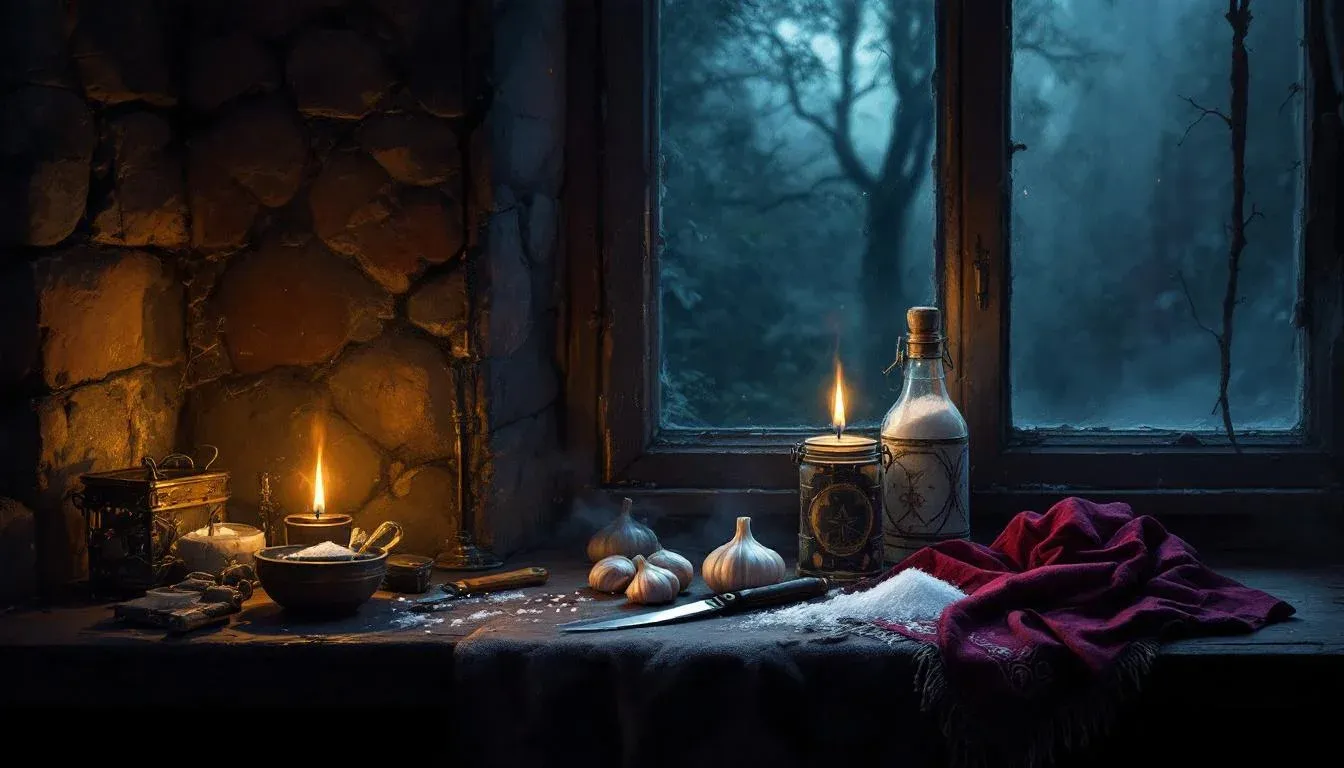
Iron was the first line of defense. A knife under a baby's cradle protected the infant from evil spirits. An iron nail in the threshold prevented demons from entering. Scissors left open near a sleeping child cut the thread of any curse aimed at it. The logic was old: iron, the metal of weapons, was hostile to spirits that belonged to an older, pre-metallurgical world. The chort could not cross it. The rusalka recoiled from it.
Salt was the second defense. It absorbed evil the way a sponge absorbs water. People carried small bags of salt as talismans. Salt was thrown over the left shoulder — toward the devil, believed to stand behind you on that side. A line of salt across a doorway prevented hostile magic from entering.
Garlic served a parallel function across the southern and western Slavic lands, particularly where vampire belief was strong. The Slavs did not think garlic repelled spirits because of its odor. They believed it carried an intrinsic spiritual force hostile to the unclean dead.
Every household maintained its own arsenal: embroidered protective patterns on shirt collars and sleeves (the geometric designs were not decorative — they were barriers), crosses carved at every doorway, wormwood and nettles above stable doors, aspen stakes in fence posts. The Domovoy — the household spirit — was fed with offerings of bread and milk left behind the stove. The boundaries of the home were spiritual fortifications, and maintaining them was as routine as feeding the animals.
Porcha: The Dark Side
Porcha — the curse, the spoiling — was the great fear of village life. The word comes from the verb portit' ("to spoil"), and it described hostile magic targeting a person's health, livestock, crops, marriage, or luck.
The evil eye (sglaz) was the simplest vector — an envious glance that transmitted harm without ritual. More deliberate porcha involved burying cursed objects — knotted cords, animal bones, nails wrapped in black thread — under a victim's doorstep. A skilled vedma could send porcha through food, a handshake, or spoken words aimed at the victim's back.
Diagnosis used divination: melting wax into cold water produced shapes the healer interpreted. Rolling an egg over the victim's body and cracking it into water revealed the curse's nature by the patterns the yolk formed. Dark or bloody meant severe porcha. Clear meant natural illness.
The cure was a counter-zagovor combined with physical purification — washing with charmed water, fumigation with burning herbs, stepping over an iron object — and the healer's spoken words commanding the curse to return to its sender or dissolve into the elements.
Volkhvy: The Old Priests and Their Divination
Before the vedma inherited the fragments of magical knowledge, there were the volkhvy — the pagan priests of pre-Christian Slavic society. They maintained the temples, led the rituals, performed the sacrifices, and practiced divination.
The first written mention of a volkhv appears in the Primary Chronicle under the year 912, where a volkhv predicts Prince Oleg's death from his own horse. The prophecy comes true — Oleg is bitten by a snake that crawls from the horse's skull — and the story's placement in the chronicle suggests that even Christian scribes treated the volkhvy's power as genuine, if demonic in origin.
Their divination methods — gadanie — were varied. They cast lots, throwing marked sticks or bones. They examined animal entrails. Among West Slavic tribes, a sacred horse was led between angled lances: if it stepped out with its right leg each time, the omen was favorable. They entered altered states through chanting, drumming, or ingesting particular herbs, and communicated with the spirits of the dead.
The Primary Chronicle records volkhvy-led uprisings in the Novgorod and Rostov regions as late as 1071 — nearly a century after Vladimir's baptism of Kyiv. The uprisings were suppressed. The volkhvy were killed or driven underground. But their knowledge fragmented and resurfaced in the practices of village healers, midwives, and wandering znakhari who carried pieces of the old system into the modern era.
Divination survived among ordinary people too. On Kupala Night, girls floated wreaths on the river and read marriage prospects from how the wreaths behaved. During winter Svyatki, young women sat between two mirrors in a dark room, gazing into the infinite regression of reflections, waiting for a future husband's face to appear. At Baba Yaga's crossroads — where three or more paths met — divination carried particular power and particular danger, because the spirits who answered your questions were not obligated to be kind.
Dvoeverie: The Faith That Swallowed Its Rival
The most remarkable feature of Slavic magic is how thoroughly it survived Christianization — not by hiding from the Church, but by climbing inside it. The phenomenon that medieval clergy called dvoeverie — "double faith" — was not a transitional phase. It was a permanent condition that persisted for a thousand years.
The mechanism was absorption, not replacement. Perun, the thunder god, became St. Elijah, who rode a chariot across the sky and threw lightning. Veles, the god of cattle and the underworld, became St. Vlasiy (Blaise), patron of livestock. Mokosh, the earth goddess, became the Virgin Mary — or more precisely, Mary acquired Mokosh's attributes without anyone officially admitting it.
The Church objected. Centuries of sermons thundered against pagan persistence. But the Church also compromised. It blessed wells sacred to water spirits. It built chapels at former pagan shrines. It tolerated the Kupala bonfires by attaching them to St. John the Baptist. The result was not the triumph of Christianity over paganism. It was something stranger: a single interlocking system in which the same person could attend Sunday liturgy and, on Monday morning, whisper a pre-Christian charm over a sick child without experiencing any contradiction.
Slavic folk magic did not die. The volkhvy vanished. The village vedma became rarer as urbanization dissolved the oral networks that sustained her knowledge. The zagovory were written down by 19th-century folklorists — Afanasyev, Sakharov, Maykov — and in being written down, they were simultaneously preserved and killed, because a zagovor on a page is a specimen in a jar, not a living thing whispered over a sick child's forehead at three in the morning.
But pieces survive in ways most people do not recognize as magical. The grandmother who spits three times over her left shoulder at bad news is performing a protective charm. The family that places bread and salt before guests at the threshold is enacting a ritual whose roots predate Christianity by centuries. The person who knocks on wood after saying something optimistic is sealing a verbal formula against the jealous attention of spirits.
The vedma knew that magic lived in words, in plants, in iron and salt and fire. She knew that the boundary between the safe and the dangerous was maintained through daily effort, and that the earth provided everything humans needed to defend themselves — if they knew where to look and what to say.
She was, after all, the one who knows. And some of what she knew is still in the room with you, hiding in your habits, waiting to be recognized.