There is a line in the oldest surviving work of East Slavic literature that has kept scholars arguing for two centuries. It appears in the Tale of Igor's Campaign — the Slovo o polku Igoreve — a twelfth-century epic about a failed military expedition against the Cumans. The armies are marching. The steppe is flat and hostile. And then the anonymous poet reaches for an image so old it must have already sounded archaic to his audience:
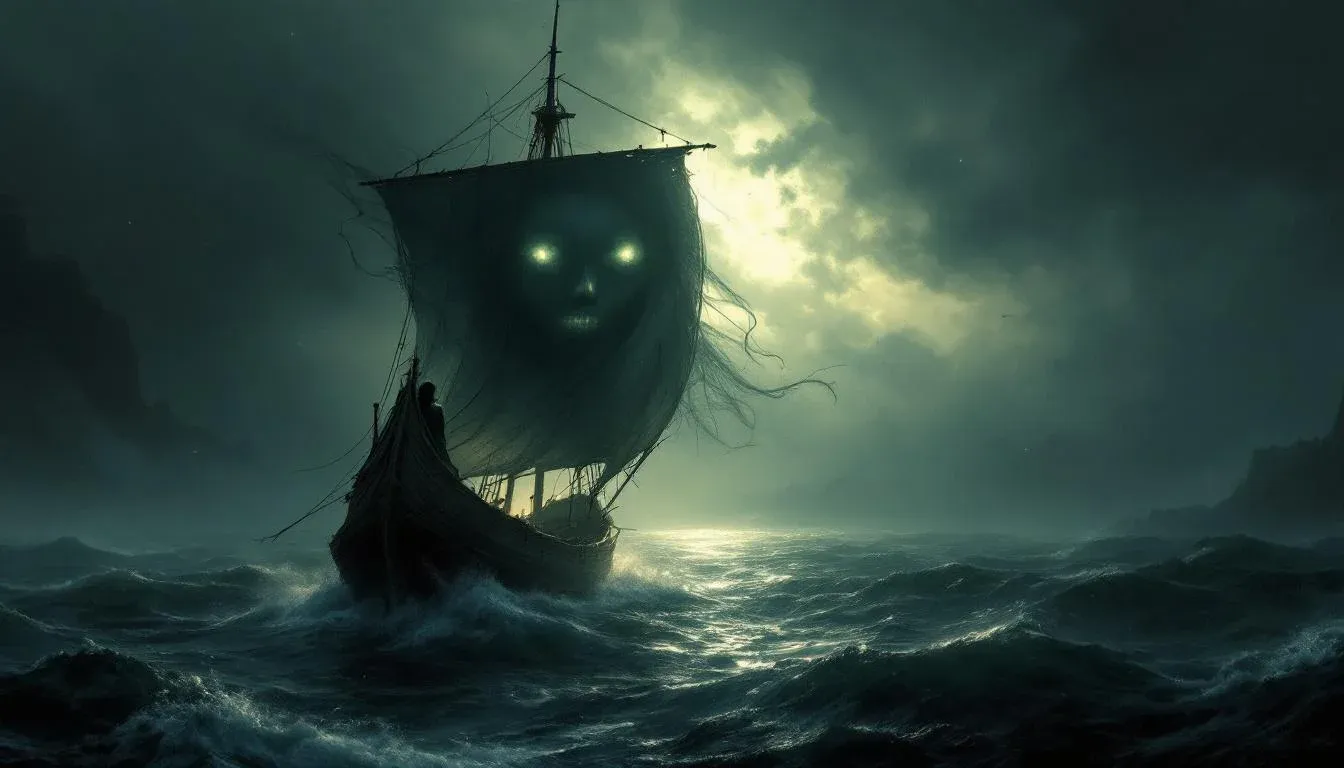
The winds — Stribog's grandsons — blow arrows from the sea against Igor's brave troops.
Eight words in the original. A throwaway metaphor, almost — the winds as a god's grandchildren, loosing arrows across the battlefield like invisible archers. But those eight words are, along with a list in a chronicle and a name scratched into the margins of a Byzantine translation, virtually everything we have. They are the reason we know Stribog existed at all.
He was the god of wind. All winds. Not one direction, not one season, not the gentle breeze or the killing gale alone — all of it. Every current of air that bent the grass on the steppe or ripped thatch from a peasant's roof was understood to be one of his descendants. And that single image — the grandfather whose grandchildren are the winds themselves — is one of the most striking theological ideas in all of Slavic mythology. It means the wind is not a force. It is a family.
The Hill Outside the Palace
Stribog first appears in the Primary Chronicle, compiled by monks in Kyiv around 1113. Under the year 980, the chronicler records that Prince Vladimir Sviatoslavich — not yet a Christian, still a warlord consolidating power — erected wooden idols on a hilltop outside his palace. The passage is brief and has the tone of an inventory:
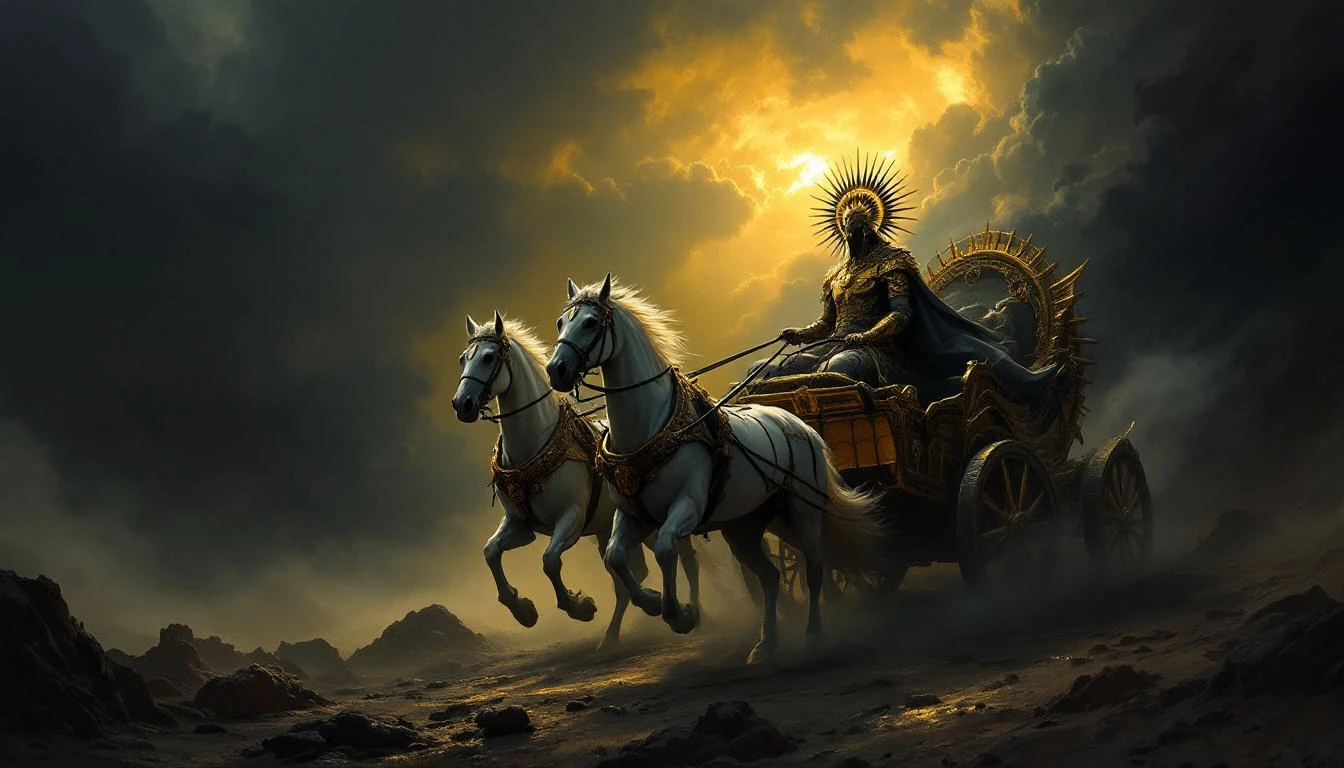
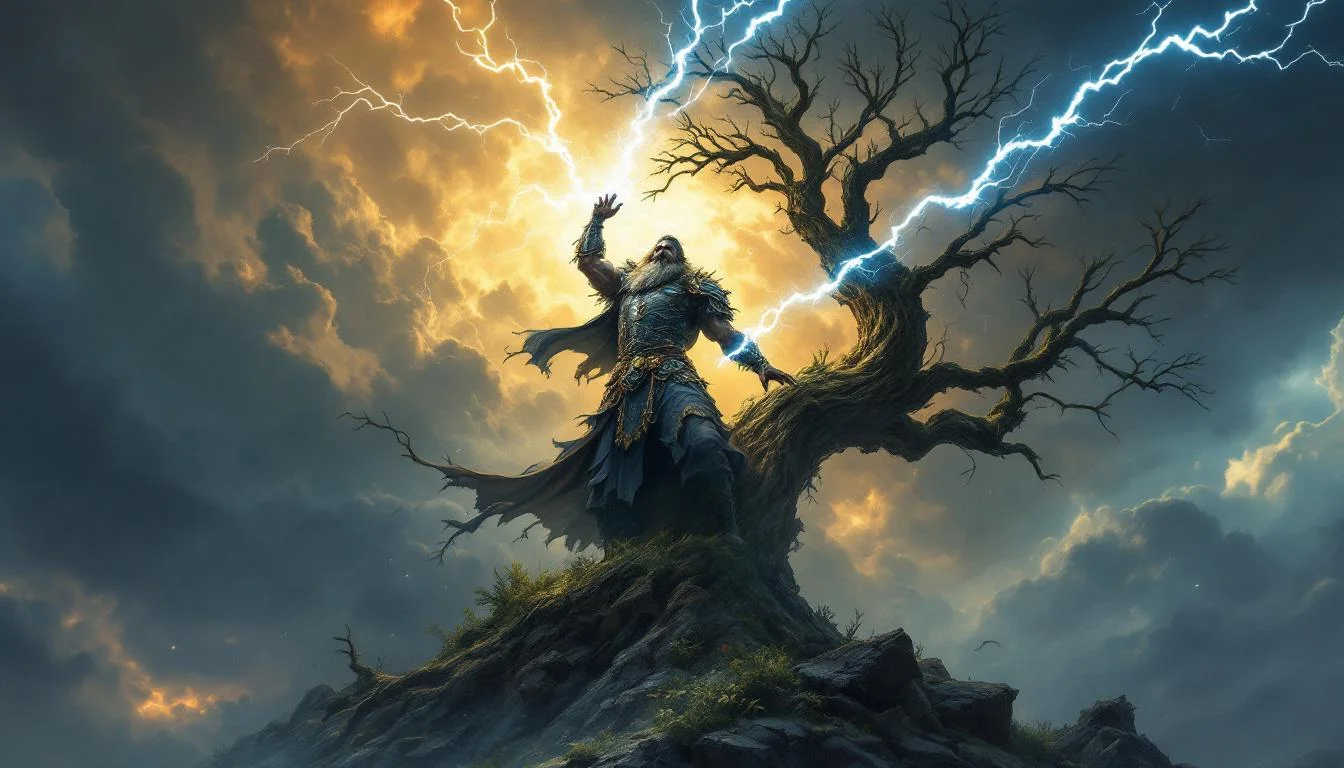
And he set up idols on the hill outside the castle courtyard: one for Perun, carved of wood, with a silver head and a golden mustache, and others for Khors, Dazhbog, Stribog, Simargl, and Mokosh. And they offered sacrifices to them, calling them gods.
Six gods. Perun gets a physical description — the silver head, the golden mustache. The other five get nothing but their names. Stribog stands fourth in the list, after the solar deities Khors and Dazhbog, before the enigmatic Simargl and the earth-goddess Mokosh. The ordering may reflect a hierarchy, or it may reflect nothing more than the chronicler's memory. We do not know. The passage tells us that Stribog was important enough to stand among the six principal gods of Vladimir's official cult. It does not tell us why.
This is the fundamental problem with Stribog. He appears in exactly three East Slavic written sources. The Primary Chronicle names him. The Slovo o polku Igoreve calls the winds his grandsons. And the Word on the Idol-Worshipers, a medieval homily railing against lingering paganism, mentions him in a list of gods the Slavs should stop worshipping. That is the entire textual record. Three mentions across two centuries. No myths, no hymns, no descriptions of rituals, no depictions on temple walls. For a god who stood in the capital of a major medieval state, the silence is remarkable.
What Does "Stribog" Mean?
The name itself has generated more scholarly heat than almost any other single word in Slavic religious studies. Everyone agrees on the second element: bog means "god." The battle is over the first syllable.
The most widely cited interpretation comes from Roman Jakobson, the great structural linguist. He connected stri- to the Proto-Slavic verb sterti, meaning "to extend, spread, scatter, widen." Under this reading, Stribog is the "Spreader God" or "Disperser God" — the one who distributes. Jakobson saw this as complementary to Dazhbog, whose name means "Giving God." One god gives wealth; the other scatters it across the world. The wind, after all, spreads seeds. It carries rain. It disperses everything it touches. If Dazhbog is the hand that offers a gift, Stribog is the breath that carries it to every corner of the land.
A second theory, advanced by the French Indo-Europeanist Marc Vey and later adopted by Vyacheslav Ivanov and Vladimir Toporov, takes a more radical approach. Vey proposed that stri- descends from the Proto-Indo-European word for "father" — ph₂tēr — through a chain of sound changes: ph₂tēr became ptri-, which became stri-. Under this reading, Stribog literally means "Father God" or "God the Father" — an epithet for a supreme sky deity in the oldest layer of Indo-European religion. Ivanov and Toporov placed Stribog in the first tier of Georges Dumézil's trifunctional hypothesis, alongside the sovereign gods of other Indo-European traditions.
This etymology is elegant. It is also, by the consensus of most working Slavic linguists, probably wrong. The sound change Vey described does not follow established patterns in Slavic historical phonology. The Proto-Slavic word for "father's brother" — stryjь — which Vey used as a bridge, is cognate with Lithuanian strùjus ("uncle, old man") and Old Irish sruith ("old, venerable"), and derives from a different Proto-Indo-European root entirely. The "Father God" reading remains influential in mythological studies, but the linguistics do not support it.
A third possibility links stri- to the Proto-Slavic root stry-, meaning "to flow, to stream," from Proto-Balto-Slavic srū-, ultimately from Proto-Indo-European srew- ("to flow"). This gives us "Flowing God" or "Streaming God" — a natural fit for a wind deity, since air and water obey the same physics of current and turbulence. The ancient Slavs may not have articulated this in scientific terms, but anyone who has watched wind ripple across a wheat field or push waves along a river understood the connection intuitively.
No consensus exists. The name carries its ambiguity like the wind carries dust — it spreads in every direction and settles nowhere.
Grandsons of the Wind
The Slovo o polku Igoreve is a strange and beautiful text. Written around 1185 — or possibly later, since its authenticity has been debated since the eighteenth century — it recounts Prince Igor Svyatoslavich's disastrous campaign against the Cumans. The poem is saturated with pre-Christian imagery. Rivers speak. Animals prophesy. The sun darkens as an omen. And the winds are not weather. They are people — specifically, they are Stribog's grandchildren.
This is not a casual metaphor. The poet does not say the winds are like Stribog's grandsons. He says they are his grandsons. In the worldview of the Slovo, the winds have a genealogy. They belong to a family. They have a grandfather who rules them, and they carry out actions in the world — in this case, blowing arrows against Igor's army — with the purposefulness of living beings obeying an elder.
The idea of personified directional winds is not unique to the Slavs. Greek mythology had the Anemoi — Boreas, Notus, Eurus, and Zephyrus — each governing a cardinal direction. Norse mythology placed four dwarves at the corners of the sky to hold it up. But the Slavic version, as preserved in this single poetic line, has a distinctive flavor. The winds are not servants or functionaries. They are descendants. The relationship is familial, not bureaucratic. Stribog does not command the winds the way a general commands soldiers. He fathered the line from which they descend, and they carry his blood in their gusts.
Later folklore — collected centuries after the conversion to Christianity, filtered through oral tradition and the distortions of time — preserves faint traces of this idea. Folk beliefs across the East Slavic world personified winds as spirits with individual characters: the warm south wind that coaxed crops from the soil, the bitter north wind that killed livestock, the east wind that brought renewal with the dawn, the west wind that carried change and unsettled weather. Whether these folk spirits descend directly from the "grandsons of Stribog" or represent a parallel tradition is impossible to determine. The chain of transmission is too broken, the intervening centuries too dark.
Wind, Grain, and Survival
To understand why a wind god mattered enough to stand among Vladimir's six, you have to understand what wind meant to the people who worshipped him.
The Slavic world of the ninth and tenth centuries was overwhelmingly agricultural. The vast majority of the population were subsistence farmers growing wheat, rye, barley, millet, and flax on cleared forest land or open steppe. Their survival depended on weather — not as an abstract concept, but as a daily, lethal reality. A late frost killed the seedlings. A drought shriveled the grain. A hailstorm flattened a field in minutes. And wind was the messenger that carried all of it.
A warm wind from the south meant the growing season had arrived. A cold wind from the north in May meant famine by December. The direction of the wind in spring determined which fields to plant first. The wind's behavior before a storm warned experienced farmers to harvest early or cover their haystacks. Wind dried the grain after rain. Wind powered the primitive sails of river traders moving goods along the Dnieper and Volga. Wind spread fire — the most feared catastrophe in a world of wooden houses.
Stribog, then, was not a decorative deity. He was the god of the force that could feed you or starve you, carry your ship or sink it, dry your crops or fan the flames that consumed your village. Praying to the wind was not poetry. It was survival.
Sailors and river merchants had particular reason to honor him. The trade routes that connected Scandinavia to Byzantium — the famous "route from the Varangians to the Greeks" — ran down the Dnieper and across the Black Sea. Every merchant who loaded furs and wax and slaves onto a boat and pushed off from a Kyivan wharf was placing his fortune in the wind's hands. A favorable wind meant profit. An unfavorable wind meant days of delay, spoiled cargo, or death on open water. These were men who understood, in their muscles and their account books, that the wind had a personality. It could be generous or cruel. It could be courted.
The Open Sanctuaries
No archaeological site has been definitively identified as a temple or sanctuary of Stribog. This is not surprising — the archaeological record for pre-Christian Slavic worship sites is thin across the board, and the gods whose shrines we can identify tend to be the ones with the most dramatic destruction stories, like Perun's hilltop idol in Kyiv or the great temple of Svantevit at Arkona.
What later folklore and comparative evidence suggest is that wind worship happened in open places. High ground. Riverbanks. Coastal promontories where the wind never stopped. The logic is straightforward: you worship the wind where you can feel it. An enclosed temple would have been a contradiction — you do not honor the god of open air by shutting him inside walls.
Some scholars have noted that the tradition of building windmills on high, exposed hilltops in the Slavic world carried echoes of older sacred geography. The mill, after all, is a device that catches the wind and converts it into food — grain into flour. It sits on a hilltop, exposed to every direction, turning with every shift of the breeze. Whether medieval Slavic millers understood their windmills as standing on what had once been sacred ground is unknowable. But the coincidence of location — high, exposed, oriented to the wind — is suggestive.
The Complementary God
One of the most productive ideas in Stribog scholarship is Jakobson's suggestion that Stribog and Dazhbog formed a complementary pair. Dazhbog — the "Giving God," associated with the sun, wealth, and abundance — represented the act of bestowing. Stribog — the "Spreading God" or "Dispersing God" — represented the act of distributing what had been given.
This makes a kind of deep structural sense. The sun gives warmth and light. The wind carries that warmth across the land, distributes moisture as rain, and scatters seeds across plowed fields. Without the giver, there is nothing to spread. Without the spreader, the gift stays in one place and rots. The two gods are not rivals or duplicates. They are two halves of a single agricultural process: creation and distribution, production and delivery.
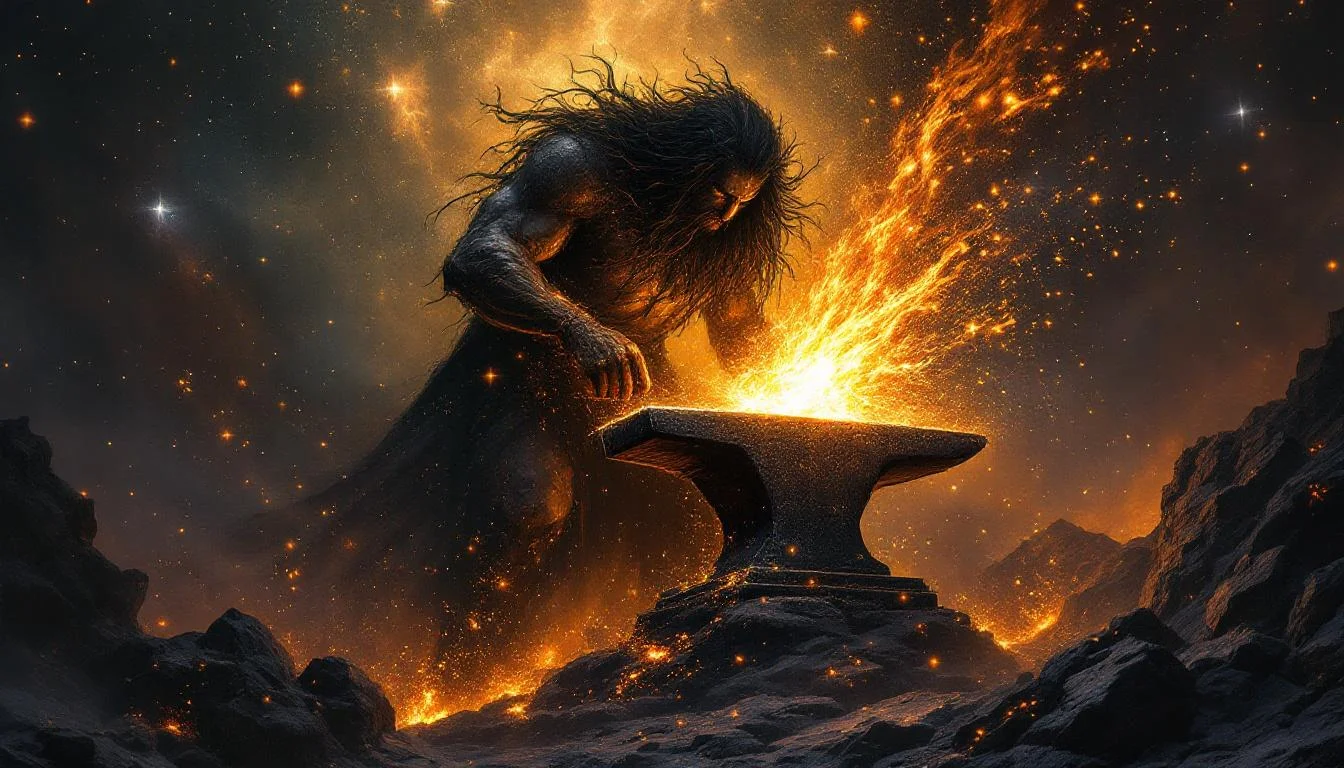
If this pairing is correct — and it remains a hypothesis, not a proven fact — then Stribog's placement in Vladimir's pantheon between the solar deities and the earth goddess makes structural sense. He is the middle term, the mechanism that connects the sky's generosity to the ground's fertility. Perun rules the storm. Dazhbog gives the sunlight. Stribog carries both to where they are needed. Svarog, the celestial smith, forges the tools. Mokosh receives the harvest in the earth. The six gods are not a random collection. They are a system.
What Happened to the Wind
When Vladimir converted to Christianity in 988, the idols on the Kyiv hilltop were destroyed. The Primary Chronicle describes the destruction of Perun's statue in humiliating detail — dragged by horses, beaten with sticks, thrown in the river. It says nothing about what happened to the other five idols. Stribog's wooden image was presumably chopped up, burned, or thrown away alongside the rest. The silence of the record is itself a statement: Stribog was not important enough to the Christian chroniclers to merit a destruction narrative. He was simply gone.
But the wind kept blowing.
In the centuries after conversion, wind retained its personality in Slavic folk belief. Peasants across Russia, Ukraine, and Belarus continued to speak of winds as living beings with intentions and moods. The vikhir — the whirlwind — was understood as a demon or an unclean spirit, spinning in place where something terrible had happened. Certain winds carried disease. Others brought luck. Fishermen on Lake Ilmen and the White Sea addressed the wind directly, asking for calm water and safe passage, using formulas that echoed older prayer.
None of these folk traditions mention Stribog by name. The god had disappeared from living memory long before the first folklorists arrived with their notebooks in the nineteenth century. What survived was not the name but the idea — that the wind was not an impersonal force, that it had character and will, that it could be spoken to and sometimes, if you chose the right words, it might listen.
The Problem of Silence
Stribog forces a question that runs through all of Slavic mythology: how do you write about a god you barely know?
The honest answer is: carefully. Every sentence about Stribog is built on three textual mentions, a disputed etymology, and a web of inferences drawn from comparative mythology and later folklore. We do not know what he looked like. We do not know what stories were told about him. We do not know what prayers were addressed to him, what offerings were left for him, what festivals marked his sacred days. We know his name, his position in a political pantheon, and a single poetic metaphor about his grandchildren.
This is not a failure of scholarship. It is the nature of the material. The pre-Christian Slavs did not write. Their mythology was oral, transmitted by voices that fell silent when the monasteries rose and the monks began recording only what they considered worth preserving — which was, for the most part, Christian content lightly dusted with pagan references to explain what the missionaries had overcome.
What the silence tells us, paradoxically, is something important. Stribog was not a marginal deity. You do not put a minor spirit in a state-sponsored pantheon alongside the thunder god and the sun god. Vladimir's hilltop was not a democracy — every god on that hill served a purpose, represented a constituency, filled a role in the cosmological architecture that Vladimir was trying to standardize and control. Stribog was there because the wind mattered. Because the people who farmed the steppe and sailed the rivers and felt the north wind cut through their walls in January needed a name for the force that ruled their lives, and the name they had was Stribog.
The winds — Stribog's grandsons — are still blowing. They scatter seeds across Ukrainian black earth and pile snow against Russian fences and push fishing boats across the Baltic. They do not remember their grandfather's name. But they carry it anyway, in every gust that bends the wheat and every gale that strips the last leaves from the October trees. Somewhere in that sound — if you listen with the ears of a twelfth-century poet watching an army march into disaster — you can almost hear the old man breathing.