The city of Szczecin sits where the Oder River meets the Szczecin Lagoon, a few miles from the Baltic Sea. In the twelfth century it was a major Pomeranian stronghold — fortified, prosperous, and stubbornly pagan at a time when Christianity was advancing across northern Europe with sword and sermon in equal measure. The city had four temples. The largest stood on a hill called Trzyglow — a name that translates, roughly, to "three-headed" — and inside it was the most important religious object in all of Pomerania.
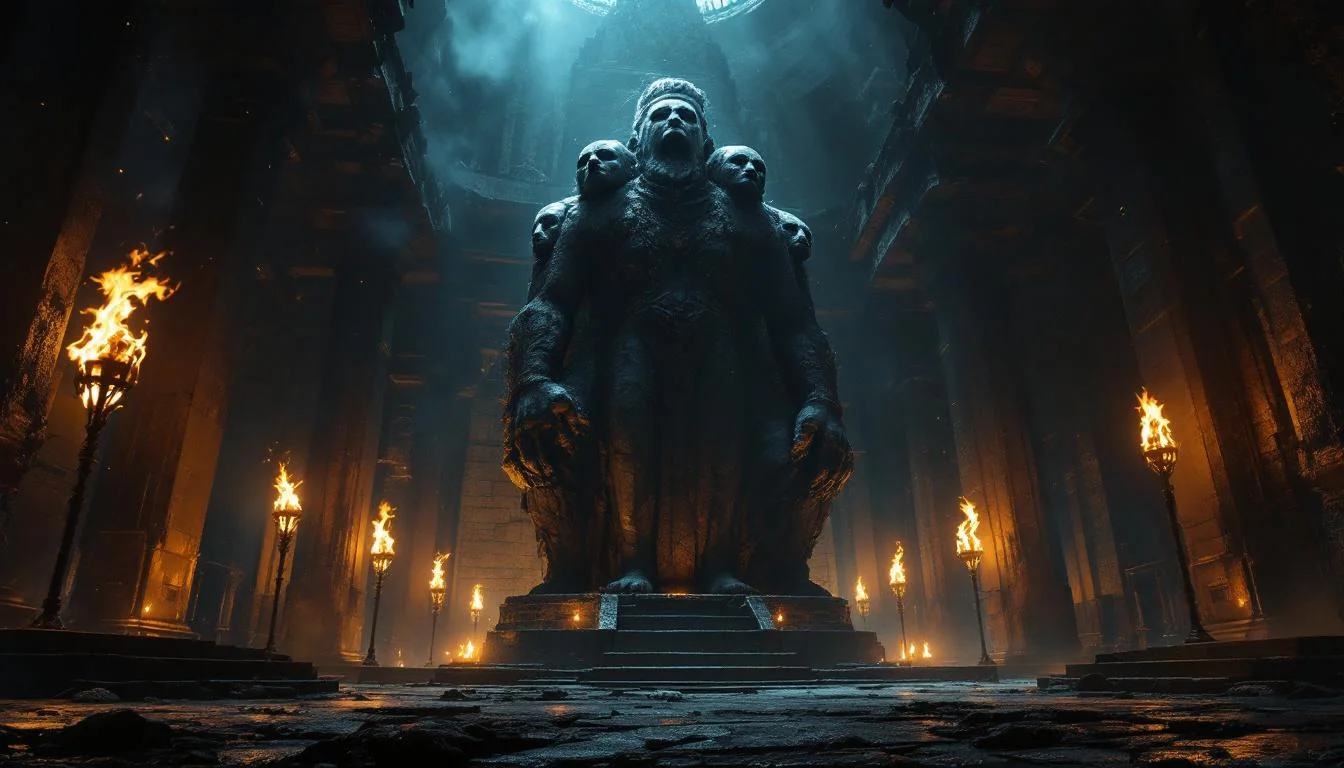
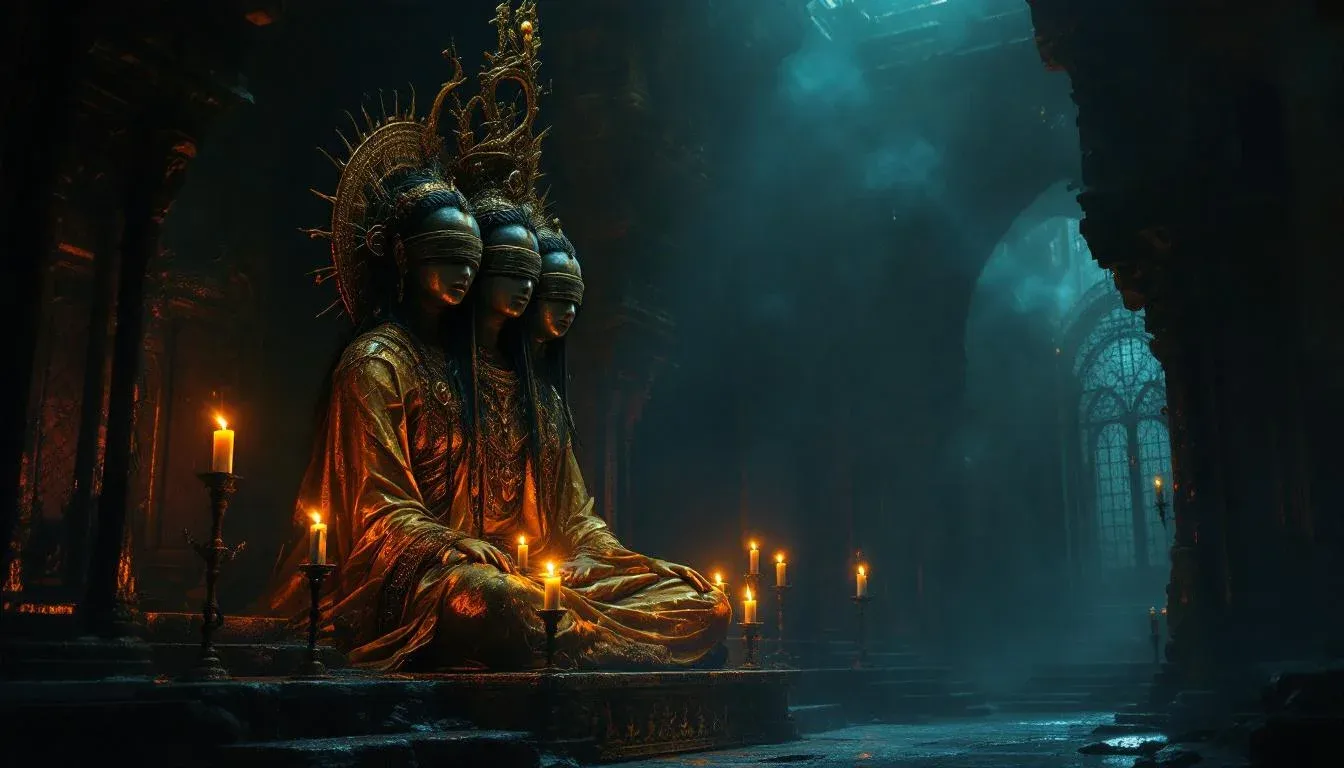
It was a statue with three heads. Its eyes were covered with a golden veil. Its lips were sealed shut with gold. And the priests who tended it said this god ruled three kingdoms at once: the sky above, the earth below, and the underworld beneath both.
His name was Triglav. The three-headed one. And unlike nearly every other god in the Slavic world, he was not merely powerful. He was too powerful to look at anything at all.
The Sources: Three Monks and One Bishop
Everything we know about Triglav comes from the same narrow window of history — the years between 1124 and 1128, when Bishop Otto of Bamberg conducted two missionary campaigns into Pomerania. Otto was not the first Christian to enter the region, but he was the first to arrive with enough political backing and military muscle to force actual conversions. His patron was Boleslaw III Wrymouth, the Polish duke who had conquered much of Pomerania by force and wanted the spiritual infrastructure to match his political control.
Otto's campaigns were recorded by three chroniclers: the anonymous Vita Prieflingensis from Prufening Abbey (before 1146), the Vita Ottonis by the monk Ebo (c. 1151), and the most detailed account — the Dialogus de vita Ottonis by the monk Herbord (c. 1158-1159).
These three accounts do not agree on every detail. But on Triglav, they converge. All three describe the idol, the temples, and the destruction.
The Slavic Pomeranians left no written records of their own beliefs. What we have is the testimony of the men who came to erase those beliefs — every sentence written by someone who considered the god a demon. The information is invaluable. The perspective is hostile.
Three Heads, Three Worlds
The idol of Triglav was carved from wood. Three heads sat on a single body. According to the priests of Szczecin, each head corresponded to one of the three realms the god ruled: the heavens, the earth, and the underworld.
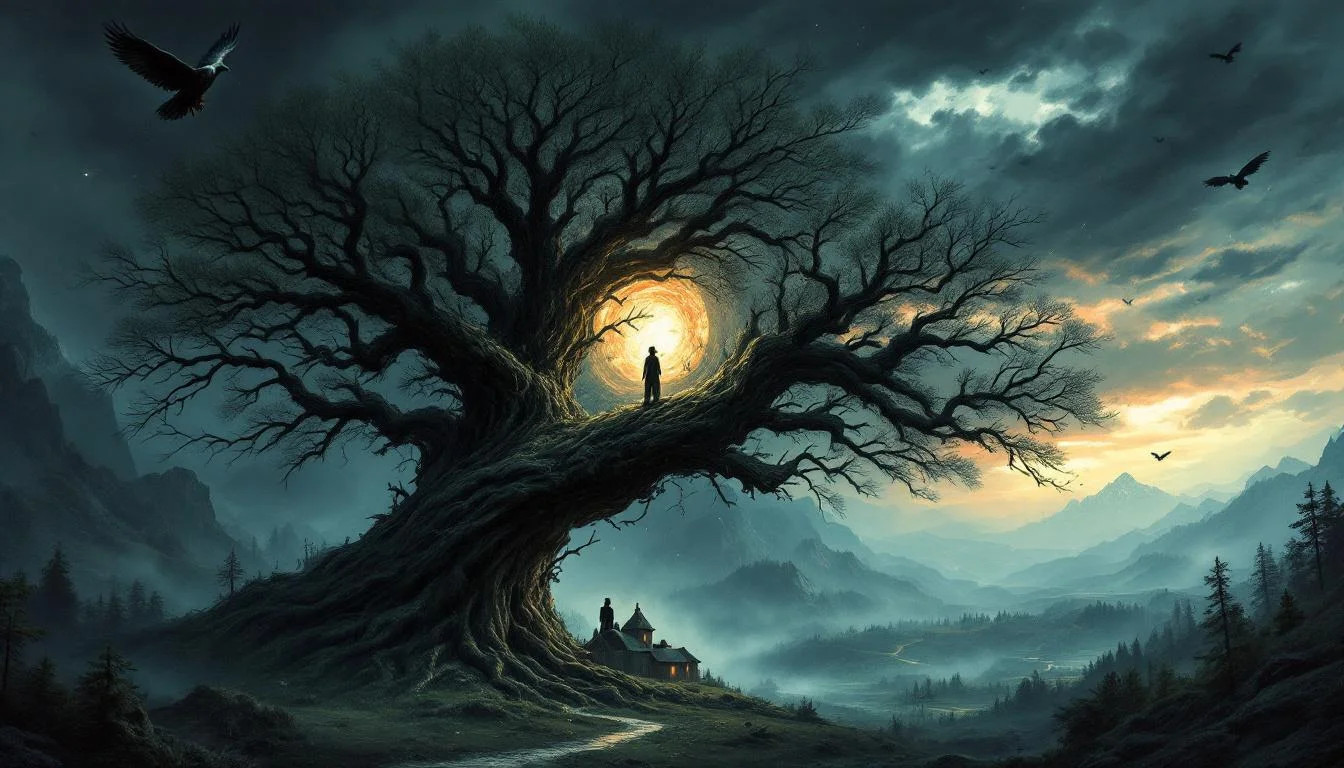
This is a cosmological statement, not merely an artistic choice. The Three Worlds model — sky, earth, and the realm below — runs through Slavic belief like a structural beam. It appears in the concept of the World Tree, whose branches touch the heavens, whose trunk stands on the earth, and whose roots reach into the domain of the dead. Triglav does not inhabit one layer of this cosmos. He holds all three. His triple head is a map of existence itself — each face turned toward a different plane, each pair of eyes watching a different kingdom.
The comparison to Svetovit, the four-headed god of Arkona, is immediate. Svetovit's four faces pointed to the four cardinal directions. He was a horizontal god, scanning the horizon for enemies and opportunities. Triglav's three faces are vertical. He does not scan the horizon. He holds the axis of the universe — up, middle, down — from the domain of the sky gods to the silent country of the dead.
If Svetovit was the god who watched everything, Triglav was the god who contained everything. Not a guardian but the architecture itself.
The Golden Blindfold
And here is the detail that separates Triglav from every other Slavic deity and from most gods in any mythology: his eyes and lips were covered with gold.
The priests explained this to Otto's biographers. Triglav's eyes were veiled because the god was too sacred to look upon the sinful world of men. If he saw human wrongdoing directly — the lies, the betrayals, the petty cruelties that accumulate in any community — his wrath would be uncontrollable. The blindfold was not a limitation. It was a mercy. The gold across his lips served a parallel function: the god was too powerful to speak directly to mortals. His pronouncements came through other channels — through his priests, through his horse, through the machinery of divination — never from his own mouth.
This is a strikingly sophisticated theological idea. Most pagan deities are defined by what they see and do. Zeus watches from Olympus. Odin gave an eye to see further. Svetovit had four faces so nothing would escape his gaze. Triglav is defined by deliberate blindness — a god who has chosen not to look. The implication is not that the mortal world is beneath his concern, but that his concern for it would be catastrophic.
There is a practical dimension too. A god who cannot see is a god who does not directly punish. The priests become the god's eyes — they decide what Triglav knows, what offends him, what pleases him. The blindfold, whatever its theological justification, made the priesthood indispensable.
The Temples of Szczecin
Herbord describes four temples in Szczecin, of which the temple of Triglav on the Trzyglow hill was the most prominent. The precinct was decorated with carved and painted images — scenes of men and animals rendered with enough skill that Herbord says they looked almost alive. The walls held trophies: weapons taken from enemies, spoils of war, horns for feasting. This was a hall of power, hung with proof of victories the god had sanctioned.
A second temple also housed images of Triglav. Near the temple buildings, two objects of particular sanctity were kept: a gilded and silver-plated saddle of extraordinary craftsmanship, and a black horse. The saddle was ceremonial — it hung on the wall and was never placed on any animal's back, a symbol of the god's dominion. The horse was operational. It was Triglav's living oracle.
Wolin, the other major Pomeranian town, also maintained Triglav worship. Known to Norse sagas as Jomsborg, it was one of the wealthiest Slavic cities on the Baltic coast. Triglav's presence in both Szczecin and Wolin confirms he was not a local deity but the chief god of the entire Pomeranian polity.
The Black Horse
Where Svetovit had a white horse, Triglav had a black one. The color inversion is significant. White horses in Indo-European tradition belong to the sky and solar gods. Black horses belong to the underworld, to night, to the chthonic powers beneath the earth. Triglav, ruler of all three worlds including the realm of the dead, kept a horse colored for the darkness below.
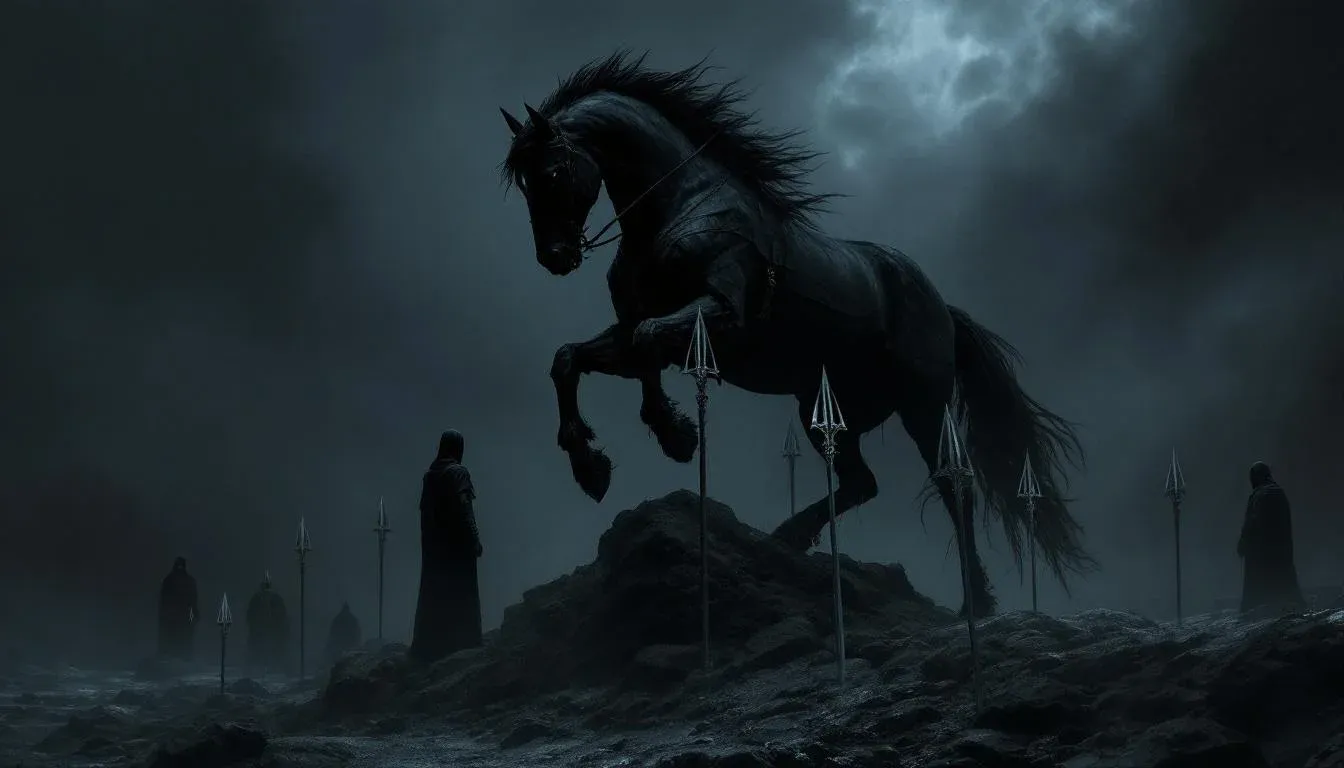
The divination procedure followed a specific ritual form. When the Pomeranians deliberated whether to go to war, priests laid nine spears on the ground before the temple, spaced about a cubit apart. Nine — three times three — reinforced the sacred geometry of the god's own number. The chief priest then led the black horse over the spears three times.
If the horse crossed all nine spears without stumbling — stepping cleanly over each lance on every pass — the omen was favorable. The army would march. If the horse's hooves struck any of the spears, even once, the campaign was abandoned. The god had spoken. War was refused.
They also kept there a horse of marvellous size, black in colour, spirited and wild. He was kept at common expense, and none might mount him except for the one priest... When they sought a decision about going to war... servants would set nine spears at a cubit's distance from one another on the ground, and then saddling the horse, the priest who had charge of it would lead the horse, reined and stepping, three times across the spears. If the horse walked without entangling its legs among the spears, it was taken as a sign of success and they would march forth confidently.
No one was permitted to ride the sacred horse except the chief priest. The animal was maintained at communal expense, fed and stabled as a public charge — community property, sacred property, and the voice of the god simultaneously.
The parallels between Triglav's oracle and Svetovit's white horse at Arkona are too close to be coincidental. Both involve a consecrated horse of a specific color, spears on the ground, an overseeing chief priest, and a verdict on whether to march to war. The differences are in the details: black versus white, nine spears crossed three times versus three rows with the leading foot as the deciding factor. These are regional variations on a single divinatory tradition that probably predates both temples and reaches back into deep Indo-European religious culture.
Otto's First Mission: 1124
Otto of Bamberg arrived in Pomerania in the spring of 1124, traveling from the south through Polish-controlled territory with the backing of Duke Boleslaw and papal authority. He was not a solitary monk. He traveled with priests, servants, guards, and wagonloads of gifts — a diplomatic mission with baptismal water.
The smaller towns fell quickly — Pyrzyce, then Kamien. Szczecin was different. It was the political and religious center of Pomerania, the home of Triglav, and its citizens had no interest in abandoning a god who had given them military success for generations.
The negotiations lasted two months. Otto argued, bribed, threatened, and invoked the Polish duke whose armies had recently demonstrated what happened to cities that resisted. Eventually Szczecin's leading men agreed to baptism. The calculation was simple: Poland was powerful, Christianity came with Poland, and resistance meant war.
Once the conversions were secured, Otto turned to the temples. The idol of Triglav was destroyed — the wooden body chopped apart or burned. Otto personally took the three silver-plated heads and sent them to Pope Callixtus II in Rome as proof that Pomerania's chief god had been decapitated. The saddle and temple treasures were confiscated. The black horse's fate went unrecorded.
The Relapse and the Second Mission: 1128
The Christianity Otto planted in 1124 did not take root. Within a few years, the Pomeranians reverted. Temples were rebuilt. Rituals resumed. This was not unusual — forced conversions across medieval Europe frequently failed on the first attempt. Christianity required infrastructure: churches, resident priests, bishops, schools. Otto had left the baptism but not the scaffolding.
In 1128, Otto returned with stronger backing — the Holy Roman Emperor Lothar II alongside the Polish duke. He tore down rebuilt temples at Gutzkow and Wolgast, erected churches on their foundations, and reinforced the faith in backsliding Szczecin and Wolin. At a congress on the island of Usedom on June 10, 1128, the assembled Pomeranian nobility formally accepted Christianity. This time, the conversion held. Within a generation, Pomerania was nominally Christian, its bishopric established at Wolin and later moved to Kamien.
Triglav did not survive the second mission. The temples were gone, the idol destroyed, the black horse vanished from the record, the priesthood dissolved.
Triglav and the Mountain
There is a mountain in the Julian Alps, on the border between modern Slovenia and Italy, called Triglav — "Three Head." At 2,864 meters, it is the highest peak in Slovenia and has been a symbol of Slovenian national identity since at least the nineteenth century. It appears on the Slovenian coat of arms and the national flag.
The connection to the god is debated. Some scholars argue the South Slavs who settled the area in the sixth and seventh centuries brought Triglav worship with them and named their highest peak for the deity. Others say the name is purely descriptive — three visible summits, three heads of rock. The truth is probably layered. The Slavic settlers spoke a language in which triglav already carried divine resonance. The word they chose was not neutral, whether or not they still actively worshipped the deity by name.
The mountain Triglav is now a hiking destination, a national park, and an emblem on a flag. The god Triglav is three silver-plated heads that arrived in Rome nearly nine hundred years ago and have since been lost. Both versions of the name survive. Neither remembers the other.
What Triglav Tells Us
Among the West Slavic deities, Triglav occupies a unique position. He is not the most documented — Svetovit holds that distinction. He is not the most widely worshipped — Perun held that status among the East Slavs. But Triglav is the only Slavic god whose defining characteristic is self-imposed limitation.
Every other major deity is defined by capacity. Perun commands thunder. Svetovit sees all directions. Veles rules the underworld. Triglav's power is expressed through restraint. He covers his own eyes. He seals his own mouth. He rules everything and looks at nothing.
What is clear is that the Pomeranians built their most important temple for this god. Not for a warrior who smashed enemies, not for a seer who revealed the future, but for a sovereign who chose blindness. They gave him the highest hill in their most powerful city, the largest shrine, the richest ornaments, and a coal-black horse to speak on his behalf because his own lips were sealed with gold.
Then a bishop from Bamberg cut off his heads and mailed them to Rome. The gold blindfold, the sealed lips, the three faces turned toward heaven, earth, and the silent country beneath both — reduced to souvenirs in a papal trophy case, and eventually lost even from that.
What the Pomeranians said to their three-headed god in the dark of the temple on the hill — what prayers they whispered, what comfort they found in a deity who refused to watch the suffering he could have stopped — no one recorded. The monks who wrote the accounts were not interested in Pomeranian theology. They were interested in its destruction.
The blindfold remains the most haunting detail. A god whose mercy consists of looking away.