On the northern tip of the island of Rügen, where the Baltic Sea throws itself against chalk cliffs that have been crumbling since before the Romans arrived, there was once a fortress. It stood on a headland called Cape Arkona — a natural stronghold with sheer drops on three sides and a massive earthwork rampart on the fourth. Inside that fortress, the Rani tribe — the last independent Slavic people on the Baltic coast — built a temple. And inside that temple stood the most thoroughly described pagan idol in the entire written record of Slavic civilization.
He had four heads. He held a drinking horn filled with mead. And once a year, a white horse walked through rows of spears to tell his people whether they would live or die.
His name was Svetovit. Or Svantevit. Or Sventovit. The spelling shifts depending on which medieval chronicler you trust and which modern language you transliterate into. The god himself did not shift. For the Rani, he was fixed and absolute — the seer who watched every direction at once, the war god whose white stallion rode out at night to trample the enemies of his people. Helmold of Bosau, the German chronicler who wrote about the Slavs of the Baltic in the 1170s, called him simply the "god of gods." Not a god among equals. The god above all others.
We know more about his worship than about any other deity in the Slavic world. Not because the Slavs wrote about him — they did not write at all — but because the man who ordered his destruction brought along a historian.
Saxo and the Fortress
The primary source for everything we know about the temple at Arkona is the Gesta Danorum — "Deeds of the Danes" — written by Saxo Grammaticus around the year 1200. Saxo was a Danish clerk, probably attached to the household of Archbishop Absalon of Lund, the same Absalon who personally led the assault on Arkona in 1168 alongside King Valdemar I of Denmark. The Gesta Danorum is not a neutral document. It is a celebration of Danish conquest. But it is also meticulous. Saxo was educated, observant, and interested in details. His description of the temple runs to several pages and includes architectural specifics, ritual procedures, and the physical appearance of the idol itself.
No other Slavic temple received anything close to this level of documentation. The hilltop shrines of Perun in Kyiv and Novgorod are mentioned in a few terse sentences by the chroniclers. The sanctuary at Rethra, sacred to the Redarii tribe, is described in fragments by Thietmar of Merseburg. But Arkona — because its fall was a military triumph worth celebrating — was recorded with the thoroughness of a war correspondent embedded with the winning army.
In the middle of the town was an open space, where stood a temple of wood, of exquisite workmanship, respected not only for the magnificence of its worship but also for the majesty of its idol. The outer wall of the building was marked with various rude paintings. There was a single entrance. The temple itself was enclosed by a double enclosure: the outer wall being covered by a purple roof, while the inner, resting on four pillars, instead of walls had hangings. In the building stood a huge image, far surpassing the stature of any human body, wonderful for its four heads and necks, of which two seemed to look towards the front and two towards the back.
What Saxo describes is a structure of real sophistication. The outer enclosure had walls painted with scenes. The inner sanctum was not a solid room but a draped space, with fabric hangings between four posts — a kind of sacred theater where the idol loomed through veils, lit by whatever light filtered through the cloth. The building stood in the center of the fortified town. Arkona was not a city with a temple. It was a temple with a city around it.
The Idol: Four Heads, One God
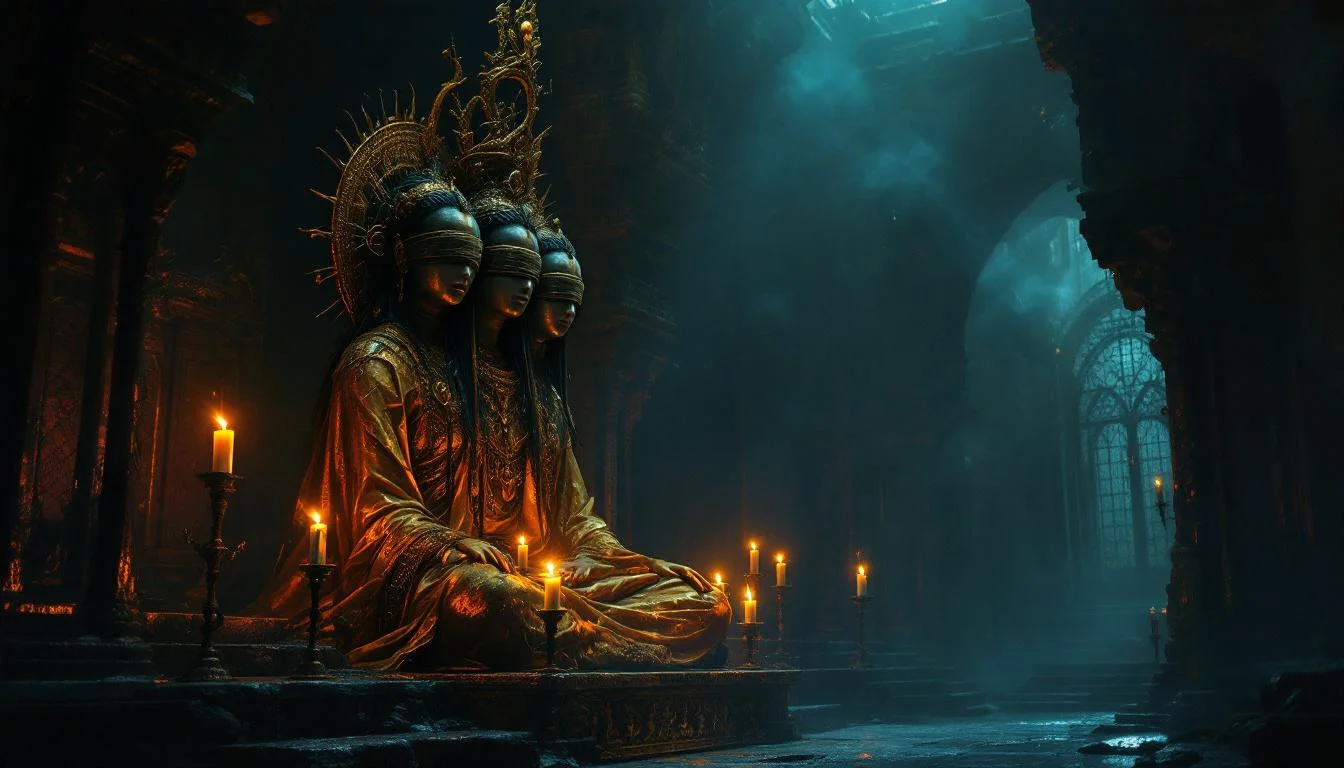
The statue was carved from a single piece of wood — almost certainly oak. It was enormous, likely four to five meters tall. The figure had four heads joined at the neck, each facing a cardinal direction: north, south, east, and west.
The meaning of the four heads has been debated since the medieval period. The most straightforward interpretation is cosmological — Svetovit sees everything, in every direction, at all times. He is the all-seeing god, the guardian who never turns his back because he has no back to turn. A deity with four faces cannot be surprised, flanked, or deceived. Every army approaching Arkona from any direction across the Baltic was already observed.
The comparison to Triglav — the three-headed god worshipped at Szczecin and Wolin — is instructive. Triglav's three heads were said to represent his dominion over sky, earth, and underworld. If that formula holds, Svetovit's four heads extend the pattern: he rules not only the vertical cosmos but the horizontal plane, every quarter of the horizon. He is not merely a god who sees everything. He is a god who is everywhere.
Saxo describes the statue's further details. In its right hand, the idol held a drinking horn — a curved vessel inlaid with various metals. The left hand rested on its hip. Near the idol lay a bridle, a saddle, and a sword of enormous size, its blade and silver-chased scabbard testifying to the wealth lavished on the god's possessions.
The horn was not decorative. It was a working ritual instrument, central to the annual prophecy that defined the rhythm of life at Arkona.
The Mead and the Harvest
Once a year, after the harvest was gathered, the Rani held a festival at the temple — the central event of the community's calendar, the moment when the god spoke to his people about the year to come.
The ceremony was conducted by a high priest of remarkable status. Saxo notes that this priest was the only person in the settlement whose hair and beard were allowed to grow long — a mark of sacred distinction. He was also the only individual who could enter the inner sanctum. He held his breath while inside, running out periodically to exhale at the door, so that the god would not be contaminated by mortal breath.
The ritual centered on the drinking horn. At the start of each year, the priest filled it with mead and placed it in the idol's hand. At the harvest festival, he examined it. If the liquid had barely diminished, the prophecy was favorable: abundance, full granaries, peace. If the horn was significantly emptied, disaster loomed — famine, drought, or war.
The logic is practical beneath its religious surface. A horn of liquid left for a year in an enclosed wooden building evaporates at a rate determined by temperature and humidity. A warm, dry year — which tends to be good for crops — would evaporate more liquid. A cold, wet year — poor for growing — would preserve it. The oracle may have been a crude hygrometer dressed in theology. The priest did not need to fake the prophecy. The physics did it for him.
But to the Rani, this was the voice of the god. Svetovit, through the mead in his horn, was telling his people whether he was pleased or angry, whether he had drunk deeply in satisfaction or barely sipped in displeasure.
The White Horse and the Spears
The mead prophecy concerned the harvest. The horse prophecy concerned war.
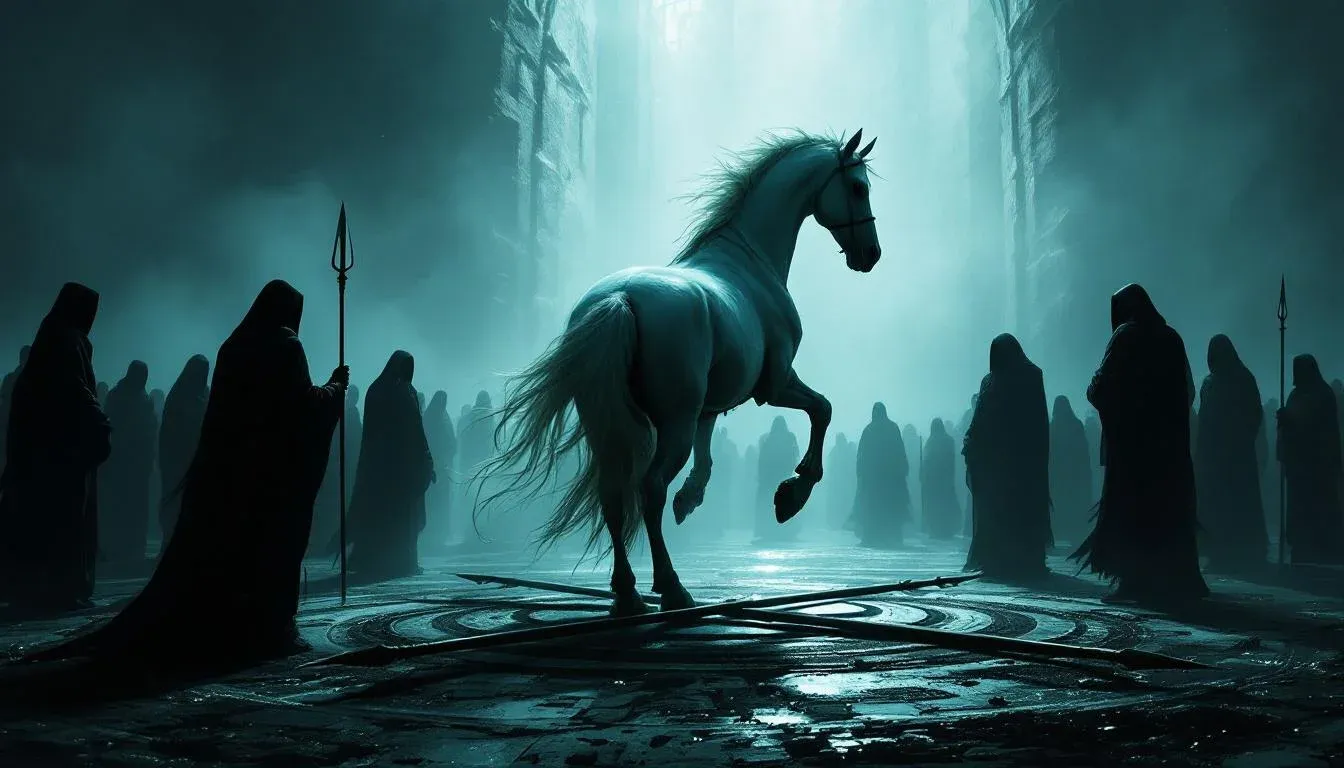
Dedicated to Svetovit was a white stallion of extraordinary sanctity. No person was permitted to ride this horse except the high priest. The Rani believed that Svetovit himself rode the horse at night, galloping out from the temple to wage invisible war against the enemies of his people. The evidence was physical: the horse was sometimes found in the morning drenched in sweat and caked with mud, as though it had been ridden hard across rough ground.
When the tribe was considering a military expedition, the priest brought the white horse to the temple forecourt, where rows of spears had been set into the ground: three rows of paired lances, laid crosswise. The horse was then led through these rows. If it stepped over the first row with its right foot leading, the omen was favorable and war could proceed. If the left foot led, the campaign was abandoned.
This is remarkably similar to horse-oracle practices described by the Roman historian Tacitus among the Germanic tribes a thousand years earlier. Tacitus, writing around 98 AD, recorded that the Germans kept sacred white horses in consecrated groves and observed their movements to divine the will of the gods. A thousand years separate Tacitus from Saxo, and the practice is essentially unchanged — white horse, sacred enclosure, spears on the ground, right foot versus left. This suggests deep inheritance: a divinatory technique rooted in the Proto-Indo-European world, carried forward independently by Germanic and Slavic peoples from a common ancestor culture.
The horse oracle gave the priest enormous political power. He controlled the animal. He set the spears. He interpreted the result. In theory, the god decided. In practice, a man who could predict whether a war would happen held more authority than any chieftain.
God of Gods — and the Question of Perun
Helmold of Bosau, writing around the same year Arkona fell, placed Svetovit at the summit of the West Slavic divine hierarchy. Among the various deities to whom the Slavs assigned dominion over fields, forests, and human fortunes, Helmold wrote, one god in the heavens ruled over the others. The subordinate gods sprang from his blood, and each governed a particular domain. Helmold identified Svetovit as this supreme deity.
This raises a question scholars have never fully resolved: what was Svetovit's relationship to Perun? Among the East Slavs, Perun occupied the supreme position — thunder god, sky lord, deity of princes and warriors. But among the West Slavs, Perun barely appears. Svetovit holds his place.
Some scholars have suggested Svetovit was simply the West Slavic name for Perun — the same god, different mask. The war function, the association with horses and prophecy, all have rough parallels. Others argue Svetovit was an entirely independent deity who rose to prominence through the specific conditions of Baltic Slavic society.
The name itself may hold a clue. Svet- means "holy" or "sacred" in the older Slavic interpretation (from the root svęt-), while some read it as "light" or "world" (svět). The suffix -vit likely derives from a word meaning "lord." Svetovit is either "Holy Lord" or "Lord of the World" — titles befitting a supreme deity. He was not named for a natural phenomenon like thunder or wind. He was named for dominion itself.
June 1168: The End of the Four-Headed God
The Danish interest in Rügen was not primarily religious. It was strategic. The island controlled Baltic trade routes, and the Rani were effective pirates whose raids harassed Danish shipping. Christianization was moral cover for an imperial project.
King Valdemar I and Bishop Absalon landed at Arkona on May 19, 1168, with a substantial force. The siege lasted roughly four weeks. The fortress held — those chalk cliffs and the earthwork rampart were formidable. But the Danes had time and resources, and the garrison had only three hundred men. The Rani held faith in Svetovit's protection. Saxo reports that the defenders believed their god would personally intervene — that the white horse would scatter the invaders, that the four-headed seer would blind the Danish archers.
The god did not intervene.
On June 15, 1168, the fortress fell. Absalon entered the temple. The great idol was examined, measured, and then destroyed: chopped into pieces and fed to the cooking fires of the Danish army. The four heads that had watched the horizon for centuries were split apart with axes and burned as firewood. The drinking horn was taken. The sword was seized. The white horse was claimed as a trophy. The temple's accumulated treasure — generations of tithes and plunder — was confiscated. The Rani princes, Tetzlav and Jaromar, submitted to Danish overlordship and accepted baptism.
In a single afternoon, the most thoroughly documented center of Slavic pagan worship ceased to exist.
What Survived
The physical destruction was total. No fragment of the Svetovit idol has ever been found. The temple site on Cape Arkona has been largely consumed by coastal erosion — the chalk cliffs have retreated steadily since the medieval period, and much of the fortress area has fallen into the sea.
What survived was the description. Saxo's account preserved Svetovit in text with a precision no other Slavic deity received. We know what his idol looked like, what it held, how it was housed, how its prophecies were made. We know the rituals of the horse and the horn, the political and economic structure that sustained his cult, his priesthood, his garrison, his tithe system.
This is both gift and curse. It gives us the clearest window into West Slavic religious practice that exists. But that window was cut by the men who destroyed what lay behind it. Saxo did not interview the high priest. He did not record the Rani's own understanding of their god. He described what he saw from the outside and filtered it through a Christian framework in which pagan idols were demons and their destruction was righteousness.
We do not know what prayers the Rani spoke to Svetovit. We do not know what stories they told about him — whether he had a wife, children, enemies, or adventures. We do not know whether they sang to him or chanted or simply stood in silence before those four wooden faces. The inner life of the cult — the theology, the mythology, the emotional reality of what it meant to worship a four-headed god on a cliff above the Baltic — died with the last generation that remembered it.
All that remains is the shell: an idol described by an enemy, a horse that stepped over spears, and a horn of mead slowly evaporating in the dark.