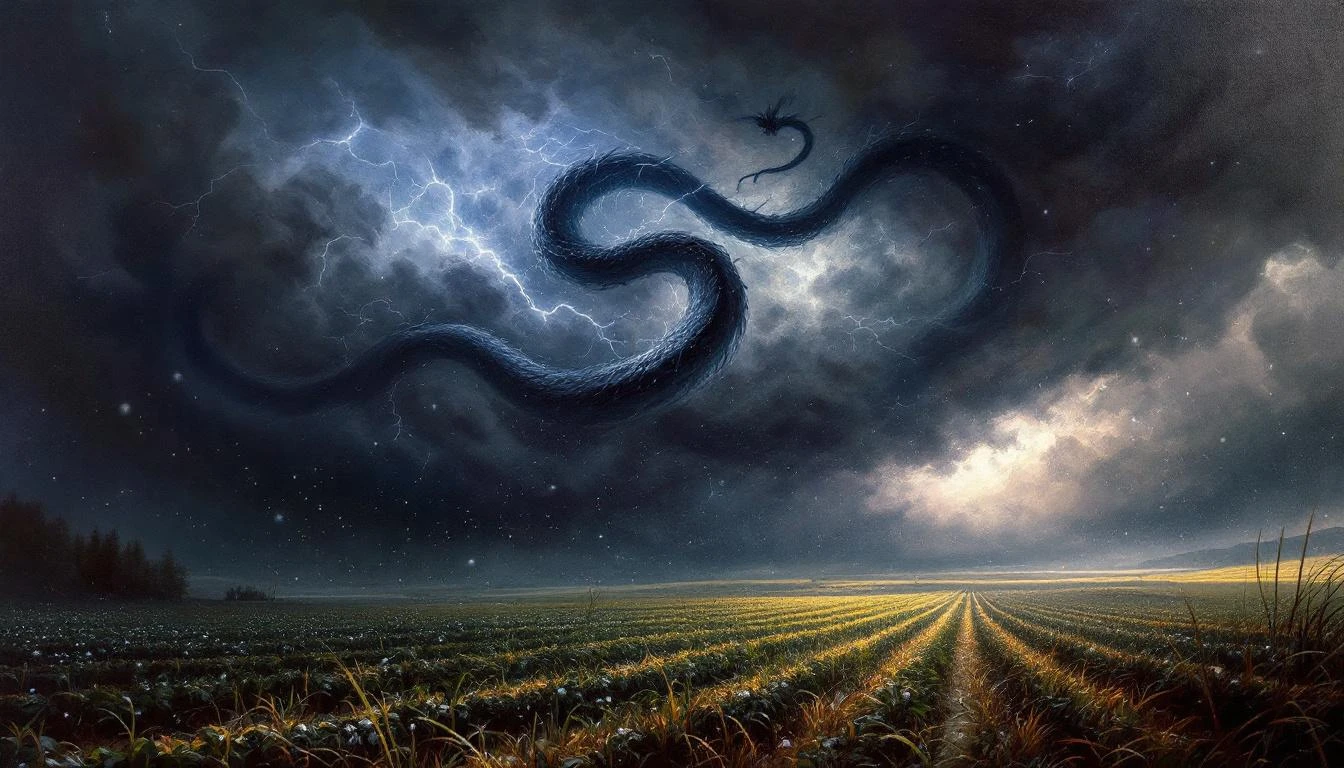
The storm comes over the mountain. The sky turns the color of a bruise — black and yellow and wrong. The livestock press against the barn walls, silent. Hail is coming, the kind that flattens wheat and cracks skulls. But in a house at the edge of the village, a man lies down. He closes his eyes. His breathing slows until his wife cannot tell if he still breathes at all. His body goes cold.
He is not sleeping. He is going to war.
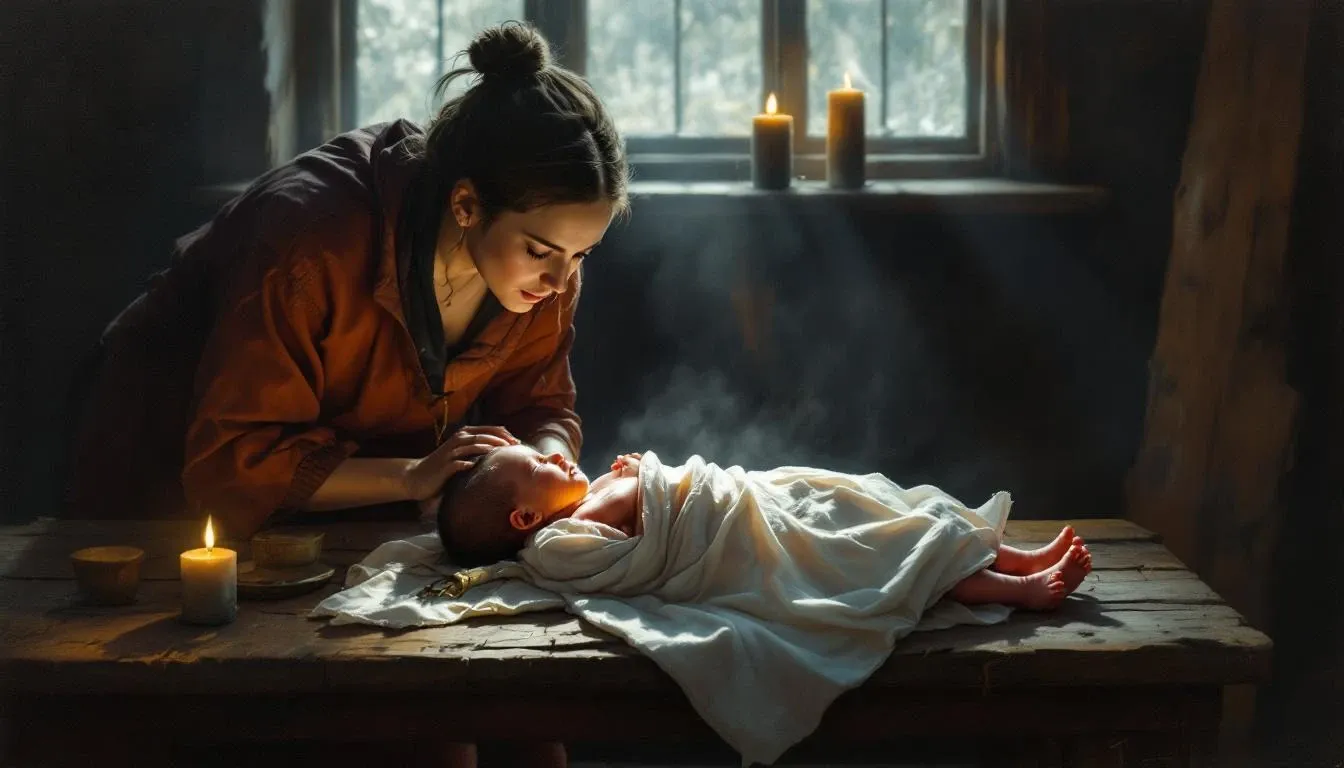
The Zduhać is one of the most extraordinary figures in South Slavic folklore — a man (or sometimes a woman, sometimes even an animal) whose soul leaves the body during storms to fight the Ala, the demonic storm-bringers, in aerial combat among the clouds. He is born to this duty. He did not choose it. The mark was placed on him at birth, visible to anyone who knew what to look for: a caul over his face, a membrane of amniotic tissue covering the newborn like a second skin.
In Serbian, Montenegrin, and Bosnian tradition, the Zduhać occupies a position unlike any other supernatural being. He is not a spirit. He is not a god. He is a living, breathing human who happens to possess a soul capable of detaching from its body and waging war in the sky. He is the village's first line of defense against supernatural catastrophe — and he may not even know he is doing it.
Born Under the Caul
The caul — košuljica, literally "little shirt" — was the sign. A child born with the amniotic membrane still covering its face was marked by fate for a life between worlds. The midwife knew immediately. The mother knew. The village would know soon enough.
Not every caul-born child became a Zduhać. The membrane had to be preserved carefully — dried, sometimes sewn into a small pouch and worn around the child's neck, sometimes hidden in the rafters of the house. If the caul was destroyed or lost, the power might never manifest. If it was kept safe, the child would grow into its inheritance. By adolescence, the storms would start calling.
The ethnographer Tihomir Đorđević, documenting Serbian folk beliefs in the early twentieth century, recorded that caul-born individuals were treated with a mixture of respect and unease. They were valuable — their community needed them. But they were also uncanny, touched by something that marked them as not-entirely-ordinary. A Zduhać might be your neighbor, your cousin, the man who plowed the field next to yours. But when the sky darkened and his eyes went glassy and he slumped against the nearest wall, you knew his soul was somewhere else entirely, doing something you could never see.
The tradition also extended beyond humans. Certain animals — dogs, cattle, even roosters — could be born with the caul and possess the Zduhać nature. A caul-born dog might fall into a death-like trance during storms, its spirit joining the aerial battle alongside human Zduhać. This detail reveals something important about the belief system: the Zduhać was not primarily about human exceptionalism. It was about a cosmic duty that transcended species. The storm needed fighters. Nature selected them where it could find them.
The Battle in the Clouds
When the Zduhać's soul departed, it rose. The body remained behind — limp, cold, seemingly dead. Village women knew not to move it, not to shake it, not to weep over it as though the man had died. The soul was fighting. If the body was disturbed, the soul might not find its way back.
What happened above the clouds was described with remarkable consistency across Serbian, Montenegrin, and Bosnian sources. The Zduhać fought the Ala — massive, serpentine storm-demons that drove hail and destructive winds toward cultivated land. The Ala wanted to destroy crops. The Zduhać wanted to protect them. The battle was physical, violent, and exhausting.
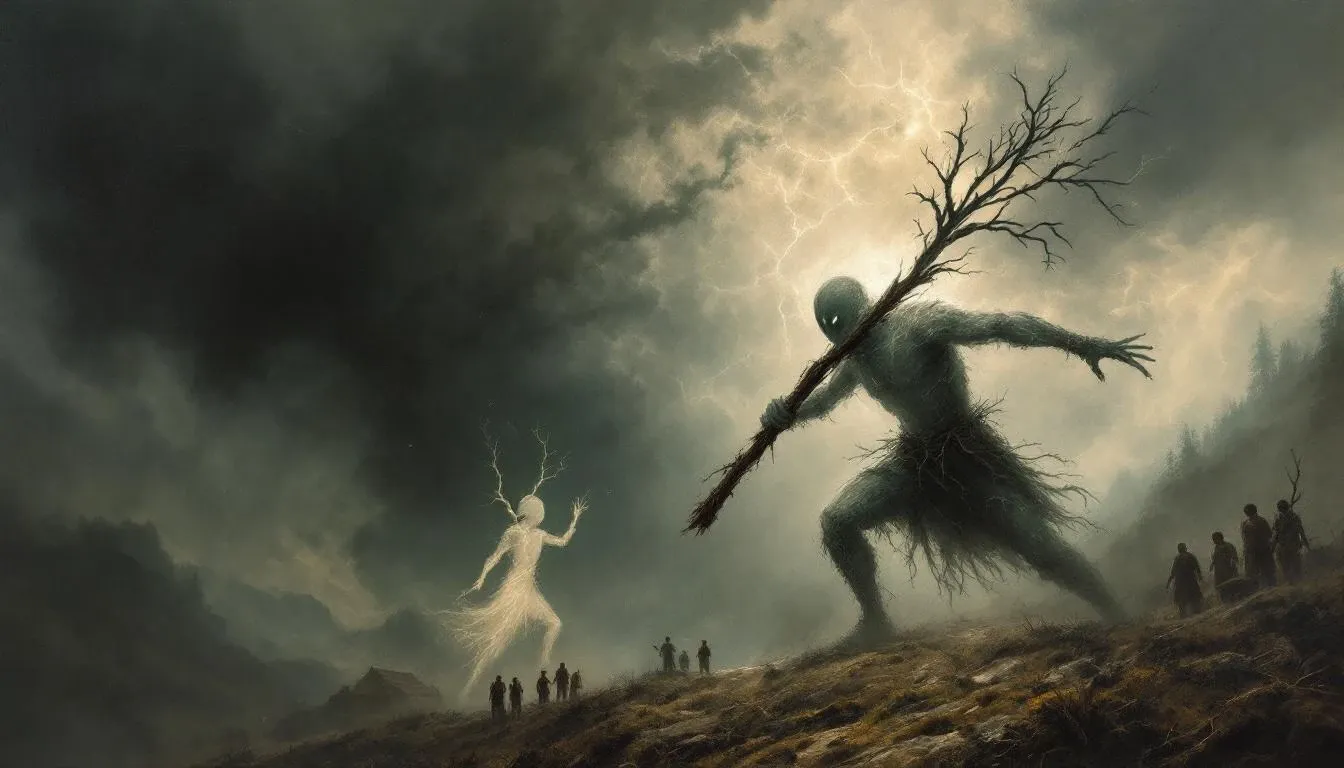
The weapons were extraordinary. A Zduhać might wield an uprooted tree — torn from the earth by sheer spiritual force and swung like a club against the body of the Ala. Some traditions describe them fighting with fence posts, wagon axles, or entire haystacks hurled at the enemy. Others speak of the Zduhać wrestling the Ala bare-handed, grappling with a creature of fog and malice in the heart of the thunderhead.
The battles were not solitary affairs. Multiple Zduhać from multiple villages might converge on the same storm, fighting on the same side against the Ala swarm. But there was a complication: a Zduhać protected his territory. If the Ala were driven away from one village, they might be driven toward another. This meant that Zduhać from neighboring regions sometimes fought each other, each trying to redirect the hail away from their own fields and toward someone else's. The aerial war was not simply good versus evil — it was territorial, political, a supernatural extension of the rivalries between communities.
The Trance and the Return
The departure of the soul was involuntary. A Zduhać did not choose when to fight — the storm chose for him. As the clouds gathered, a profound drowsiness would overcome him. He might be eating dinner, walking to the market, tending his animals. It did not matter. The heaviness would press him down, and within minutes he would be unconscious — or something that looked exactly like unconsciousness.
Some sources describe the Zduhać as fully aware of his dual existence. He knew what he was, knew what was happening when the trance took him, and could recount the battles afterward. Others — and this is the more common tradition — describe Zduhać who fought without conscious knowledge. They would wake from the trance exhausted, sometimes bruised, sometimes bleeding from wounds that had no visible cause, with only fragments of dream-memories: a sense of flight, of struggle, of vast dark shapes in the wind.
The return was dangerous. If the body had been moved — carried indoors, turned face-down, covered with a blanket in the wrong way — the soul might not reconnect. Stories circulated of Zduhać who woke disoriented, speaking in fragments, unable to recognize their families for hours or days. Worse stories told of those who never woke at all — their souls lost in the upper air, defeated by the Ala, unable to find the thread back to their flesh.
The exhaustion after battle was real and visible. A Zduhać who had fought a long storm might sleep for a full day afterward, waking pale and hollow-eyed. The bruises were interpreted as evidence of the combat — marks left by the Ala's claws or tail, transferred somehow from the spirit-body to the physical one. In some communities, these marks were displayed with a certain pride. In others, they were hidden, kept private, spoken of only within the family.
The Benevolent Werewolf
Here is where the Zduhać intersects with another strand of Slavic belief, one that complicates the Western understanding of the werewolf considerably.
In Serbian tradition, the Vukodlak — the werewolf — was not always evil. There existed a category of benevolent werewolf whose transformation served a protective function. These beings, sometimes called vlkodlak or identified directly as a type of Zduhać, transformed not to hunt humans but to fight demons. Their wolfishness was a weapon deployed in defense of the community.
The overlap between the Zduhać and the benevolent werewolf is not coincidental. Both are born marked — the caul for the Zduhać, specific birth circumstances for the werewolf. Both undergo involuntary transformation. Both fight supernatural enemies on behalf of a community that fears them slightly even as it depends on them. Both exist in a state of spiritual liminality — neither fully human in the ordinary sense, nor fully Other.
This parallel extends across the Adriatic to the Italian benandanti — the "good walkers" of Friulian tradition, documented extensively by the historian Carlo Ginzburg. The benandanti were born with the caul, left their bodies at night in spirit form, and fought witches and demons to protect the harvest. The structural similarity to the Zduhać is so precise that scholars have argued for a shared Proto-Indo-European origin — a common ancestor belief about caul-born spirit warriors that survived in parallel in both the Slavic and Italic traditions.
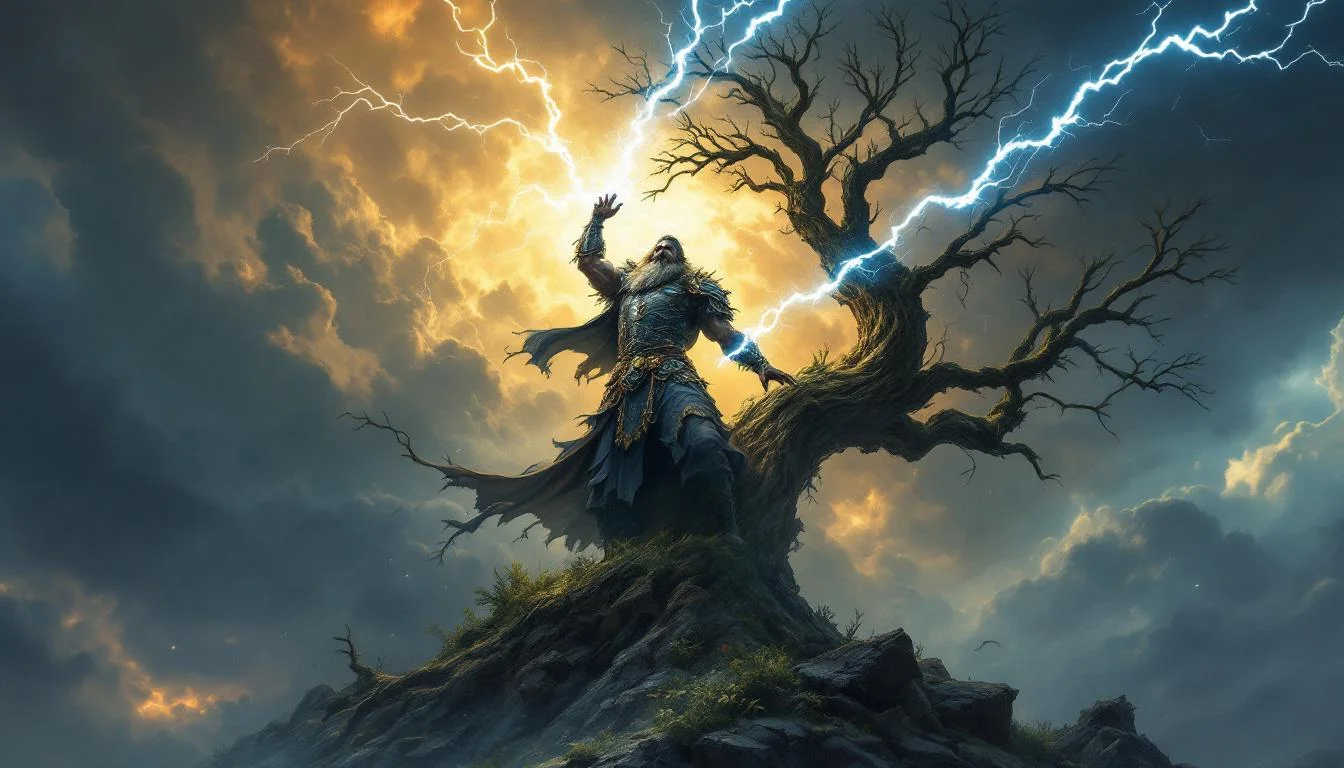
The connection to Perun, the Slavic thunder god, is also significant. Perun was the divine storm-warrior, the god who struck demons with lightning bolts and maintained cosmic order through violence against chaos. The Zduhać can be understood as a human echo of Perun's function — a mortal granted a fraction of the thunder god's duty, fighting the same enemies on a smaller scale with cruder weapons. Where Perun hurled lightning, the Zduhać swung uprooted trees. The principle was identical: the storm is a battlefield, and someone must fight on the side of order.
Regional Variants and Local Names
The Zduhać was not called Zduhać everywhere. The name itself — derived from a root meaning "breath" or "spirit" — was primarily Serbian and Montenegrin. In Bosnia, the same figure appeared under the name stuha or stuhać. In parts of Croatia, the term mogut was used — literally "the powerful one." In Bulgarian tradition, a related figure was the zmey — though the Bulgarian zmey carried additional connotations of dragon-nature and erotic relationships with human women that the Serbian Zduhać typically lacked.
In Montenegro specifically, the Zduhać tradition was exceptionally well-preserved into the twentieth century. Montenegrin ethnographers recorded testimony from individuals who claimed to be Zduhać or who identified specific neighbors as such. The mountain villages of Montenegro, isolated and conservative, maintained oral traditions that had eroded elsewhere. A Montenegrin Zduhać was typically a respected elder — not feared the way a witch was feared, but regarded with the gravity owed to someone who carried a communal burden.
The Bosnian variant introduced an additional element: the Zduhać's spirit did not always fight in human form. It might appear in the clouds as a great bird, a serpent of light, or simply a wind — a directed, intelligent gust that slammed into the Ala's body and dispersed its hail-bearing fog. This shape-flexibility of the spirit-in-combat distinguished the Bosnian tradition from the Serbian one, where the Zduhać typically fought in a recognizable humanoid shape.
The zduhać is a man whose spirit, during sleep, leaves the body and engages in combat with hostile spirits — especially the ala — in order to defend the fruits of the earth from hail and destructive storms. He is born with the caul, which is preserved with care by his mother. Without the caul, he cannot fight. With it, he is the shield of his entire region.
The Social Function of the Storm-Fighter
Why did this belief persist so stubbornly across centuries and regions? The answer lies in the agricultural reality of the Balkans. Hailstorms were — and remain — one of the most devastating natural threats to crops in southeastern Europe. A single severe hailstorm could destroy an entire season's harvest in minutes, condemning a village to hunger. The terror of hail was not abstract. It was existential.
The Zduhać belief provided three things that raw meteorology could not:
First, agency. If hail was simply random weather, there was nothing to be done. But if hail was sent by the Ala — malicious, intentional, targetable — then it could be fought. The existence of the Zduhać meant that the village was not helpless against the storm. Someone was fighting for them, even if they could not see it.
Second, explanation. When hail struck one village but spared the next, the Zduhać framework provided a reason. The spared village had a stronger Zduhać. The struck village had a weaker one, or none at all, or one whose caul had been lost. Differential outcomes were not random. They were the result of invisible combat.
Third, social cohesion. The Zduhać was a figure of communal defense. His sacrifice — the involuntary trances, the exhaustion, the wounds — was borne on behalf of everyone. He knit the village together around a shared protector, a figure who embodied the community's vulnerability and its resilience simultaneously.
The Sleeper and the Storm
There is something deeply human in the image of the Zduhać — the man who lies still while his soul wages war. He is present and absent. He is vulnerable in his flesh and mighty in his spirit. He cannot control when duty calls him, cannot refuse the summons of the gathering clouds. He wakes tired, sometimes hurt, carrying the weight of a battle no one witnessed.
The Zduhać was not a hero in the epic sense. He did not seek glory or adventure. He was a farmer, a herder, a craftsman — an ordinary man with an extraordinary burden placed on him at birth by a membrane of tissue over his face. The Ala did not care about his comfort or his schedule. The storm came when it came, and when it came, he went.
In the villages of Montenegro and Serbia, the last generation that genuinely believed in the Zduhać is now very old or gone. The tradition survives in ethnographic archives, in folklore collections, in the memory of grandchildren who were told stories about great-uncles who fell asleep during thunderstorms and woke with bruises they could not explain.
But the storms still come over the mountains. The sky still turns black and yellow. And somewhere in the deep grammar of the culture, beneath the modern surface, there persists a sense — not quite belief, not quite disbelief — that someone ought to be fighting up there. That the hail should not fall unopposed. That a man born under the caul has a duty to his people that transcends the waking world.
The Zduhać sleeps. The storm rages. And in the space between body and sky, an ancient war continues.