The sky turns green. Not dark — green. A poisoned, bilious color that spreads from the western horizon like a bruise blooming under skin. The air goes still in the way that air goes still before violence — the held breath of the atmosphere, the absolute silence that replaces birdsong and wind and the normal background sounds of a living world. The cattle are already running. The dogs are under the house. The old woman in the garden has dropped her hoe and is crossing herself and muttering words that are not quite prayers and not quite curses, because the sky is the wrong color and she has seen this before, and she knows what comes next.
What comes next is hail the size of walnuts, falling from a sky that was clear twenty minutes ago. It shreds the wheat. It pulverizes the grapes. It strips the leaves from the fruit trees and leaves them standing naked and broken like skeletons in August. In fifteen minutes, a season's labor is destroyed — the crop that would have fed the village through winter, beaten into the mud by ice that has no business falling from a summer sky.
In modern meteorology, this is a severe convective event. In the villages of Serbia, Bulgaria, North Macedonia, and the broader Balkans, this is an ala — a storm demon of enormous power and ancient hunger, coiling through the thunderheads, steering the hail with deliberate malice onto the fields of those it has chosen to destroy.
What an Ala Is
The ala (ала) — also hala (хала) in Bulgarian and Macedonian tradition — is a class of supernatural being responsible for destructive storms, hailstorms, whirlwinds, and eclipses. She is not a weather phenomenon with a supernatural explanation. She is a being for whom destructive weather is an instrument — a weapon deployed against the human world with varying degrees of intentionality, from mindless hunger to calculated revenge.
The term ala has no clear etymology. Some scholars derive it from Turkish alaca (variegated, striped — referring to the mottled appearance of storm clouds), suggesting the word entered South Slavic languages during the Ottoman period. Others trace it to Greek alla or to Arabic roots, both passing through the Ottoman cultural layer that shaped so much Balkan vocabulary. Still others argue for a native Slavic origin, connecting it to archaic roots meaning \to devour\ or \to rage.\ The uncertainty is appropriate. The ala belongs to the deep substrate of Balkan folk belief — the layer where Slavic, Thracian, Greek, and Turkish traditions mixed until their boundaries dissolved — the same substrate that produced the Bukavac and other creatures unique to the Balkan intersection of cultures.
What is clear is that the ala is not simply a dragon, though English-language sources often translate her that way. The Zmey Gorynych of Russian folklore — the multi-headed, fire-breathing dragon of epic tales — is a creature of narrative, a villain in hero-stories, a monster to be slain. The ala is something different. She is a creature of environment — a force woven into the weather itself, present in the texture of the storm rather than flying above it. When the ala passes over your fields, you do not see a dragon. You see the storm. The storm is her. Her body is the cloud. Her breath is the wind. Her hunger is the hail.
The Shapes She Takes
The ala has no fixed form. She shifts between shapes with the fluidity of the weather systems she inhabits — now visible, now invisible, now a vast dark presence filling half the sky, now a small creature scuttling between furrows in a field. The folk accounts describe her in multiple, often contradictory forms.
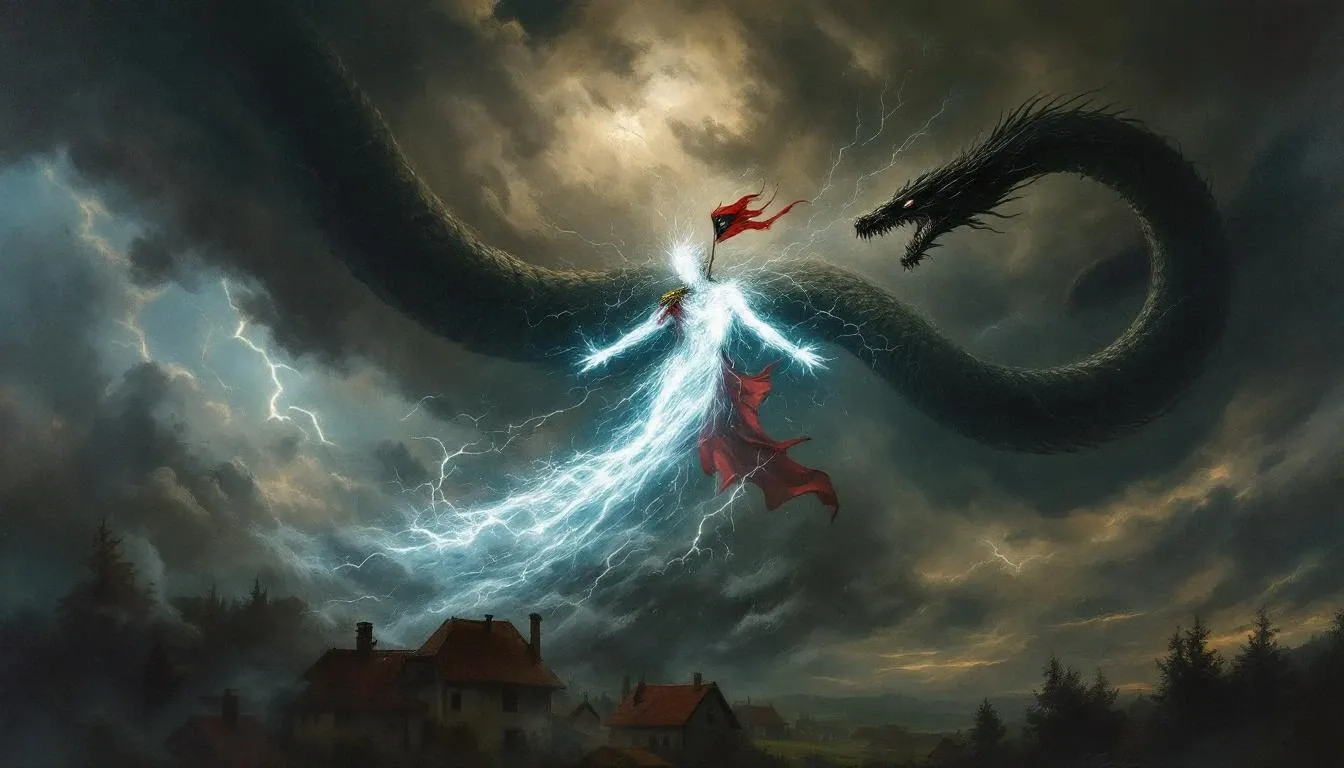
The serpentine form. Most commonly, the ala is described as an enormous serpent or dragon-like creature — black, with a body that stretches from horizon to horizon, coiling through the upper atmosphere as she moves. She has wings in some accounts, fin-like appendages in others, or no visible limbs at all — just a vast sinuous body threading through the thunderheads like a worm through earth. This form is most associated with the visible approach of a storm: the darkening sky, the rolling clouds, the sense of something massive and purposeful moving toward you across the landscape.
The cloud form. In many traditions, the ala is the storm cloud — not a creature hiding within it, but the cloud itself animated by malicious intent. A particular cloud formation — dark, low, moving against the prevailing wind, tinged with that poisonous green — was identified as an ala by farmers who had learned to read the sky the way a sailor reads the sea. The ala-cloud moved differently from natural weather. It targeted. It steered. It found the ripest field, the fullest vineyard, the most vulnerable crop, and emptied its hail directly onto it with a precision that no random weather event could achieve.
The eagle form. In parts of Bulgaria and Macedonia, the hala took the form of a monstrous eagle — vast-winged, dark-feathered, blotting out the sun as it passed. This form connects to the eclipse tradition (discussed below), where the ala was believed to swallow the sun. An eagle large enough to swallow the sun is an image of terrifying scale — a creature whose wingspan spans the sky itself, whose shadow is the darkness of eclipse, whose hunger is measured in celestial objects.
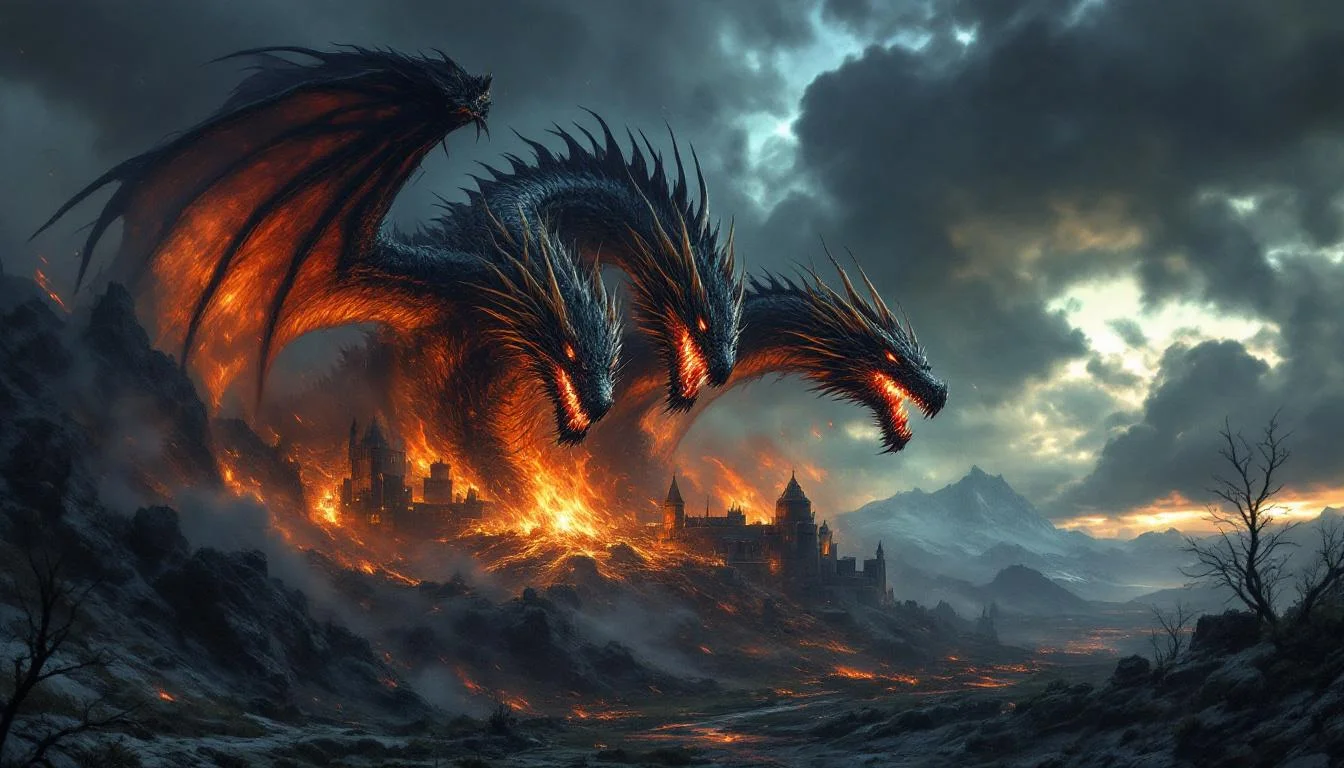
The human-adjacent form. In some Serbian traditions, the ala could appear as a woman — haggard, wild-haired, enormous, with burning eyes and a mouth that opened wider than any human jaw should permit. In other accounts, she appeared as an old man with a distended belly, suggesting the gluttony that drove her to devour crops. In Bulgarian tradition, the hala sometimes took the form of a three-headed being — each head representing one of her destructive powers: hail, wind, and darkness.
The invisible form. Often, the ala had no visible shape at all. She was present in the behavior of the storm rather than in any observable body — felt in the unnatural targeting of the hail, in the way the wind seemed to hunt specific buildings, in the localizing of damage to patterns too precise for chance. The ala was diagnosed by her effects rather than her appearance: if the storm destroyed exactly the one field that belonged to the man who had angered the spirits, that was an ala at work.
What She Eats
The ala is fundamentally a creature of appetite. Her primary motivation across all traditions is hunger — a vast, chronic, insatiable hunger that drives her to consume on a scale that dwarfs any biological creature.
Crops. This is her primary food source in the practical folklore of farming communities. The ala devours grain, grapes, fruit, vegetables — anything that grows in the fields. She consumes them through the mechanism of hail: the ice stones are her teeth, grinding the crops to pulp. A field destroyed by hail has been eaten by an ala. The loss is not waste — it is feeding. The farmer's devastation is her satisfaction. The economic catastrophe of a destroyed harvest is, in the ala's economy, simply dinner.
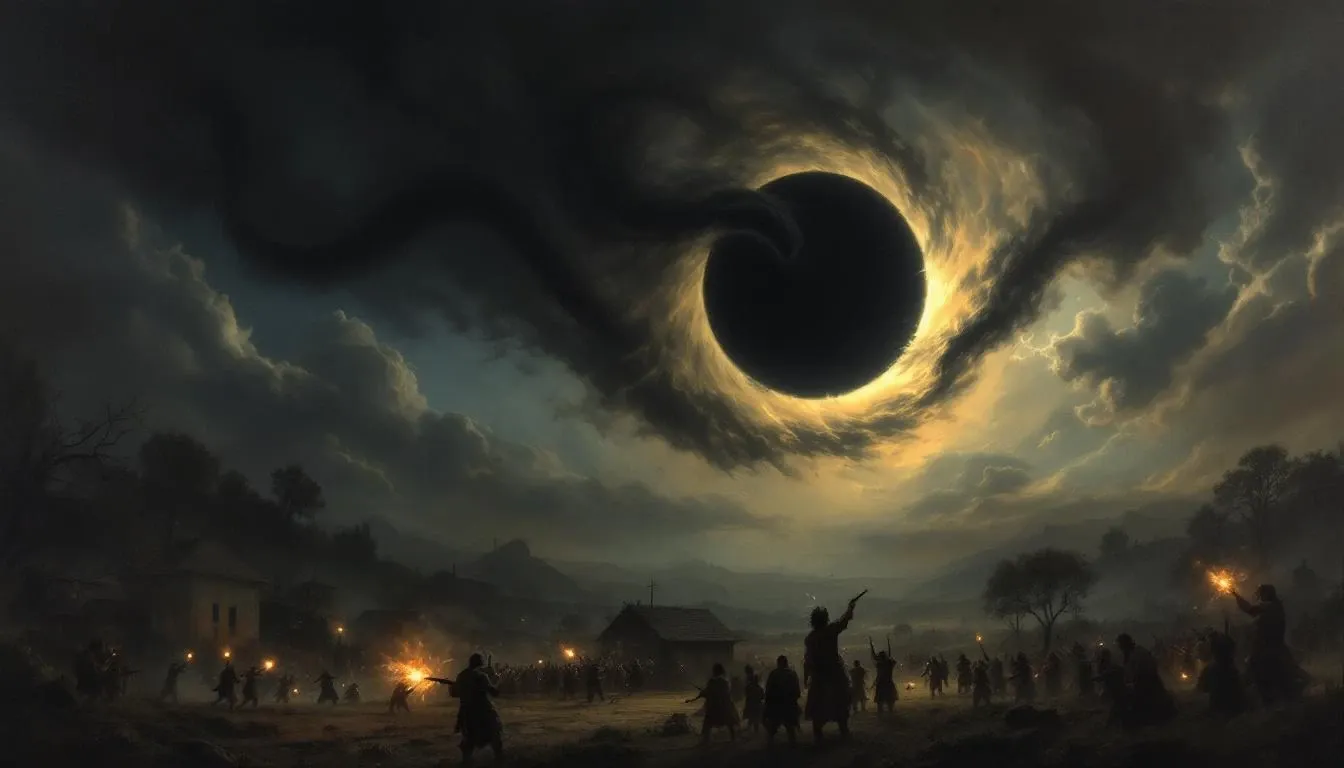
The sun. During solar eclipses, the ala was believed to be swallowing the sun — devouring the celestial body the way she devoured earthly crops, her hunger so vast that even stars were food. Balkan villagers responded to eclipses with tremendous noise — banging pots, firing guns, shouting, ringing bells — to frighten the ala into releasing the sun before she consumed it entirely. The eclipse was understood not as an astronomical event but as a predator-prey interaction between a storm demon and the source of all light.
The moon. Lunar eclipses received the same explanation. The ala consumed the moon — causing the red shadow of eclipse as the moon passed through the ala's body, stained by her internal darkness before being released. The blood-red color of a total lunar eclipse was interpreted as the moon wounded by the ala's teeth, bleeding from the bite.
Human vitality. In some traditions, the ala fed not only on crops and celestial bodies but on human life force — draining strength and health from those caught in her storms. A person struck by ala-driven weather might not be physically injured but would afterward suffer malaise, weakness, depression — as though something essential had been sucked from them along with the warmth of the sunlight the ala had blocked.
The ala is pure hunger given motion. She does not destroy from malice, as a devil does, nor from territorial aggression, as a zmaj might. She destroys because she is empty and the world is full, and the distance between these two states is what we call a storm.
The Zduhać: The Human Who Fights Storms
The ala would be an unstoppable force — a demon of weather against which no human defense could prevail — if not for the zduhać (здухаћ). The zduhać is one of the most extraordinary figures in South Slavic folklore: a human being, born with a special gift, whose soul leaves their body during storms and fights the ala in the clouds.
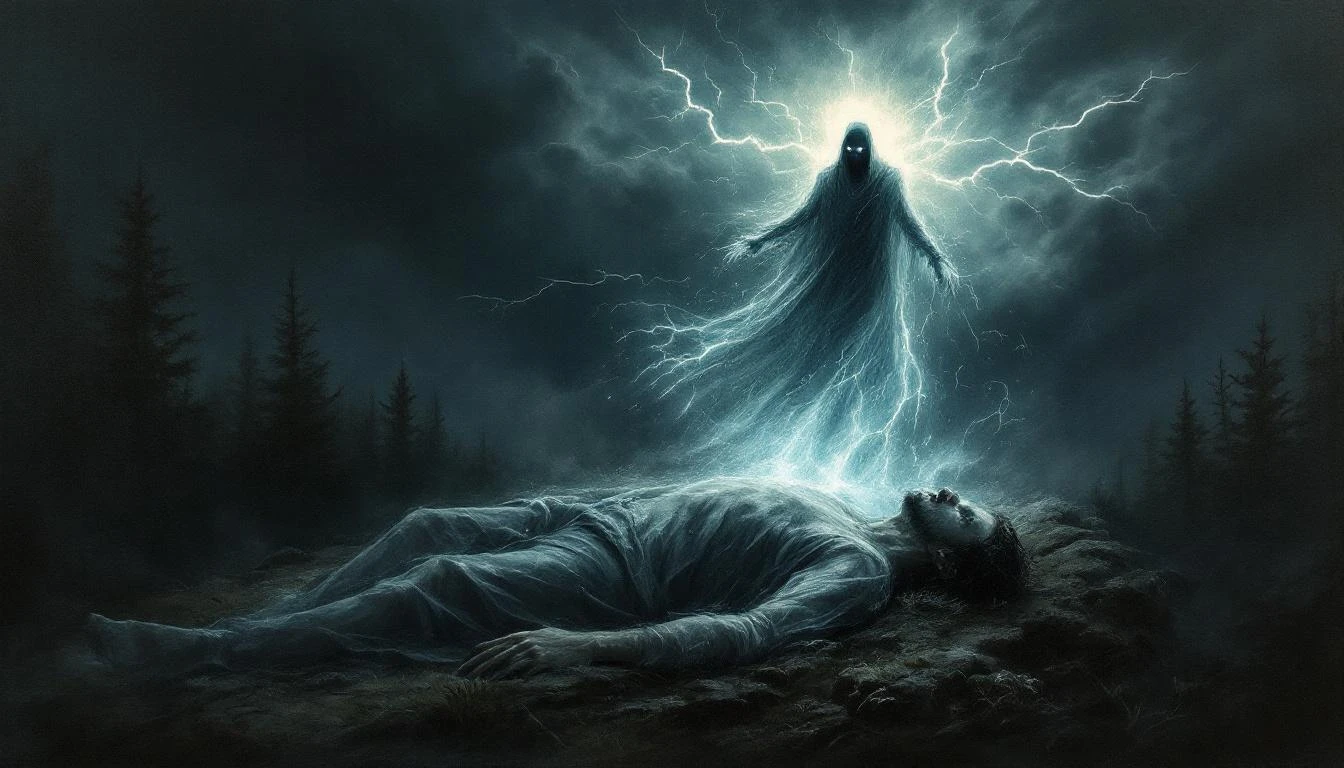
The zduhać (sometimes stuha, zduhač, or vedogonja depending on region) was typically male, though not exclusively. He was born with a caul — the amniotic membrane sometimes covering a newborn's face at birth — which marked him as a person with supernatural potential. In life, he appeared ordinary. He farmed, married, raised children, grew old. But when storms approached — when the sky turned green and the air went still and the ala descended — the zduhać fell into a sudden, unnatural sleep. His body remained in bed, inert and unresponsive. His soul rose into the sky.
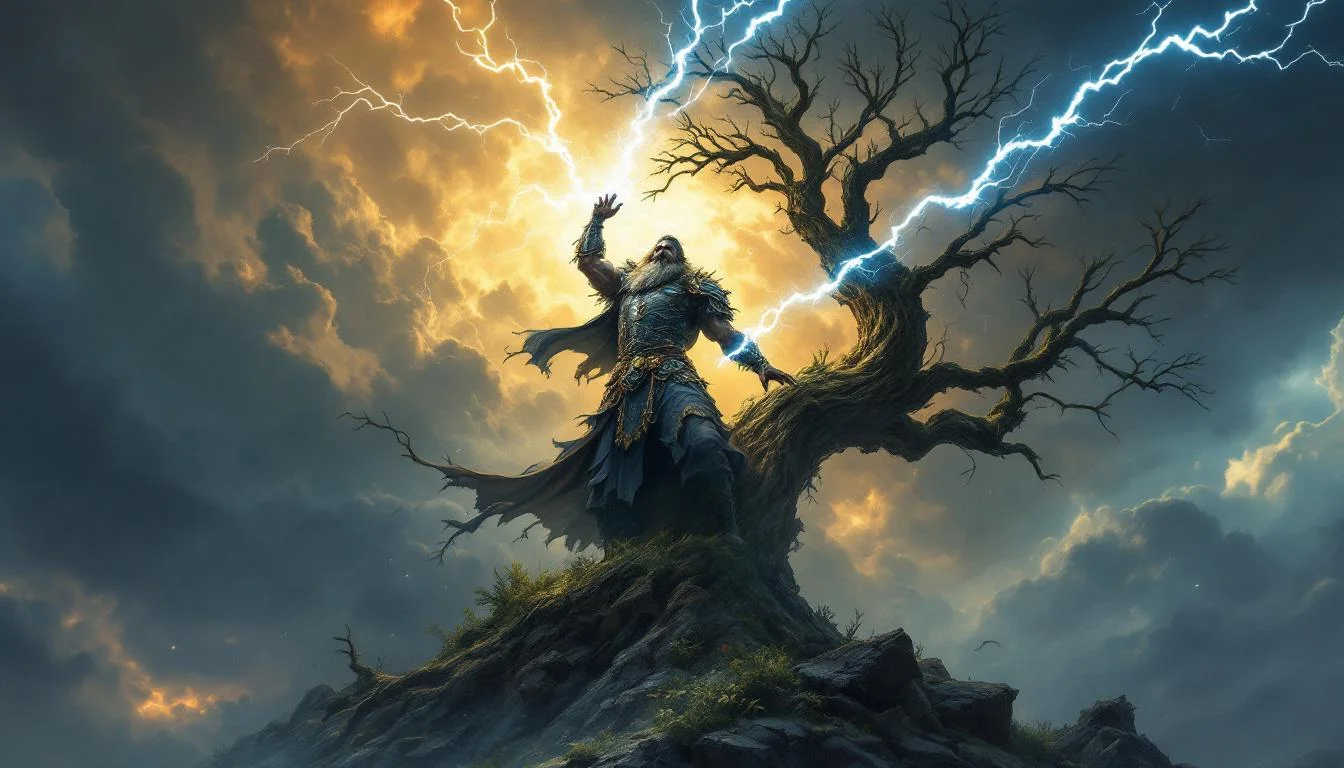
In the clouds, the zduhać fought the ala. The battle was physical — punching, wrestling, hurling the demon away from the village, deflecting the hailstorm toward uninhabited mountains or empty fields. The zduhać used weapons formed from the weather itself: lightning bolts, gusts of wind, chunks of ice torn from the ala's own ammunition and hurled back at her. The fight could last hours. While it raged, the storm churned above the village, the sky flashing and roaring, the wind shifting direction unpredictably as the combatants struggled for control.
If the zduhać won, the storm passed harmlessly. The hail fell on the mountains, or dissolved into rain, or simply stopped. The village was saved. The zduhać woke from his sleep exhausted, bruised — sometimes with physical injuries that had no earthly explanation, marks on his sleeping body that corresponded to the wounds he received in the clouds. If the zduhać lost, the hail fell. The crops died. And the zduhać might not wake at all.
Villages that had a known zduhać considered themselves blessed. He was their defender, their aerial warrior, the one person standing between them and the ala's hunger. The zduhać received no payment for this service — it was not a profession but a condition, something he was born into and could not refuse. He fought because the ala came, and the ala came because the crops were ripe, and the crops were ripe because the season turned, and so the cycle continued, year after year, the human soul against the storm demon, agriculture's invisible guardian locked in perpetual combat above the clouds.
The Connection to Perun and the Storm-God Tradition
The ala did not emerge in a theological vacuum. She belongs to a broader mythological system in which weather — storms in particular — was understood as the domain of divine conflict. In the reconstructed Proto-Slavic religion, Perun — the thunder god, wielder of lightning, lord of the sky — stood as the supreme opponent of chthonic, serpentine forces associated with darkness, water, and the underworld.
The mythologist Ivanov and the linguist Toporov developed this into their famous \Basic Myth\ theory: the fundamental narrative of Slavic mythology was the eternal combat between Perun (sky, thunder, order, fire) and Veles (earth, water, cattle, chaos). Perun hurled thunderbolts from the sky. Veles-as-serpent stole from the upper world and fled to the lower. The storm was the battlefield. Lightning was Perun's weapon. Rain was the stolen waters being released.
The ala fits into this framework as a descendant — or a fragment — of the Veles-serpent. She is a chthonic creature in the sky, a being of darkness and hunger inhabiting the realm of thunder and light. She is the enemy that Perun fights. In regions where the old god's name was forgotten but his function persisted, the zduhać took his place — a human champion wielding storm-weapons against the serpentine destroyer. The zduhać is Perun's heir in human flesh, the thunder-god's function transferred to a mortal vessel after Christianity made the old gods impossible to worship openly.
This is why the ala's primary enemy is thunder and lightning. Folk practices for driving away the ala consistently involve noise and fire — simulated thunder, simulated lightning. The banging of pots during eclipses, the ringing of church bells during hailstorms, the firing of guns into the threatening clouds — all are echoes of Perun's thunderbolts, deployed by mortals who no longer remember the god but still remember the principle: the storm-serpent fears the storm-lord's weapons.
Regional Variations
The ala/hala concept spreads across the entire South Slavic world, with regional variants that reflect local geography, agricultural concerns, and the specific anxieties of different landscapes.
Serbia. The Serbian ala is most strongly associated with hailstorms and crop destruction. She is typically serpentine, sometimes described as having multiple heads, and is fought by the zduhać. Serbian tradition is the most developed in terms of the ala-zduhać combat narrative, with detailed accounts of specific battles, specific zduhać families known for generations of storm-fighting, and specific locations where the fights took place.
Bulgaria. The Bulgarian hala tends toward larger scale. She swallows the sun. She causes earthquakes by turning in her sleep beneath the mountains. She is fought not by a zduhać equivalent but by zmeyove — dragons who are, in this tradition, protective rather than destructive, defenders of the community against the hala's hunger. The Bulgarian system inverts the Serbian one: in Serbia, the human zduhać fights the aerial serpent; in Bulgaria, the serpentine zmey fights the aerial monster. Same structure, different assignments.
North Macedonia. The Macedonian tradition emphasizes the ala's connection to specific geographic features — particular mountains, particular passes, particular valleys where storms concentrate. The ala is more territorial here — she does not roam but rules a defined area, and the storms she sends are not random predation but deliberate governance of her domain. Farmers within her territory must appease her with offerings or accept periodic destruction as a kind of supernatural tax.
Slovenia and Croatia. In western South Slavic traditions, the ala concept blurs into Germanic weather-demon traditions — Wettergeist, storm-spirits that ride the wind. The figure is less serpentine here, more diffuse — a force within the weather rather than a creature causing it. The zduhać equivalent in these regions is called vedomec or kresnik, and his battles in the sky are described with imagery that owes as much to Central European Bänkelsang traditions as to Balkan folk belief.
The Ala Survives
Modern Balkan farmers do not, for the most part, believe in literal storm demons coiling through the atmosphere with malicious intent. They have weather radar, crop insurance, anti-hail nets, and silver iodide cloud seeding. The mechanism of hailstorm formation is well understood: strong updrafts in cumulonimbus clouds suspend water droplets until they freeze into layered ice stones that fall when gravity overcomes the updraft's force. No serpent required.
And yet. When a hailstorm destroys a single field while leaving the neighboring fields untouched — which happens, because hailstorms are genuinely localized in ways that feel personal to the farmer standing in the wreckage — the word ala surfaces. Not with full belief behind it. Not as a literal explanation. But as a name for the feeling — the sense that the destruction was targeted, that the universe singled you out, that the loss was not random but chosen. The ala gives that feeling a shape. She transforms helpless victimhood into a narrative with an antagonist, and narratives with antagonists are more bearable than pure meaningless loss.
The sky still turns green sometimes, in the Balkans, in summer, when the conditions align. The color is produced by the interaction of reddish sunlight with the blue-green of ice-laden clouds — a well-documented optical phenomenon. The old woman in the garden still looks up at that color and feels something ancient tighten in her chest. The cattle still run. The dogs still hide. And somewhere above the cloud line, in the space between meteorology and myth, the ala is still hungry.
She has been hungry since before the fields were planted. She will be hungry when the fields are dust. The sky is her plate. The earth is her food. And the storm — the beautiful, terrible, green-skied storm — is the sound she makes while eating.