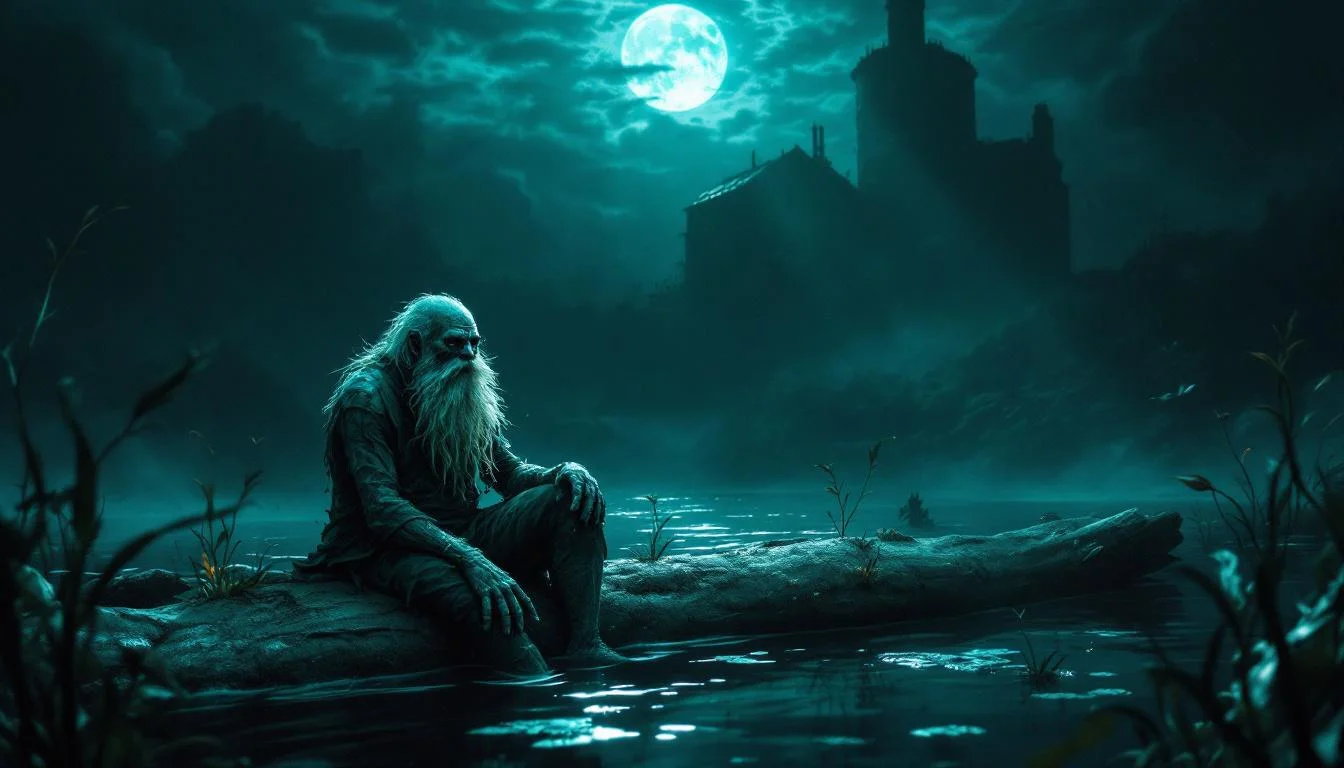
In the flatlands of Syrmia, where the Sava River spreads wide and lazy before meeting the Danube, the villages sit low and close to the water. The land here is ancient alluvial plain — rich, black, and wet, seamed with oxbow lakes, reed-choked marshes, and pools that appear in spring and never fully drain. It is good land for farming. It is excellent land for fishing. And it is, according to the people who have lived there for centuries, precisely the kind of land where something with six legs and gnarled horns and bright blue eyes waits at the bottom of the deepest water, listening for the sound of footsteps on the bank. The name of that something is Bukavac, and if you are hearing it for the first time, you should understand that the people who coined it were not being poetic. They were being descriptive. Buka means noise — a roar, a bellow, a sound that rattles the windows of houses a quarter mile from the shore. The Bukavac is the thing that makes that noise. And by the time you hear it, the creature is already out of the water and moving toward you in the dark.
Serbian demonology does not lack for water spirits. The Vodyanoy presides over rivers and millponds across the broader Slavic world, demanding tribute from fishermen and millers. The Rusalka haunts the shallows with the memory of a drowned woman's grief. But the Bukavac belongs to a different order of threat entirely. It is not a spirit that can be appeased with offerings or outwitted with ritual knowledge. It is not tragic, not melancholy, not interested in negotiation. It is a predator — massive, physical, six-legged, and hungry — and its hunting ground is the still water of southern Serbia's lake country, a region where the boundary between dry land and the aquatic world has never been entirely stable.
The Shape of the Thing
The ethnographic record on the Bukavac is frustratingly thin compared to better-documented creatures like Baba Yaga or Koschei the Deathless, but what exists is remarkably consistent across sources. The creature is described as a monster of considerable size, possessing six legs — not four, not eight, but six, an anatomical detail that places it outside the familiar categories of mammal, reptile, or insect and into something older and less classifiable. Its horns are described as gnarled or twisted, curving from a broad skull in a configuration that suggests a battering instrument rather than ornament. Its eyes are bright blue — not the pale, washed-out blue of a winter sky but a vivid, luminous blue that would be visible in near-total darkness, the kind of blue that appears in deep water when sunlight penetrates from above and everything takes on an unnatural, electric clarity.
Beyond these defining features, the descriptions vary but converge on a general impression of amphibious grotesqueness. The skin is slimy — coated with the mucous film common to things that spend their lives submerged. The body is massive and low-slung, built for power rather than speed, with a long tail that trails behind it and a wide mouth that suggests a predator accustomed to swallowing things whole rather than tearing them apart. Some accounts give it webbed feet. Others describe claws capable of gripping mud and stone with equal purchase. All agree that when the Bukavac hauls itself out of the water and onto the bank, the sound of its movement — the wet, heavy drag of its belly across reeds and mud — is enough to freeze a person in place before the bellowing even begins.
The six legs deserve particular attention, because they are not a casual detail. In Slavic folk zoology, the number of limbs carried meaning. Four-legged creatures were natural, terrestrial, comprehensible. Things with more legs than that — or fewer, or an odd number — belonged to the demonic order, the world of nechist, the unclean forces that existed alongside the natural world but did not obey its rules. A six-legged creature is emphatically unnatural. It moves wrong. It occupies space wrong. It is a violation of the basic pattern that every farmer, every fisherman, every child who had ever watched a horse or a dog understood instinctively. The Bukavac's extra pair of legs was not just a physical trait — it was a theological statement. This thing was not made by the same hand that made the ox and the wolf.
The Howl Across the Water
If the Bukavac's body is its weapon, its voice is its signature. The name itself — derived from buka, the Serbo-Croatian word for noise, uproar, racket — tells you what the creature was most famous for before anyone saw it clearly enough to count its legs. The Bukavac's cry carried across the flat Syrmian landscape with a force that villagers compared to thunder, except that thunder came from the sky and had an explanation. The Bukavac's roar came from the surface of a lake that had been silent a moment before, and it had no explanation at all.
The bellowing served a dual purpose that reveals something about the creature's hunting intelligence. First, it was a territorial announcement — a declaration that the lake or pool or stretch of river belonged to the Bukavac and that anything in or near the water after dark was trespassing. In this sense, the Bukavac functioned in folklore much as the Vodyanoy did: as a supernatural enforcer of boundaries between the human world and the aquatic one, a reminder that water — especially still water, deep water, water you cannot see through — is not your territory once the sun goes down. Second, and more practically, the roar was a hunting tool. A person startled awake by a sound they cannot identify will do one of two things: freeze or run. Either response served the Bukavac's purposes. A frozen victim was easy to approach. A running victim made noise, broadcasting their position across the flat terrain where the Bukavac, with its six legs and its low center of gravity, could cover ground faster than a panicked human stumbling through reeds in the dark.
The accounts are specific about timing. The Bukavac emerged at night — always at night — and the bellowing preceded its appearance on shore by a margin that varied from minutes to seconds depending on how close the creature's resting place was to the bank. Fishermen who worked late on the Sava tributaries learned to read the silence that preceded the roar. When the frogs stopped calling and the night herons went quiet and the surface of the water went perfectly, unnaturally still — that was the interval. That was the moment to pull in your nets, collect your things, and put as much distance between yourself and the water as your legs could manage.
The Strangler's Method
What the Bukavac did when it caught its prey was consistent across every account that survives: it strangled. Not bit, not clawed, not dragged beneath the surface in the manner of the Vodyanoy. It leaped — and for a creature of its described mass, the leap was the most terrifying part — onto the back of its victim, whether human or animal, and used its weight and its limbs to compress the throat and chest until breathing stopped. The image is not of a serpentine constrictor but of something closer to a great cat's ambush: a sudden impact from above or behind, an overwhelming application of mass, and then the slow, horrible compression as the victim's struggles grew weaker.
This method of killing is significant because it suggests the Bukavac was understood as a physical predator rather than a magical one. The Vodyanoy drowned his victims through supernatural manipulation of the water itself — currents that appeared from nowhere, weeds that tangled with unnatural persistence. The Rusalka lured men into the water with song and beauty before pulling them under. The Bukavac used no magic, no lure, no supernatural mechanism. It used weight and strength and the advantage of surprise, the way a leopard uses weight and strength and the advantage of surprise. It was, in the taxonomy of Slavic demons, unusually material — a thing you could theoretically fight, if you were strong enough and fast enough and not paralyzed by the sight of a six-legged monstrosity landing on your companion's shoulders in the dark.
The Bukavac was believed to dwell in still waters — lakes, swamps, and the quiet bends of rivers — emerging only after nightfall with a terrible bellow that gave the creature its name. It would leap upon man or beast alike and strangle them, and the people of Syrmia warned their children never to approach the water after dark, for the Bukavac does not bargain and does not forgive.
The strangulation motif also connects the Bukavac to a broader pattern in South Slavic demonology where nocturnal creatures kill by suffocation rather than by wound. The mora — the nightmare spirit that sits on a sleeper's chest — kills the same way: by weight, by pressure, by the slow denial of breath. The Vukodlak, in some of its vampiric aspects, was said to visit sleeping victims and press down on their bodies until they could not breathe. The Bukavac, then, is the outdoor, aquatic version of a suffocation terror that the South Slavs carried with them from bedroom to lakeside, from the pillow to the riverbank — the primal fear that something heavier than you will pin you down in the dark and you will not be able to draw the next breath.
The Drekavac's Cousin
No discussion of the Bukavac is complete without mentioning its close folkloric relative, the Drekavac — the Screamer. Both creatures are products of South Slavic, specifically Serbian, folk tradition. Both are defined primarily by the sounds they make: buka (noise, roar) for the Bukavac, dreka (scream, shriek) for the Drekavac. Both are nocturnal. Both were reported in overlapping regions of Serbia and the former Yugoslav territories. And both were used by rural communities as explanatory frameworks for the unsettling sounds that carry across flat, wet landscapes after dark — the sounds that have no visible source and no satisfying natural explanation.
But the differences between them reveal the precision with which Serbian folk belief categorized its demons. The Drekavac is, in most traditions, the restless spirit of an unbaptized child — a creature born from human tragedy, small and hairy with long claws, whose scream is the cry of an infant twisted into something predatory. It climbs onto a person's back and forces them to run until the rooster crows at dawn, shredding their face with its claws if they resist. It is afraid of light and dogs. It is, at its core, a ghost — a human soul that went wrong.
The Bukavac is none of these things. It has no human origin. It fears nothing that the sources record. It does not ride its victims — it crushes them. Where the Drekavac is pathetic and pitiable beneath its horror, a dead child that cannot rest, the Bukavac is simply monstrous. It has no backstory, no tragedy, no explanation for what it is or where it came from. It lives in the water. It comes out at night. It kills. The absence of origin mythology is itself a statement: some things in the Slavic demonic bestiary were understood as having always existed, as features of the landscape as permanent and as inexplicable as the lakes themselves.
Syrmia: The Landscape That Made the Monster
To understand why the Bukavac belongs specifically to Syrmia and not to the mountain villages of central Serbia or the coastal towns of the Adriatic, you need to understand the geography. Syrmia — Srem in Serbian — is a wedge of lowland between the Sava and the Danube, two of Europe's great rivers. The region is flat. Dramatically, oppressively flat. The highest point is Fruška Gora, a low mountain that barely qualifies as a hill by Balkan standards. Everything else is floodplain: black earth, standing water, reed beds that stretch to the horizon, and a network of channels, oxbow lakes, and seasonal pools that rearrange themselves every spring when the rivers swell.
This is a landscape that produces sounds. Water moving through reeds. Wind across open marsh. Bitterns booming in the pre-dawn dark — a sound that carries for miles and sounds, to an untrained ear, like nothing that should exist in nature. Frogs in such numbers that their collective chorus becomes a physical vibration. And beneath all of it, the constant, low murmur of water finding its level, draining and filling and draining again across a terrain that is never quite land and never quite lake. A person living in this environment, dependent on it for fish and fertile soil but perpetually aware of its capacity to flood, to shift, to swallow a path that was dry ground yesterday — that person would not find it difficult to believe that something lived in the deepest pools. Something that owned the water the way a Leshy owned the forest. Something with a voice that could be heard over the frogs and the wind and the reeds. Something with six legs, because nothing natural has six legs, and whatever lived at the bottom of those black Syrmian lakes was certainly not natural.
The reported sightings — and there were reported sightings, as late as the early 20th century, from the shores of the Sava in the Syrmian stretch — always followed the same pattern. A sound first. Then a disturbance on the water's surface. Then something large and low and wet on the bank, moving with a speed that its bulk should not have permitted. And then, if the witness was wise enough to have already started running, nothing more than the sound of the creature returning to the water, the splash, and the silence that followed.
Why the Bukavac Matters
The Bukavac occupies a unique position in the Slavic bestiary precisely because it is so stubbornly, irreducibly physical. In a mythological tradition rich with shapeshifters, tricksters, and spirits that operate through enchantment and deception — Zmey Gorynych with his three scheming heads, the Vodyanoy with his supernatural control of currents, the Rusalka with her unearthly song — the Bukavac is just a monster. It does not shapeshift. It does not bargain. It does not have a weakness that a clever hero can exploit. It is a large, loud, six-legged predator that lives in a lake and kills things that come too close to the edge. There is something refreshingly honest about that, and something deeply unsettling.
Because the Bukavac represents a category of fear that does not require supernatural elaboration to function. You do not need to believe in the unquiet dead or the politics of river spirits or the theological implications of unbaptized souls to be afraid of the Bukavac. You just need to stand on the shore of a Syrmian lake at two in the morning, alone, with the frogs gone suddenly silent and the water doing something you cannot see, and hear a sound from the direction of the reeds that is louder than anything you have heard before and lower than anything a known animal should be capable of producing. The Bukavac is the mythology of that moment — the split second before rational explanation arrives, when your body knows something your mind has not yet processed, and every instinct you possess is screaming at you to move.
That is why the Bukavac endures. Not as a well-developed character in the great narrative of Slavic myth, but as something more primal than narrative: a shape in the dark, a sound across the water, and the ancient, universal certainty that the lakes belong to something else after nightfall. The people of Syrmia gave that certainty six legs and a pair of gnarled horns and bright blue eyes. They gave it a name that sounds like the noise it makes. And they told their children, in the same flat, matter-of-fact tone that Serbian grandmothers have used for centuries: stay away from the water at night. The Bukavac does not care that you do not believe in it.