On the smooth surface of an endless sea, at the hour when sunset bleeds the sky purple, a bird sits on a dead tree and speaks. She does not sing — not the way the Alkonost sings, which makes you forget your own name, and not the way the Sirin sings, which pulls you toward death like a tide you cannot resist. The Gamayun speaks. She tells you things. She tells you how the earth was separated from the sky. She tells you the true names of gods who existed before the first humans drew breath. She tells you what is coming — war, famine, plague, the fall of princes — in a voice so clear and steady that you understand every word.
That is the problem. You understand every word, and the words do not stop, and what they describe is more than any human mind was built to carry.
The Gamayun is the prophetic bird of East Slavic mythology. She is not a creature of joy or sorrow. She is a creature of knowledge — raw, unfiltered, absolute — and in the Slavic mythological tradition, knowledge of that magnitude was never considered safe. It was considered a form of fire. The kind that illuminates and the kind that burns are the same flame.
The Name: From Persian Winds to Russian Woods
The word "Gamayun" did not originate in the Slavic languages. Its roots reach east, into Persian and Turkic soil. The most widely accepted etymology connects it to the Persian "Humayun" — meaning "royal," "fortunate," "blessed" — itself derived from the mythical Huma bird of Iranian legend. The Huma was said to fly endlessly above the earth, never landing, and its shadow falling on a man's head marked him for kingship. The Old Avestan root hu-māiia carries meanings of "skillful" and "miraculous."
How the Persian bird became a Slavic prophet is a story of trade routes and manuscript copying. Byzantine and Islamic cultural currents flowed north along the Volga and Dnieper river systems for centuries, carrying stories, images, and fragments of belief. Somewhere between the bazaars of Persia and the wooden churches of Novgorod, the Huma shed its royal associations and took on something darker and more specific: the power to know everything and the compulsion to say it all aloud.
By the time the Gamayun appears firmly in East Slavic sources — in folklore, in folk prints known as lubki, in carved wooden panels above peasant doorways — she has become something the Persians would not quite recognize. She is still a bird of destiny. But she no longer merely blesses kings with her passing shadow. She sits on a branch, opens her mouth, and recites the entire architecture of creation. That is a fundamentally different kind of creature.
Messenger of the God Below
Every bird in Slavic myth serves a master, whether she admits it or not. The Alkonost and Sirin are birds of paradise — Irii, the bright garden beyond the sky where souls rest and the World Tree flowers. The Firebird answers to no one but is linked to solar worship, to the blazing crown of the heavens.
The Gamayun belongs to Veles.
This is the crucial detail that separates her from every other mythological bird in the Slavic tradition. Veles is the god of the underworld, of cattle and accumulated wealth, of poetry, sorcery, and the dead. He lives beneath the roots of the World Tree, in Nav — the cold, wet realm where all things go when they leave the light. He is also the keeper of hidden wisdom: the secrets that the earth buries, the truths that are too heavy for daylight.
A prophet who serves Veles is not delivering cheerful news from paradise. She is delivering intelligence from the lowest layer of the cosmos — from the place where the dead whisper and the roots of all knowledge grow in darkness. When the Gamayun speaks of how the world began, she is speaking from beneath the world, looking up through soil and root and stone. When she names the fates of heroes, she names them the way a coroner names the cause of death: accurately, without comfort, and after the fact of the thing is already sealed.
This link to Veles also explains a detail that often puzzles readers encountering the Gamayun for the first time: why is a bird of wisdom and prophecy depicted as troubled, even tormented? If she possesses all knowledge, should she not be serene? The answer is in who she works for. Veles is a chthonic god — a deity of the deep places, the underside, the wet darkness under stones. His gifts always carry weight. In the Slavic mythological system, the knowledge that comes from below is knowledge that costs something. The Gamayun knows everything, and that everything includes the suffering that has already happened and the suffering that is on its way. She cannot unknow any of it. She is trapped in omniscience the way a prisoner is trapped in a cell.
What the Gamayun Knows: The Songs of Creation
Later compilations — particularly those influenced by the romantic nationalism of the nineteenth century — attempted to reconstruct the Gamayun's supposed "songs" as a coherent cosmogonic text. The most famous of these is "The Songs of the Bird Gamayun," a cycle that draws on genuine folklore, medieval apocrypha, and varying degrees of scholarly invention. The compiler Alexander Asov published this material alongside his controversial translation of the Book of Veles, and scholars have debated the authenticity of both texts for decades.
But the underlying folk belief is not in dispute. Across multiple independent sources — from peasant oral tradition recorded by ethnographers, to carved wooden panels in northern Russian villages, to the imagery on copper enameled staroobryadcheskie (Old Believer) crosses — the Gamayun was understood to possess knowledge of creation itself. Not vague, mystical knowledge. Specific narrative knowledge: which god made the earth, how the sky was stretched over it, what happened when the first humans disobeyed, how the cosmic order was established and by whom.
This made her a deeply ambivalent figure for the Orthodox Church. A bird that knows how the gods (plural) made the world is a bird that remembers a time before Christ, before monotheism, before the Church existed. The Gamayun's cosmogonic songs are, by their very nature, pagan. They describe a universe built by Svarog the heavenly smith, sustained by Rod the progenitor, and divided into three worlds — Prav, Yav, and Nav — with different gods ruling each. The Church could absorb the Alkonost and Sirin by reimagining them as birds of paradise in a Christian heaven. The Gamayun, who remembered a different heaven entirely, was harder to tame.
The Gamayun and Her Sisters: How the Three Birds Differ
Slavic folklore places three bird-women on or near the World Tree, and casual retellings often blur them together into a single category — "Russian mythical birds" — as though they were interchangeable. They are not. Each one represents a distinct force, and confusing them means missing the architecture of the mythology.
The Sirin sings of sorrow. Her song is lethal: mortals who hear it lose their will to live and follow the sound until they perish. She is a bird of the afterlife, of mourning, of the grief that lies on the far side of beauty. Her Greek ancestor is the Siren, and like the Siren, her danger is that her music is too beautiful to resist and too sad to survive.
The Alkonost sings of joy. Her song is equally overpowering, but instead of sorrow it delivers ecstasy — a paradisal bliss so total that the listener forgets who they are, where they come from, and what they were doing. The Alkonost does not kill through grief. She kills through happiness so complete that ordinary life becomes unbearable. She is named from the Greek Alcyone, the mourning wife transformed into a kingfisher.
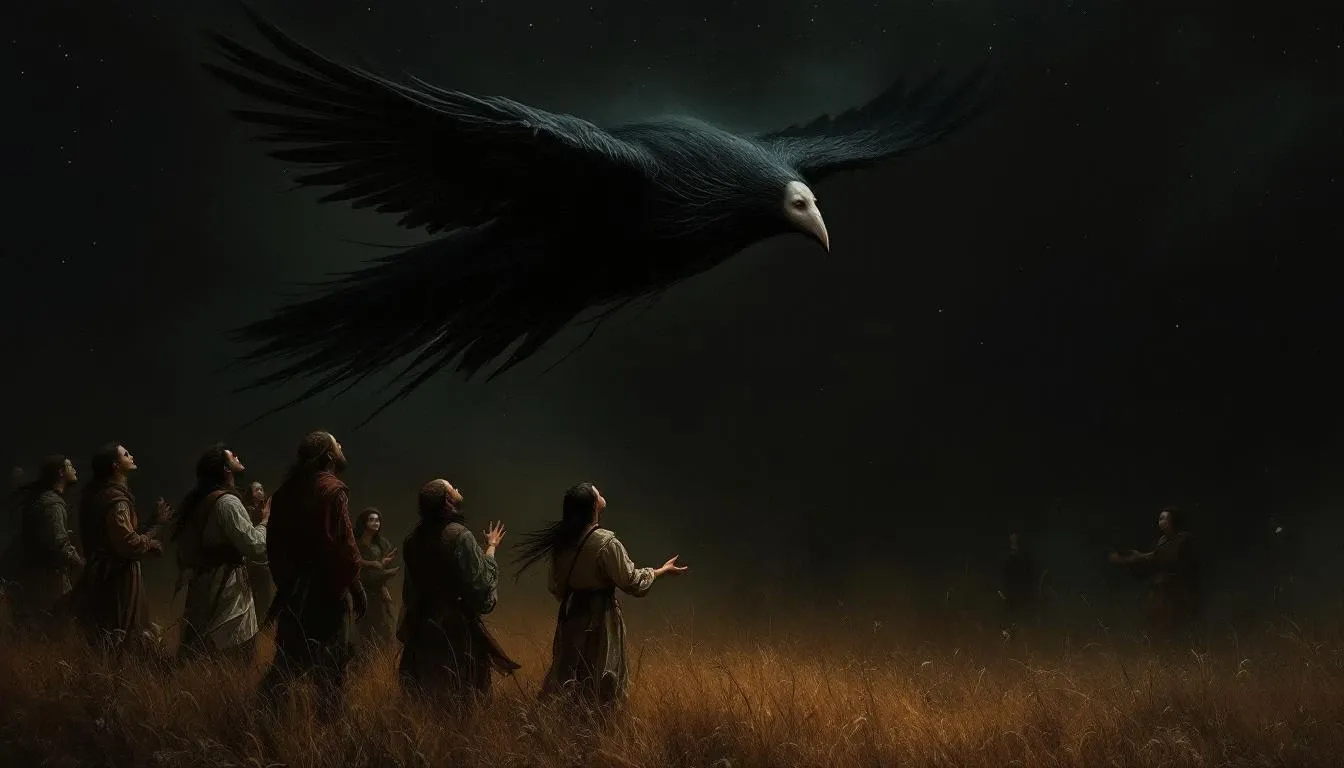
The Gamayun does neither. She does not sing melodies at all. She speaks. She delivers information — prophecies, histories, genealogies of gods, accounts of wars that have not yet been fought. Her danger is not emotional but intellectual. She does not make you sad or happy. She makes you know. And the knowledge she offers is comprehensive enough to crush you under its weight.
"I wanted to convey the anxiety and sadness of the bird who knows everything — the creation of the world, the fates of gods and men, and the catastrophes still to come — and cannot stop telling it."
Together, the three birds form a triad: sorrow, joy, and knowledge. Or, put differently: the pain of the past, the bliss of paradise, and the terrible clarity of seeing what is actually real. In the symbolic logic of Slavic myth, the Gamayun is the most dangerous of the three — not because knowledge is worse than sorrow or joy, but because knowledge includes both, and everything else besides.
Vasnetsov's Painting: The Image That Fixed the Myth
Before 1897, the Gamayun existed in folk prints, in oral tradition, in the margins of medieval manuscripts. She had many faces — sometimes a radiant woman with wings, sometimes a peacock-like bird with a human head, sometimes a dark-feathered creature perched on a storm cloud. There was no single canonical image.
Then Viktor Vasnetsov painted her.
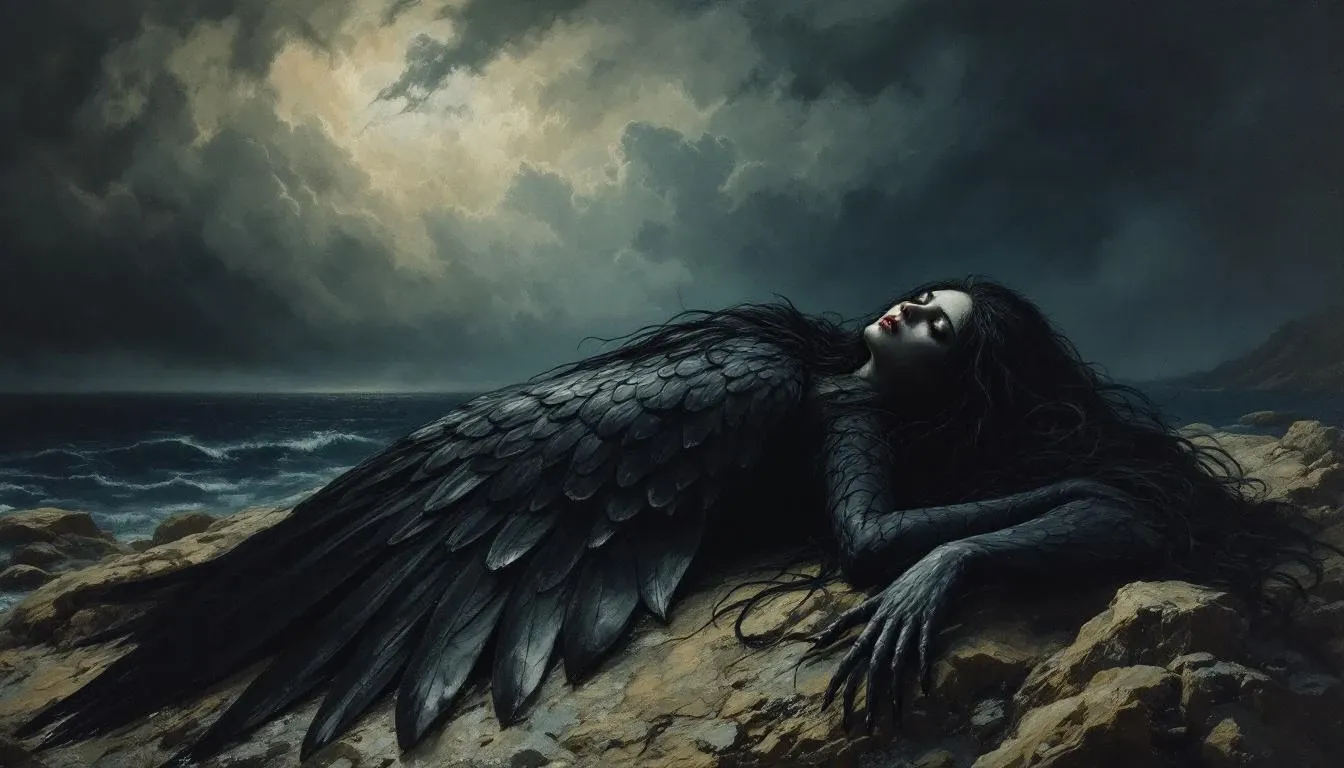
"Gamayun, the Prophetic Bird" was completed in 1897, part of Vasnetsov's larger project of reimagining Russian folklore and mythology through the visual language of Romanticism and Symbolism. The painting shows a bird with large dark wings perched on a slender, windblown tree. The bird has the face of a young woman — beautiful, but not serene. Her expression carries a heaviness that could be grief or exhaustion or simply the accumulated weight of too much sight. The background blazes with the deep purples and reds of a sunset reflected on still water. The composition places the bird precisely between the dying light above and the dark water below — between the worlds, between day and night, between what has already happened and what is about to.
The painting measures 200 by 150 centimeters. It now hangs in the Dagestan Museum of Fine Arts in Makhachkala. It is, by a considerable margin, the most reproduced image of the Gamayun in existence, and it permanently altered how Russians visualize the creature. Before Vasnetsov, the Gamayun could look like almost anything. After Vasnetsov, she was a dark-winged bird with a troubled woman's face, sitting alone on a branch over water, knowing too much and unable to stop speaking.
The painting also established a tonal shift. Earlier folk depictions often showed the Gamayun as regal, even cheerful — a bird of wisdom as a positive attribute, a symbol of learning and foresight you might carve above your door for good luck. Vasnetsov made her tragic. In his rendering, knowing everything is not a privilege. It is a sentence.
Blok's Poem: The Prophecy That Came True
Two years after Vasnetsov finished the painting, the twenty-year-old Alexander Blok — who would become one of the most important Russian poets of the twentieth century — saw it and was stricken. In February 1899, he wrote a short poem titled "Gamayun, the Prophetic Bird," directly responding to the image.
The poem is only twelve lines long. In it, the Gamayun sits on the endless waters, dressed in purple sunset, prophesying. She cannot lift her battered wings. She sings of the coming of the Tartar hordes, of rows of bloody executions, of earthquake, famine, and fire, of cowardice and the death of justice.
What makes the poem extraordinary is not its literary quality, though Blok's compression is remarkable. What makes it extraordinary is that it was accurate. The twentieth century brought Russia exactly what the Gamayun described — invasions, revolutions, famines, mass executions, the collapse of justice under totalitarian rule. Blok himself would live to see the beginning of it: the 1905 revolution, the First World War, the October Revolution of 1917. He died in 1921, of what his doctors called "exhaustion" and what his contemporaries understood as despair. He had watched the prophecy unfold.
In 1967, Dmitri Shostakovich set the poem to music as part of his "Seven Verses of Alexander Blok" suite, cementing the triangular link between Vasnetsov's visual image, Blok's verbal prophecy, and the original folklore. The Gamayun had traveled from peasant oral tradition to canvas to verse to orchestral score — each medium adding a new layer of weight to the same core idea: there is a bird who knows everything, and what she knows is terrible, and she cannot stop telling you.
The Dangerous Weight of Total Knowledge
The Gamayun's central proposition — that a creature could possess complete knowledge and be destroyed by it — resonates because it describes a real human anxiety. We want to know things. We build entire civilizations around the acquisition of information. And then, periodically, we learn something we cannot unlearn, and it breaks us.
In the Slavic mythological framework, this is not a modern problem. It is baked into the structure of the cosmos. The three worlds — Prav, Yav, and Nav — are separated for a reason. The living are not supposed to see into Nav, the realm of the dead and the hidden. The gods of Prav keep their own counsel. Mortals inhabit Yav, the visible world, and their sanity depends on the boundaries holding.
The Gamayun violates those boundaries. She sees across all three worlds simultaneously. She knows what the gods know, what the dead know, and what the living have not yet experienced. And she speaks it aloud — to anyone who can hear, to anyone who can understand, whether or not they asked. She does not wait for permission. She does not filter. She is an open channel between all layers of reality, and standing too close to that channel is like standing too close to a fire.
This is why folk tradition insists that only certain people can understand the Gamayun's words. Not because she speaks in code — she speaks plainly — but because the human mind has a threshold for how much truth it can metabolize at once. Most people hear the Gamayun and perceive only birdsong, wind noise, the rustle of branches. The few who actually parse her words receive the full weight of cosmogonic and prophetic knowledge in a single unbroken stream. Whether this is a gift or a punishment depends entirely on what they do with it afterward.
The old tales do not record anyone who heard the Gamayun and was made happy by the experience.
A Bird for the Age of Information
There is a reason the Gamayun persists in Russian cultural memory while dozens of other mythological creatures have faded into specialist footnotes. She maps onto something permanent in the human relationship with knowledge. The Firebird represents desire — the chase after beauty that bankrupts you. The Sirin represents grief made irresistible. The Alkonost represents bliss that erases identity. But the Gamayun represents the specific modern terror of knowing too much: of having access to all the information in the world and discovering that most of it is catastrophic, and that knowing it changes nothing except your own capacity for peace.
She sits on her dead tree above the water, wings too battered to fly, and she speaks. She tells you how the world was made. She tells you who the gods are and what they want. She tells you what is coming — not because you asked, not because you are ready, but because she cannot stop. The knowledge moves through her the way water moves through a channel. She is not its source. She is its path.
And if you can understand her — if you are one of the unlucky few whose ears are tuned to her frequency — then you will know everything she knows. The origins and the endings. The names of the dead and the names of those about to die. The shape of the future laid out like a road that has already been built but not yet walked.
Whether you wanted to know or not.