There was a grove somewhere in the land of the Lutici, in what is now northeastern Germany, surrounded by a forest so old that no living person remembered when it was planted. The trees were oaks, their trunks black with age, their branches knotted overhead so that even at noon the light was green and dim. No one cut firewood here. No one grazed cattle. No one entered without purpose.
Inside the grove stood a wooden building raised on a foundation made of animal horns. Its walls were carved with figures of gods and goddesses. Inside, idols stood dressed in real helmets and real armor. The chief among them was Svarozhich — Radegost — the fire god, and before his image the priests performed divinations with a sacred white horse, reading the future in the pattern of its hoofsteps over crossed spears laid on the ground.
This was Rethra. It was one of the great sacred sites of the Western Slavs, and by the time German chroniclers finished writing about it, it had already been burned to the ground.
The Slavs, as a rule, did not build churches. They did not need walls between themselves and their gods. The forest was the church. The hilltop was the altar. The oak split by lightning was the holiest icon they possessed. And for most of Slavic pagan history, the open-air sacred grove — not the roofed temple — was the primary place of worship across the entire Slavic world.
The Forest as Temple
The gods lived in nature. Not above it, not behind it, not in some abstracted heaven reachable only through doctrine — in it. In the thunder. In the river. In the roots of the oak and the darkness between the trees. To worship them, you went where they were.
The sixth-century Byzantine historian Procopius of Caesarea left the earliest written account of Slavic religion:
They believe that one god, the maker of the lightning, is alone lord of all things, and they sacrifice to him cattle and all other victims. They reverence, however, both rivers and nymphs and some other spirits, and they sacrifice to all these also, and they make their divinations in connection with these sacrifices.
No mention of temples. No mention of buildings. The Slavs of Procopius' time worshipped outdoors, at sites determined by the landscape — hilltops, riverbanks, springs, and above all, groves. When the Primary Chronicle describes Prince Vladimir's pagan shrine in Kyiv in 980 AD, it describes wooden idols set up on a hill, in the open air, with a fire burning before them. No roof. No walls.
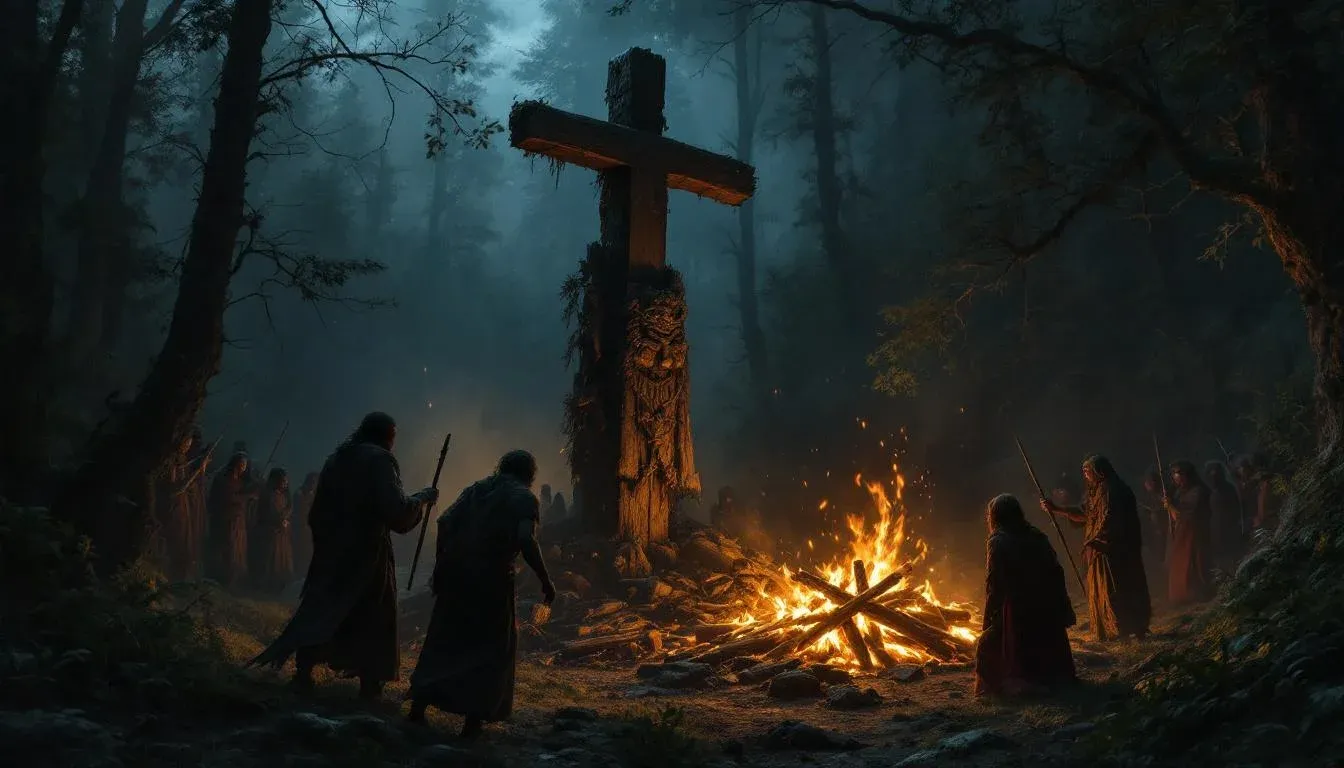
The East Slavic word for such a site was kapishche. A kapishche was not a building but a cleared space, usually circular or oval, fenced with a low wooden barrier called an opashka. At one end stood a carved wooden idol — a chur — representing the deity. Before the idol stood a stone or earthen altar, and before the altar burned a fire that was never allowed to go out.
The placement was never random. Kapishcha stood at points where the landscape concentrated power: hilltops, confluences of rivers, clearings within ancient woodland. A hilltop kapishche dedicated to Perun stood between earth and sky. A riverside shrine stood between land and water. A grove shrine stood between the tamed fields and the wild forest — between civilization and the domain of Rod and every spirit that lived beyond the plowed line.
Perun's Oaks
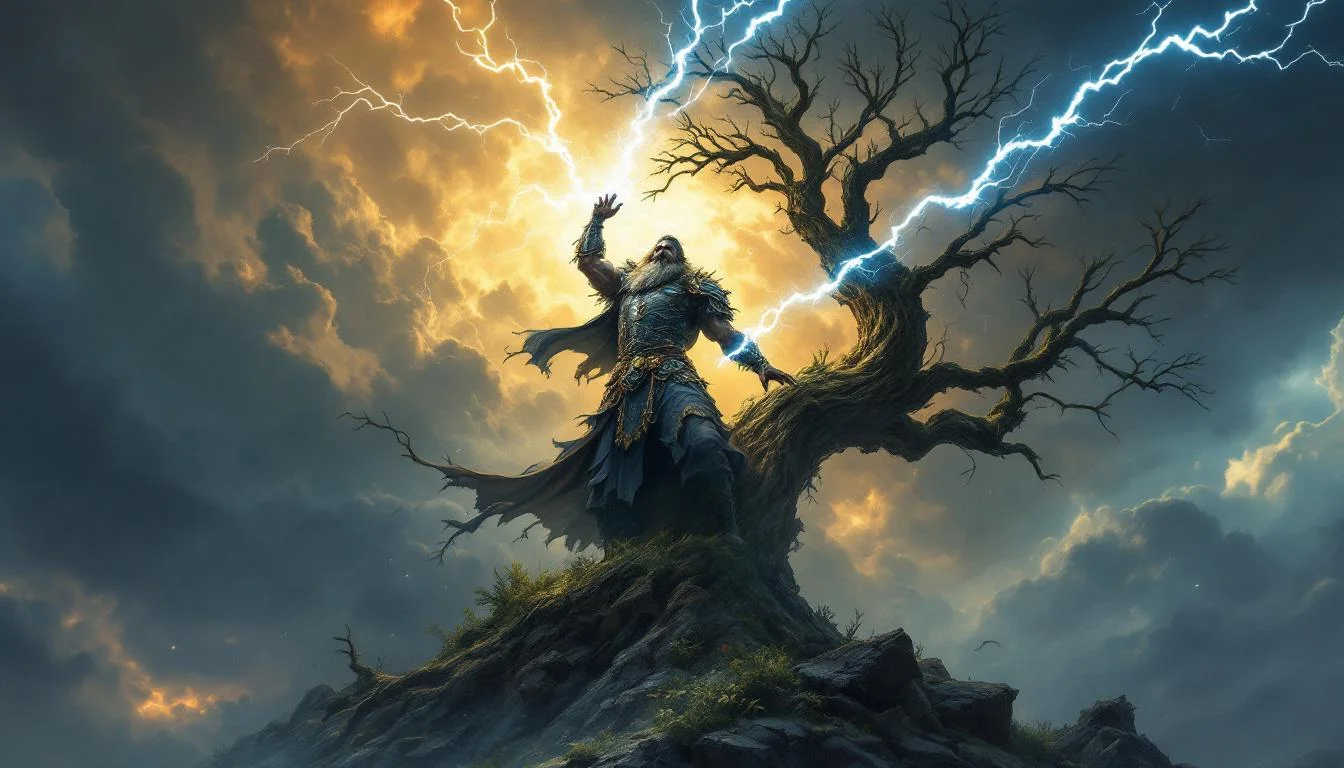
No tree was more sacred to the Slavs than the oak, and no god was more closely bound to the oak than Perun. The connection was physical and terrifying: lightning strikes the tallest tree, and in a mixed forest the tallest tree is usually an oak. An oak hit by lightning does not merely burn — it explodes. The wood shatters along the grain, leaving a trunk split open like a broken bone. To a people who read the intentions of their gods in natural events, this was Perun's fist.
Shrines to Perun were located on hilltops or within groves of ancient oaks — and often both. A perpetual fire, kindled from oak wood, burned at the base of the central tree or before the idol. Soviet-era excavations at Peryn, a peninsula jutting into Lake Ilmen south of Novgorod, uncovered what appeared to be an octagonal ritual platform with eight petal-shaped pits arranged around a central post hole — the footprint of a circular shrine with a fire in each pit and an idol in the center.
Oaks associated with Perun were treated as living icons. Cutting one down was unthinkable — the god who lived in thunder would answer the axe with a bolt. When Christian missionaries later made a deliberate practice of felling sacred oaks, the act was a calculated provocation: a dare aimed at proving the old gods lacked the power to defend their own trees.
The Great Temples of the West
There was one major exception to the open-air rule, and it came from the Western Slavs.
The Polabian and Baltic Slavic tribes — the Obodrites, Lutici, Veleti, and the Rani of Rügen — built actual enclosed temples, staffed them with professional priesthoods, and organized their religious life around these structures with a sophistication that stunned the chroniclers who encountered them. Three temple complexes stood above the rest: Rethra, Arkona, and Szczecin.
Rethra was the sacred fortress of the Redarii, located somewhere in modern Mecklenburg-Vorpommern. The exact site has never been identified — one of the great unsolved puzzles of Slavic archaeology. Thietmar of Merseburg, writing around 1012, described the wooden temple on its horn foundation, the armored idols, the sacred banners brought out only in wartime, and the divination horse. The temple was destroyed in 1068 by a Christian expedition led by Bishop Burchard II of Halberstadt. The sacred grove was cut down. The idols were burned.
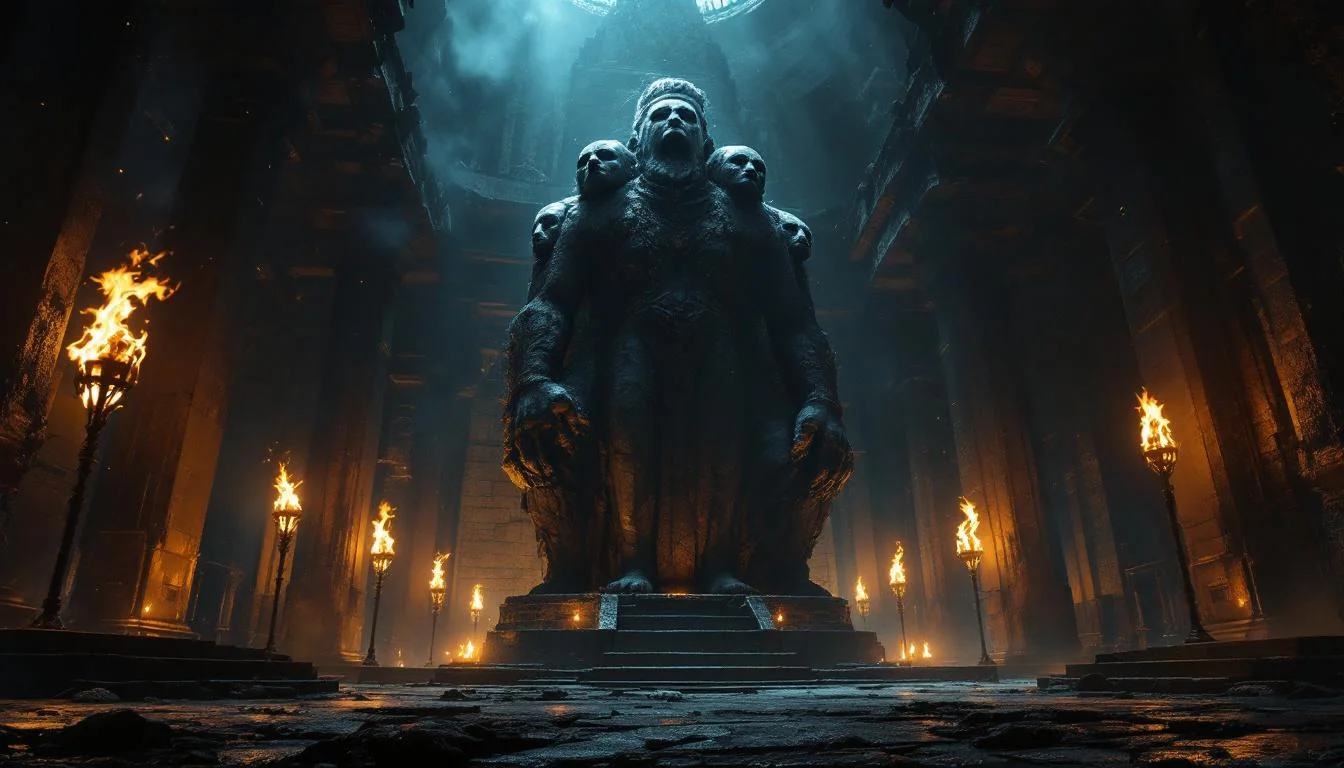
Arkona stood on the northern tip of Rügen, on a chalk cliff above the Baltic. It was the temple of Svetovit — the four-headed god of the Rani tribe and the most powerful oracle in the Western Slavic world. The temple was a square wooden building with a single chamber. Inside stood Svetovit's idol with four heads facing the cardinal directions, holding a drinking horn of precious metal. Each autumn, the high priest examined the mead remaining in the horn from the previous year: full meant prosperity; low meant famine.
In 1168, King Valdemar I of Denmark stormed Rügen, broke into the temple, and had Svetovit's idol chopped up for firewood. The sacred banners were taken as trophies. The Rani were baptized at sword-point.
Szczecin had four temples, according to Bishop Otto of Bamberg, who visited on missionary journeys in 1124 and 1128. The most important was dedicated to Triglav — the three-headed god whose silver triple head was kept as a cult object. Otto destroyed the temples, baptized the population, and took the silver heads back to Rome as proof of his success.
What distinguished these Western Slavic temples was institutional power. They collected tribute, maintained standing priesthoods, and influenced decisions about war and peace. The high priest of Arkona was, by some accounts, more powerful than the local chieftain. When Christianity came for the Western Slavs, it came not with missionaries carrying books but with armies carrying axes.
What Stood in the Grove
Whether the site was a forest clearing or a timber temple, the central object was the idol.
Slavic religious images were carved from wood — usually oak or linden — and ranged from crude posts with a face at the top to elaborate polycephalic statues with multiple heads and attributes. The most famous surviving example is the Zbruch idol, a limestone pillar discovered in 1848 in the Zbruch River in western Ukraine. It stands about 2.7 meters tall and is carved on all four sides with three tiers of figures: gods at the top, humans in the middle, and a chthonic figure — probably Veles — at the bottom, holding up the entire cosmos on his shoulders.
The Zbruch idol is a cosmogram — a World Tree rendered in stone. The three levels represent Prav (the divine world), Yav (the human world), and Nav (the underworld). This was not primitive animism. This was a structured, multilayered understanding of the cosmos, carved in permanent form and placed where the human world and the divine world overlapped.
At most kapishcha, animal bones found during excavation — cattle, horses, roosters — confirm the written sources: regular animal sacrifice was the primary offering. The animal was slaughtered, its blood poured at the base of the idol or into the fire, and portions of meat were burned while the rest was consumed in a communal feast. The feast was as important as the killing — a shared meal with the god.
The Destruction
The sacred groves did not die of neglect. They were killed, deliberately, by Christian missionaries backed by military power.
The pattern was consistent. The missionary arrived, announced that the old gods were demons, and ordered destruction. Wooden statues were chopped up and burned. Sacred trees were felled. Perpetual fires were extinguished. Churches were built on the same sites, deliberately overlaying Christian geography onto the pagan landscape.
In the East, the destruction was fast. Vladimir's conversion of Kyiv in 988 was followed by mass baptisms and church construction on the sites of former kapishcha. Resistance was localized, though in the countryside the old practices persisted — the "dual faith" (dvoeverie) that Orthodox priests complained about for centuries.
In the West, it was slower, bloodier, and more thorough. The Western Slavic tribes fought Christianization with sustained ferocity. The great uprising of 983 overthrew Christian rule across the Polabian lands and restored the old temples. Rethra survived until 1068. Arkona held out until 1168 — two full centuries after the conversion of Kyiv. The last pagan Slavic state in Europe was the principality of the Rani on Rügen, and its fall was military, not spiritual. The gods died when the army that defended their temples lost.
Helmold of Bosau described the sacred grove of Prove in Wagria — a place of tribal assembly, oaths, and oracles, surrounded by a fence marking sacred ground. He watched as Bishop Gerold of Oldenburg ordered the grove cut down and the wood burned on the spot. The stumps were left as a reminder.
What Survived
The groves are gone. The idols are ashes and river mud. But the memory survived in the landscape.
Across Poland, Ukraine, Belarus, and Russia, patches of old forest are marked by local tradition as "holy" or "cursed" — places where trees are not to be cut. The Kleczanow Forest in southeastern Poland contains 37 Slavic burial mounds, some ten meters high, and local tradition holds that the forest has been sacred since before memory.
Place names preserve what the groves could not. The word gaj (grove) appears in settlement names across the Slavic world. Bozhiy les (God's forest), svyatoy bor (holy pine forest), kapishche itself — these toponyms mark vanished shrines with the stubbornness of language, which outlasts wood and stone and even the gods.
The deepest survival is structural. The Slavic understanding that certain natural places are inherently sacred did not vanish with Christianization — it migrated. Holy springs became sites of miracle-working icons. Hilltops received chapels. The oak groves of Perun were replaced by churches dedicated to Elijah the Prophet, the Christian figure who inherited Perun's thunder, his chariot, and his Thursday. The continuity is not subtle. It is the same religion in a different coat, and the coat is thinner than the Church has ever been comfortable admitting.
The Slavs worshipped where the power was. They found it in running water, on exposed hilltops, and in the green darkness under ancient oaks. They marked these places with carved wood and perpetual fire, offered blood and grain and mead, and gathered as communities to eat with their gods. When the missionaries came with axes, the trees fell, but the ground remembered.