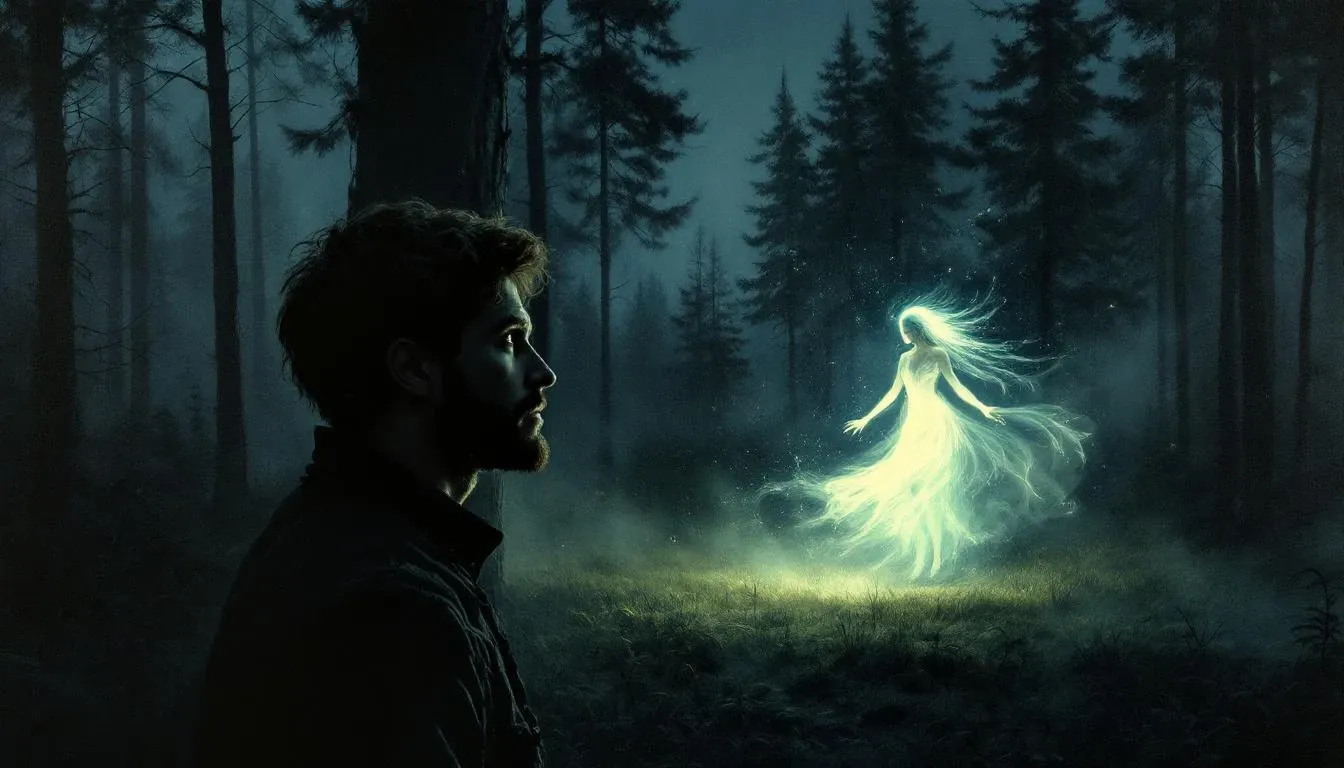
She is dancing in the meadow above the village when the shepherd sees her. He should not be here — it is past midnight, and he only came because one of the ewes wandered off and the dog refused to follow it up the slope, whining and pulling against its lead with an urgency that should have been warning enough. But he came anyway, because the ewe is valuable and the night is warm and he is young and does not yet understand that the dog knew something he did not.
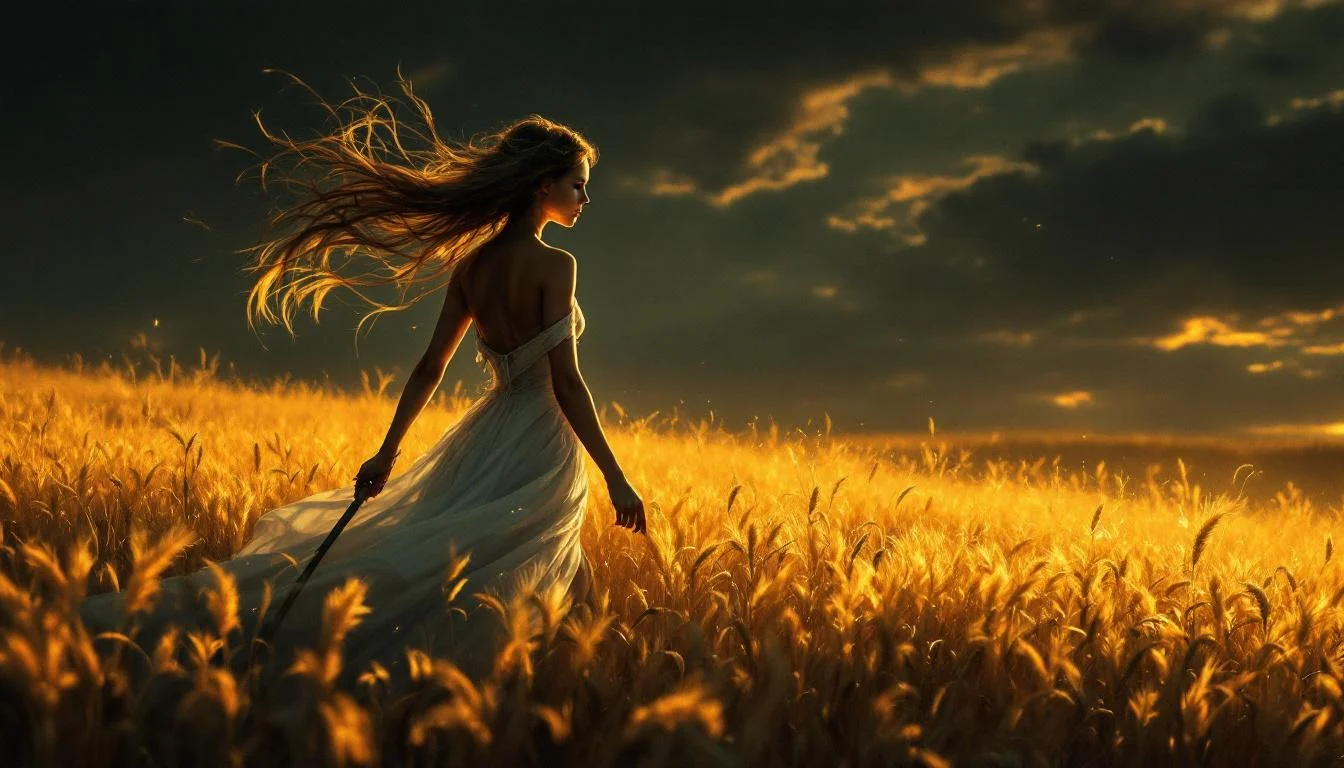
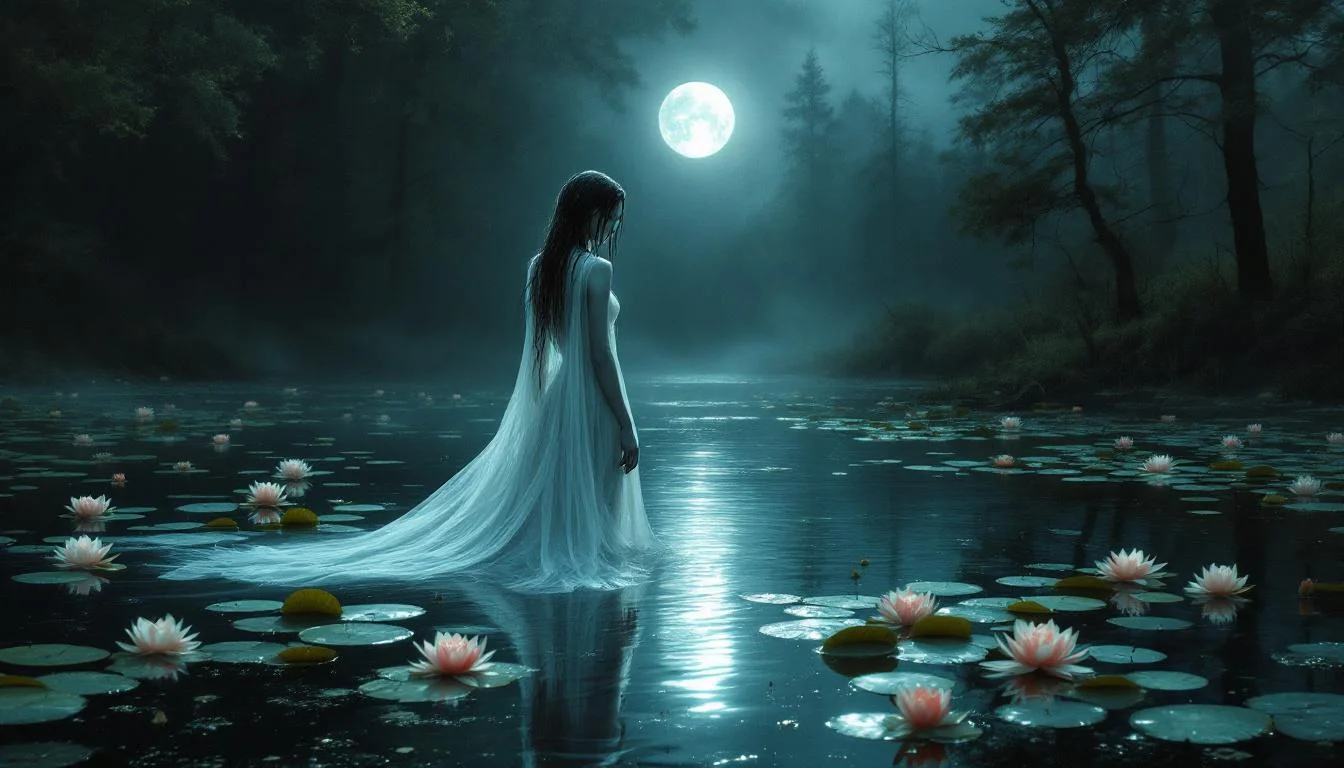
The meadow is flooded with moonlight. The grass is silver. And in the center of the clearing, three women are dancing. Their hair is loose — white-gold, impossibly long, streaming behind them like banners as they spin. Their feet do not seem to touch the ground. The music that drives their dance has no visible source — no instrument, no singer — but it fills the air with a rhythm that enters through the ears and settles in the chest and begins to pull at the muscles, urging the limbs to move.
The shepherd watches. He should not watch. He knows this — knows it in the same way the dog knew it, in the bone rather than the brain. But he cannot look away, because the women are the most beautiful things he has ever seen and the music is the most compelling sound he has ever heard and his feet are already moving, stepping forward into the moonlit grass, and the women have seen him now, and they are smiling, and one of them is extending her hand.
He will dance until his heart stops. It will take hours. He will be smiling the entire time.
What a Samodiva Is
The samodiva (самодива) — plural samodivi — is the Bulgarian term for a class of supernatural female beings that inhabit forests, mountains, meadows, and sacred springs. The word is typically parsed as samo (self) + diva (wild, divine, wondrous) — literally, the self-wild one, the being that belongs only to herself, that owes allegiance to nothing human. Other etymologies have been proposed — connections to the Latin divus (divine), to the Slavic divъ (wonder, marvel) — but the core meaning remains consistent: she is something other than human, something that exists outside the categories and obligations that bind mortal women.
In Serbian and Croatian folklore, the equivalent being is the Vila. In Slovenian tradition, she is divja žena (the wild woman). In Macedonian folklore, samovila. In Russian and Ukrainian tradition, her closest equivalents are the Rusalka and the Poludnitsa — though these correspondences are imprecise and mask significant differences in function and character. The samodiva is not a water-spirit, not a death-spirit, not a field-spirit. She is a creature of the wild places between settlements — the forests that have never been cut, the mountain meadows above the treeline, the springs that feed rivers from beneath ancient stone.
She is categorically dangerous. She is also categorically beautiful. In Bulgarian folk tradition, these two qualities are not in tension — they are the same thing. Her beauty is the mechanism of her danger. It is the trap. It is the hook. It is the thing that makes men forget that they are mortal and that mortality has limits.
The Dance of Death
The most defining trait of the samodiva — the aspect that separates her from all other Slavic fairy-types — is the lethal dance. The Vila can shoot arrows. The Rusalka drowns. The Striga drinks blood. The samodiva dances. And the dance kills.
The mechanism varies by account, but the pattern is remarkably consistent across hundreds of Bulgarian folk songs, tales, and ethnographic records. A man encounters samodivi dancing in a meadow, usually at night, usually in a moonlit clearing. He is drawn in — sometimes by enchantment, sometimes by his own desire, sometimes simply by the music that seems to fill the air without source. One of the samodivi takes his hand. He begins to dance with them. And then he cannot stop.
The dance continues through the night. It is not gentle — it is fast, whirling, ecstatic, the kind of movement that pushes the human body past its design limits. The man's heart races. His muscles burn. He gasps for air. But the music does not slow, and the samodiva's hand does not release him, and his own body has been hijacked by a rhythm it cannot refuse. He dances until dawn, or until his heart gives out — whichever comes first. Many accounts specify that the man dies smiling, his face locked in an expression of bliss that his final heartbeat could not erase.
This is not a metaphor for sexual seduction, though many modern interpreters read it that way. The folk tradition is quite specific: the man dies from dancing. From physical exertion forced upon him by supernatural compulsion. His heart stops. His lungs fail. His legs give way and the samodivi keep pulling him upright and the dance continues with his corpse for a few more rotations before they release him and he crumples to the grass like a puppet whose strings have been cut.
In the morning, villagers find the body in the meadow. The grass around it is trampled flat in a perfect circle. The man's shoes are worn through. His feet are bloody. His face is frozen in a smile that no one who sees it will ever forget. The cause of death, by village consensus, is clear: he was samodivski igran — danced by the samodivi.
The Stolen Garment Motif
Not every encounter with a samodiva ends in death. One of the most widespread motifs in Bulgarian folklore — appearing in dozens of folk songs and fairy tales — is the story of the man who steals a samodiva's garment and thereby gains power over her.
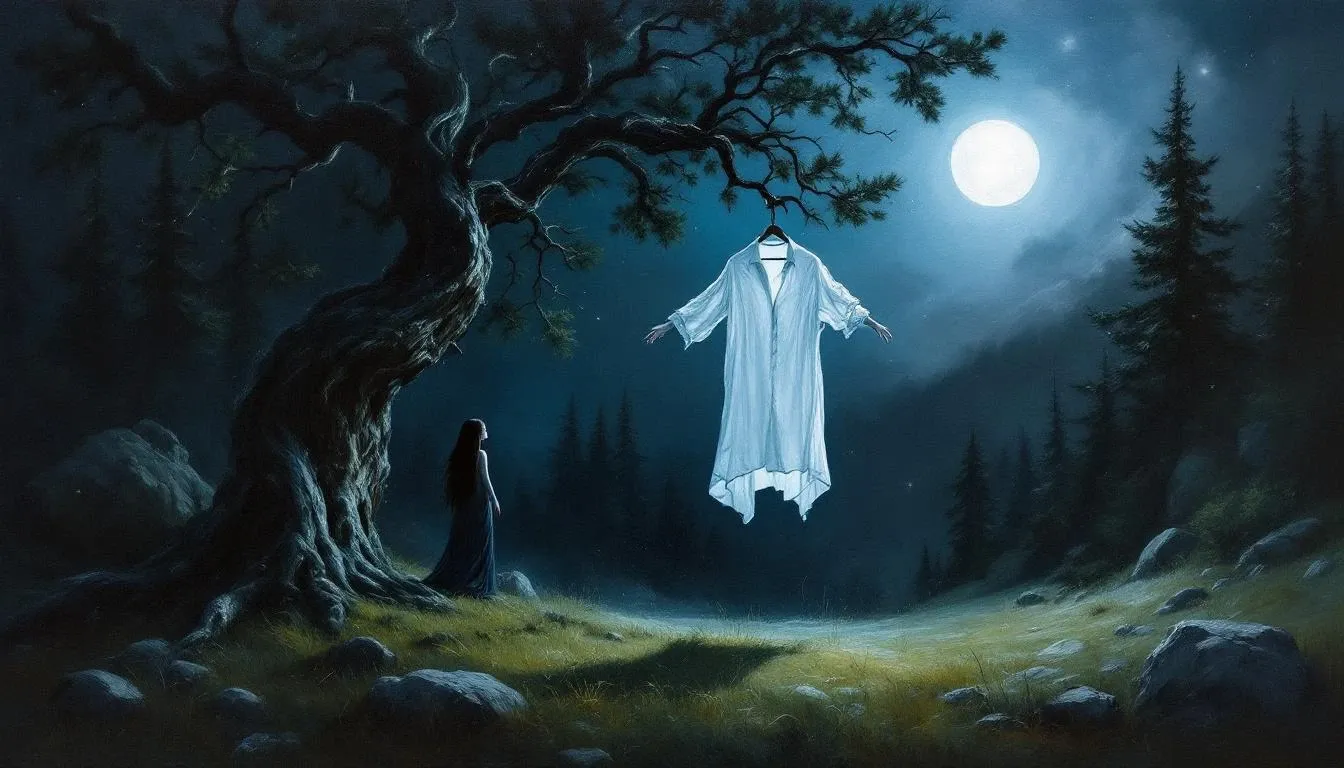
The logic operates on the principle that the samodiva's supernatural nature is bound to a physical object — usually her dress, her veil, or her wings (some traditions describe samodivi with wings of light that they remove before dancing). Without this object, she cannot fly, cannot return to her wild domain, cannot exercise her full power. A man who finds a samodiva bathing in a spring and steals her discarded clothing can compel her to become his wife — or at least to remain in the human world, bound to him, unable to escape back to the mountains.
The story of the captured samodiva-wife is deeply ambivalent. She marries the man. She bears his children. She keeps his household. She appears, to all outward observation, to be a human woman living a human life. But she is not content. She is not domesticated. She is imprisoned — held in the mortal world by the hidden garment, constantly searching for it, constantly testing the boundaries of her captivity. And eventually, inevitably, she finds what was stolen. A child reveals the hiding place. A careless moment leaves the chest unlocked. She puts on the dress, or the veil, or the wings. And she is gone — back to the mountains, back to the meadows, back to the dance. Often she takes the children with her. Often she does not.
This motif appears across multiple cultural traditions — the selkie wife in Scottish folklore, the swan maiden in Germanic tradition, the tennyo in Japanese tales. The Bulgarian samodiva version is distinguished by its emotional brutality. The man who stole the garment is not depicted as a villain in the folk tradition — he is simply a man who wanted something beautiful and found a way to keep it. But the samodiva's departure is always framed as justice. She was never his. She belonged to herself — to the wild, to the mountains, to the moonlit meadow. The theft of her garment was a violence against her nature, and her escape is not betrayal but restoration.
The samodiva who is forced to marry lives in the house as in a cage. She cooks, she cleans, she nurses the children. But her eyes are always on the mountains. She speaks less each year. And when she finds her wings — because she always finds her wings — she rises from the threshold without a word, and the house beneath her becomes as small as a bird's shadow passing over the earth.
Healing and Sacred Wells
The samodiva is not purely destructive. This is one of the most frequently misrepresented aspects of her character in popular accounts, which tend to emphasize the lethal dance while ignoring the extensive tradition of samodivi as healers, herbalists, and guardians of sacred water sources.
In Bulgarian folk belief, samodivi possessed extraordinary knowledge of medicinal plants — knowledge that exceeded anything available to human herbalists. They knew which roots cured fever, which leaves stopped bleeding, which bark dissolved kidney stones, which mushrooms brought dreamless sleep. This knowledge was the knowledge of the wild itself — the accumulated botanical wisdom of the forests and mountains where they lived, absorbed through centuries of existence in intimate contact with the growing world.
Certain springs and wells were believed to be under samodiva protection. Water drawn from these sources had healing properties — curing illness, restoring strength, granting temporary youth. But accessing the water required proper behavior. Approaching without respect, speaking loudly, or — worst of all — polluting the spring would bring the samodiva's wrath down on the transgressor. The sacred spring was her territory, her possession, her responsibility. She shared its waters with those who approached correctly, and she destroyed those who did not.
This dual nature — healer and killer, guardian and destroyer — is the essence of the samodiva. She is not evil. She is wild. She operates by the laws of the non-human world, which include generosity toward those who respect boundaries and absolute violence toward those who violate them. The man who watches her dance uninvited has violated a boundary. He has seen what he was not meant to see. The dance that kills him is not malice — it is consequence. The dog that refused to climb the hill understood this instinctively. The shepherd did not.
The Seasonal Cycle: Spring Emergence and Autumn Retreat
Samodivi are not year-round presences. Bulgarian folk tradition assigns them a seasonal calendar that mirrors the agricultural cycle and the rhythm of the wild landscape they inhabit. They emerge in spring — specifically, on Blagovets (the Annunciation, March 25) or on Gergyovden (St. George's Day, May 6), depending on the region. They are active through summer. And they retreat — disappearing from the human-accessible world — in autumn, on Krastovden (the Exaltation of the Cross, September 14) or at the onset of the first frosts.
During their active season, samodivi were believed to dance nightly in mountain meadows, particularly during the full moon. Certain locations were known as samodivsiki poliani — samodiva meadows — and were avoided after dark by anyone with sense. The grass in these meadows was said to grow differently — greener, thicker, in circular patterns that marked the paths of the nightly dance. Livestock that grazed in samodiva meadows might produce exceptionally rich milk, or might sicken and die. The outcomes depended on whether the samodivi considered the grazing an intrusion or an offering.
The spring emergence of the samodivi coincided with the return of greenery, birdsong, and warmth. In some traditions, they were directly responsible for spring's arrival — their dance warming the earth, their bare feet coaxing the dormant roots back to life. This benevolent interpretation coexisted with the lethal one without contradiction. The samodivi bring spring and they kill those who watch them dance. Both are true. The wild is both generous and merciless, and the samodiva embodies both qualities because she is the wild, given a woman's shape and a woman's capacity for beauty and rage.
The Vila Connection: South Slavic Fairy Taxonomy
The relationship between Bulgarian samodivi and Serbian/Croatian Vile is one of the most discussed problems in South Slavic comparative folklore. The two beings share so many traits — supernatural beauty, association with mountains and forests, lethal dancing, shape-shifting, healing knowledge, the stolen-garment motif — that many scholars treat them as regional variants of a single being.
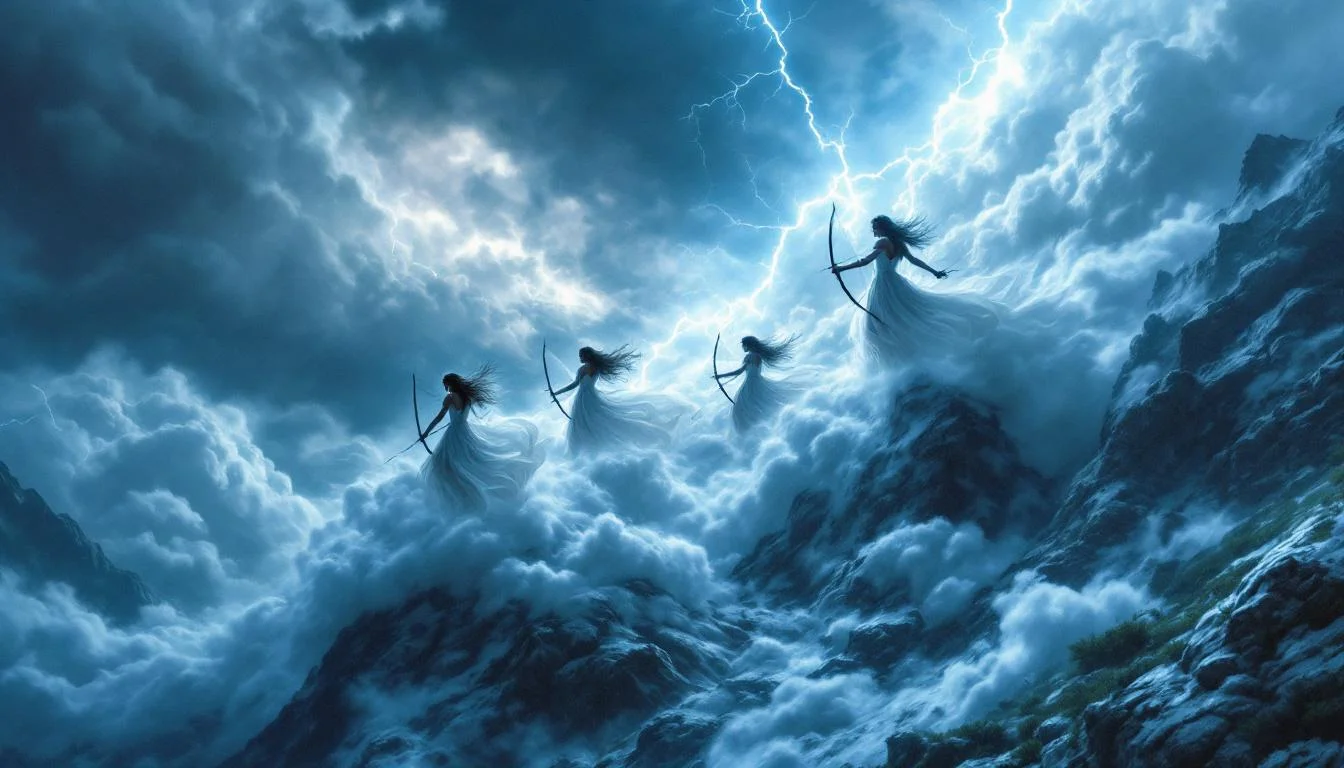
And yet the differences are real. The Vila has a stronger martial tradition — Serbian epic poetry depicts Vile as warrior-maidens who shoot arrows, ride deer, and fight alongside heroes in battle. The Vila has a closer relationship to specific heroes — she can be a sworn sister (posestrina) to a mortal man, offering protection and counsel. The samodiva has less interest in individual humans and more in collective events — she dances with groups, she guards places rather than people, she rarely forms the kind of personal bond that the Vila-hero relationship represents.
The distinction may be historical rather than typological. Serbian folk tradition was heavily shaped by the epic poetry tradition — the long narrative songs performed by gusle players that formed the backbone of Serbian cultural identity through centuries of Ottoman rule. In that tradition, supernatural women needed to be allies and enemies within epic narratives — they needed personalities, relationships, story arcs. The Vila developed these. Bulgarian folk tradition operated more through lyric songs, local legends, and ritual practices — contexts that favored the samodiva's more impersonal, more elemental character.
Both are daughters of the same Proto-Slavic concept — a wild female supernatural being associated with the untamed landscape. Time, geography, and the needs of different storytelling traditions shaped them into different creatures. But if you stood in a moonlit meadow in the mountains between Sofia and Belgrade and saw a white-haired woman dancing, you would not need to ask which country's folklore you had stumbled into. The dance would be the same. The beauty would be the same. The danger would be the same.
The Folk Metal Revival
In the 21st century, the samodiva has experienced an unlikely resurrection through Balkan folk metal — a subgenre of heavy metal that draws on South Slavic folklore, traditional instruments, and pagan imagery. Bands from Bulgaria, Serbia, North Macedonia, and neighboring countries have adopted samodiva imagery for album covers, song lyrics, and live performances, placing her alongside other Slavic mythological figures in a cultural space that is simultaneously ancient and aggressively modern.
This is not the sanitized, Disney-adjacent resurrection that often happens to folklore in popular culture. Folk metal's samodiva is not a cute fairy or a New Age goddess. She is the dangerous, beautiful, alien figure of the original tradition — the dancer who kills, the spirit who cannot be tamed, the wild that refuses domestication. The musical context — distorted guitars, blast beats, guttural vocals interspersed with traditional melodies — preserves something of the original terror that gentler adaptations lose.
Whether this constitutes genuine cultural transmission or aesthetic appropriation is a question that each listener must answer for themselves. But the function is real: thousands of young people across the Balkans and beyond now know the word samodiva, can describe what she does, and have formed an emotional relationship with the concept — a relationship mediated by sound rather than text, by rhythm rather than narrative, by the visceral experience of music rather than the intellectual experience of reading folklore. The samodiva has always been a creature of sound and movement — of music that compels, of dance that kills. Folk metal may be, in some twisted way, her natural medium.
She is still dancing. The meadow is still moonlit. The music still has no visible source. And the shepherd is still climbing the hill, because the ewe is valuable and the night is warm and the dog's warning means nothing to a man who has never yet learned what it costs to see beauty that was not meant for human eyes.
The hill is not steep. The meadow is not far. The dance is already waiting.