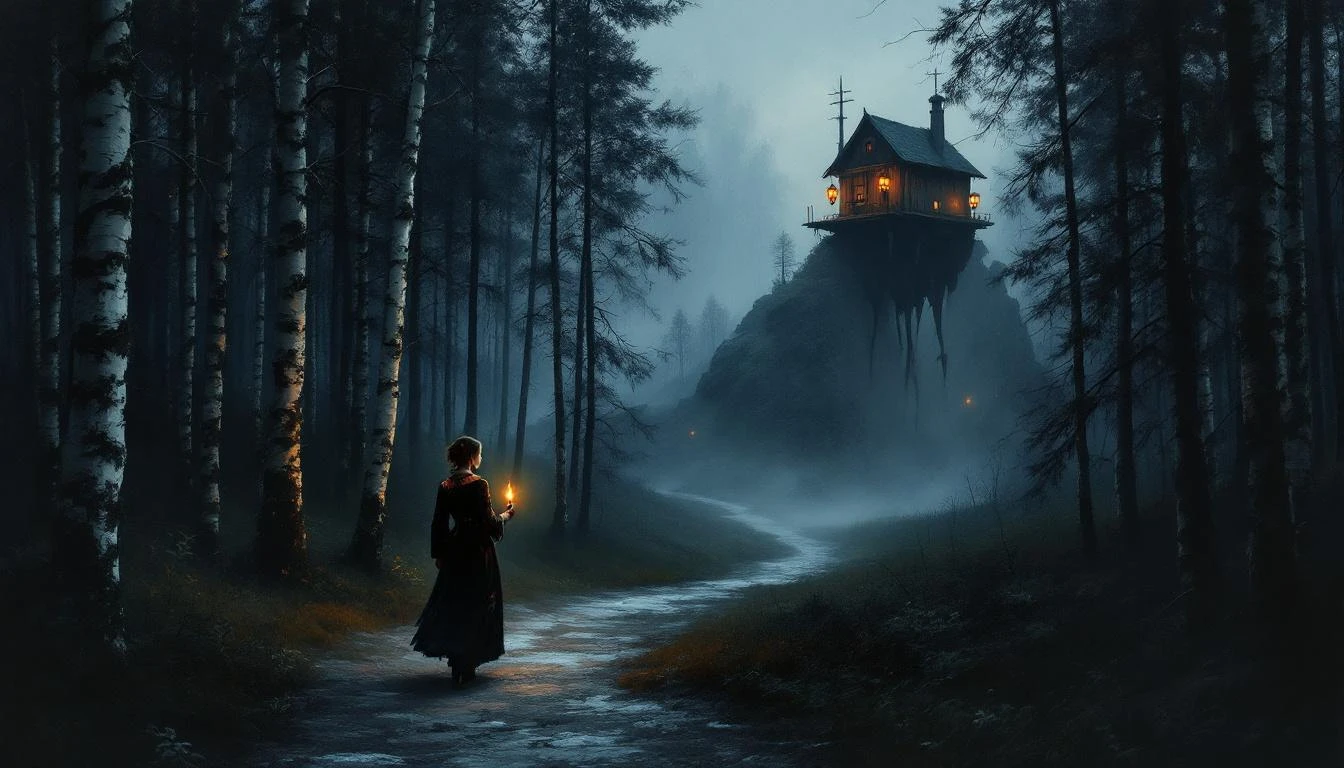
A brother and sister are walking along a road. Their parents are dead. They have nothing — no home, no family, no one who will take them in. The day is hot. The road stretches through empty fields. There is no water.
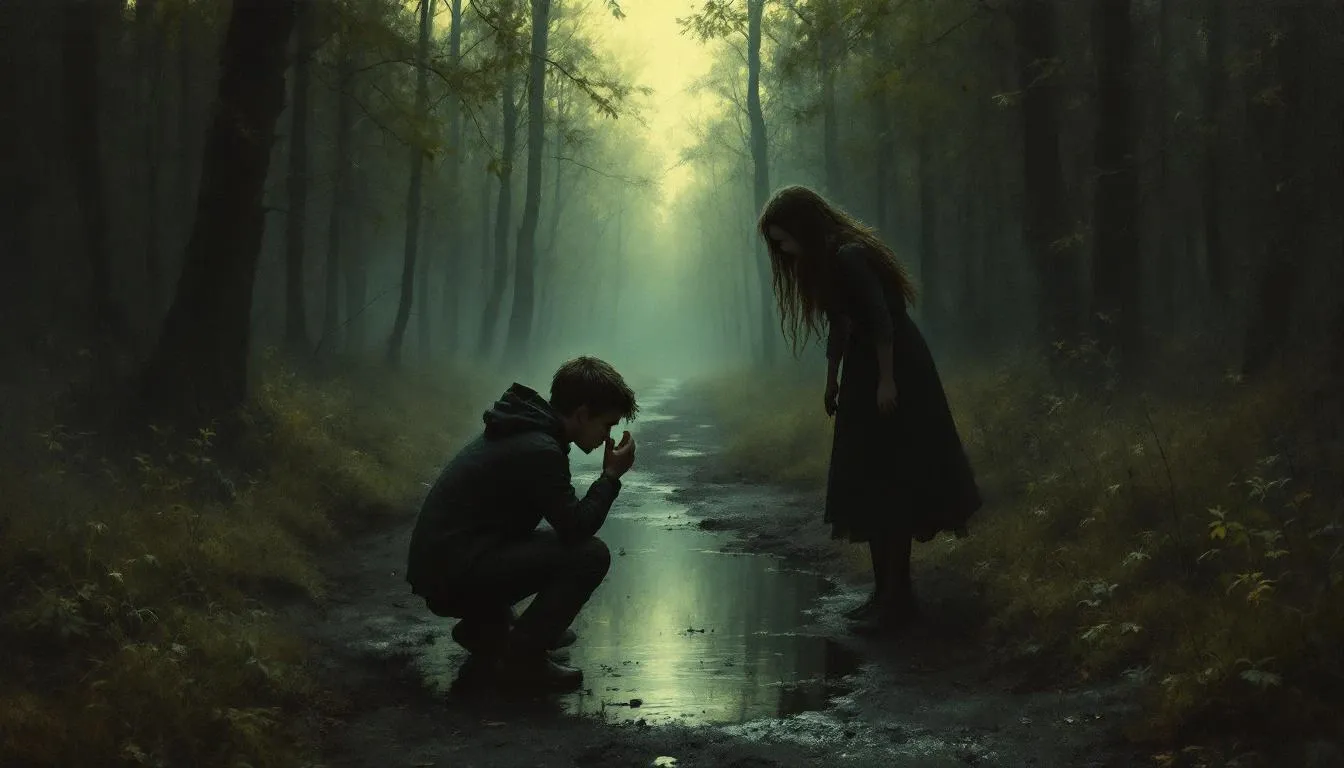
The boy is young — maybe five, maybe seven. Old enough to walk but not old enough to understand why his sister keeps telling him no. He sees a puddle in a hoofprint by the road and bends to drink. His sister pulls him back.
"Don't drink from the horse's hoofprint, Ivanushka. You'll become a horse."
They walk on. He sees another puddle, this one in the track left by a cow.
"Don't drink from the cow's hoofprint. You'll become a cow."
They walk on. The sun is merciless. The boy is crying. And then he sees a puddle in the track left by a goat.
His sister says the words again: "Don't drink, Ivanushka—"
But Ivanushka drinks.
And he becomes a little goat.
This is the opening of one of the most heartbreaking fairy tales in the Russian tradition — "Sister Alyonushka and Brother Ivanushka," collected by Alexander Afanasyev in his Narodnye russkie skazki and classified as Aarne-Thompson tale type 450, Little Brother and Little Sister. It is a story about orphans, about thirst, about the cost of one moment of weakness, and about a sister whose love is tested by every force the fairy-tale universe can bring against her — including her own drowning.
The Hoofprints
The hoofprint motif is not arbitrary. In Slavic folk belief, the mark left by an animal's hoof in wet ground was a vessel for that animal's essence. Water that collected in a hoofprint absorbed the creature's nature — its spirit, its shape, its defining quality. To drink from a horse's hoofprint was to ingest the horse. To drink from a goat's hoofprint was to ingest the goat. The transformation that follows is not punishment for disobedience. It is physics — the physics of a world in which matter and spirit are not separated, where the shape of a container determines the nature of what it holds.
This is old magic. Older than the tale itself, embedded in a worldview where sympathetic magic governed the relationship between all things. A footprint was not just a depression in the mud. It was a signature — the animal's identity pressed into the earth, lingering after the creature had moved on. Water, which in Slavic cosmology was the great connector between the worlds of the living and the dead, carried that signature into whoever drank it.
Alyonushka knows this. She warns Ivanushka three times, following the fairy-tale rule of three, and each time she is specific: drink from this track and you will become this animal. She is not guessing. She is reciting law — the law of a world in which drinking is a form of becoming, in which thirst can literally change your species.
The boy's failure is not moral. He is not wicked. He is not rebellious. He is a small child who is dying of thirst, and the fairy tale does not blame him for it. The tale blames nobody. It simply records what happens when need overwhelms knowledge, when the body's demand outweighs the mind's warning. Ivanushka drinks because he must. He becomes a goat because the world works that way.
Alyonushka's Bargain
What follows Ivanushka's transformation is the real story. The goat-boy cannot be turned back — there is no spell to reverse what the hoofprint has done. Alyonushka is now the sole human in the family. She has a brother who is a goat, no parents, no home, and no prospect of anything but wandering forever with an animal that used to be a child.
She does not abandon him. The tale is emphatic about this. She ties a silk cord around the goat's neck, leads him by the hand, and continues walking. She has accepted the situation completely: her brother is a goat, and she will care for him as a goat, and that is what her life is now.
A merchant — or in some variants, a tsar, a prince, a young nobleman — sees Alyonushka and falls in love with her. He asks her to marry him. She agrees, but only on the condition that the goat comes with her. The merchant accepts. Alyonushka moves into his house, and the little goat Ivanushka sleeps on a silken cushion in their bedroom, eats from a golden dish, and follows his sister everywhere.
The household is happy. Or it appears to be. The fairy tale allows a brief window of peace before the real disaster arrives.
The Witch at the Lake
A witch — a vedma, in the Russian original, a word that carries implications of knowledge, seeing, and the manipulation of hidden forces — sets her attention on Alyonushka. In some variants the witch has a specific motivation: she wants the merchant for herself, or she wants to destroy the girl out of envy, or she is simply what witches in Russian fairy tales are — agents of destruction who require no motivation beyond their own nature.
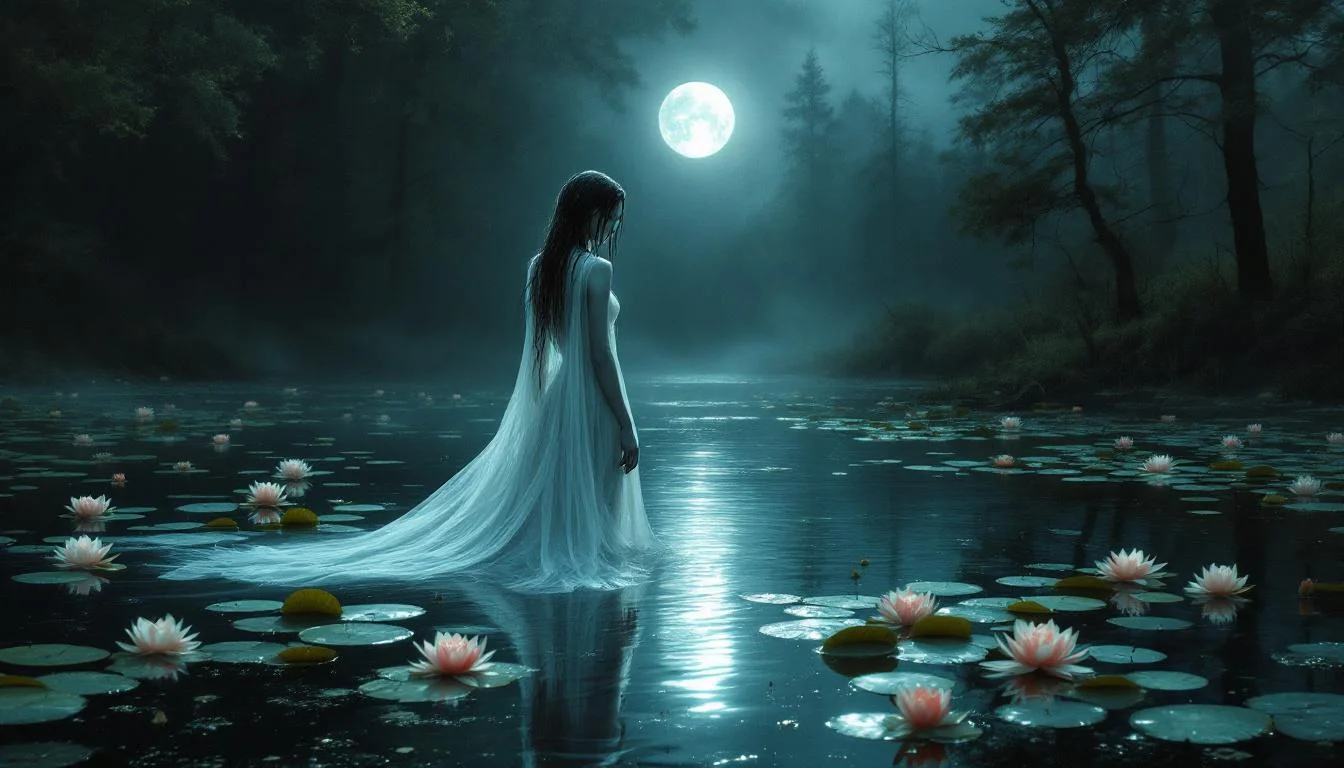
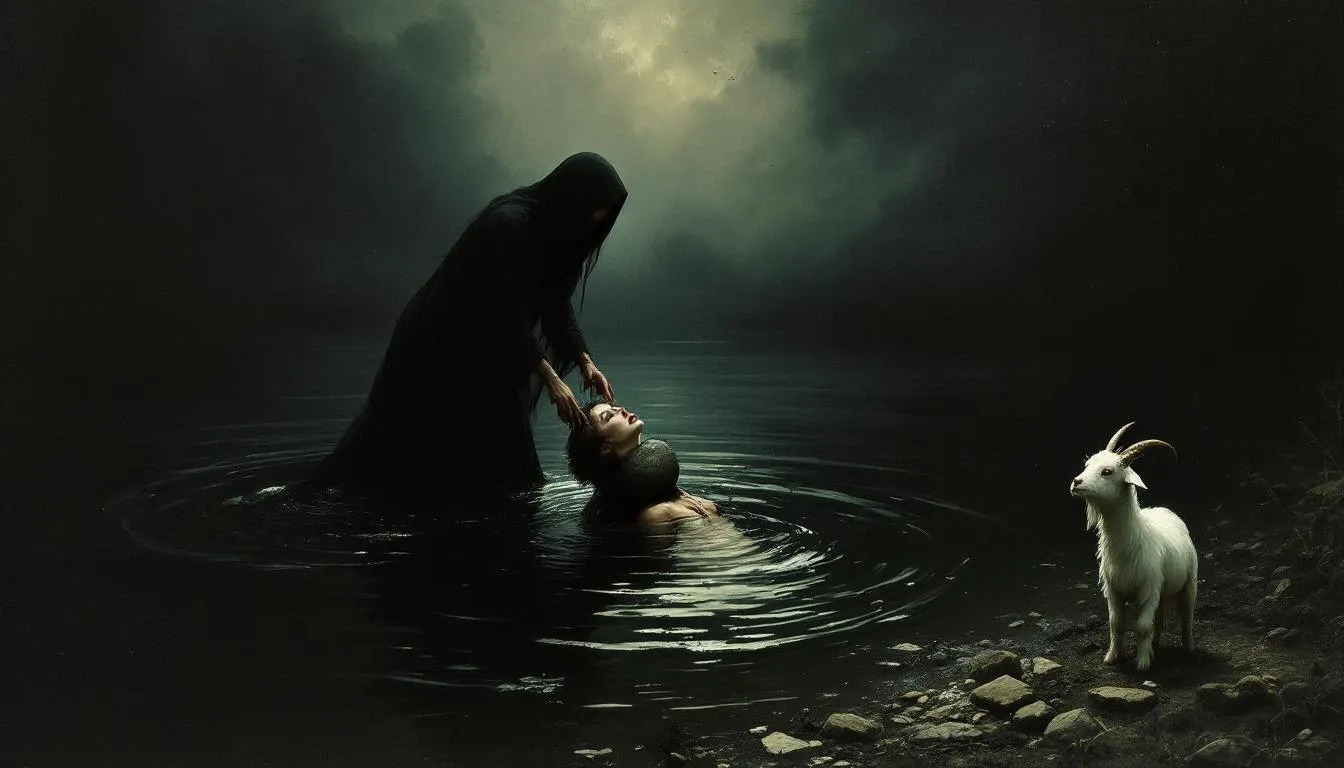
The witch befriends Alyonushka. She invites her to swim in the lake. They go together to the water's edge. Alyonushka wades in. And the witch ties a heavy stone around her neck and pushes her under.
Alyonushka sinks. She drowns. She lies at the bottom of the lake with a stone on her chest while the water closes over her and the light fades and everything goes dark.
The witch then takes Alyonushka's form. She walks back to the merchant's house wearing Alyonushka's face, speaking with Alyonushka's voice, sleeping in Alyonushka's bed. The merchant notices nothing. The substitution is perfect in every detail but one: the little goat knows.
Ivanushka knows. He goes to the lake every morning and every evening and calls to his sister under the water:
"Alyonushka, my sister dear,Come up, come up from the deep.The fires are burning hot,The cauldrons are boiling,The knives are being sharpened —They want to slaughter me."
Because the witch, in Alyonushka's form, has told the merchant that the goat must be killed. A goat in the house brings bad luck, she says. An animal in the bedroom is unseemly. The merchant, who promised his wife he would keep the goat, begins to be persuaded.
The goat's song from the lakeshore is one of the most haunting passages in Russian folklore. It is a child's voice — because Ivanushka is still a child, despite his goat's body — crying to a dead sister for help while the household prepares to butcher him. The fires, the cauldrons, the sharpening knives — these are not metaphors. They are the literal preparations for the goat's slaughter, described by a creature who understands exactly what is happening and cannot stop it.
The little goat ran to the lake, stood on the bank, and cried out: "Alyonushka, my dear little sister! Swim out, swim out to the shore. Fires are burning high, cauldrons are boiling, knives of steel are being sharpened, and they want to slaughter me!" And from the depths of the lake came a voice: "Oh, Ivanushka, my dear little brother! A heavy stone pulls me to the bottom, silken weeds wind about my legs, yellow sands press upon my breast."
The Rescue
In Afanasyev's version, the merchant eventually follows the goat to the lake and hears the exchange — the goat's pleading and the drowned girl's reply from beneath the water. In other variants, it is a servant, a passing traveler, or an animal helper who discovers the truth. The mechanism varies. The outcome does not.
The merchant orders the lake dragged. Fishermen or servants wade into the water and find Alyonushka at the bottom, the stone still tied to her neck, her hair tangled in silken weeds. They cut the stone free. They pull her to the surface. And the moment she breaks the water and breathes again, the goat-brother Ivanushka tumbles three times on the grass and becomes a boy again.
Both transformations reverse at the same instant. The sister rises from the dead. The brother returns to human form. The tale links these two events as a single act of restoration — as if Alyonushka's drowning and Ivanushka's goat-shape were the same curse, two expressions of a single disruption in the order of things, and the undoing of one necessarily undid the other.
The witch is exposed. In most variants, she is burned, or torn apart by horses, or driven into the forest where she belongs. The fairy tale does not waste sympathy on her. She entered the story as a force of destruction, and she leaves it as ash or silence.
The merchant and Alyonushka resume their marriage. Ivanushka is a boy again, sleeping on his silken cushion, eating from his golden dish. The tale ends with the formula: "And they began to live and prosper, and to chew bread together." The Russian fairy tale knows that the highest reward it can offer is not treasure or a kingdom but bread — enough to eat, a roof, a family intact.
Vasnetsov's Painting
In 1881, Viktor Vasnetsov — the painter who, more than any other artist, gave Russian fairy tales their visual form — painted "Alyonushka." It hangs in the Tretyakov Gallery in Moscow. It shows a girl sitting on a rock at the edge of a dark pond, her bare feet just above the water, her head bowed, her hair loose and tangled with leaves. She is surrounded by birch trees and still water and the particular quality of northern forest light that makes everything look like it is about to rain.
There is no goat in the painting. No witch, no merchant, no stone. Just a girl alone at the water's edge, looking into a darkness that does not look back.
Vasnetsov originally titled the painting "A Fool" — Alyonushka (Durachka) — a reference to the folk term for a holy simpleton, a person so innocent that the world's cruelty seems not to have touched them. He later changed the title to simply "Alyonushka," letting the fairy-tale association do its work. The painting does not illustrate a specific moment in the story. It captures instead the emotional core — the loneliness of a girl who has lost everything, sitting at the border between the living world and the water where the dead wait.
The painting became one of the most reproduced images in Russian art. Every schoolchild in Russia knows it. It has appeared on chocolate boxes, postage stamps, calendar pages, and the walls of hospitals and orphanages. There is something in the image that the Russian national consciousness recognized immediately and has never released: the girl alone, the dark water, the grief that does not cry out but simply sits, very still, at the edge of the world.
The Orphan Tradition
"Sister Alyonushka and Brother Ivanushka" belongs to a specific genre within Russian fairy tales: the orphan tale. These are stories in which the protagonists begin with nothing — no parents, no protectors, no resources — and must navigate a world that is actively hostile to the unprotected. The orphan tale is not a subset of the fairy tale. It is a reflection of Russian social reality. In the centuries when these stories were told and retold, orphans were among the most vulnerable members of village society. Without family, without land, without the protection of a household, an orphan child was exposed to every predator — human and supernatural — that the world contained.
Alyonushka and Ivanushka are the archetypal fairy-tale orphans. They have nothing. They are walking along a road that leads nowhere. The only resource Alyonushka possesses is knowledge — the knowledge of the hoofprint magic — and even that is insufficient, because knowledge cannot override a child's thirst.
The tale's emotional power comes from this vulnerability. Alyonushka is not a princess. She is not a warrior. She is not a sorceress. She is a girl — possibly twelve, possibly fourteen — carrying the full weight of parenthood for a younger brother, and when that brother is transformed into an animal, she does not break. She ties a cord around his neck and keeps walking. When the merchant offers marriage, she does not demand a palace — she demands only that the goat stay with her. Her conditions are minimal because her expectations have been beaten down to the essentials: a roof, food, and her brother alive, in whatever form.
The Rusalka Connection
Alyonushka's drowning places her, temporarily, in the same category as the rusalka — the drowned maiden who becomes a water spirit. In Slavic folk belief, a woman who died by drowning — especially a young, unmarried woman, especially one who died through violence or betrayal — became a rusalka, trapped between death and life, haunting the waterways.
Alyonushka's exchange with Ivanushka from beneath the lake uses the language of the rusalka tradition. She speaks of silken weeds winding around her legs, of yellow sand pressing upon her chest, of the weight of the stone holding her down. She is conscious. She can hear her brother. She can respond. But she cannot rise. She is held in the state between drowning and death, between the human world and the water world, exactly where a rusalka would be.
The tale pulls her back before the transformation is complete. The rescue — the stone cut free, the body pulled to the surface — interrupts the process of becoming a rusalka. Alyonushka returns to the living because the story demands it, because the fairy-tale contract insists on restoration. But the fact that she lingered at the bottom of the lake for days, conscious and speaking, means she was already partway into that other existence. The tale acknowledges this by reversing both transformations simultaneously — Alyonushka's near-rusalka state and Ivanushka's goat form — as if they were two aspects of the same unnatural condition.
The connection is not incidental. The tale of Alyonushka and Ivanushka likely preserves, in fairy-tale form, an older ritual narrative about the boundary between the living and the water-dead. Kupala Night — the midsummer festival that centered on bonfires and river bathing — included rituals for placating rusalki, and the songs sung during Rusalka Week share imagery with Alyonushka's lake-bottom lament: the weeds, the sand, the weight on the chest, the voice calling from below the surface.
What the Tale Teaches
The fairy tale does not moralize in the obvious sense. Ivanushka is not punished for disobedience — he is a thirsty child. Alyonushka is not punished for carelessness — she warned him three times. The merchant is not punished for failing to recognize the witch — the disguise was perfect. Nobody in the story deserves what happens to them.
Instead, the tale teaches something harder: that the world is full of dangers that are not your fault, that love does not protect you from transformation, that a sister's voice from beneath the water is the most you can hope for when everything has gone wrong, and that sometimes — not always, but sometimes — the stone is cut free and the brother tumbles three times on the grass and you get to go home.
The fires are extinguished. The cauldrons are emptied. The knives are put away. And a little goat becomes a boy, and a drowned girl breathes again, and the bread is broken together, and the story ends.