A marriage among the early Slavs was not a celebration. It was a transaction conducted between two clans under the surveillance of gods, ancestors, and every spirit that haunted the threshold between the living world and the dead one. The bride wept — not from sentiment but from ritual obligation, because she was dying. Her old identity, her membership in her father's household, her place at his hearth and under the protection of his domovoy — all of it was being annihilated so that a new woman could be assembled on the other side, in the house of a man she might never have spoken to before the matchmakers arrived. The wedding songs said it plainly: the bride's braid was unplaited and her maiden wreath removed because the girl who wore them no longer existed. What walked out of the father's house and into the husband's was something else entirely — a wife, a creature of a different spiritual category, subject to different gods and different dead.
This was not metaphor. The Slavs organized their spiritual world around the household, and the household was organized around its ancestors. To leave one house for another was to leave one set of protective spirits for another, to abandon the ancestors who had guarded you since birth and submit to ancestors who owed you nothing. The bride's tears were the correct response to what was, in every magical sense, an act of death and resurrection performed in broad daylight, witnessed by two villages, and sealed with bread.
The Merchant and the Goods: Svatovstvo
The process began with svatovstvo — matchmaking — and matchmaking began in secret. The groom's family dispatched emissaries, the svaty, to the bride's household, often arriving after dark to avoid the evil eye. The timing was not casual. Night visits reduced the chance that jealous neighbors or hostile spirits would notice the negotiation and curse it before it could succeed. In many regions, the matchmakers chose a route that avoided crossroads — places where demons gathered — and they did not look back once they set out, because looking back invited misfortune to follow them home.
The svaty did not speak directly. They used a coded language of commerce: "You have the goods, we have the merchant." "You have a little dove, we have a bright falcon." The bride was merchandise, the groom a buyer, and the entire exchange was conducted in the grammar of the marketplace because the transaction it described was, in fact, economic. The veno — the bride-price — was real money, paid by the groom's family to the bride's father in compensation for the loss of a working member of his household. Among the Polians, as the Primary Chronicle records, this purchase-marriage was the civilized norm, distinguishing them from the Drevlians and the Radimichi, who still practiced older methods.
Those older methods were blunt. The chronicle describes tribes who captured their brides at spring gatherings, village games, and water-drawing sites — u vody — where girls came to fetch water and young men came to take wives. The Drevlians, the Radimichi, the Viatichi, and the Severians all practiced some form of bride capture, though the chronicle notes that the abductions often happened "after having previously come to an agreement" with the women themselves. The distinction between capture-marriage and consensual elopement was not always clear, and the Slavs do not seem to have been troubled by the ambiguity. What mattered was that the woman had crossed from one household to another — whether she walked, was carried, or ran.
The Bride's Death: Devichnik and the Lament
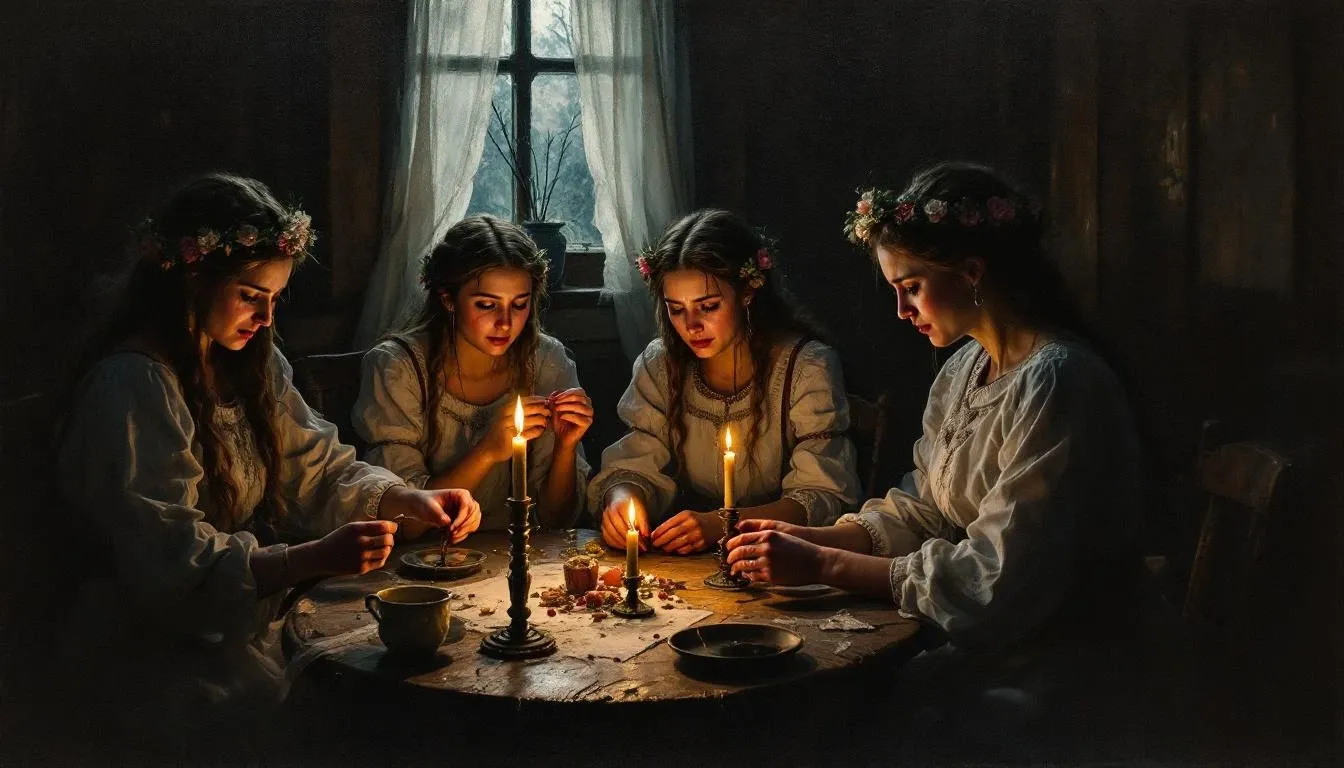
Once the families agreed on terms, the bride entered a liminal period — days or weeks during which she was, in spiritual terms, already dying. The devichnik, the maiden's farewell gathering, was not a party. It was a funeral. The bride sat among her unmarried friends and wept, and her weeping was not optional. The wedding laments — prichitaniya — were a complex poetic form, improvised and performed aloud, in which the bride mourned her own passing. She addressed her father's house, her mother's garden, her girlhood freedom, the birch tree outside her window, the river where she bathed. She spoke to them as a dying person speaks to the world they are leaving.
The laments contained real grief and real fear. A bride entering her husband's household entered it as the lowest-ranking member, subordinate to her mother-in-law, answerable to her husband's entire family, separated from every person who had ever protected her. The folk songs did not sugarcoat this. They compared the husband's house to a dark forest, his mother to a serpent, his sisters to thorns. "Into a strange family I go," one East Slavic lament runs, "where no one knows me, where no one will weep for me." The tears were the correct ritual response to what the bride actually faced. That they were also compulsory — that a bride who did not weep was considered unlucky, unnatural, possibly cursed — only underlines how seriously the Slavs took the transition. The grief was real. The ritual demanded it be performed.
The culminating act of the devichnik was the unplaiting of the bride's braid. An unmarried Slavic girl wore her hair in a single braid, uncovered. A married woman wore it in two braids, hidden under a cloth — the povoynik or kosynka. The moment of unplaiting was the moment of death. The maiden's hairstyle was destroyed, and with it the maiden herself. Her friends sang while they undid the braid, and some of the oldest surviving wedding songs belong to this moment: slow, minor-key, heavy with the weight of something irreversible happening in a warm room full of women who know exactly what it means.
The Wedding Day: Bread, Crowns, and the Bound Hands
The wedding day was a procession of ritual barriers. The groom's party — the druzhina, a word that also means "war-band," and the coincidence is not accidental — rode to the bride's house mounted on horseback, dressed in their finest, sometimes carrying weapons. The best man, the druzhka, led the procession and served as the groom's ritual protector. His job was part ceremonial, part magical: he negotiated with the bride's family, paid the symbolic ransoms demanded at each stage, and wielded a whip wrapped in ribbons that functioned as an anti-demonic weapon. He cracked the whip at doorways and thresholds to drive away unclean spirits. He was the groom's sorcerer, his advocate, and his bodyguard rolled into one.
At the bride's door, the groom's party found it barred. The bride's brother — or another male relative — sat inside with a weapon, guarding his sister. The groom paid ransom: money placed on the table, coins placed on the bride's body, vodka poured. This was theater, but it was theater built on the skeleton of a real practice. The brother's weapon recalled the era of bride capture, when taking a woman required defeating the men who protected her. Even after capture-marriage became a nostalgic echo rather than a live custom, the performance of resistance survived, because the Slavs understood that marriage was a form of violence — a severing — and that the rituals acknowledging this were not ornamental but necessary.
Inside, the couple was seated on sheepskins or furs — symbols of wealth and fertility — for the posad ceremony, the formal seating that marked the beginning of their shared life. Their hands were bound together with a rushnyk, the embroidered ritual towel that appears at every critical moment of Slavic life from birth to death. The rushnyk was not decorative. It was a channel for protective magic, its geometric patterns — diamonds, crosses, stylized trees — encoding blessings for fertility, health, and the favor of the gods. The binding of hands on the rushnyk was the central legal act of the pagan wedding: it joined two bodies in the presence of witnesses and the ancestors whose patterns were stitched into the cloth.
Then came the crowning. A Slavic marriage was called venchaniye — "crowning" — and the couple was not considered married until crowns of flowers rested on their heads. The wreaths were woven from periwinkle and myrtle, plants associated with love and fidelity since the Kupala Night festivities, where the same flowers appeared in the divination wreaths girls floated on rivers. The two witnesses held the crowns above the couple's heads while vows were spoken. Afterward, the officiant — a village elder, a volkhv (pagan priest), or later an Orthodox priest who had inherited the form without fully understanding its origin — led the couple three times around a sacred tree or altar, tracing the circle that symbolized the path of shared life, the cyclical year, and the orbit of the sun.
The songs of the wedding feast are full of allusions to a bridal purchase. The bride is called 'the merchandise,' the bridegroom is a 'merchant' or a 'duke,' and the whole transaction between the two families is described in the language of the marketplace.
The Korovai: A Sun Made of Dough
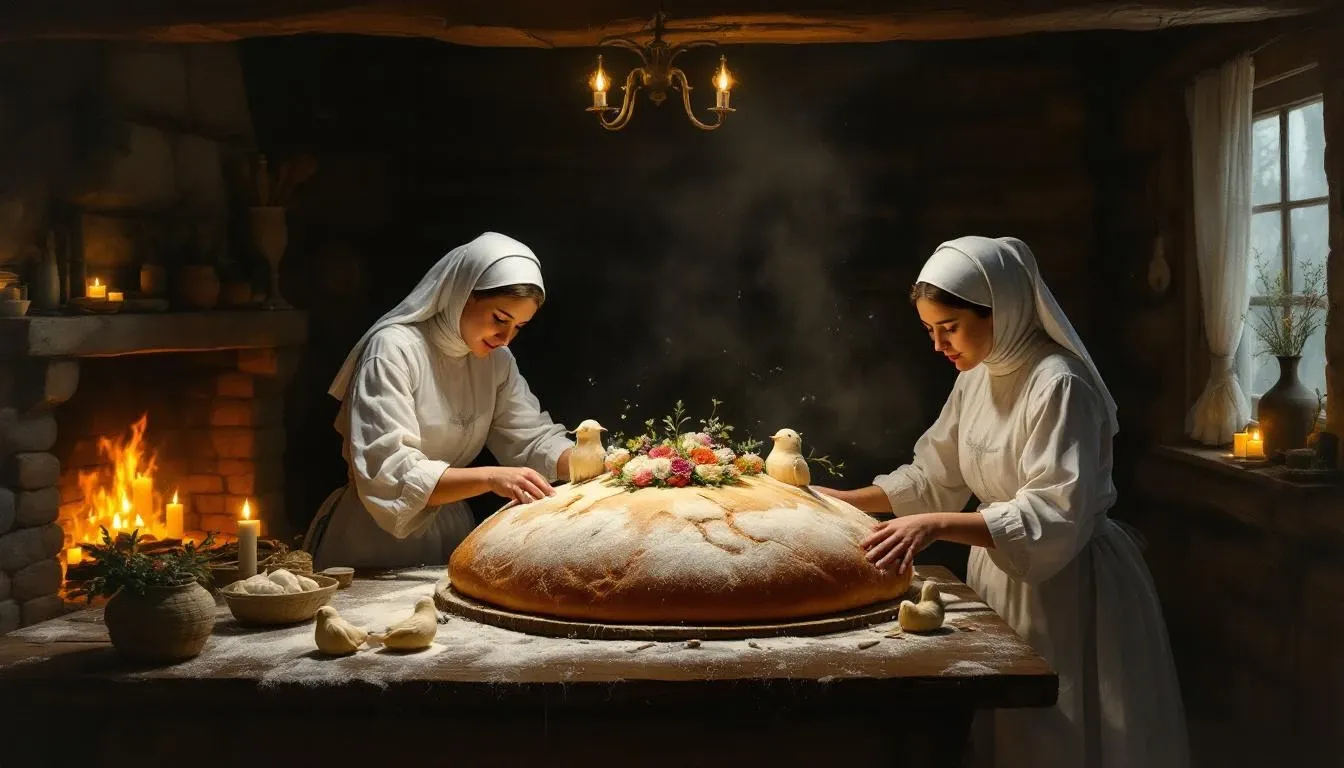
No element of the Slavic wedding was more sacred than the korovai — the great round wedding bread. Its shape was the shape of the sun, and in a culture where the sun was the supreme deity — where even the word for "wedding feast" (svadba) derives from a root meaning "to bring together" under the sun's witness — a solar bread was not a metaphor. It was a miniature cosmos placed on the table, and its division among the guests replicated the distribution of cosmic favor.
The korovai was baked in the bride's home by a group of women called korovainytsi, always invited in odd numbers — five, seven, nine — because even numbers belonged to the dead. These women were carefully selected: they had to be married, their husbands had to be alive, and they had to have borne living children. No widow, no barren woman, no woman touched by death could handle the dough. While they kneaded and shaped the bread, they sang ritual songs that guided the work and charged the loaf with protective power. The baking of the korovai was itself a ceremony, a women's mystery conducted in the domestic space that men were excluded from.
The finished loaf was enormous, sometimes the width of a table, decorated with figures sculpted from salt dough: birds representing the bride and groom, suns and moons, pine cones, animals, flowers. Wheat stalks, herbs, nuts, and fruits were pressed into the surface. The decorations were not ornamental — each element carried specific meaning. The birds were the couple. The sun was fertility. The pine cones were longevity. The entire arrangement was surrounded by a wreath of periwinkle, circling the bread the way protective magic circled the household.
At the feast, the korovai was divided according to strict protocol. The top — representing the sky, the moon — went to the couple. The next tier went to the parents. Subsequent rings went to relatives, then to guests, then to the musicians and servants. In eastern Ukraine, the mothers received small shoes sculpted from dough, and the fathers received decorative owls. Everyone ate from the same sacred bread, and in eating it, they affirmed their place in the social order that the marriage had just rearranged. In times of hardship — war, famine, plague — the sharing of bread alone could constitute a marriage, because the bread was the marriage. Everything else was commentary.
Spirits at the Threshold: Protection and the Evil Eye
The Slavs married under siege. Every stage of the wedding was shadowed by the belief that hostile spirits, jealous neighbors, and practitioners of harmful magic were drawn to the ceremony the way predators are drawn to the scent of blood. The transition from maiden to wife — the destruction of one identity and the construction of another — tore a hole in the spiritual fabric of the household, and through that hole, anything could enter.
The countermeasures were elaborate and layered. The bride's face was covered with a veil — not for modesty but for concealment. If demons could not see her face, they could not target her. Her bridesmaids wore dresses similar to hers, serving as decoys: if an evil spirit struck, it might hit a bridesmaid instead of the bride. In some regions, a different woman was dressed as the bride and presented to the groom's party first — a false bride, a deliberate misdirection, offered to confuse whatever was watching. Loud noises drove away unclean spirits: gunshots during the vows, the cracking of the druzhka's whip, the banging of pots, the shouting of guests. Silence was dangerous. Silence meant the spirits could hear themselves think.
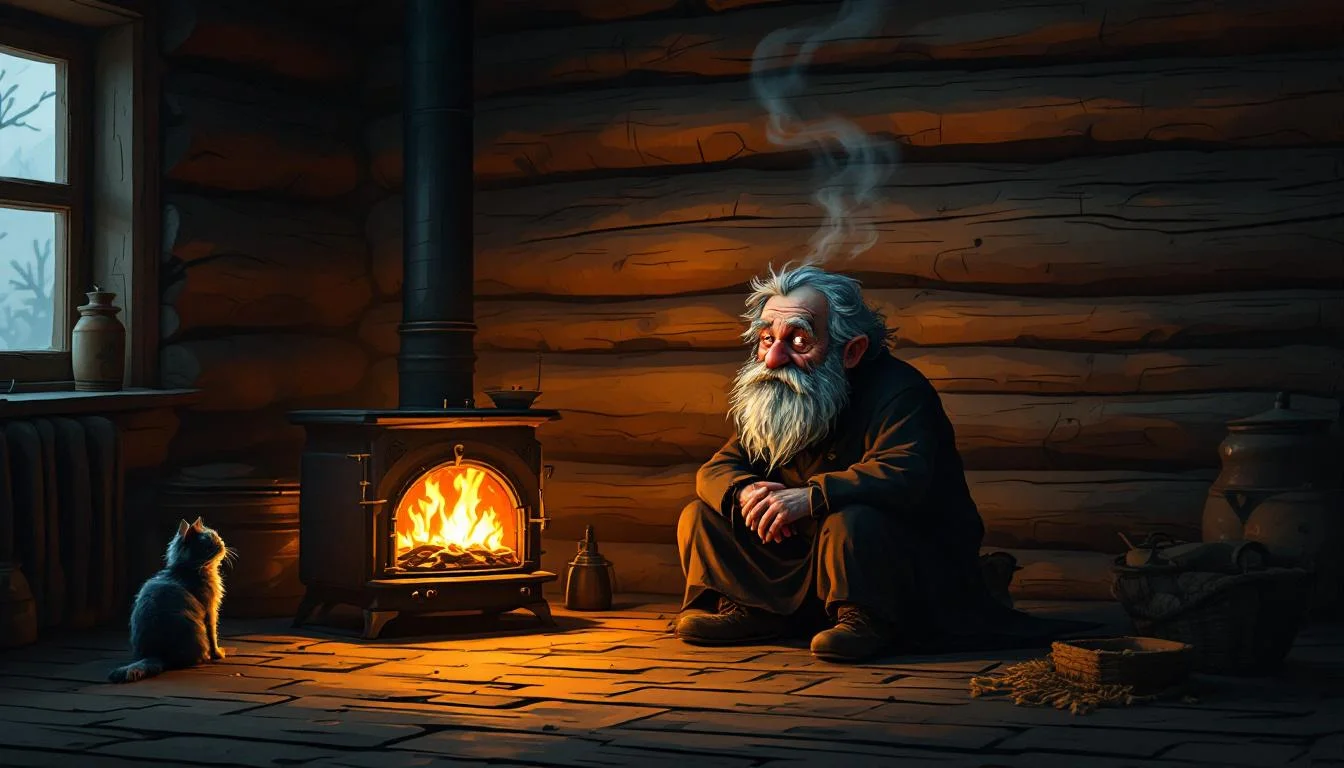
The domovoy — the house spirit — had to be managed with particular care. The bride was leaving one domovoy's protection and entering another's territory. If the new domovoy rejected her, the household would suffer: milk would sour, animals would sicken, children would not come. The bride was formally introduced to the new domovoy upon entering her husband's house, sometimes by placing an offering of bread and salt in the corner behind the stove where the spirit was believed to live. She addressed it aloud, asking for acceptance. Whether the spirit answered was a matter for the family to interpret in the weeks and months that followed — by the behavior of the livestock, the quality of the bread, the sounds in the walls at night.
After the Feast: The Morning and the Proof
The wedding feast lasted days. Drinking was expected, excess was tolerated, and the songs grew increasingly explicit as the night deepened. But the critical moment came the morning after the wedding night, when the proof of the bride's virginity was displayed — typically a stained bedsheet or chemise shown to the assembled families. If the bride was proven "honest," the celebrations continued with renewed energy. If she was not, the consequences were severe: disgrace for her family, potential annulment of the marriage, violence.
This public verification was not incidental. It was the final stage of the transaction that had begun with the svaty's midnight visit. The groom's family had paid for untouched goods, and they expected delivery. The bride's family had guaranteed their daughter's virtue, and the morning inspection was the audit. That it was also a humiliation — that the most intimate moment of a young woman's life was submitted to communal scrutiny over breakfast — was not a bug in the system. It was the system. The Slavic wedding was a clan affair, not a private one, and the clans kept accounts.
In the days following, the newlyweds visited both families, receiving blessings and establishing the networks of obligation that would sustain them. The bride baked bread in her new home for the first time — proving her competence to her mother-in-law, introducing her hands to the new oven, letting the domovoy learn her scent. She was watched. She was judged. She was, in the eyes of the community, a new creature, assembled from the wreckage of the girl she had been, bound by rushnyk and bread and the weight of two clans' expectations.
Why Slavic Wedding Rites Matter
The Slavic wedding was a technology for managing the most dangerous transition in social life: the movement of a human being from one family to another. Every element — the midnight matchmaking, the commercial language, the laments, the barriers, the crowning, the bread, the bound hands, the loud noises, the veiled face, the morning proof — addressed a specific anxiety. The spirits might attack. The bride might grieve. The domovoy might reject her. The groom's family might cheat. The bride's family might lie. The ancestors might disapprove. The marriage might fail.
The rituals did not eliminate these anxieties. They contained them. They gave each fear a specific ritual response, a countermeasure, a song. The bride's grief was real, so the lament gave it a form. The spirits were hostile, so the druzhka cracked his whip. The transition was violent, so the brother stood armed at the door. The bread was sacred, so the women who baked it had to be untouched by death. Nothing was left to chance because the Slavs did not believe in chance. They believed in a world dense with intention — spirits, ancestors, gods, forces — and the wedding was the moment when all of those intentions converged on two people standing on a sheepskin, hands bound with an embroidered towel, crowned with flowers that would wilt before the week was out.
The goddess Lada, invoked in wedding songs across the Slavic world, was not a goddess of romantic love. She was a goddess of cosmic order — the principle that holds things together when they should fly apart. Marriage was the test case. Two strangers, two clans, two sets of ancestors, two domovye — all forced into alignment by bread and song and the stubborn human insistence that the dangerous transition can be managed, that the spirits can be appeased, that the bride who dies as a maiden can be reborn as a wife and survive the crossing.
Centuries of Christianity softened the language. The volkhv became a priest. The sacred tree became an altar. The flower crown became a metal one. But underneath the theological veneer, the old structure persisted — the barriers, the ransoms, the bread, the binding, the fear. The Orthodox wedding ceremony still includes a triple circumambulation, still crowns the couple, still demands witnesses. The form endures because the anxieties it addresses have never fully disappeared. People still leave one family for another. The threshold is still dangerous. And somewhere behind the stove, the domovoy is still deciding whether to let the stranger stay.