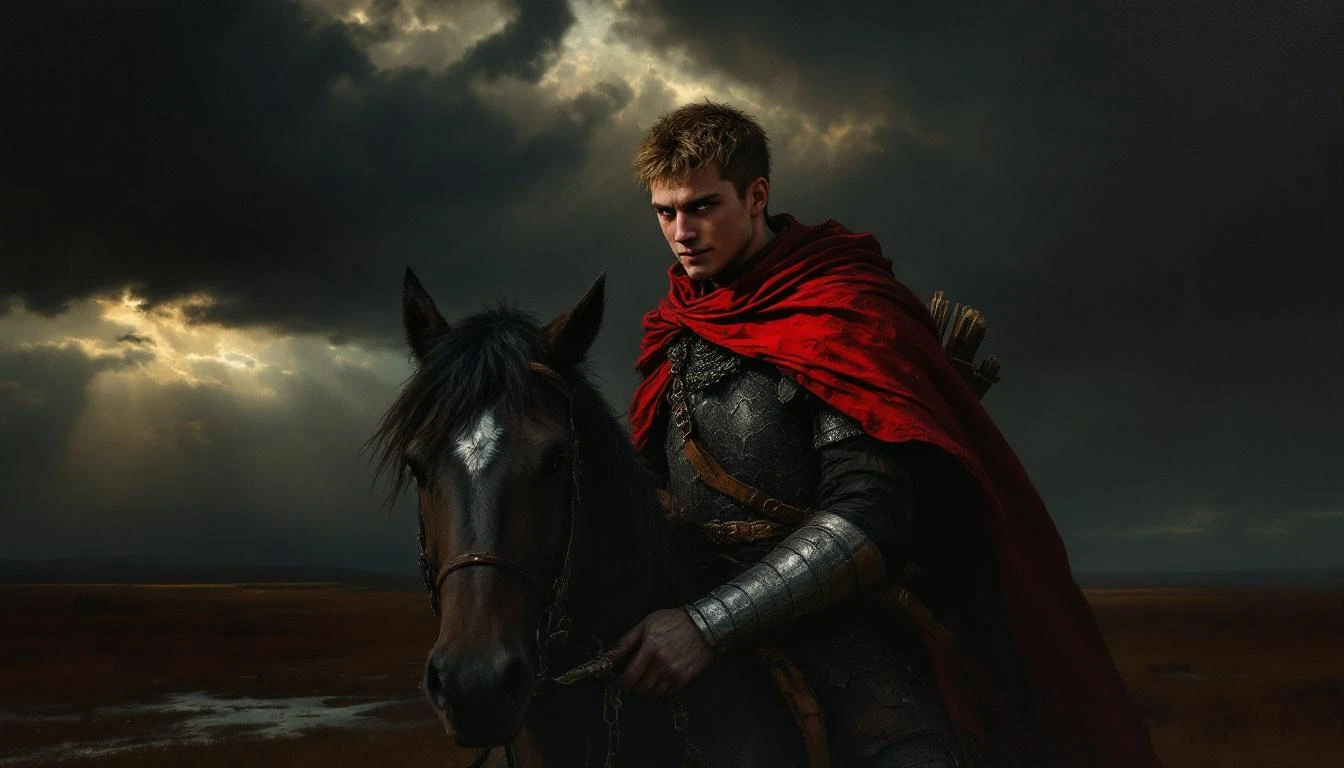
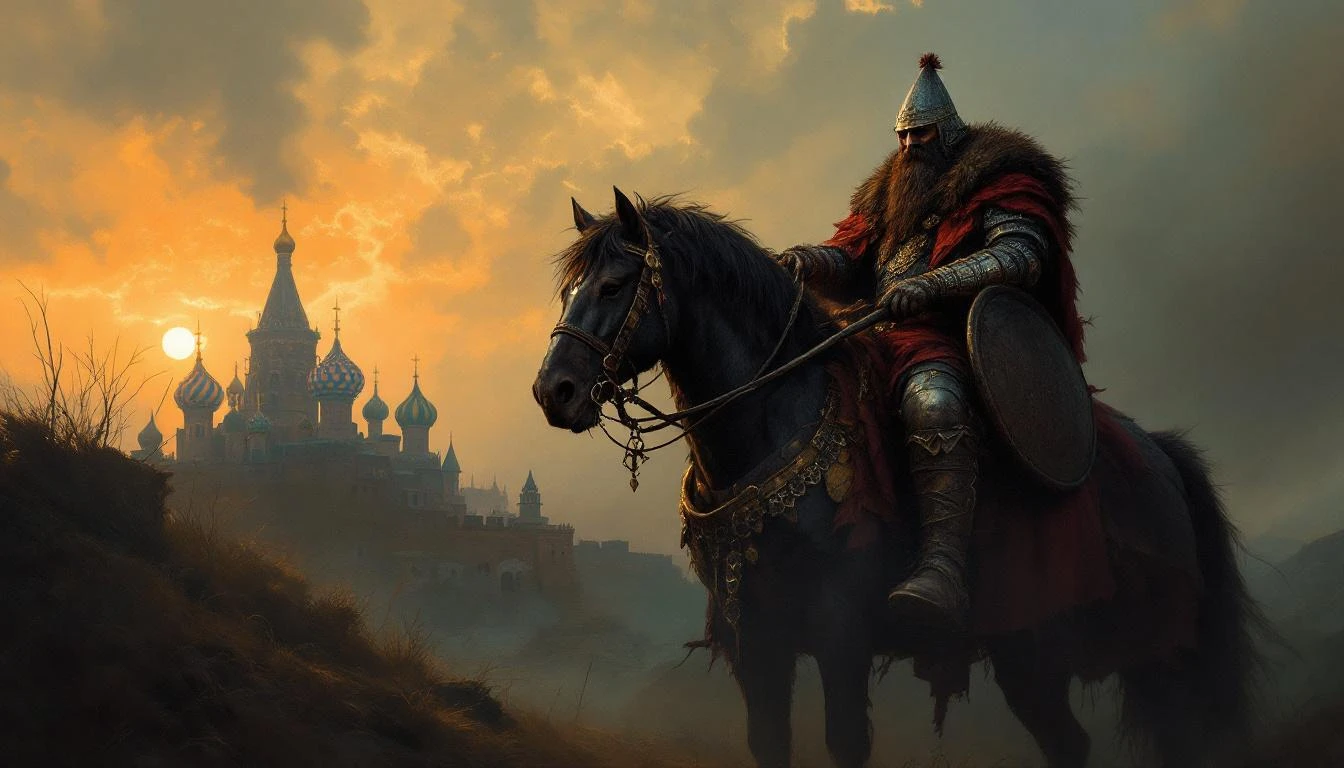
Before Ilya Muromets, before Dobrynya Nikitich, before Alyosha Popovich — before any of the heroes whose names fill the byliny and whose deeds protect the Russian land — there was a bogatyr so immense that the earth groaned under his feet. His horse was the size of a mountain. His armor weighed more than a city. When he rode, the forests bent away from his path like grass in a gale, and the rivers shifted their courses to avoid being trampled.
His name was Svyatogor. The Holy Mountains were his home, because only mountains could hold him. He never rode to the open field. He never came to Kyiv. He never served Prince Vladimir or defended the borders. He could not. The flat earth could not bear his weight. He was too big, too strong, too heavy for the world he lived in.
That is the tragedy of Svyatogor, compressed to its essence: the mightiest warrior in all of Slavic mythology is the one who cannot do anything. His strength has no purpose. His power has no application. He exists in a state of pure, useless supremacy — a bogatyr with nothing to fight, a giant with nowhere to go, the strongest man in a story that does not need him.
And the byliny know exactly what to do with a character like that. They kill him. They kill him slowly, in a stone coffin, while the man who will replace him watches and learns.
The Holy Mountains
Svyatogor lives in the Svyatye Gory — the Holy Mountains, a mythological landscape that does not correspond to any real mountain range, though scholars have tried to connect it to the Caucasus, the Carpathians, or the Urals. The byliny do not describe the Holy Mountains with geographic precision. They describe them with the language of cosmic architecture: the mountains are high enough to touch the sky, ancient enough to have no human history, silent enough that only Svyatogor's voice and his horse's hooves break the stillness.
The Holy Mountains are a boundary. They mark the edge of the heroic world — the world of the byliny, where bogatyrs ride and fight and serve princes. Beyond that edge is something older, something from before the time when human heroes could accomplish anything. Svyatogor belongs to that older world. He is a relic, a leftover, a figure from a previous age of the earth that has not yet finished dying.
This places Svyatogor in a category that scholars of comparative mythology recognize immediately: the elder giant, the primordial being whose time has passed. The Norse have Ymir, the frost giant from whose body the world was made. The Greeks have the Titans, overthrown by the Olympians. The Vedic Indians have the Asuras, displaced by the Devas. In each case, the pattern is the same: an older, more powerful, less purposeful generation of beings gives way to a younger, more directed, more functional one. The old gods must die so the new heroes can live.
Svyatogor is the Slavic expression of this pattern. He does not fight the new heroes. He is not a villain. He is something sadder: a giant who knows he is obsolete and cannot do anything about it.
The Meeting with Ilya
The central bylina of the Svyatogor cycle describes his meeting with Ilya Muromets, and it is one of the most psychologically complex episodes in all of Russian oral poetry.
Ilya is riding through the Holy Mountains — how he got there varies between versions, but the byliny are not concerned with logistics. He sees Svyatogor on his enormous horse, the giant's head brushing the clouds, his body swaying with the slow rhythm of a creature so large that speed is meaningless. In some versions, Ilya sees Svyatogor from behind and, not knowing who this colossal rider is, strikes him on the back with his mace. Svyatogor does not feel it. He continues riding, unaware. After several more blows — any one of which would kill an ordinary man — Svyatogor finally glances over his shoulder and notices Ilya the way a man might notice a fly.
"I thought it was a gnat biting," Svyatogor says in one version. Or: "I thought a twig fell from a tree."
He does not attack Ilya. He is not angry. He picks Ilya up — man, horse, and all — and drops him into his pocket, or into his saddlebag, and continues riding. For three days, Svyatogor carries Ilya in his pocket. Ilya, the strongest bogatyr of the human world, the man who defeated the Nightingale the Robber and fought off the Tatar hordes single-handedly, rides in a giant's pocket like a child's toy.
This is the byliny's way of establishing the hierarchy. Ilya is the greatest of the human heroes. Svyatogor is not a human hero. He belongs to an order of magnitude that renders human strength irrelevant. The gap between them is not a matter of degree. It is a matter of kind.
Eventually — after Svyatogor's horse complains that carrying two bogatyrs is too much even for him — Svyatogor takes Ilya out and they become companions. The giant and the peasant ride together through the Holy Mountains, an image that carries the full symbolic weight of two ages of the world traveling side by side: the dying age of giants and the rising age of men.
The Bag of Earthly Burden
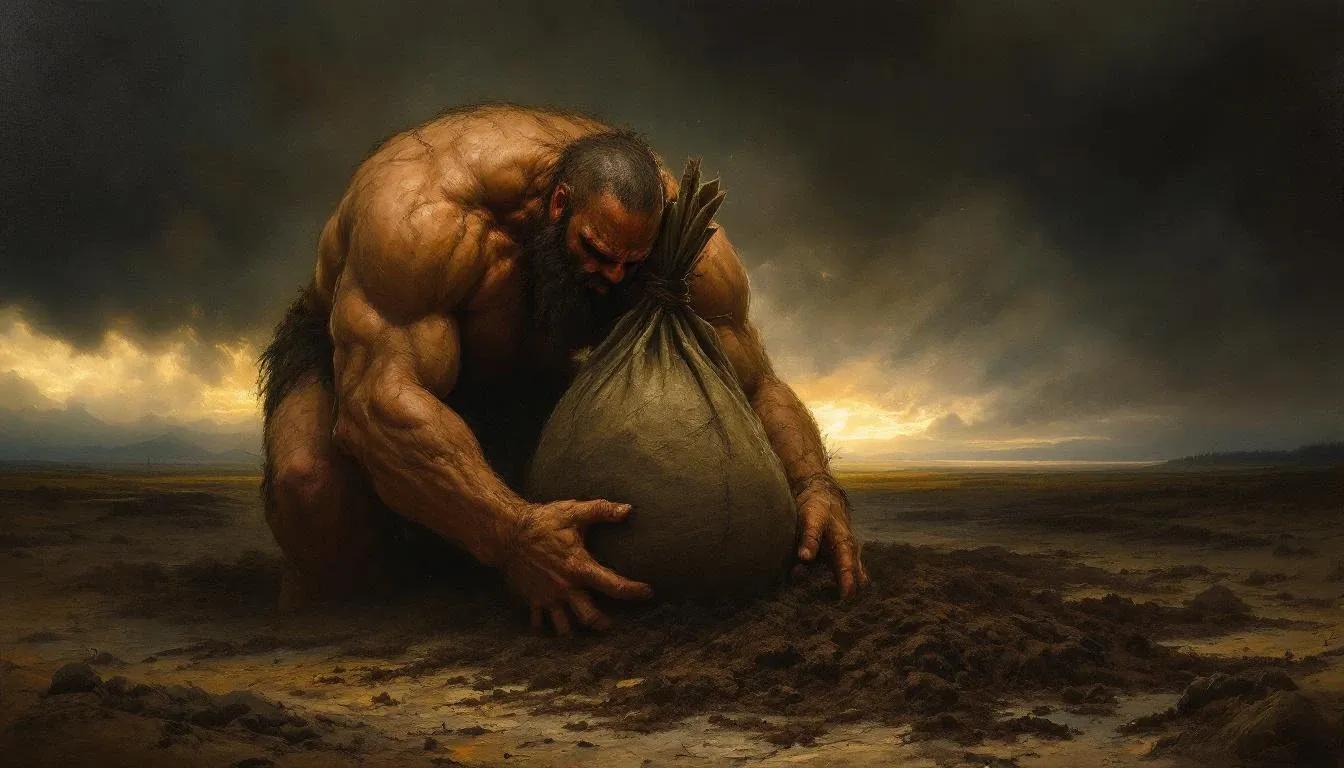
In one of the most famous episodes of the bylina, Svyatogor and Ilya encounter a small leather bag lying on the road. It looks insignificant — a traveler's pouch, the kind of thing a merchant might carry.
Svyatogor tells Ilya to pick it up. Ilya dismounts, bends down, grabs the bag, and cannot move it. He pulls with all his strength — the strength that toppled Solovei-Razboynik, the strength that held the border against entire armies — and the bag does not budge. Not by a hair's width.
Svyatogor laughs. He will show the peasant how it is done. He dismounts from his colossal horse, bends his enormous body, wraps both hands around the bag, and pulls.
The bag does not move. But Svyatogor does. He sinks. The earth opens beneath him, slowly, as if swallowing him. He pulls harder, and he sinks deeper — up to his knees, then his waist, then his chest. The harder he pulls, the deeper he goes. His face reddens. His muscles strain against the fabric. His strength — the greatest strength in all the world — avails him nothing.
And Svyatogor pulled at the bag, and he sank into the earth up to his knees. And he pulled again, and blood ran down his face, and he sank into the earth to his waist. And he could not lift the bag, and he could not free himself from the earth.
What is in the bag? The bylina answers: tyaga zemnaya — the weight of the earth, the earthly burden, the gravity of the terrestrial world. The bag contains the force that holds everything down. It is the earth's own pull, concentrated into an object, and no amount of strength can overcome it because strength is part of it. You cannot lift gravity. You are gravity. The stronger you are, the more you are what the bag contains.
In some versions, Svyatogor dies at the bag. In others, he frees himself but is weakened, diminished, aware now that his strength has limits — or rather, that his strength is itself the thing that limits him. Either way, the episode delivers its message with the blunt clarity the byliny prefer: Svyatogor's power is not the solution. Svyatogor's power is the problem.
The Stone Coffin
The climactic episode of the Svyatogor cycle is the stone coffin, and it is the most important mythological passage in the entire bogatyr tradition.
Svyatogor and Ilya are riding together when they come upon a stone coffin by the road. In some versions it is on a mountain path. In others it is in an open field. The coffin is enormous, carved from a single block of stone, with a lid lying beside it. An inscription on the coffin reads: "Whoever this coffin is made for, he shall lie in it."
Ilya lies down in the coffin. It is too big. He does not fit — the space yawns around him like a child in an adult's bed. The coffin is not for Ilya.
Svyatogor lies down in the coffin. It fits perfectly. The stone conforms to his massive body as if it were carved from his measurements. He smiles — the dark humor of the byliny — and asks Ilya to close the lid, just for a moment, to see how it feels.
Ilya closes the lid. And the lid will not come off.
Svyatogor pushes from inside. The stone does not move. He strikes it with his fists — fists that could break mountains. The stone does not crack. He tells Ilya to strike the coffin with his mace. Ilya swings, and where the mace hits, iron bands appear, sealing the lid tighter.
Svyatogor understands. This is his death. The coffin was placed here by fate, or by the earth itself, or by whatever power decides when a giant's time is over. He does not rage. He does not beg. He does what the dying generation always does in mythology: he passes his power forward.
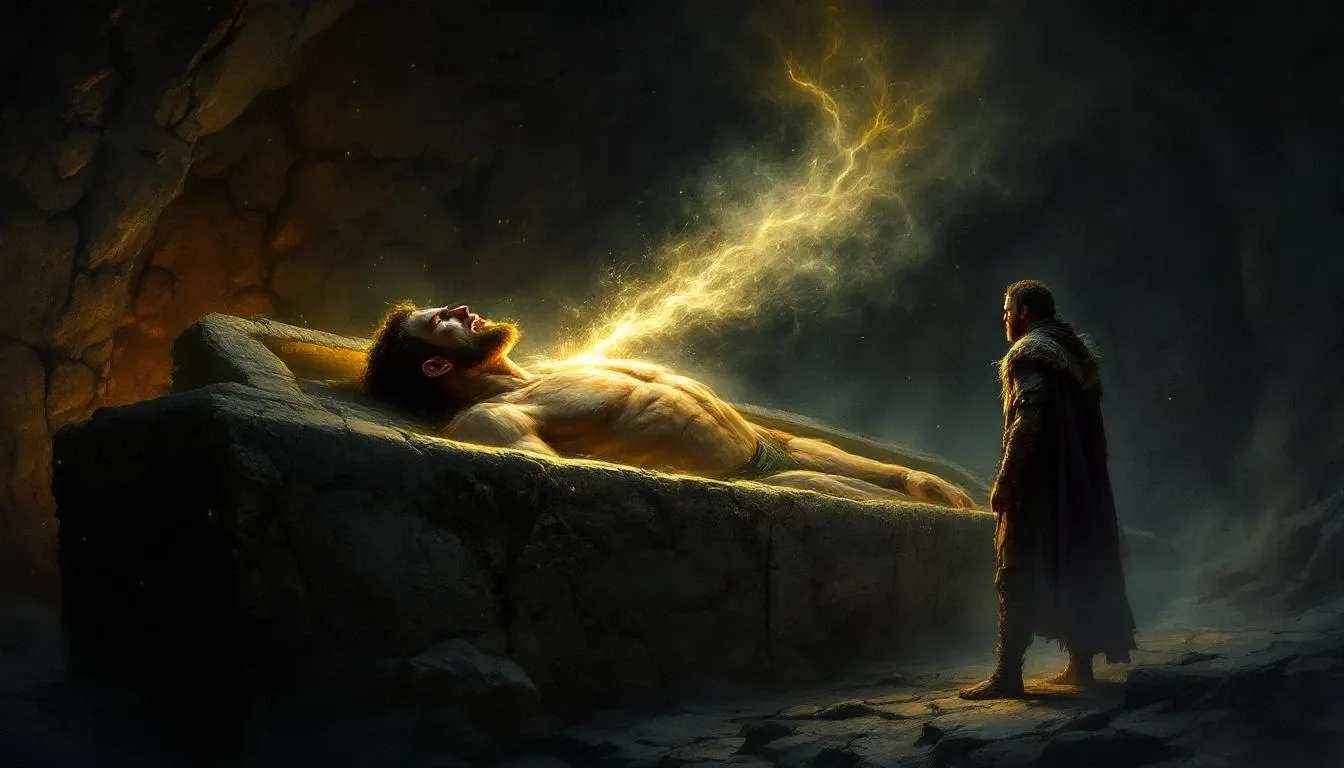
Through a crack in the stone coffin, Svyatogor breathes on Ilya. In some versions he tells Ilya to lean close and inhale his breath. In others he blows through a gap in the lid. The breath is his strength — not all of it, but the portion Ilya can carry. The portion the earth can bear. Svyatogor warns Ilya: take only what is offered. If you try to take all of my strength, you will end up in a coffin beside me.
Ilya takes the breath. He absorbs Svyatogor's strength — the partial inheritance, the measured transfer. He stands up, and he is now the strongest bogatyr in the world. Not the strongest being. Svyatogor was the strongest being. Ilya is the strongest human hero, which is a different thing — a thing with limits, a thing with purpose, a thing the earth can carry.
Svyatogor dies in the coffin. The lid seals. The iron bands tighten one final time. The giant of the Holy Mountains is entombed in stone, and the age of human heroes begins.
The Wife's Betrayal
Not all versions of the Svyatogor bylina end at the coffin. Some include an additional episode — the story of Svyatogor's wife — that adds a layer of domestic tragedy to the cosmic one.
In these versions, Svyatogor has a wife whom he keeps in a crystal casket. He carries her with him in his pocket (the byliny have a thing about pockets) because he does not trust her to stay faithful if left alone. When he stops to rest, he takes her out, and she prepares food and drink for him.
In some versions, while Svyatogor sleeps, his wife seduces Ilya — or attempts to. In the more common versions, she simply talks to Ilya, and the intimacy of the conversation is itself the betrayal. Svyatogor wakes, discovers what has happened, and kills his wife. In other tellings he does not kill her — the narrative simply moves on, leaving the betrayal unresolved, a wound that festers beneath the surface of the giant's final journey.
This episode has been interpreted in various ways. The psychoanalytic reading is obvious: the giant who tries to control everything — his wife, his world, his fate — loses everything precisely because of that control. The woman in the casket is a mirror of Svyatogor himself — imprisoned, constrained, kept in a container that preserves but also suffocates. His jealousy creates the conditions for the betrayal he fears.
The mythological reading is more structural. Svyatogor's wife represents the last attachment binding him to the living world. Her betrayal severs that attachment, freeing him — or condemning him — to the coffin. The giant who has already lost his purpose, his place, and his relevance to the heroic world now loses his personal bond as well. Everything must be stripped away before the transfer of power can occur. The old age must be fully dead before the new one can begin.
What Svyatogor Means
Svyatogor is one of the most philosophically rich figures in all of Slavic folklore, and his meaning radiates in several directions at once.
At the most basic level, he is a story about the limits of strength. The mightiest being in the world cannot lift a bag, cannot escape a coffin, cannot ride in the open field. His power is real and absolute and completely useless. This is not a paradox. This is a diagnosis. Svyatogor represents power that has outgrown its context — the warrior who is too strong for the wars that remain, the god who is too large for the world that needs him.
At a mythological level, he represents the necessary death of the old order. The Titans fell so the Olympians could reign. Ymir was slain so Midgard could be built. Svyatogor dies in his stone coffin so that Ilya Muromets can ride to Kyiv and defend the human world with strength that is scaled to human problems. The old power was cosmic. The new power is political. The old hero belonged to the mountains. The new hero belongs to the road, the court, the battlefield.
At a human level, the story speaks to every generation that watches the previous one die. Svyatogor is the father who was stronger than you will ever be — and whose strength was not enough, in the end, to keep him alive. Ilya standing at the coffin, receiving the giant's final breath, is every child who inherits from the dead and must figure out what to do with the inheritance. You do not get all of it. You get the portion you can carry. The rest stays in the coffin with the dead.
The bylina singers who performed the Svyatogor cycle understood this. They sang it not as a tale of triumph but as a tale of passage — the moment when one era hands its remaining strength to the next and then lies down in the container that was always waiting for it. The lid closes. The iron bands seal.
And somewhere on the open road, a peasant from Karacharovo rides toward Kyiv, carrying in his body the last breath of a giant, doing with it the one thing the giant never could: something that matters.