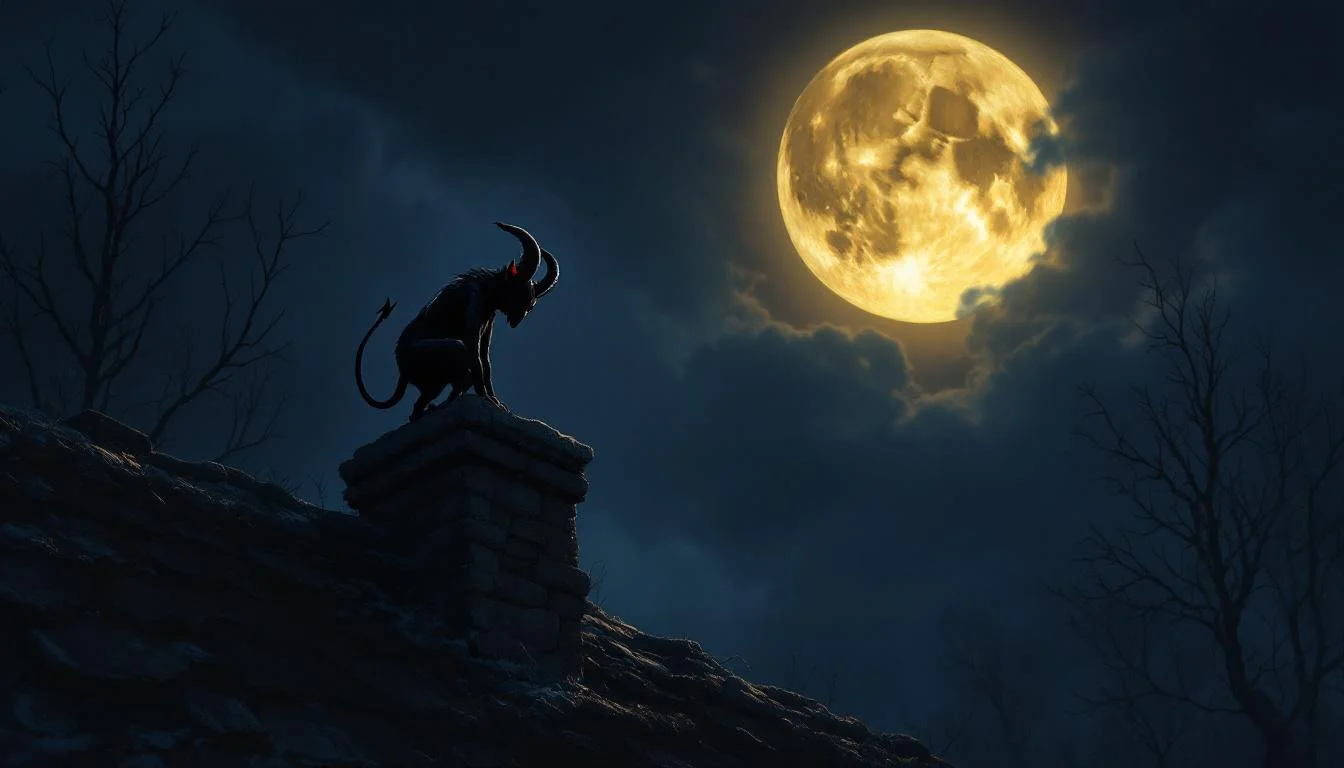
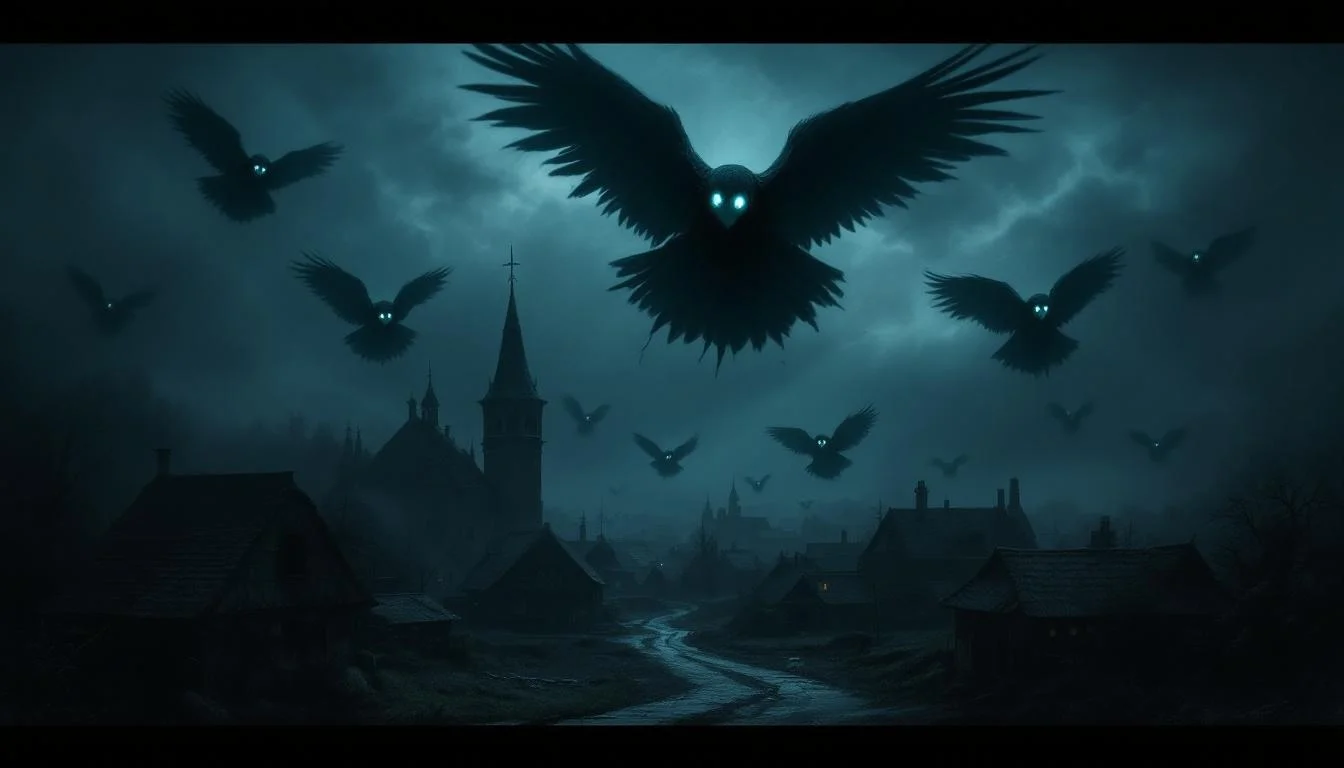
There is a moment in Nikolai Gogol's 1835 horror novella that has not lost a single volt of its power in nearly two centuries. A young seminary student stands alone in a candlelit chapel, reciting psalms over a dead witch's coffin, protected only by a chalk circle drawn on the stone floor. For two nights the circle has held. The dead woman has risen from her coffin, summoned flying demons, even called up the coffin itself to ram the invisible barrier — and failed. On the third night, she calls a different name.
"Bring Viy! Go fetch Viy!"
The doors burst open. Something enters that is not like the other creatures. It is squat, heavy, earth-colored, covered in black soil as though it has clawed its way up from the deep underground. Its legs are twisted roots. Its arms are crusted with clay. And its eyes are sealed shut behind eyelids so thick, so impossibly heavy, that they hang to the ground like iron curtains.
It cannot see. Not yet.
"Lift my eyelids," says Viy. "I cannot see."
A dozen gnarled servants rush forward. They grip the edges of those terrible lids. They heave. The eyelids rise — and behind them is a gaze that kills everything it touches.
The philosopher Khoma Brut makes one final, fatal mistake. He looks. Their eyes meet. Viy sees him. And Khoma drops dead on the chapel floor without a wound on his body.
This is the scene that made Viy the most terrifying creature in all of Slavic horror literature. Not a vampire who drains blood. Not a witch who casts spells. Something worse — a being whose entire existence is organized around a single, annihilating act of perception. When Viy sees you, you cease to exist.
But where did Gogol find this monster? Did he pull it from genuine Ukrainian folklore, as he claimed? Or did the greatest horror writer in the Russian language invent something so primal, so deeply disturbing, that it felt like folklore even though it never was?
The answer, as with most things in the Slavic spirit world, is stranger than either option.
Gogol's Claim: A Folk Legend Retold
Gogol published Viy in 1835 as part of his collection Mirgorod, alongside stories set in the world of the Ukrainian Cossacks. In his author's note, he made a specific and very deliberate claim:
Viy is a colossal creation of the folk imagination. The story itself is a folk legend, which I have retold exactly as I heard it, without changing anything.
This is a lie. Or at best, a half-truth wrapped in the confident tone of a writer who understood that horror gains power from the appearance of authenticity. Gogol did not "retell" a single unified folk legend. No folklorist before or after him has ever found a Ukrainian folk tale that matches the plot of Viy — the three-night vigil, the dead witch, the protective circle, and the climactic summoning of a heavy-lidded underground demon.
What Gogol actually did was far more interesting. He took fragments — real fragments, from real traditions — and welded them into something new. The seminary students wandering the Ukrainian countryside are drawn from his own childhood memories of Poltava province. The dead witch who rises from her coffin belongs to a widespread East Slavic motif of the restless dead. The protective circle is an ancient magical practice found across European folklore. And Viy himself — the creature with the killing gaze and the iron eyelids — appears to be Gogol's fusion of at least two separate folk traditions into a single, unforgettable monster.
The Folk Roots: Who Is Behind the Iron Eyelids?
Scholars have spent nearly two centuries trying to trace Viy back to his sources, and the trail leads in two directions at once.
The first and most convincing leads to Saint Cassian — or more precisely, to the folk version of Saint Cassian that Ukrainian and Russian peasants believed in, which had almost nothing to do with the historical Christian saint and everything to do with something much older.
In the folk beliefs of Ukrainians from the Kharkiv, Poltava, Vinnytsia, and Odessa regions — the very regions Gogol knew intimately — Cassian (Kasyan) was not a benevolent saint. He was a terrifying figure who sat motionless on a chair with his eyelashes hanging down to his knees, so long and so heavy that he could not see through them. Only once every four years — on February 29th, the leap day — did his eyelashes rise. And whatever Cassian looked at on that day died. Cattle perished. Crops failed. People fell sick and did not recover. Entire villages could be blighted by a single glance from the saint whose eyes were meant to stay shut.
The second trail leads deeper into pre-Christian East Slavic mythology, to a figure called Niy or Niya — a chthonic deity of the underworld sometimes identified in later reconstructions as a Slavic equivalent of Pluto or Hades. Some scholars, particularly those working with comparative Indo-European mythology, have proposed that Viy descends from this underworld god, whose name may share a root with the Slavic word navь — the realm of the dead, the place where the Nav spirits dwell. Under this reading, Viy is not merely a demon but a displaced god of death whose worship was suppressed after the Christianization of Kyivan Rus in 988 and who survived only as a fragment of nightmare folklore.
The name Viy itself remains disputed. The most common etymology connects it to the Ukrainian word viya — "eyelash" — which would make his name literally "the one defined by his eyelids." Another theory links it to the Old Slavic root viti, meaning "to twist" or "to wind," which would connect him to the twisted, root-like body that Gogol describes. A third, more speculative proposal derives the name from viti in the sense of "to howl" — the voice of something that calls from underground.
Whatever the etymology, the composite picture is consistent: Viy is a being of the deep earth, the underworld, the lightless places beneath the surface of the living world. His eyes are sealed because he belongs to a realm where there is no light and no sight. When his eyelids are forced open in the world above, the darkness behind them is not merely absence — it is an active, annihilating force. Viy does not shoot beams from his eyes. He simply looks, and the act of being seen by something from the deepest layer of the dead is incompatible with being alive.
The Three Nights: Anatomy of the Horror
The genius of Gogol's story lies in its structure. The horror escalates across three nights, each one worse than the last, building toward the moment when Viy is finally summoned.
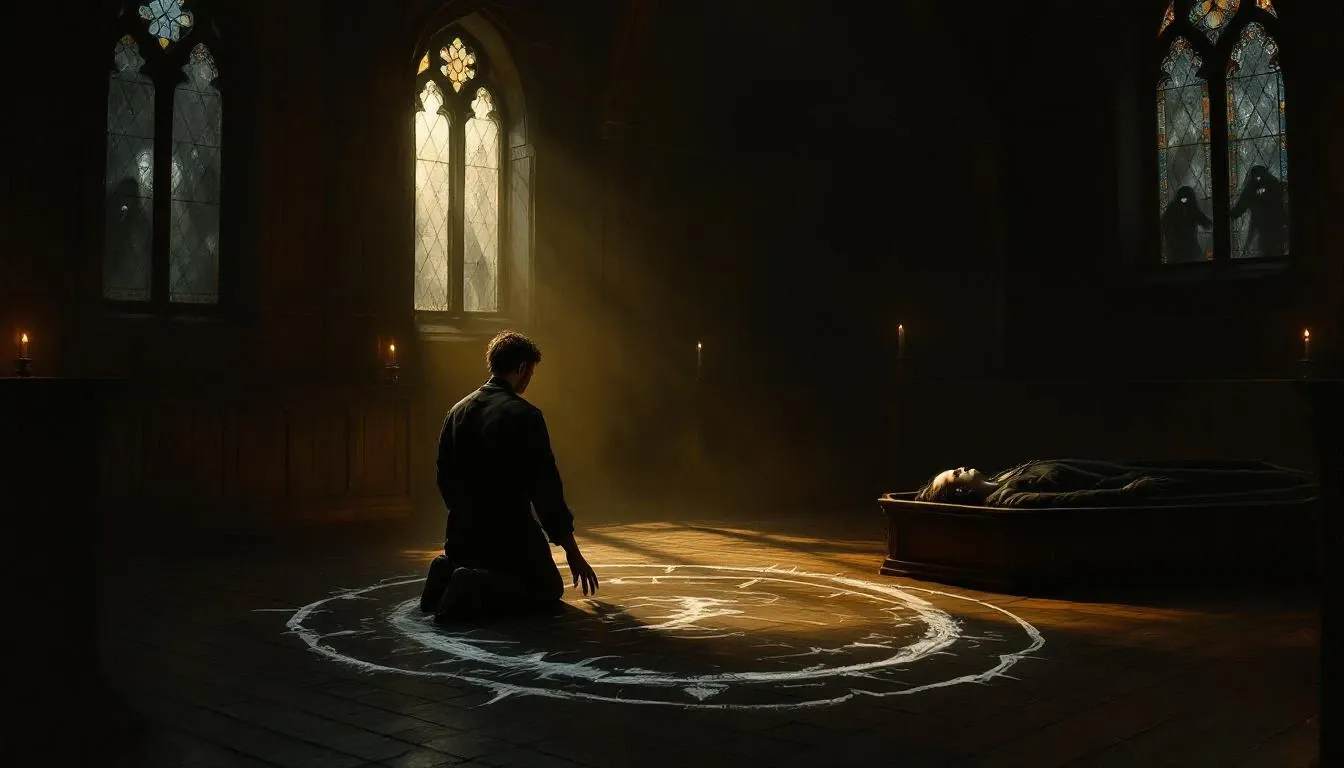
The first night. Khoma Brut, a philosophy student from the Kyiv seminary, is brought against his will to the estate of a wealthy Cossack sotnik whose daughter has died. The dead girl had specifically requested that Khoma — and no one else — read psalms over her body for three consecutive nights. Khoma recognizes her as the witch who had ridden him through the night sky on a demonic flight, and whom he had beaten to death in self-defense. He knows what she is. He does not want to be in this chapel. But the sotnik's Cossacks will not let him leave.
On the first night, the corpse rises from the coffin. Khoma, standing inside his chalk circle, reads the psalms in a voice shaking with terror. The dead witch walks straight toward him — but she cannot see through the circle's barrier. She gropes the air with her pale hands, searching for him, her dead eyes staring at nothing. The cock crows. She falls back into the coffin. Khoma survives, but his hair has turned grey overnight.
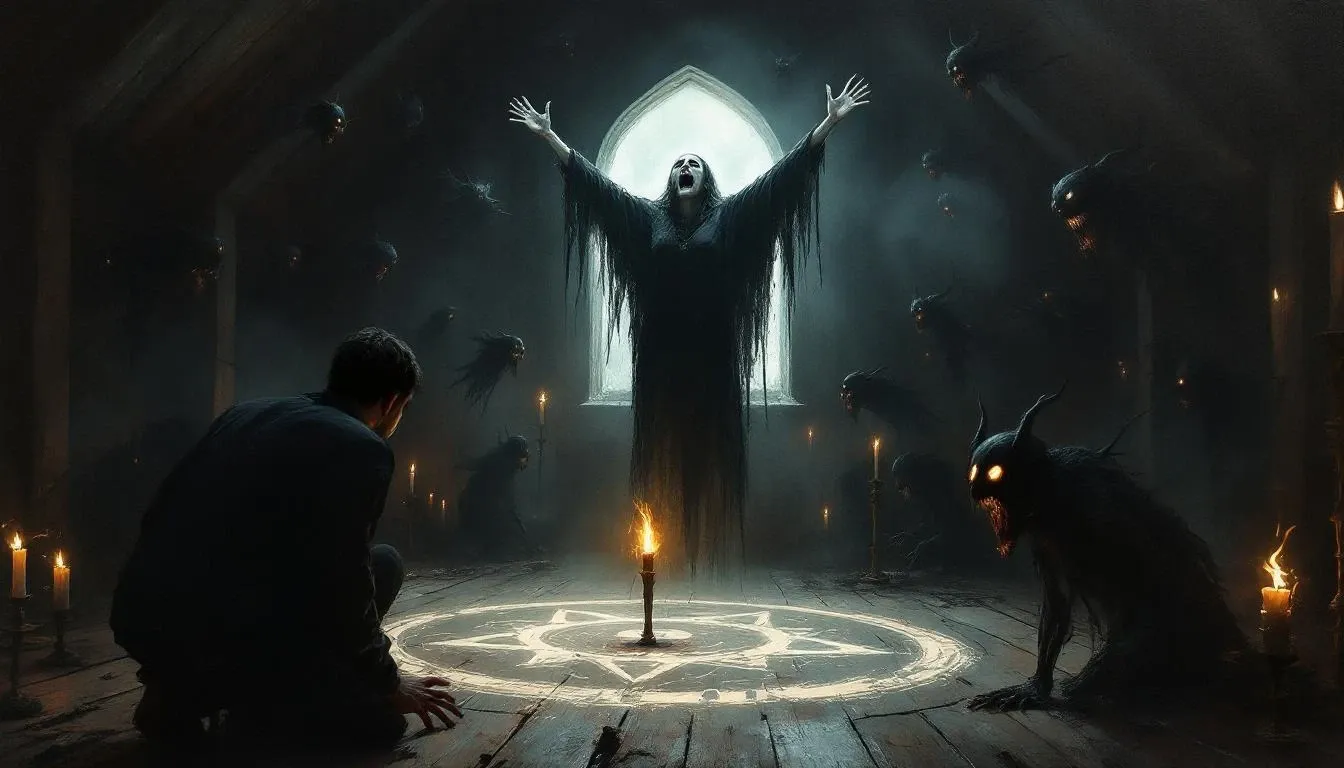
The second night. The witch is angrier. She calls up reinforcements — a howling mob of flying demons, monstrous creatures that scrape and batter against the invisible wall of the circle. The coffin itself launches into the air and rams the barrier repeatedly, trying to shatter it. The noise is unbearable. The chapel fills with the sound of claws and wings and the grinding of the coffin against the floor. But the circle holds. Dawn comes. Khoma collapses, spent.
The third night. This is the night that has haunted readers for nearly two hundred years. The witch summons everything. The chapel fills wall to wall with creatures so grotesque they defy description — things with wings and fangs and too many legs, things covered in slime, things that should not exist. But none of them can breach the circle. And so the witch speaks the words that change everything.
"Bring Viy! Go fetch Viy!"
And what enters the chapel is worse than all the other monsters combined, not because it is larger or more violent, but because it possesses the one weapon that can penetrate any defense. It can see you. Not with the limited sight of a demon or a spirit. With the gaze of the underworld itself.
The horror of Viy is not physical destruction. It is exposure. Khoma's chalk circle protected him from everything — claws, fangs, the brute force of a flying coffin. It could not protect him from being perceived. Once Viy's eyelids are lifted and those dead, earthen eyes find him behind his barrier, the circle means nothing. You cannot hide from something that sees through all concealment. The act of being seen by the lord of the deep earth is the act of dying.
The 1967 Film: Soviet Horror's Only Masterpiece
For decades after Gogol wrote Viy, no filmmaker dared to adapt it. The Soviet Union did not permit horror as a genre. Horror was considered bourgeois, decadent, incompatible with the materialist worldview of the socialist state. Ghosts and demons did not exist; therefore, films about ghosts and demons should not exist either.
Then, in 1967, directors Konstantin Yershov and Georgi Kropachyov found a loophole. They pitched Viy not as a horror film but as a faithful adaptation of a classic work of Russian literature. Gogol was part of the canon — a great realist writer studied in every Soviet school. You could not ban Gogol. And if you could not ban Gogol, you could not entirely ban his most famous monster.
The resulting film — with special effects supervised by the legendary Aleksandr Ptushko, the Soviet Union's master of cinematic fantasy — became the first and, for the entire Soviet era, the only officially produced horror film in the USSR. It was a sensation. Soviet audiences, who had never seen anything like it on screen, packed theaters. The final sequence in the chapel, with its hand-crafted demons and the unforgettable appearance of Viy himself — a squat, earth-colored figure with mechanical eyelids that grind open like rusted shutters — remains one of the most effective horror sequences ever filmed, in any country, in any era.
The 1967 Viy succeeded because it understood something fundamental about Gogol's story: the horror is not in the monsters themselves but in the waiting. The first two nights build an almost unbearable tension. You know what is coming on the third night. You know the circle will not hold. And when Viy finally appears — slow, heavy, inevitable — the payoff is devastating precisely because it has been so patiently earned.
Forbidden Empire: Viy Reimagined for the 21st Century
In 2014, Russian-Ukrainian director Oleg Stepchenko released Viy 3D, known internationally as Forbidden Empire — a loose reimagining of Gogol's story that replaced the seminary student with Jonathan Green, a fictional 18th-century British cartographer who stumbles into a cursed Ukrainian village while traveling east from England.
The film was a commercial success in Russia, earning over $35 million, but it was a fundamentally different creature from either Gogol's story or the 1967 film. Where Gogol wrote intimate psychological horror and the Soviet directors crafted atmospheric folk terror, Forbidden Empire offered a CGI-heavy fantasy adventure closer in tone to Pirates of the Caribbean than to anything in Slavic folklore. The village, the witch, the chapel vigil, and Viy himself are all present — but filtered through the sensibility of a big-budget international co-production designed to sell tickets in markets that had never heard of Gogol.
The critical response was divided. Some praised the film's ambition and visual spectacle. Others argued that it had stripped Viy of precisely the qualities that made him terrifying — the slowness, the heaviness, the sense of something incomprehensibly ancient rising from the deep earth. A sequel, Viy 2: Journey to China (2019), pushed even further from the source material, pairing the cartographer character with a fictionalized version of the Chinese emperor in an adventure that had essentially nothing to do with Slavic folklore at all.
The contrast between the 1967 and 2014 films tells you something important about what makes Viy work as a horror figure. He is not a creature of spectacle. He is a creature of weight — literal, physical, spiritual weight. His iron eyelids are heavy. His body is heavy. His footsteps are heavy. The dread he generates comes from the feeling that something impossibly dense and impossibly old has been dragged up from the bottom of the world, and it does not belong in the light. Turn him into a CGI set piece and you lose the gravity — in both senses of the word.
Is Viy Real Folklore or Gogol's Invention?
This is the question that has divided scholars of Slavic mythology for generations, and the honest answer is: both.
No folklorist has ever found a pre-Gogol text that uses the name "Viy" for a specific demon. The word itself appears in no dictionary, no ethnographic collection, no folk tale recorded before 1835. In this narrow sense, Viy is Gogol's creation. He invented the name and gave it a body.
But the concept behind Viy — a being of the underworld with a killing gaze sealed behind impossibly heavy eyelids — is documented in Ukrainian folk tradition independently of Gogol. The folk Cassian with his eyelashes down to his knees. The belief in leap-year death curses. The broader East Slavic tradition of nav'i — spirits of the dead who bring plague and death simply by appearing among the living, creatures from the same dark afterlife realm that Viy seems to call home. The chort who tempts and tricks. The Nav spirits who leak through the cracks between worlds. All of these are real, documented, pre-Gogol traditions.
What Gogol did was synthesis. He took the folk Cassian's killing gaze and heavy eyelids, fused them with the concept of a chthonic underworld ruler, placed the result inside a narrative structure drawn from widespread East Slavic tales of vigils over the dangerous dead, and gave it a name that sounded like a Ukrainian word for eyelash. The result was a character so perfectly assembled from genuine folk materials that it became folklore. After 1835, Ukrainians and Russians began telling stories about Viy as though he had always existed. He entered the folk imagination through the door of literature and never left.
This is the rarest achievement in the relationship between written and oral culture. Gogol did not simply record folklore. He did not simply invent a character. He created something that folklore adopted as its own — a literary monster that passed the only test that matters in the world of myth: people believed in him.
And in the dark chapels of Ukrainian folk memory, where the candles gutter and the chalk circles grow thin, Viy is still waiting underground. Patient. Heavy. His iron eyelids sealed shut.
"Lift my eyelids. I cannot see."
No one who hears those words — in Gogol's prose, in the 1967 film, in the whispered retellings that still circulate in Ukrainian villages — ever forgets them. Because they contain a terror older than literature, older than Christianity, older than any written language. The terror of being seen by something that should never have opened its eyes.