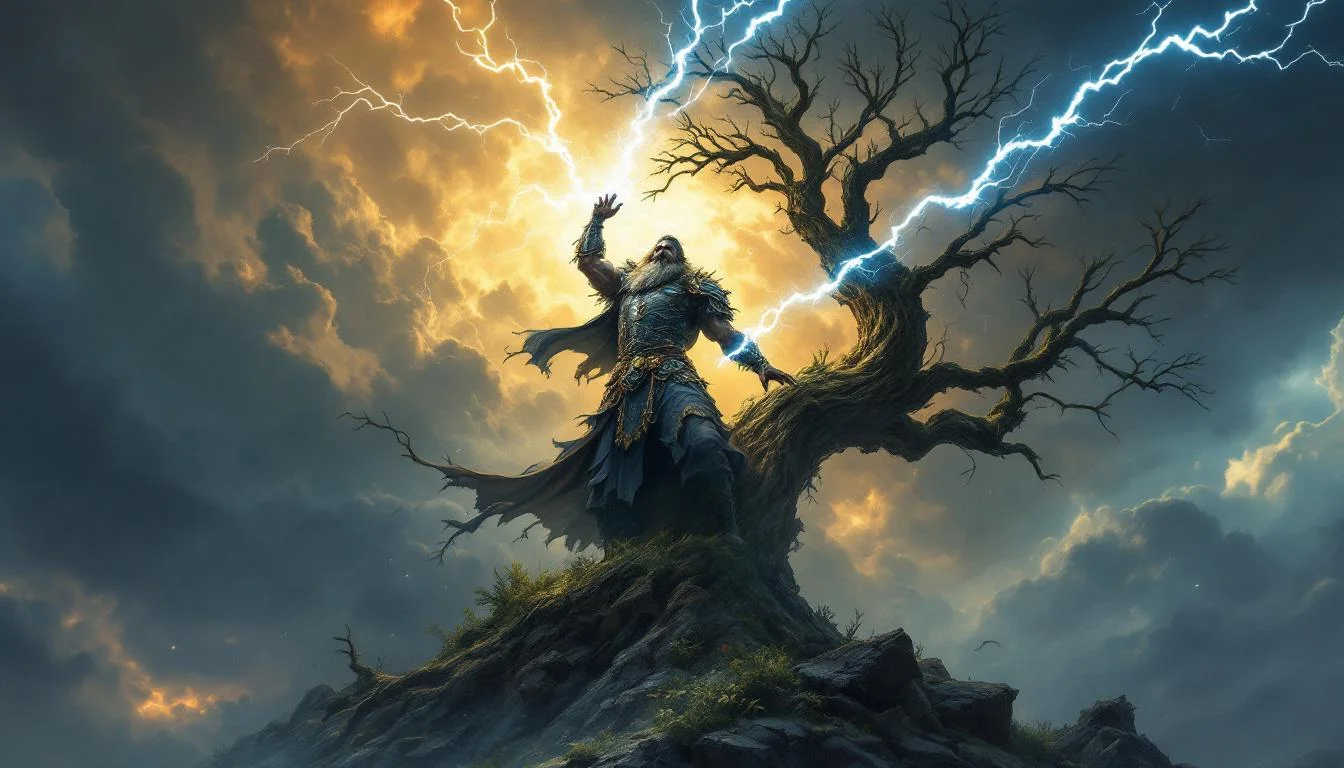
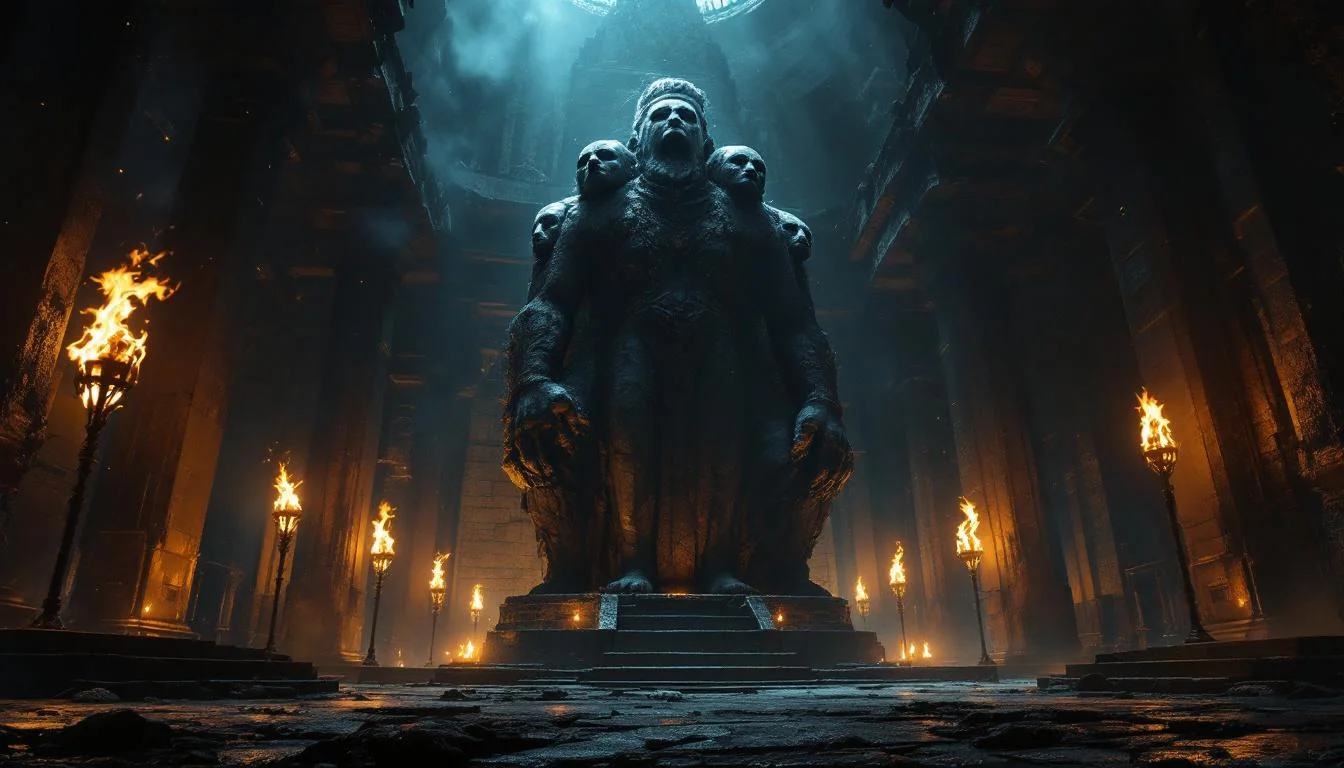
The statues burned slowly. Oak does not catch fire the way pine does — it resists, blackens, holds its shape long after the flames have hollowed it out. So when Bishop Absalon's men toppled the great four-headed idol of Svetovit at Arkona in the summer of 1168, the god did not vanish in a flash. He smoldered. He cracked. His four carved faces, each gazing outward toward a different cardinal point, watched the Danes dismantle his sanctuary piece by piece as the fire worked its way through his wooden body. The priests who had served him for centuries were forced to stand and observe. The sacred white horse that had been used for divination was led away. The treasury — centuries of offerings from across the Slavic world — was looted. And when the fire finally finished what the axes had begun, there was nothing left on the chalk cliffs of Rügen but ash and the memory of something that had been worshipped there since before anyone could remember.
This was not an isolated act of vandalism. It was the final chapter in a process that had been grinding across the Slavic world for three hundred years — a systematic campaign to uproot, discredit, and erase one of the last major pagan civilizations in Europe. The Christianization of the Slavs was not a gentle awakening. It was a demolition project, carried out with fire, iron, political coercion, and the cold patience of an institution that measured its victories in centuries. And yet, for all its thoroughness, it failed to finish the job. The old gods did not die. They went underground, changed their names, hid inside Christian holidays, and waited.
The Political Arithmetic of Conversion
The Slavic peoples did not convert to Christianity because they were persuaded by theological arguments. They converted because their rulers decided it was useful. The pattern repeated itself across Eastern and Central Europe between the ninth and twelfth centuries: a prince or king, facing military pressure from Christian neighbors, economic isolation, or the need for a unifying ideology to hold fractious tribal territories together, would accept baptism and then impose the new religion on his subjects by decree. Faith was secondary. Power was the point.
The South Slavs went first. The Bulgarians under Boris I accepted Christianity in 864 after a combination of Byzantine military pressure and famine forced his hand. The Serbs and Croats followed in the same century, though the process was uneven and required repeated missionary campaigns. Among the West Slavs, the Moravians received the famous mission of Saints Cyril and Methodius in 863, who translated liturgical texts into Old Church Slavonic — one of the few genuinely intellectual contributions of the Christianization process, and one that gave the Slavs a written language even as it dismantled their oral religious traditions. The Poles accepted baptism under Mieszko I in 966, a calculated diplomatic move to avoid being conquered by the already-Christian Germans. The Czechs converted around the same period, under similar pressures.
But the most dramatic — and most documented — conversion came in the east, in the lands of Kievan Rus', where a prince named Vladimir stood on a hill overlooking the Dnieper River in 988 and decided to remake the spiritual world of an entire civilization.
Fire on the Dnieper: The Baptism of Rus'
Vladimir Sviatoslavich was not a pious man. Before his conversion, he had attempted to consolidate Slavic paganism into an official state religion, erecting a pantheon of six gods on a hill outside his palace in Kyiv — Perun at the top, with his silver head and golden mustache, followed by Khors, Dazhbog, Stribog, Simargl, and Mokosh. It was a political pantheon, designed to unify the diverse tribal cults of his realm under one hierarchy. It failed. The tribes did not stop worshipping their local gods simply because a prince had arranged a new order on a hilltop.
So Vladimir tried a different approach. According to the Primary Chronicle, he sent envoys to study the religions of his neighbors — Islam, Judaism, Latin Christianity, and Greek Orthodoxy. The story of their return is almost certainly legendary: they reportedly rejected Islam because it forbade alcohol ("Drinking is the joy of the Rus'"), Judaism because its adherents had lost their homeland, and Latin Christianity because its churches lacked beauty. But in the Hagia Sophia of Constantinople, they found something that stunned them: "We knew not whether we were in heaven or on earth." Vladimir chose Byzantium, negotiated a marriage to the Emperor's sister Anna, and was baptized at Chersonesus in Crimea.
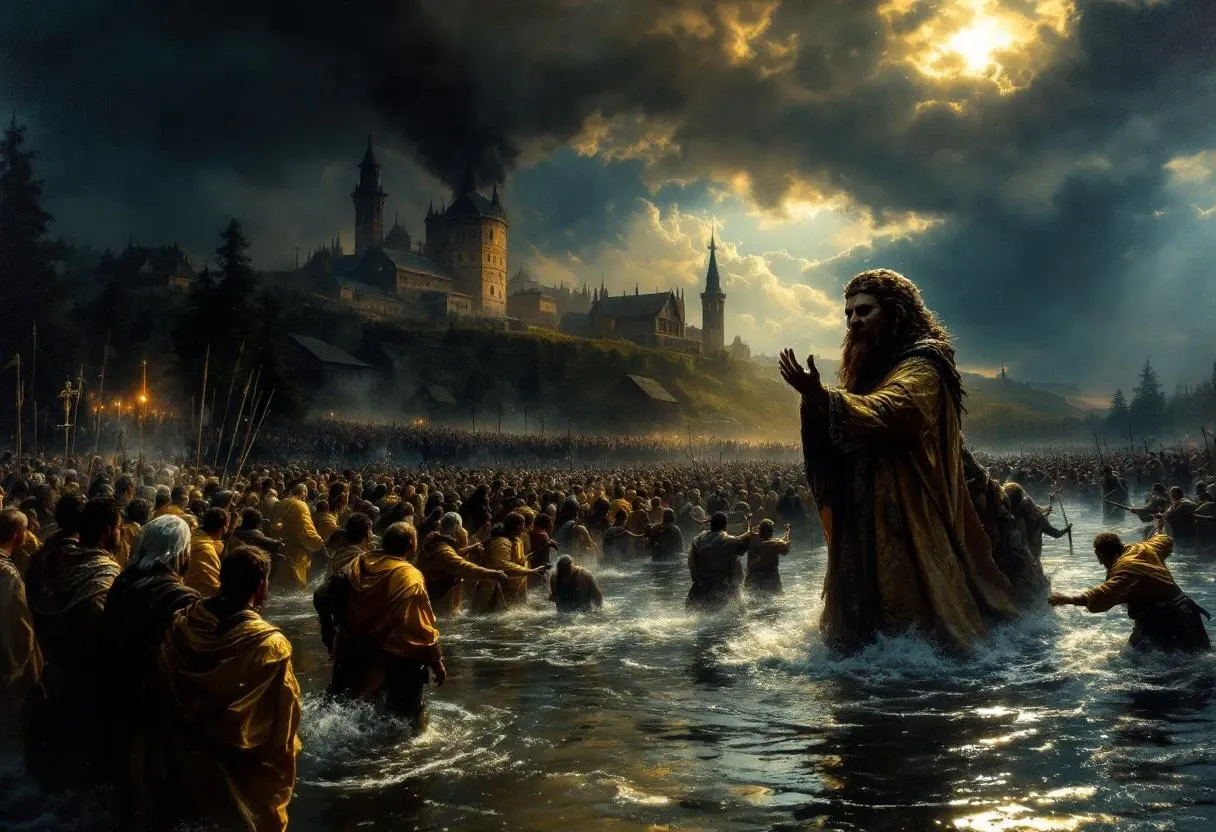
What followed in Kyiv was not gentle catechesis. Vladimir ordered every pagan idol destroyed. The statue of Perun — the supreme god, the thunder-lord, the deity he himself had elevated above all others just years before — was tied to a horse's tail, beaten with sticks, and dragged down the hill to the Dnieper, where it was thrown into the current. Twelve men were assigned to push it with poles if it washed ashore. The other idols were chopped apart and burned. Then came the order: every man, woman, and child in Kyiv was to appear at the river for baptism. Those who refused would be declared enemies of the prince.
Dobrynya baptized Novgorod by fire, and Putyata baptized it by the sword.
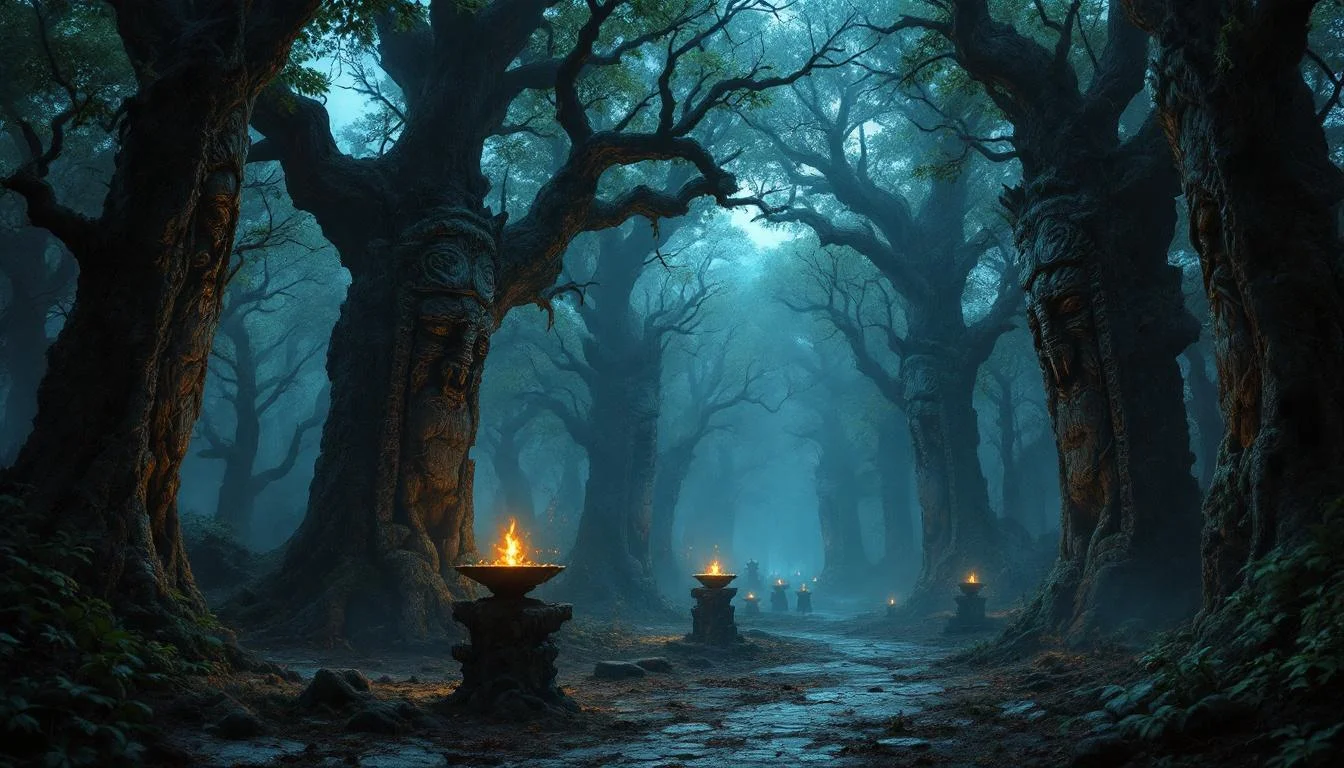
The people of Kyiv waded into the Dnieper. Some wept. Some cursed. Most simply obeyed, because the alternative was exile or worse. But the real violence came in Novgorod, where the population actively resisted. According to the Ioakim Chronicle, the locals burned down a church, murdered the relatives of Vladimir's uncle Dobrynya, and armed themselves against the missionaries. Dobrynya responded with soldiers. Putyata, the military commander, attacked the city at night. Houses were set on fire. The pagan sacred groves outside the city, including the great shrine at Peryn dedicated to Perun, were demolished. The Novgorodians were baptized at swordpoint, and a bitter proverb was born: "Dobrynya baptized by fire, Putyata by the sword."
The Crusade Against the Western Slavs
While the East Slavs were being baptized by their own princes, the West Slavs — particularly the Polabian and Baltic Slavs — faced something far worse: foreign invasion disguised as holy war. The Germanic kingdoms to the west had been waging a slow, brutal campaign of conquest against the Slavic tribes along the Elbe and the Baltic coast since the tenth century, and Christianity was both the justification and the instrument.
The great sacred groves and temple complexes of the Western Slavs were prime targets. The temple of Rethra, dedicated to the fire god Svarozhich-Radegost, was one of the most important pagan sanctuaries in Northern Europe — a wooden structure built on a foundation of animal horns, its walls carved with images of gods, its interior guarded by armed idols in real helmets and armor. The German chronicler Thietmar of Merseburg described it with a mix of horrified fascination and grudging awe. It was destroyed multiple times during the German campaigns, rebuilt each time by the stubborn Lutici, and finally eradicated for good in 1068.
The temple of Svetovit at Arkona on the island of Rügen was the last great pagan sanctuary to fall. For centuries it had served as the spiritual center of the Rani tribe and a destination for pilgrims from across the Slavic world. The four-headed god received tithes from every Slavic merchant who passed through the Baltic. His priests kept a sacred white horse that no one but the high priest could ride, and they read omens from the pattern of its hoofsteps over crossed spears. When the Danes under King Valdemar I besieged Arkona in June 1168, the defenders held out for four weeks before fire breached their walls. Bishop Absalon personally supervised the destruction. The idol was chopped apart, dragged through the settlement, and burned. The temple was demolished. The population was baptized by force.
In 1147, Pope Eugenius III had already declared a formal crusade against the pagan Slavs of the Baltic — the Wendish Crusade, the first papal call to holy war not directed against Muslims. Saxon, Danish, and Polish armies marched into Slavic territory under the banner of the cross, forcing tribute, burning villages, and demanding mass baptisms at the point of a sword. As Helmold of Bosau recorded in his Chronica Slavorum, the Slavic response was fierce: the Lutici and Obotrites repeatedly revolted, burned churches, expelled German clergy, and reasserted pagan worship at their rebuilt temples. The great Slavic revolt of 983 had already demonstrated that Christianization by conquest could be reversed — the rebels destroyed the bishoprics of Havelberg and Brandenburg, massacred priests, and restored the old religion for nearly a century. But by 1185, the military balance had tipped irreversibly. The last organized pagan resistance on the southern Baltic coast was broken, though the beliefs it defended would endure in other forms for centuries to come.
The Gods Become Saints: Dvoeverie and the Art of Survival
The Slavic peasantry did not abandon their gods simply because a bishop told them to. What happened instead was something far more interesting and far more stubborn: a centuries-long process of absorption, disguise, and quiet resistance that medieval Church writers called dvoeverie — "double faith."
This was not a conscious strategy of resistance — or not only that. It was the natural behavior of a deeply conservative agricultural society that organized its entire existence around seasonal cycles, and those cycles had been governed by the old gods for as long as anyone could remember. The Church calendar was layered over the pagan one with varying degrees of success. Kupala Night — the midsummer festival of bonfires, river bathing, and the search for the mythical fern flower — was officially renamed for Saint John the Baptist, whose feast day fell conveniently close to the summer solstice. Maslenitsa, the riotous spring festival of pancakes, fistfights, and the burning of a straw effigy of winter, was absorbed into the pre-Lenten calendar but retained its pagan character so completely that Orthodox clergy spent centuries writing sermons against it. Kolyada, the winter solstice celebration, was folded into Christmas but kept its songs, its costumes, its door-to-door processions that had nothing whatsoever to do with the Nativity.
The lower clergy — village priests who were themselves the sons and grandsons of pagans — often participated in these celebrations. Church authorities railed against this. Sermons from the eleventh through fourteenth centuries contain furious condemnations of Christians who continued to visit sacred groves, make offerings at springs, consult volkhvy (pagan priests or sorcerers), and invoke the names of old gods in their daily speech. The fact that these condemnations were repeated century after century is itself proof that they were not working.
What Was Lost
The Christianization of the Slavs destroyed an entire religious civilization, and because it succeeded, we will never fully know what that civilization contained. The descriptions we have of Slavic temples, rituals, and gods come almost exclusively from the writings of the people who destroyed them — German chroniclers like Thietmar and Helmold, Byzantine missionaries, and Orthodox Church authorities compiling lists of forbidden practices. These are the notes of the prosecution, not the testimony of the accused.
We know that the Slavs worshipped in sacred groves and hilltop shrines long before they built wooden temples. We know that their gods were carved in wood and painted, dressed in real clothing and armor, and that some — like the four-headed Svetovit and the three-headed Triglav — had multiple faces gazing in different directions, a visual language of omniscience that has no parallel in the Germanic or Celtic traditions. We know that divination by sacred horses was widespread, that fire was central to ritual, and that the dead were cremated on pyres that sometimes included the sacrifice of a wife or slave. We know that there was a rich oral tradition of myths, songs, and incantations, fragments of which survived in folk songs, fairy tales, and byliny recorded by ethnographers centuries later. But we do not have a single text written by a Slavic pagan about their own beliefs. Every word was spoken, and every word was vulnerable to the silence that followed conversion.
Slavic Paganism Today: Rodnovery and the Revival
The old gods did not stay buried. Beginning in the late Soviet period and accelerating after the fall of communism, a movement called Rodnovery — Slavic Native Faith — has sought to reconstruct and practice the pre-Christian religion of the Slavs. The movement exists across Russia, Ukraine, Poland, the Czech Republic, and Serbia, with communities ranging from academic reconstructionists who parse medieval sources with scholarly rigor to eclectic practitioners who blend Slavic symbolism with broader neopagan frameworks.
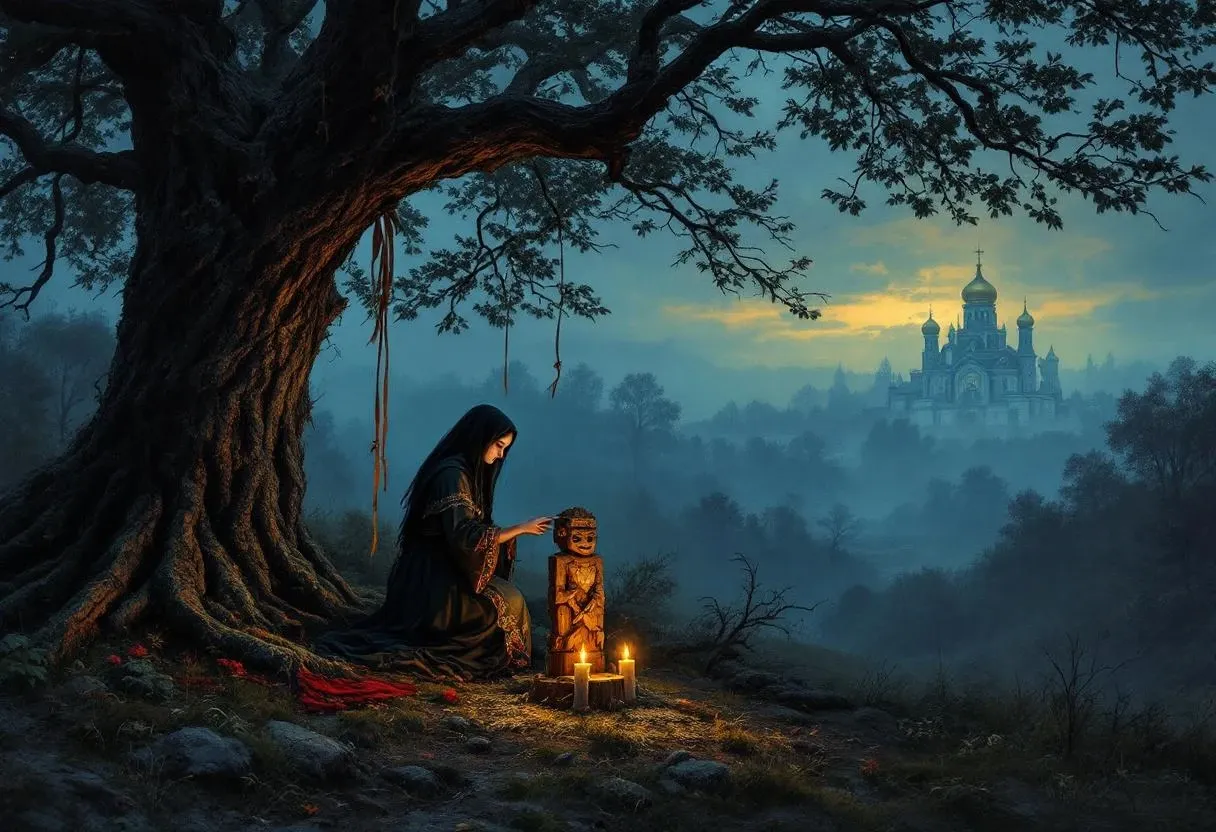
Rodnovery practitioners celebrate the old calendar — Kupala Night, Kolyada, Maslenitsa — and maintain sacred groves where carved idols of Perun, Veles, and Mokosh stand as they did a thousand years ago. The movement’s relationship with scholarship is complex: serious practitioners draw on ethnographic sources and archaeological evidence, but the lack of written Slavic scripture means that reconstruction inevitably involves creative interpretation.
The practice known as dvoeverie — dual faith — that characterized Slavic Christianity for centuries has, in a sense, come full circle. Many modern Slavs maintain a relationship with both the church calendar and the older rhythms beneath it, lighting candles for saints whose feast days fall on dates that once belonged to pagan gods, and observing folk customs whose roots reach back to a time before the baptismal waters of the Dnieper washed over the idols of Kyiv.
The Fire That Would Not Go Out
The most remarkable thing about the Christianization of the Slavs is not that it happened. Every pagan culture in medieval Europe was eventually absorbed by one of the Abrahamic religions — the Slavs were neither the first nor the last. What is remarkable is how incomplete the victory was. A thousand years after Vladimir dragged Perun into the Dnieper, Slavic villagers were still jumping over bonfires on Kupala Night, still burning straw effigies of winter at Maslenitsa, still leaving bread and milk for the domovoy behind the stove, still tying ribbons to the branches of ancient oaks that their ancestors had considered sacred. The forms of worship changed. The calendar shifted. New names were assigned to old powers. But the underlying relationship between the Slavic people and the forces they had always worshipped — the storm, the forest, the river, the turning of the seasons, the dead who never quite leave — proved more durable than any institution that tried to replace it.
Today, across Russia, Ukraine, Poland, the Czech Republic, and the Balkans, the old festivals survive in forms that would be instantly recognizable to a tenth-century pagan. Rodnovery — the modern movement to reconstruct and revive Slavic paganism — has grown steadily since the collapse of the Soviet Union, drawing on folklore, archaeology, and the stubborn fragments that survived a millennium of suppression. Whether this constitutes a genuine religious revival or a cultural reaction to the upheavals of modernity is a question scholars continue to debate. What is beyond debate is that the fire the bishops tried to extinguish at Arkona, at Rethra, at Peryn, on the banks of the Dnieper in 988, never quite went out. It burned low. It burned hidden. But it burned.