Before there was earth, there was water. Before there was a word for the world, there was a stone. It sat in the middle of the primordial ocean on an island that no ship could find on purpose, and it held the weight of everything that would ever exist. The Slavs called it the Alatyr — the white stone, the burning stone, the father of all stones, the navel of the earth. Every healing river flowed from beneath it. Every magic spell invoked it. Every road in creation, if you traced it far enough, led back to it. The Alatyr was not just a rock. It was the first altar, the original fixed point, the place where the gods set down the axis of the universe and said: here. Everything starts here.
The name survives in hundreds of recorded folk charms, in spiritual verses sung by wandering blind beggars across the Russian countryside, in the opening formulae of incantations so old that the people who recited them had long forgotten what the words originally meant. They remembered enough. They remembered that when you needed to reach the deepest source of power in the cosmos — when illness had to be stopped, when blood had to be staunched, when a curse needed lifting — you began your journey at the white stone on the island in the sea. You began at the Alatyr.
The Stone on the Island in the Ocean
The Alatyr sits on the island of Buyan, in the middle of the sea-ocean — the vast primordial waters that existed before the earth took shape. Buyan is the Slavic cosmos in miniature: an island that appears and vanishes with its own logic, invisible to those who seek it deliberately, accessible only to those whose need or magic is strong enough to part the waves. It is the first dry land, the original fragment of solid ground that rose from the waters of creation, and the Alatyr is its centerpiece — the stone upon which the entire cosmological architecture was built.
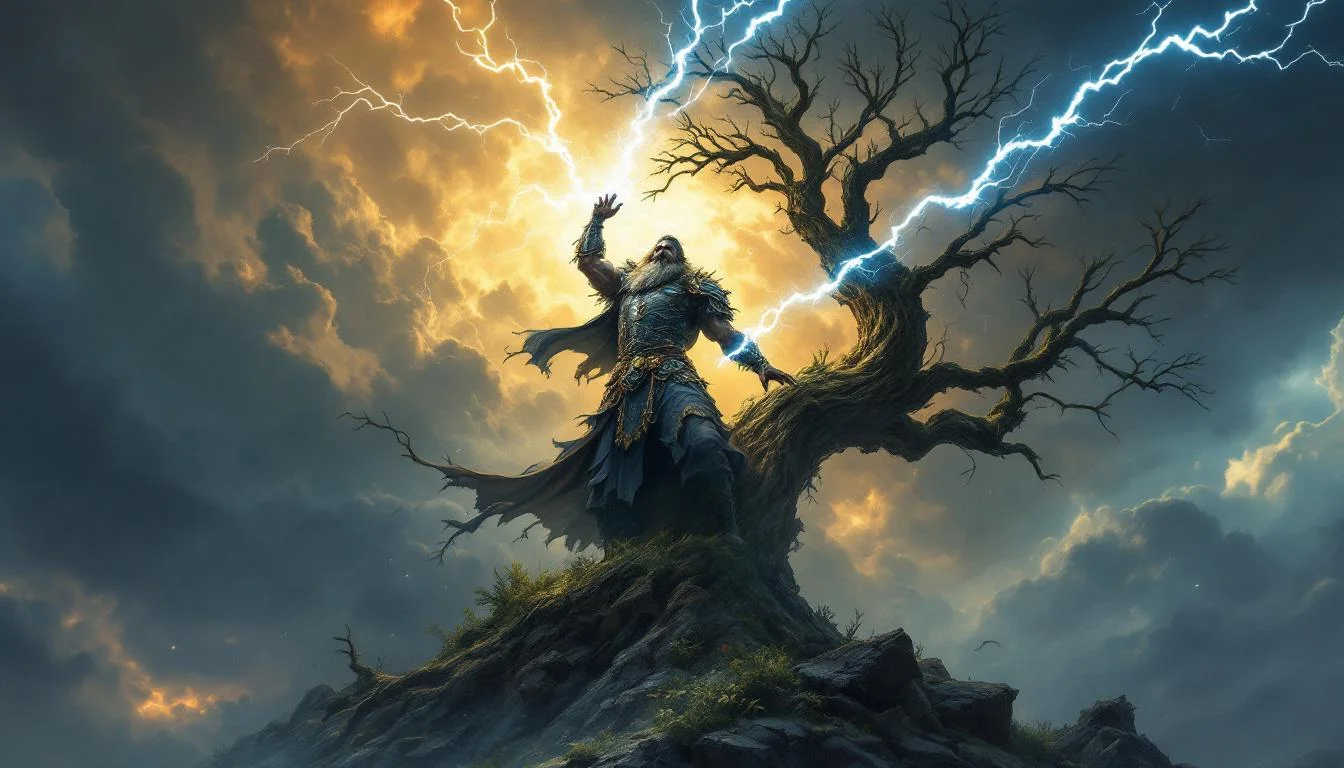
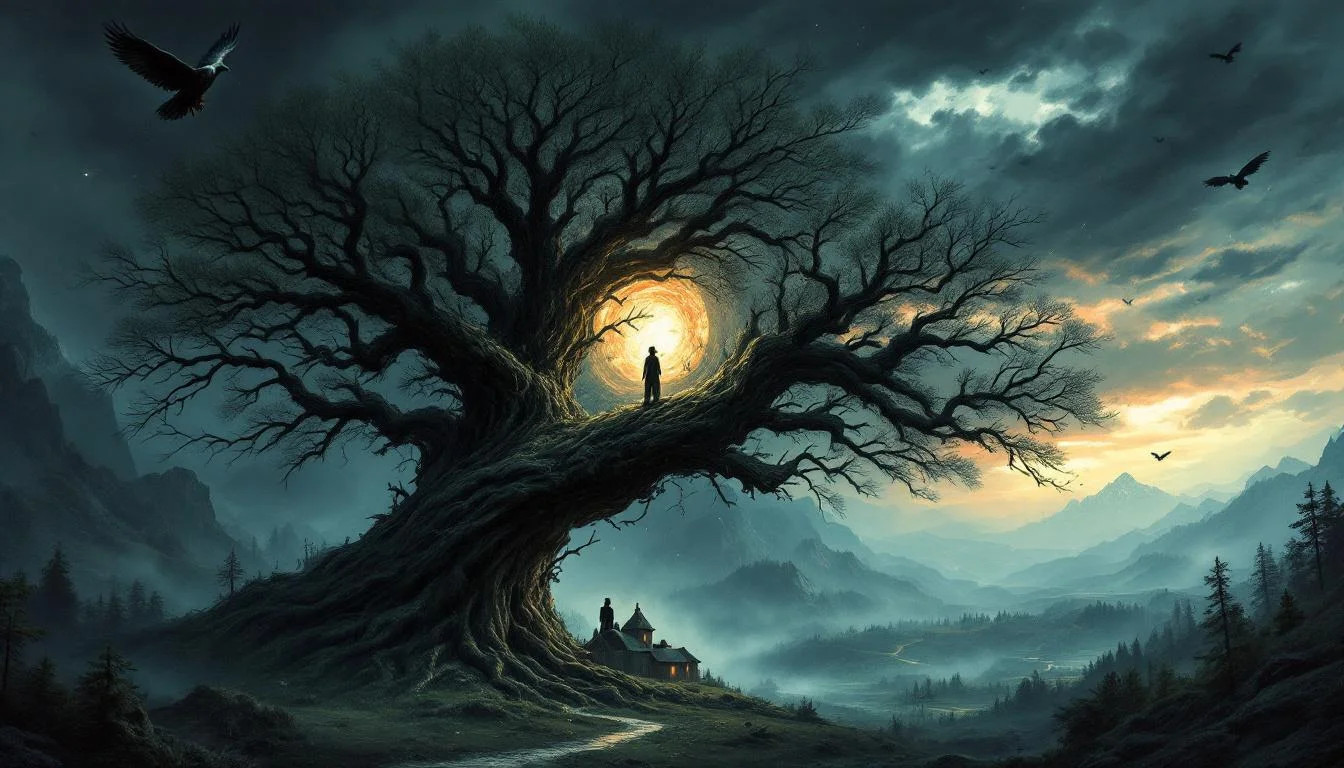
The spiritual text known as the Golubinaya Kniga — the Dove Book, that strange catechism of folk cosmology recited by kaliki perekhozhie, the wandering pilgrims of medieval Russia — places the Alatyr at the navel of the world. It describes the stone as an altar standing in the center of the ocean, a cosmic fulcrum from which all sacred geography radiates outward. "On that ocean, on the blue sea, lies the white Latyr-stone," one version reads, "on that white Latyr-stone stands a holy golden church." The church is a Christian overlay. Peel it back and you find what was there before the missionaries arrived: a stone so sacred that even the gods built upward from it, not downward toward it. The World Tree — that colossal oak whose roots reach into the underworld and whose crown disappears into the heavens — grows from this stone. Its roots grip the Alatyr the way a hand grips the one solid thing in a flood. Without the stone, the tree has no foundation. Without the tree, the three worlds have no axis. Without the axis, the universe collapses into the formless water it came from.
This is not decoration. This is structural. The Alatyr is the bottom of the stack — the load-bearing element beneath every other sacred symbol in Slavic cosmology. It sits beneath the World Tree, which sits beneath the three worlds, which sit beneath the gods. Remove it and everything above it falls.
Names of the Unnameable
The Alatyr has many names because a thing that fundamental resists being pinned to a single word. In recorded folklore it appears as the white stone, the cerulean stone, the grey stone, the golden stone, the sea stone, the heavenly stone, the paradisiac stone. Less often, and more ominously, the black stone. Each name captures a different facet of what it is, the way different peoples looking at the same mountain from different valleys will give it different names and all be correct.
The word "alatyr" itself is a puzzle that etymologists have been turning over for more than a century without reaching consensus. Oleg Trubachyov, one of the most rigorous Slavic linguists of the twentieth century, connected it to the Russian word yantar — amber. This is not as strange as it sounds. Amber was the most sacred organic stone in the Baltic and Slavic world: warm to the touch, golden, translucent, capable of trapping light and ancient insects in its body, washed up on northern shores like a gift from the primordial ocean. A "white burning" stone found at the edge of the sea — the description fits amber as well as it fits myth. Viktor Martynov proposed an Iranian origin, deriving alatyr from al-atar, meaning "white-burning" or "fire-white," which captures the stone's double nature: luminous and hot, sacred and dangerous. Roman Jakobson, the great structural linguist, offered yet another path, linking it to "Latyr" as an alternation of "latygor," from Latgalia — the Latvian lands — suggesting the word originally meant "Latvian stone," a reference to Baltic amber carried south along ancient trade routes.
The variant names found in manuscripts and oral recordings — Alabor, Alabyr, Latyr — suggest the word was already old and fractured by the time anyone started writing it down. It had been worn smooth by centuries of mouths, the way a river stone is worn smooth by water. What remains is not a word with a clear etymology but a sound with a feeling: something hard, something white, something that burns.
The Healing Waters Beneath
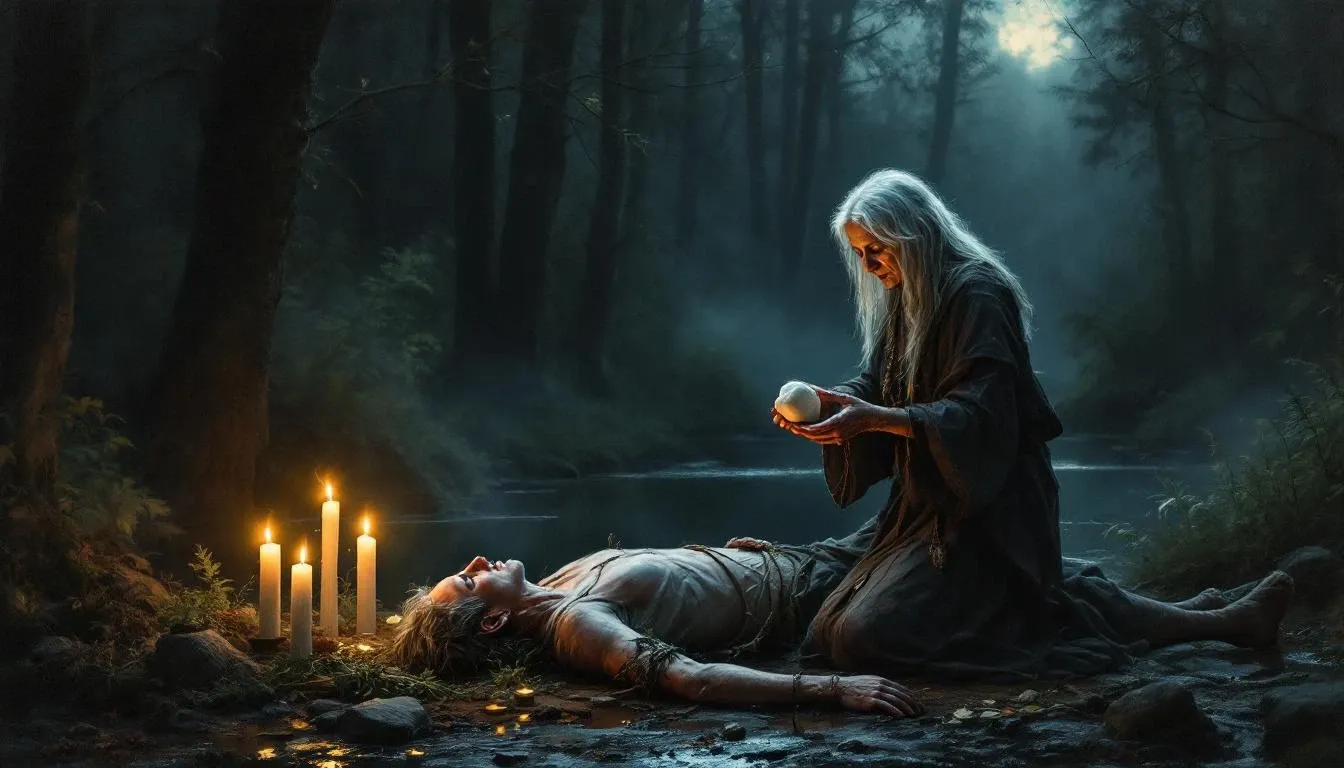
From beneath the Alatyr flows a river. The spiritual verses are specific about this: "from under the white-alatyr-stone" pours a miraculous spring that gives the entire world "food and healing." This is not a creek. This is the source — the original headwater from which all rivers of sustenance and restoration descend. Every stream that ever cured a fever, every sacred spring where pilgrims washed their eyes, every well whose water tasted different from the water in other wells — all of them, in the mythological imagination, trace their origin back to the flow beneath the Alatyr.
The stone's healing power is not passive. It does not simply sit there radiating goodness like a warm hearth. It is a mechanism, a cosmic pump that draws something up from the deepest layers of creation and pushes it outward through the world's waterways. The Dove Book describes the stone as containing sacred letters — inscriptions, laws, or truths written on or within its surface. These are not decorative carvings. They are the operating instructions of the universe, the encoded rules by which reality maintains itself. The healing water that flows from beneath the stone is, in a sense, the physical expression of those laws — truth made liquid, divine order dissolved into something that can be drunk, that can wash a wound, that can carry life into places where death has settled.
This concept has parallels far beyond the Slavic world. The Omphalos at Delphi marked the navel of the Greek world. The Foundation Stone in Jewish tradition — the Even ha-Shetiyah beneath the Temple Mount — was the first solid object created, the point from which the world expanded outward. The Black Stone of the Kaaba, the sacred mountain of Meru in Vedic and Buddhist cosmology, Te-Pito-te-Henua on Easter Island — all of these are axis mundi markers, stones or places that anchor the universe to a single central point. The Alatyr belongs to this ancient and global family of navel-stones, and it carries its own particular Slavic weight: the emphasis on water, on healing, on the idea that the center of the world is not a place of power in the political sense but a place of restoration. You do not go to the Alatyr to conquer. You go to be made whole.
The Guardians: Garafena and Gagana
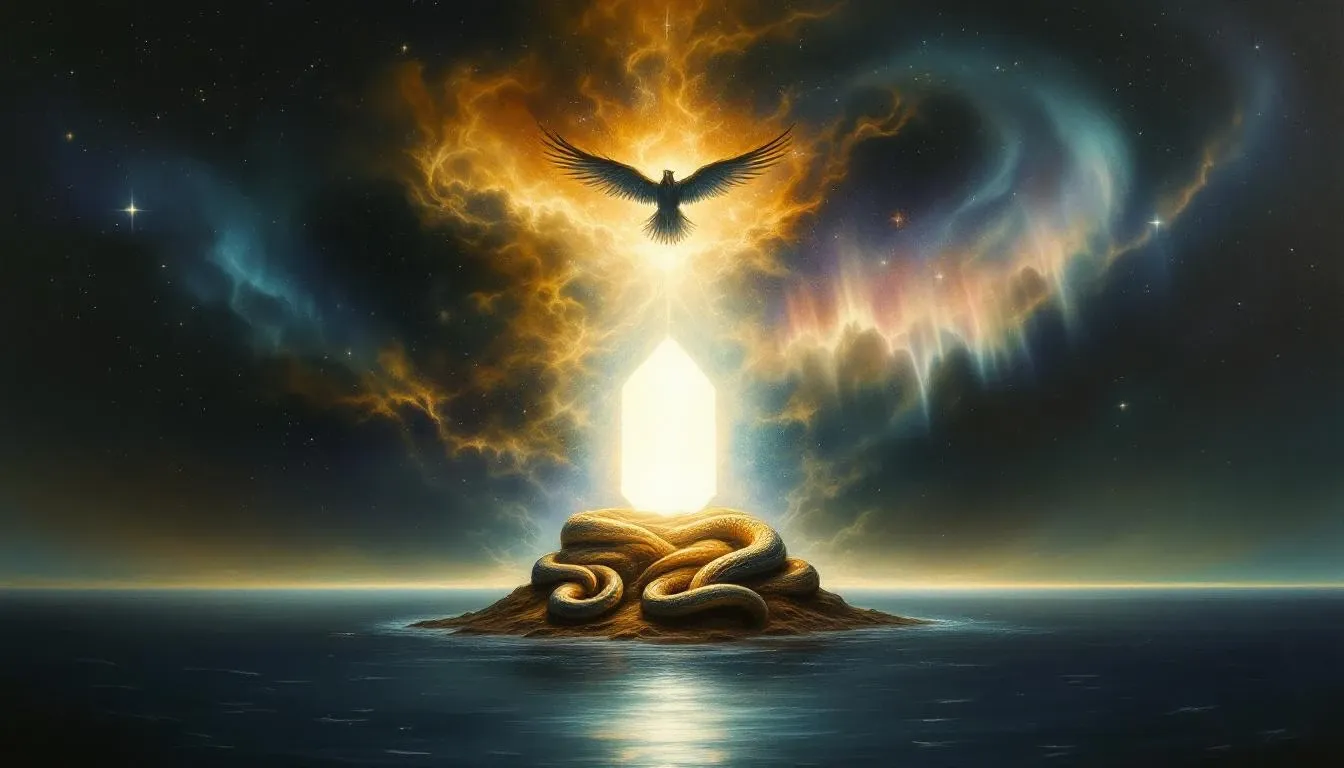
The Alatyr does not stand unprotected. Two beings guard it — the serpent Garafena and the bird Gagana — and their presence at the stone tells you everything you need to know about its position in the cosmic order.
Garafena is a wise serpent, sometimes described as the queen of all serpents. She coils around or beneath the stone, her body wrapped among the roots that reach down into the dark water. She is not the enemy. She is the keeper. In Russian folk incantations against snakebite, Garafena's name is invoked not as a threat but as an authority — the one serpent whose word commands all other serpents, the one who can call poison back into the earth because she dwells at the place where all venom originates. Her presence at the Alatyr mirrors Veles coiled among the roots of the World Tree: chthonic, ancient, connected to the underworld, but not evil. Necessary. The guardian from below.
Gagana is a bird — miraculous, with an iron beak and copper claws, dwelling in the branches above the stone the way Perun's eagle perches in the crown of the World Tree. She is the guardian from above, the watcher, the one who sees everything from her height and whose metallic body suggests something forged rather than born — something made to last, something that cannot be broken by ordinary means. Together, Garafena and Gagana reproduce in miniature the same vertical structure that defines the entire Slavic cosmos: serpent below, bird above, sacred center between them. The Alatyr stone sits precisely at the point where the two forces meet, where the upward pull of heaven and the downward pull of the underworld achieve a momentary, perfect balance. It is the still point. The guardians ensure it stays still.
Blessed I rise, setting forth through doors and gates opening to the East, to the Eastern side, to the pristine field, to the sea-ocean, onward to the holy island of God... where lies the stone Alatyr, the father of all stones. Just as the stone Alatyr yields no water, may I yield no blood; just as a hen yields no milk, may this wound yield no pain.
The Alatyr in Zagovory: The Lock on Every Spell
If you want to understand how deeply the Alatyr penetrated Slavic consciousness, do not look at myths. Look at magic. The zagovory — the oral incantations that formed the backbone of East Slavic folk medicine and protective sorcery for centuries — invoke the Alatyr more consistently and more reverently than any other sacred object. The stone appears in healing charms, love spells, protection formulae, livestock blessings, and haemostatic incantations designed to stop bleeding. It is the opening address of the magical journey, the first landmark the healer's words must pass through before they reach the source of power.
The typical structure of a zagovor follows a geographic path: the speaker rises, blesses themselves, walks east through doors and gates, crosses the pristine field, reaches the sea-ocean, arrives at the island of Buyan, and finds the stone Alatyr. Only then — only after the verbal journey has reached the cosmic center — does the actual work of the spell begin. The opening is not filler. It is the power cable. The healer is routing their words through the deepest channel available, connecting their small human voice to the stone that sits at the foundation of everything. Without the Alatyr as an anchor point, the spell has no ground. With it, the spell draws on the same force that holds the World Tree upright and keeps the three worlds from collapsing into each other.
The haemostatic charm is the clearest example of the stone's sympathetic function. "Just as the stone Alatyr yields no water, may I yield no blood." The logic is not metaphorical — it is operational. The stone is impermeable, absolute, unyielding. By invoking its nature, the healer transfers that quality to the patient's body. The wound becomes, for the duration of the spell, as closed and sealed as the surface of the white stone. This is not poetry. This is technology — the most ancient technology available, the technology of words spoken in the right order at the right place in the cosmos, aimed at the right object.
The fact that the zagovor tradition survived well into the twentieth century — that village healers in remote areas of northern Russia were still reciting these formulae from memory, still beginning their charms with the journey to the island of Buyan and the stone Alatyr — tells you something about the depth of the stone's hold on the East Slavic imagination. Christianity arrived a thousand years ago. The missionaries forbade the old rituals, burned the groves, broke the idols, replaced Perun with the Prophet Elijah and Veles with Saint Nicholas and Baba Yaga with the devil. But the Alatyr endured beneath the new names. It was too deep in the language of healing, too embedded in the opening lines of every charm, too necessary as a cosmological anchor. You could change the gods. You could not change the stone.
Why the Alatyr Stone Matters
The Alatyr is not a myth about a stone. It is a myth about the need for a center — the human insistence that somewhere, beneath the chaos and confusion of ordinary life, there is a fixed point that does not move. A place where the rivers of healing begin. A place where the laws of the universe are written down. A place you can reach, if your words are right and your need is real, by walking east through the doors and gates, across the pristine field, over the sea-ocean, to the island that no one can find on purpose.
Every civilization builds this myth in its own materials. The Greeks used a carved stone at Delphi. The Jews used the Foundation Stone beneath the Holy of Holies. The Norse used a well beneath the roots of Yggdrasil. The Slavs used a white stone on a vanishing island in the middle of an ocean that existed before the world. The specifics differ. The need does not. Humans require a navel — a point from which everything radiates and to which everything returns. Without it, the map has no center and every direction is equally meaningless.
The Alatyr gave the Slavic universe its center. The World Tree grew from it. The healing waters flowed from beneath it. The guardians watched over it. The spells began at it. And when a healer in a wooden village in the Arkhangelsk region pressed her hand against a wound and whispered the old words — the journey east, the sea-ocean, the island, the white stone that yields no water — she was not performing a quaint rural superstition. She was doing what humans have always done when they face suffering: reaching for the center, the still point, the stone that holds. The Alatyr was always there. It was there before the oak tree grew from it. It was there before the gods sat upon it. It will be there after the last person who remembers its name has crossed the Kalinov Bridge and vanished into Nav. Because the center does not depend on being remembered. It simply is.