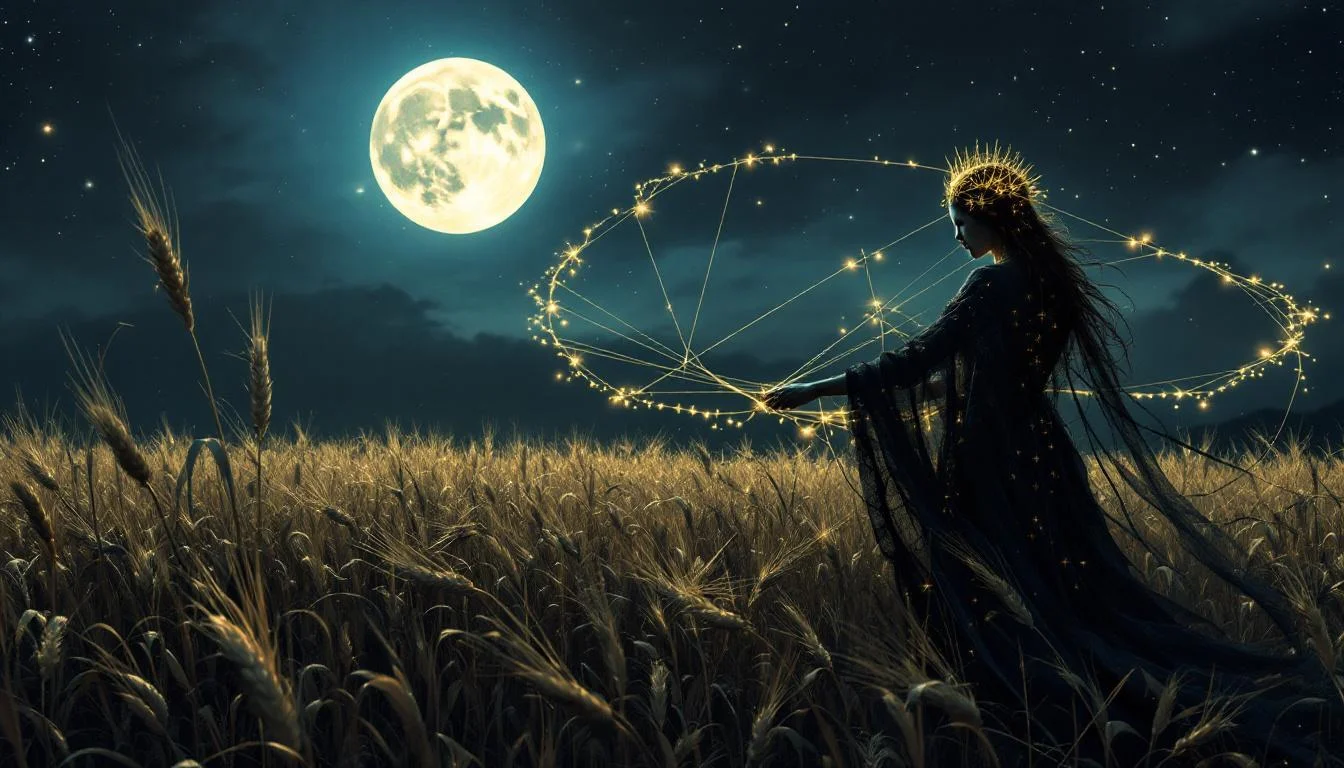
There is a moment in a Balkan summer when the sky turns white and the earth cracks. The sun hangs in place for weeks without interruption. Wells drop. Rivers shrink to ankle-deep trickles. The wheat in the fields stops growing and begins to die standing up — still green on the outside, already dead at the root. The village watches the sky every morning and sees nothing. No cloud. No promise. Just heat.
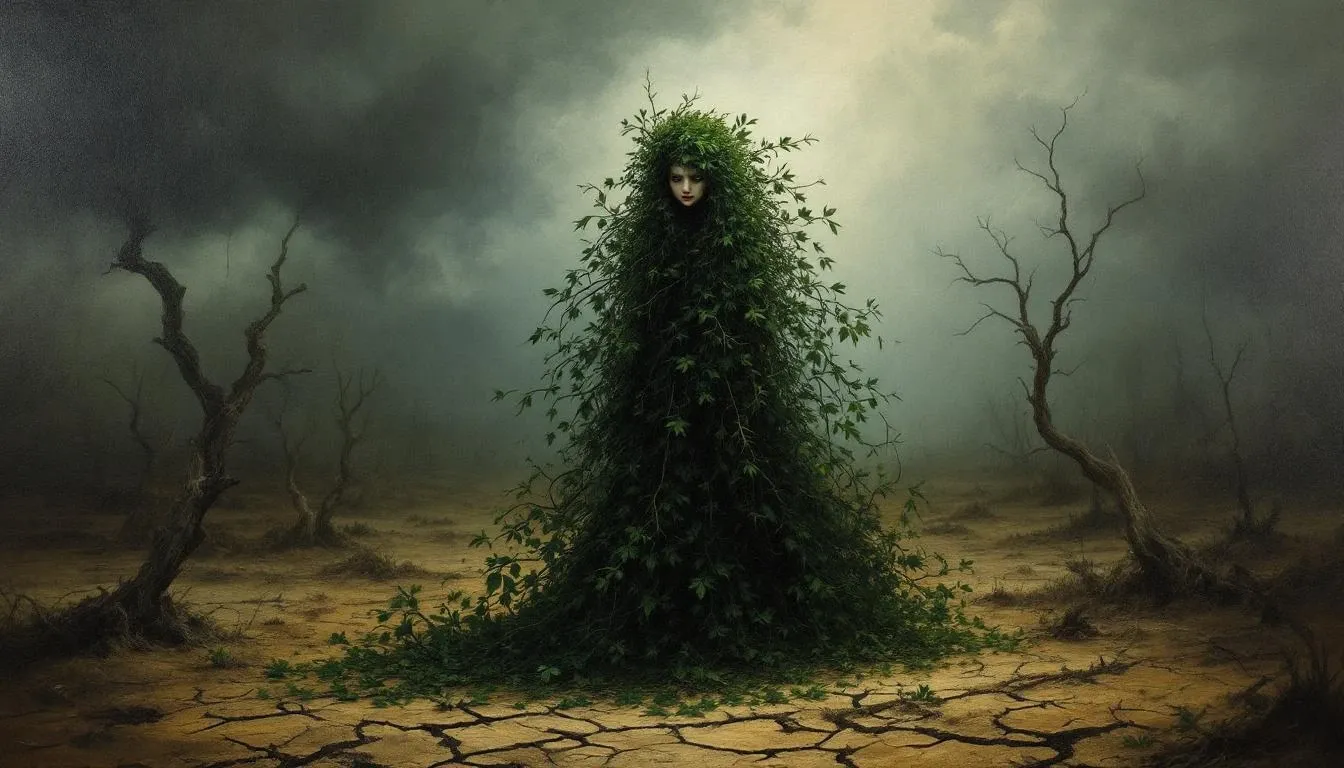
And then, one morning, a group of girls walks out of a house. They are young — twelve, thirteen, fourteen — dressed in nothing but thin white shirts, barefoot, their hair loose and unbound. One of them is covered head to foot in fresh green leaves and flowers, so thick that her face is barely visible. They walk to the first house in the village, and they begin to sing.
The homeowner comes out. She listens. And then she pours a bucket of water over the leaf-covered girl.
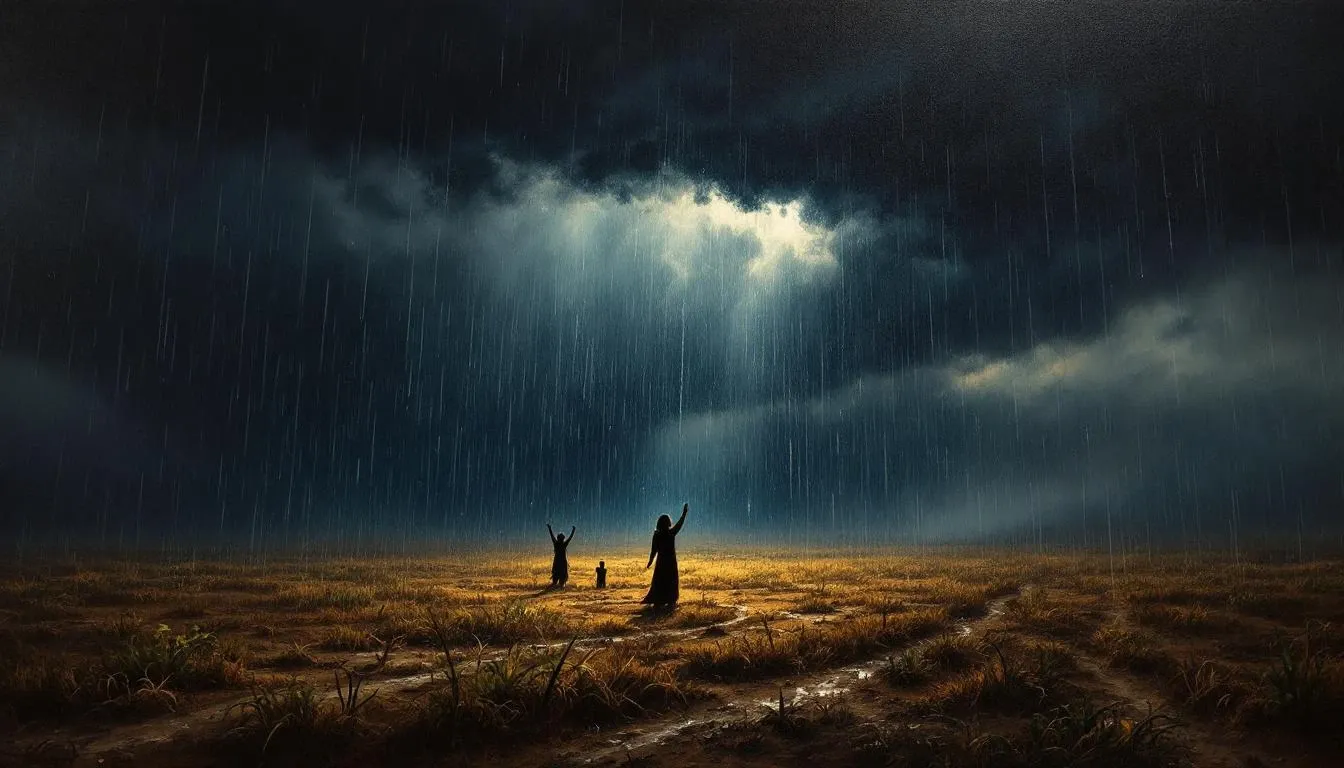
The girls sing louder. They move to the next house. Another bucket. And the next. And the next. By the time they reach the end of the village, the lead girl is soaked through, water streaming off the leaves and flowers, her white shirt transparent and clinging, the water pooling in her footprints in the dust.
This is the Dodola ritual. It has been performed in Serbia, Bulgaria, North Macedonia, Croatia, Bosnia, Romania, and Greece in recognizably similar forms for as long as anyone can remember. It survived the Ottoman Empire, two world wars, Communist atheism, and the general advance of modernity. In some villages in southern Serbia and northern Macedonia, it was still being performed in living memory.
The name of the goddess it invokes — or the spirit, or the force, or the concept, depending on how much theology you want to read into a bucket of water and a song — is Dodola. Or Perperuna. Or Preporusha. Or Dodo. The name changes with the language and the village. The water does not change. The water is always the point.
The Ritual in Detail
The Dodola ceremony follows a consistent pattern across the South Slavic world, with regional variations in song lyrics, the number of participants, and specific customs, but with a core structure that remains remarkably stable across centuries and borders.
The ritual is performed during drought — specifically during the dry summer months when rainfall has failed and the agricultural community faces potential crop loss. It is not a seasonal festival performed on a fixed calendar date (unlike Kupala Night or Kolyada, which occur at set times regardless of weather). Dodola is reactive. It happens when the rain does not come.
A group of girls — typically unmarried, typically adolescent — is assembled. One girl is chosen as the dodola (in Serbia) or perperuna (in Bulgaria and Macedonia). This girl is the embodiment of the ritual: she becomes the rain-bringer, the living petition. Her companions serve as chorus, attendants, and witnesses.
The chosen girl is adorned with fresh vegetation. In Serbian accounts, she is wrapped in leaves, grass, flowers, and green branches until she resembles a walking bush more than a person. In some Bulgarian variants, the girl wears a skirt made entirely of fresh greenery. The vegetation is the key visual element — the girl becomes a figure of living growth, a walking representation of the green world that needs water to survive.
The group processes through the village, stopping at each house. At every stop, they sing the Dodola song — a chant whose lyrics vary by region but consistently invoke rain, water, and the renewal of the fields. The homeowner (typically the woman of the house) then pours water over the dodola girl. In some traditions, the water is poured from a bucket or pitcher. In others, it is thrown from a basin. The result is the same: the vegetation-clad girl is drenched, and the water runs off her body and her greenery into the dust of the courtyard.
After the dousing, the homeowner gives the girls gifts — food, eggs, grain, sometimes small amounts of money. The girls move on to the next house and repeat the performance. By the time they have processed through the entire village, the dodola is soaked to the bone, the streets are wet, and the community has collectively enacted a drama of rainfall.
When there is drought in summer, the village girls assemble and dress one of their number in grass and flowers from head to foot. They call her the dodola. They lead her from house to house and sing, and the housewife of each home pours a full pail of water over her. The song goes: 'Dodola walked through the village, O dodo, O dodole! She prayed God to send the rain, O dodo, O dodole! That the gentle rain might fall, O dodo, O dodole! That the crops might grow and thrive, O dodo, O dodole!'
Sympathetic Magic and the Logic of Water
The ritual operates on the principle of sympathetic magic — the idea that performing an action symbolically causes that action to happen in reality. Pour water on a girl covered in vegetation, and rain will pour from the sky onto the vegetation in the fields. The small act compels the large one. The village courtyard becomes a model of the landscape, and what happens in the model happens in the world.
This is not unique to Slavic practice. Rain-making rituals based on sympathetic water-magic appear across cultures worldwide — from the rain dances of the Pueblo peoples to the water-pouring ceremonies of Southeast Asia. The logic is universal because the need is universal: when the rain does not come, you make it come by showing the sky what you want it to do.
But the Dodola ritual adds layers that move it beyond simple sympathetic magic. The girl is not merely doused. She is transformed — covered in living vegetation, made into a green spirit, turned into a figure that is neither fully human nor fully natural. She is the fields personified, the crops made ambulatory, the earth walking through the village asking each household for the one thing it cannot provide for itself.
The gifts the householders give are not payment for a performance. They are reciprocity — the human side of a bargain in which the divine side is rain. The dodola brings the promise of fertility (represented by her greenery) to each house. The householder gives back sustenance (food, grain, eggs) and water. The exchange mimics the cycle of agriculture itself: the earth gives growth, humans give labor and water, and the system sustains itself.
Perun's Wife?
The mythology behind the ritual is less clear than the ritual itself. Some scholars — following the comparative work of Vyacheslav Ivanov and Vladimir Toporov on Proto-Slavic religion — have identified Dodola as the wife of Perun, the thunder god.
The argument runs as follows. In the reconstructed Slavic myth, Perun is a sky god whose primary antagonist is Veles, the chthonic serpent-god of the underworld. Veles steals Perun's wife (or cattle, or children) and drags them beneath the earth. Perun pursues Veles, strikes him with lightning, and the stolen waters — held captive in the underworld — are released as rain. The storm is the battle. The rain is the liberation.
In this framework, Dodola is the stolen wife — the female principle abducted into the dry underworld and released through the storm god's violence. Her dousing with water is not merely sympathetic magic but a re-enactment of the cosmic myth: the water poured on the dodola girl represents the rain that Perun forces from the sky when he defeats Veles and frees his wife.
The name "Perperuna" — the Bulgarian and Macedonian variant — supports this connection. Perperuna can be parsed as a derivative of Perun: the feminine form of the thunder god's name, the "Perun-ess," the woman who belongs to thunder. If Dodola is Perperuna is Perun's wife, then the rain-making ritual is a theological drama, not merely a magical procedure.
But this reconstruction depends heavily on comparative analysis and hypothesis. No Slavic text names Dodola as Perun's wife. No medieval source connects the two. The link is inferred from the structural logic of the myth and the linguistic echo of Perperuna-Perun. It is a compelling inference. It is not a documented fact.
The Greek Connection: Dione and the Rain
The Dodola ritual has parallels outside the Slavic world that suggest either cultural borrowing or a shared origin of striking antiquity. The most significant parallel is Greek.
In ancient Greek religion, Dione was a goddess associated with Zeus — in some traditions his consort, in others his feminine counterpart (the name Dione is the feminine form of Dios, the genitive of Zeus, just as Perperuna may be the feminine of Perun). Dione was worshipped at Dodona — the oldest Greek oracle, located in Epirus, in what is today northwestern Greece, directly adjacent to the Slavic-settled Balkans.
The coincidences accumulate. Dodona. Dodola. Dione. Zeus/Perun. A rain-associated goddess who is the feminine form of the thunder god's name, worshipped at a site whose name echoes the Slavic ritual. These parallels have led some scholars — notably the Serbian ethnographer Veselin Cajkanovic — to argue that Dodola and Dione descend from a common Proto-Indo-European rain goddess, the consort of the storm god, preserved independently in Greek and Slavic traditions for thousands of years.
The alternative explanation is simpler: the Slavs who settled the Balkans in the sixth and seventh centuries absorbed Greek folk practices from the populations they lived among. The Dodola ritual, in this reading, is not a Proto-Indo-European inheritance but a medieval borrowing — Slavic peasants adopting a Greek rain-making custom and giving it a Slavic name.
Both explanations are plausible. Both are unproven. The truth may involve elements of each — an ancient rain-goddess concept, inherited from the Indo-European past, reinforced and elaborated through contact with Greek folk religion in the Balkans.
Surviving Into the Modern World
The Dodola ritual demonstrated a remarkable resilience. It survived the Christianization of the Balkans — partly because the Church found it difficult to suppress a practice that was not obviously "pagan" in the way that idol-worship or animal sacrifice were obviously pagan. The girls did not invoke named gods. They sang to "God" for rain. They poured water, which was a recognizable Christian act (baptism, holy water). The ritual slipped through the theological net because it looked, on the surface, more like a folk custom than a religious ceremony.
The Ottoman period (fourteenth to nineteenth centuries) did not suppress it either. The ritual was rural, female, and seasonal — it happened in villages, was performed by women and girls, and occurred only during drought. It was invisible to imperial authorities who concerned themselves with urban centers, male political structures, and calendar-based religious observances.
Ethnographers documented the Dodola ritual in active practice across the Balkans throughout the nineteenth and early twentieth centuries. Vuk Karadzic recorded it in Serbia in the 1810s. Bulgarian folklorists documented it in Thrace and Macedonia in the 1880s and 1890s. Romanian versions — called paparuda or papaluga — were recorded in Wallachia and Moldova. Even Greek versions — perperuna or pirpiruna — were documented in northern Greece and the Peloponnese, confirming the cross-cultural spread of the practice.
The ritual declined in the twentieth century as rural populations urbanized and traditional agricultural practices gave way to modern farming. Communist regimes in Yugoslavia and Bulgaria did not actively suppress it but created social conditions — collective farming, urban migration, secularization of education — that made traditional village customs harder to sustain.
Yet it did not entirely disappear. Ethnographic expeditions in the 1960s and 1970s still found living practitioners in remote Serbian and Macedonian villages. As late as the 1990s, accounts surfaced of the ritual being performed during severe droughts in parts of southern Serbia. Whether it continues today — genuinely, as a living practice, not as a tourist performance or folklore revival — is difficult to confirm. But the duration is remarkable: a pre-Christian rain ritual surviving in recognizable form for over a thousand years after Christianization, through two empires, two world wars, and the industrial revolution.
The Wet Shirt and What It Means
Western accounts of the Dodola ritual sometimes fixate on the image of the soaked girl in the transparent white shirt — reading it through a lens of sexuality or fertility symbolism. This reading is not entirely wrong, but it is incomplete.
The wet white shirt is significant. But its significance is agricultural before it is sexual. Water on a body covered in green vegetation is a representation of rain on crops. The transparency of the wet cloth is a secondary effect, not the primary purpose. The girl is not being displayed. She is being irrigated.
That said, fertility — in its broadest sense — is obviously present. The unmarried girls, the loose hair (a sign of unmarried status in Slavic tradition), the greenery that covers the body like new growth, the water that makes everything cling and shine — these are images of fecundity. The earth is fertile. The rain makes it more so. The girls embody this principle not through sexuality but through vitality: they are young, unbound, covered in living things, and drenched with the one substance the world needs most.
The connection to Mokosh — the Slavic earth-goddess, spinner of fate, patron of women and wet things — is suggestive but undocumented. If Dodola is the rain and Mokosh is the moist earth, they are two halves of one process: the water that falls and the ground that receives it. The Dodola ritual enacts the falling. The earth does the receiving on its own.
What Dodola Tells Us
Strip away the scholarly debate — the Perun connection, the Dione hypothesis, the Proto-Indo-European comparisons. What remains is a village in the Balkans in the middle of a drought. The wells are low. The wheat is dying. There is no weather forecast, no irrigation system, no government relief program. There is only the sky, which has been empty for weeks, and the earth, which is cracking.
And so the village does the one thing it can do. It takes its youngest, most vital members — girls on the threshold of adulthood, full of the energy that the fields have lost — and it dresses them in the green life that the drought is killing. It sends them through the village as living prayers, and at each house the community performs the only act of generosity available: pouring its precious water onto a symbol of the growth it needs.
The rain may come. The rain may not come. But the ritual has done something real regardless: it has turned private suffering into collective action. Every household that pours water on the dodola has made a sacrifice — water is scarce, and they are giving it away. The act of giving binds the village together in shared purpose. The drought is no longer each family's private disaster. It is a communal problem addressed by a communal ritual, and the act of addressing it together is itself a form of survival.
This is what Dodola tells us about the people who performed her rites. They understood that the world is not always kind. They understood that sometimes the rain simply does not come. And they understood that when it does not come, the worst thing you can do is nothing. So they dressed a girl in leaves, they sang a song, and they poured water on the dry earth.
It was never guaranteed to work. But it was always better than standing still.