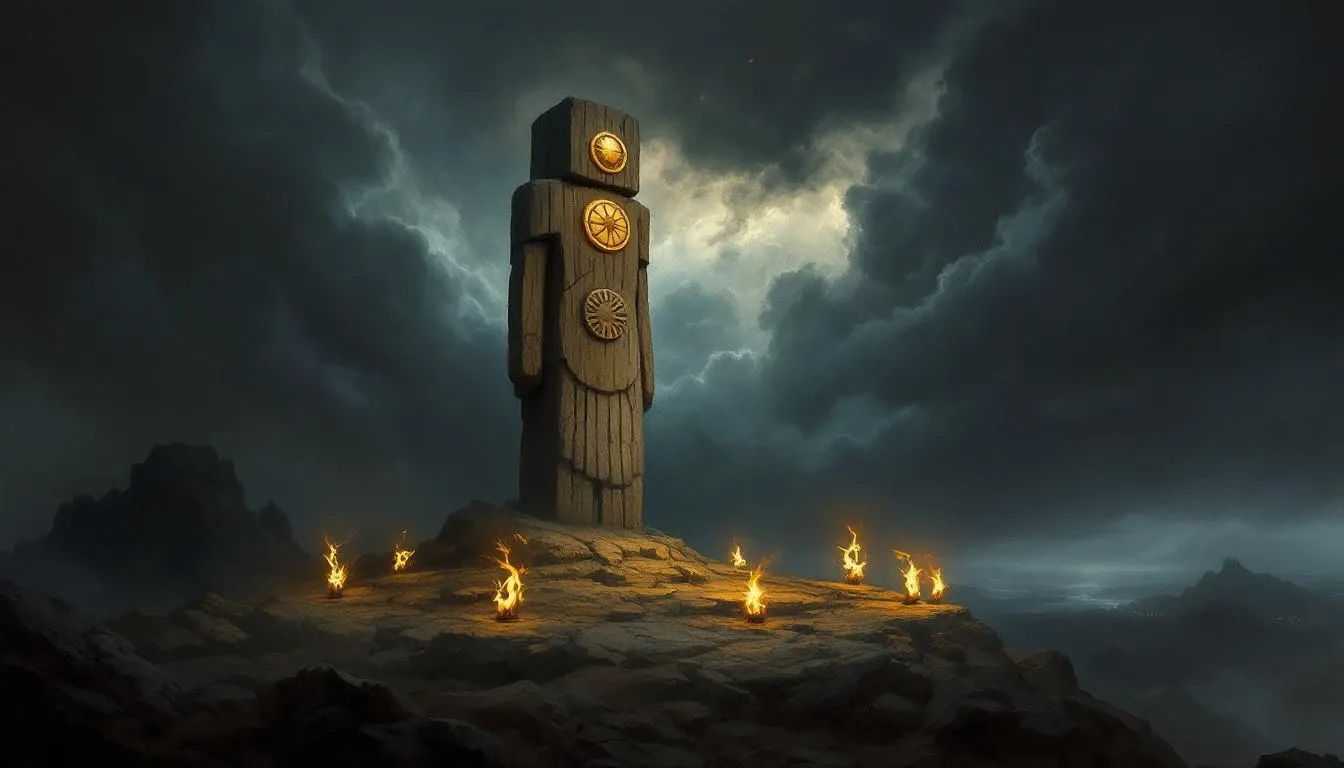
In 980 AD, Prince Vladimir of Kiev did something unprecedented. He gathered the gods of the Slavs and erected them on a hill above his city — wooden idols with silver heads and gold mustaches, arranged in a deliberate order that reflected a deliberate theology. The Primary Chronicle names them: Perun first, with his silver head and gold mustache. Then Khors. Then Dazhbog. Then Stribog. Then Simargl. Then Mokosh.
Khors was second. Khors was placed immediately after the thunder god, the supreme deity of the Slavic pantheon. This positioning was not accidental. Vladimir's pantheon was a political statement — a hierarchy made visible, a ranking of divine powers. Perun stood at the top because Perun was the god of warriors and princes. Khors stood next because Khors was... what?
This is the question that has consumed scholars of Slavic mythology for over two centuries. Who was Khors? What did he govern? Why was he important enough for second position but obscure enough to leave almost no other trace in the textual record? The answer — pieced together from etymology, comparative mythology, and the ghost-traces of forgotten worship — centers on a distinction so subtle that most modern readers miss it entirely: the difference between the sun's light and the sun's body.
The Name and Its Origins
The word Khors is not Slavic.
This is the first and most striking fact about the deity. In a pantheon of gods whose names are transparently Slavic — Perun from per- (to strike), Dazhbog from dazh- (to give) + bog (god), Stribog from stri- (to spread) + bog — Khors stands linguistically apart. His name has no obvious Slavic root. It does not parse in Proto-Slavic phonology the way the other theonyms do.
The scholarly consensus, established by the linguist Max Vasmer and refined by subsequent researchers, connects Khors to Iranian — specifically, to the Avestan word hvarə xšaēta ("radiant sun") and the Middle Persian xvaršēd / xoršid, meaning "sun" or "shining sun." The Ossetian (descendant of the Scythian-Alanic languages) word xur meaning "sun" provides an even more direct cognate.
This Iranian etymology is not surprising in context. The East Slavic tribes had centuries of contact with Iranian-speaking peoples — the Scythians, Sarmatians, and Alans who inhabited the Pontic steppe from antiquity through the early medieval period. Cultural and religious borrowing between Slavic and Iranian populations is well-documented. The god Simargl, also present in Vladimir's pantheon, is almost certainly derived from the Iranian Simurgh. Khors and Simargl together represent an Iranian stratum in the East Slavic divine hierarchy — gods borrowed from steppe neighbors and absorbed into the native theological framework.
The Iranian origin tells us something crucial: Khors was brought into the Slavic system from outside. He was adopted. This means he filled a need — a theological gap in the native Slavic framework that required a foreign concept to complete. What was that gap?
The Disc and the Light: A Critical Distinction
Here is the key to understanding Khors, and the key to understanding why Vladimir's pantheon included two apparently redundant "sun gods."
Dazhbog — whose name means "the giving god" — was the deity of solar bounty: the warmth that made crops grow, the light that sustained life, the generative force of the sun understood as a provider and father-figure. Dazhbog was what the sun does. He was function. He was effect. He was the sun as experienced by humans who needed its gifts.
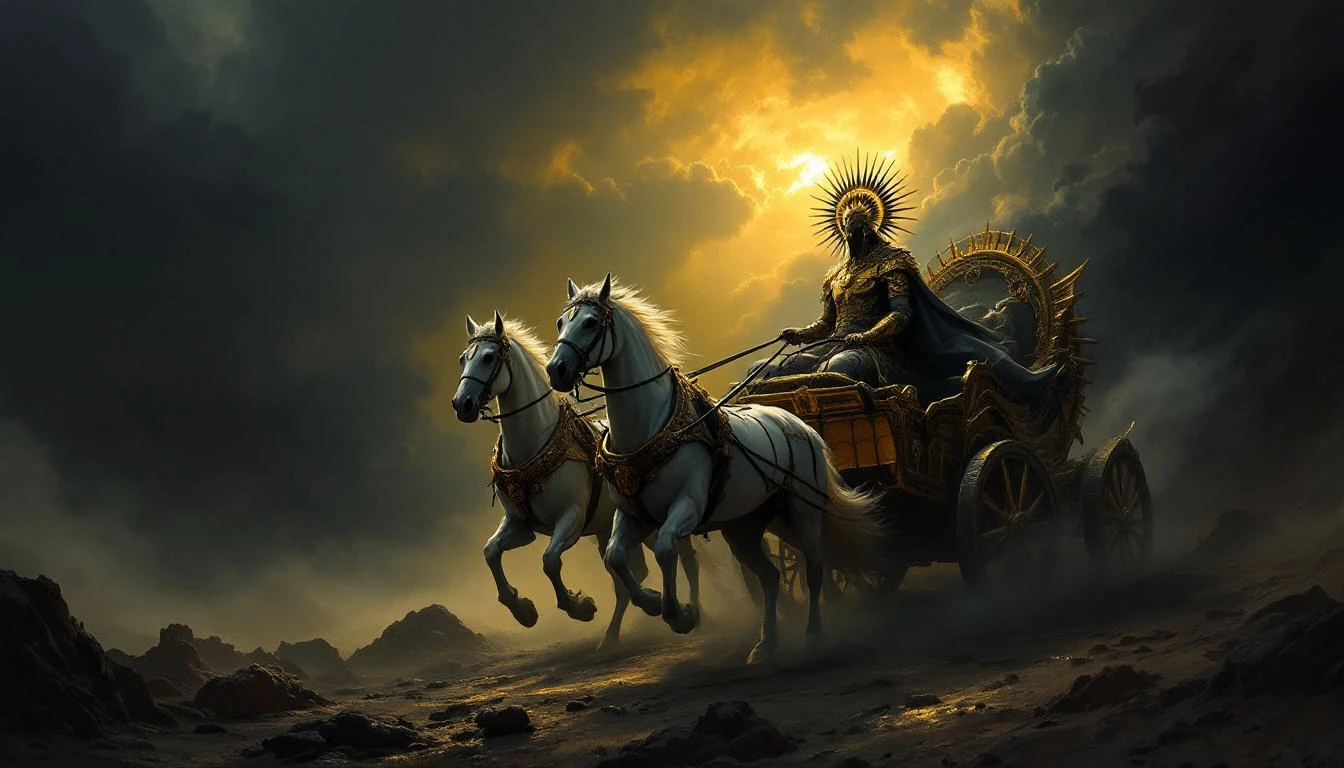
Khors was what the sun is. He was the physical object — the disc, the circle, the burning body that moves across the sky from dawn to dusk. He was the sun as astronomical entity: a thing with a shape, a path, a measurable presence independent of its effects on the world below.
This distinction — between the sun as giver and the sun as object — appears across multiple Indo-European mythologies. Greek religion distinguished between Helios (the physical sun, the chariot-driver crossing the sky) and Apollo (the god of light, music, prophecy — solar qualities without being the sun itself). Vedic Hinduism distinguished between Surya (the sun disc) and Savitar (the sun's vivifying force). The Iranian tradition that gave Khors his name distinguished between Hvare-khshaeta (the physical radiant sun) and Mithra (the deity of light and cosmic order associated with but not identical to the solar body).
Vladimir's pantheon preserved this distinction. Khors was the East Slavic Helios — the disc itself, the round burning thing in the sky, the object that rose and set and traced its path across the heavens. Dazhbog was the East Slavic counterpart to the sun's generative function — what the disc gave to the world below. Two gods because two concepts. Not redundancy but precision.
The Slovo o polku Igoreve
The most famous literary reference to Khors appears in the Slovo o polku Igoreve — the epic poem commemorating Prince Igor's failed campaign against the Cumans in 1185. The poem, composed by an anonymous author of extraordinary talent, is dense with mythological references that reveal the persistence of pre-Christian concepts in elite Kievan Rus' culture two centuries after Vladimir's forced Christianization.
The relevant passage describes Vseslav of Polotsk — a semi-legendary prince renowned for his sorcery and shapeshifting abilities:
"Vseslav the prince judged men; as prince, he ruled towns; but at night he prowled in the guise of a wolf. From Kiev, prowling, he reached, before the cocks crew, Tmutarakan. The path of great Khors he crossed, prowling, as a wolf."
The implications are precise. Vseslav, traveling as a wolf-spirit through the night, reaches his distant destination before dawn — before the sun rises. He "crosses the path of Great Khors," meaning he traverses the route that the sun disc will travel when it rises. The phrasing treats Khors explicitly as a moving body with a fixed trajectory — not as abstract light or warmth but as an object on a path that can be physically crossed.
The epithet "great" (velikiy) is significant. It indicates continued reverence — or at least the memory of reverence — for Khors in the literary culture of twelfth-century Kievan Rus'. The poet expected his audience to understand the reference, to know who Khors was, and to appreciate the significance of crossing his path. Two hundred years after Christianization, the sun disc god had not been forgotten.
Khorovod: The Circle Dance
Among the most compelling pieces of evidence for Khors's significance in Slavic culture is an etymological argument that, if accepted, embeds his name in one of the most widespread and enduring Slavic cultural practices.
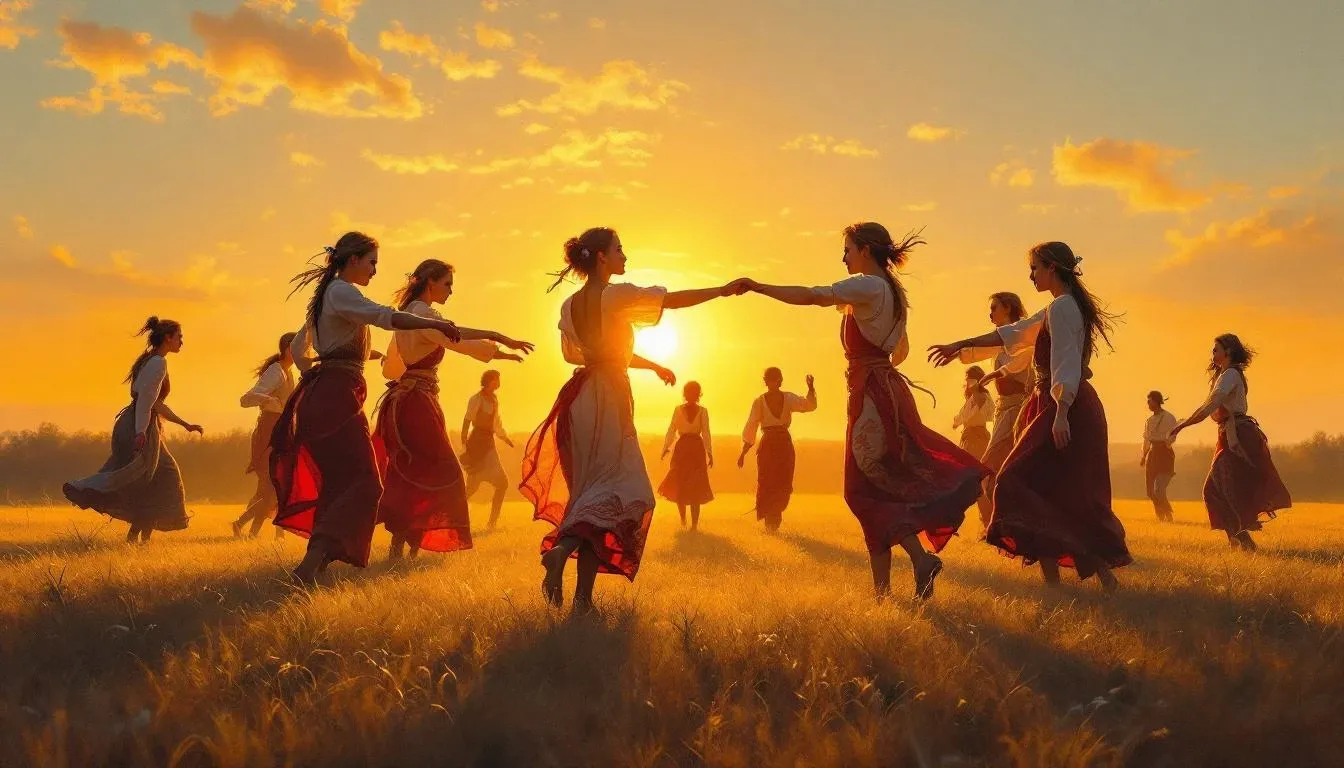
The khorovod — the round dance, performed at festivals and seasonal celebrations across the entire Slavic world — may derive its name from Khors. The word breaks down as khor- (from Khors, the sun disc) + vod- (from vodit', to lead). The khorovod is literally "Khors's leading" — the circular movement that mimics the sun's path, the human body tracing the shape of the solar disc in collective ritual.
This etymology is disputed. Alternative derivations have been proposed — from the Greek choros (dance, chorus), from a generic Slavic root meaning "circle." The Greek hypothesis has particular scholarly support, given the extensive Byzantine cultural influence on the Slavic world. But proponents of the Khors-etymology argue that the Russian khorovod and the Greek choros may both ultimately derive from the same Iranian source — xvar- / xur-, the sun — making the apparent Greek parallel not a contradiction but a confirmation of deep shared Indo-European solar symbolism.
If the etymology holds, Khors's name survived in the Russian language for over a thousand years after his worship ended — embedded in the word for a dance that continued to be performed at weddings, solstice festivals, and village gatherings long after anyone remembered that the circle they traced was the shape of an ancient sun god.
Khors was the god of the solar disc — the round, luminous body of the sun as a celestial object. He was not the sun's warmth, which belonged to Dazhbog, nor the sun's relationship to craftsmanship, which belonged to Svarog. He was the disc itself — the hvarnah of Iranian tradition, absorbed into the Slavic system to fill a specific theological function that native Slavic concepts did not already occupy.
Khorosho: The Good Sun
The second etymological argument — more speculative but more culturally resonant — connects Khors to the Russian word khorosho, meaning "good" or "well."
The hypothesis is straightforward: if Khors was the sun, and if the sun's presence was associated with goodness, prosperity, and favorable conditions, then khorosho ("it is good") may have originated as khorso — "it is Khors-like," "it is sun-like," "it is as the sun." Goodness defined as solar quality. Approval defined as sun-presence.
This is a folk etymology beloved by popular writers on Slavic mythology, and professional linguists treat it with considerable skepticism. The accepted etymology of khorosho traces it to a Proto-Slavic root meaning "beautiful" or "fine," without necessarily requiring a theophoric origin. The phonetic development is also questionable — the -osho suffix does not map cleanly to what we would expect from a derivation of the god-name.
Yet the hypothesis persists, and it persists for a reason that is not strictly linguistic. The idea that "good" comes from "sun-god" resonates deeply with the Slavic cultural framework. In a worldview where Chernobog represented darkness and evil, and where the forces of light were explicitly coded as benevolent, the notion that the word for "good" might carry a solar theology inside it is poetically — if not philologically — satisfying.
Whether or not khorosho truly derives from Khors, the persistence of the claim reveals something about how the god is wanted to be remembered: as embedded in the daily language, as surviving beneath the surface of ordinary speech, as a presence so fundamental that the word for goodness itself carries his mark.
The 980 AD Pantheon: Politics and Theology
Vladimir's decision to erect a formal pantheon on the hill above Kiev was not an act of religious devotion. It was an act of statecraft. The prince was consolidating power over a multi-tribal, multi-ethnic realm, and he needed a unified religious framework to bind his subjects together. The pantheon represented not what the Slavs naturally worshipped but what Vladimir wanted them to worship — a curated selection of deities arranged in a hierarchy that reflected his political needs.
Khors's inclusion — and his high positioning — likely reflects the Iranian-influenced populations under Vladimir's rule. The Slavic-Iranian cultural interface in the Pontic steppe region had produced communities that worshipped sun deities with Iranian names. Including Khors in the official pantheon acknowledged these communities and their traditions, incorporating them into the unified state religion rather than excluding or suppressing them.
This political reading explains a puzzle that has bothered scholars: why include two sun gods? If Dazhbog already governed the sun, why add Khors? The answer may be partly theological (the disc/light distinction) and partly political (different communities worshipped the solar function under different names, and the pantheon needed to accommodate both constituencies).
The experiment lasted only eight years. In 988, Vladimir converted to Orthodox Christianity, ordered the idols torn down and thrown into the Dnieper River, and forced his subjects to accept baptism. Khors's wooden idol — silver-headed, gold-mustached — went into the water with the rest. The formal worship ended. But the name, the concept, the dance-circle, and perhaps the word for "good" — these survived the drowning of the gods.
Svarog, Dazhbog, Khors: The Solar Triad
To fully understand Khors's position, he must be placed within the broader solar theology of the Slavic world — which is more complex than a simple "sun god" category suggests.
Svarog was the sky-father, the celestial smith, the god of fire in both its terrestrial (forge-fire) and celestial (sun-fire) forms. He was the creator of the sun — the one who forged it and set it in the sky. He was not the sun itself but its maker.
Dazhbog — literally "the giving god," called the son of Svarog in the medieval Hypatian Chronicle — was the sun in its functional aspect. He gave light, warmth, and prosperity. He was the sun as experienced, the sun as benefactor, the sun as ancestor of the Slavic princes (the Slovo o polku Igoreve calls the Russians "Dazhbog's grandchildren").
Khors was the sun in its physical aspect. The disc. The object. The thing that crosses the sky on a measurable path and can be described independently of what it gives or who made it.
Three gods, three aspects: maker, function, and body. This triad is not unique to Slavic religion — the triplication of solar aspects appears across Indo-European systems — but it is unusually explicit in the East Slavic material. The Primary Chronicle's pantheon list, by placing all three in the same official group, preserved what centuries of oral tradition had maintained: the sun is not one thing. It is a made object (Svarog's forge-work), a beneficent power (Dazhbog's gift), and a physical presence (Khors's disc). Three names because three truths about the same burning circle in the sky.
After the Baptism
The Christianization of Kievan Rus' in 988 did not erase Khors instantaneously. The process of replacing the old gods took centuries, and solar symbolism in particular proved resistant to displacement. The Christian holiday calendar absorbed solstice celebrations. Saints acquired solar attributes. The khorovod continued to be danced.
Medieval Russian polemical texts — the Slova (sermons) against paganism — continued to denounce the worship of Khors alongside Perun and other pre-Christian gods well into the twelfth and thirteenth centuries. If the denunciations were necessary, the practice must have persisted. Priests would not preach against something that had already been forgotten.
The pattern of Khors's survival mirrors that of many deities who represented natural phenomena too obvious to ignore. The sun rises every morning. You can see it. You can feel it. You can watch it move. A god who is that — who is the visible, undeniable, daily-present burning disc — cannot be easily replaced by an abstract theological concept. The Christian God does not cross the sky. He does not have a path you can point to. Khors did. And for as long as the sun rose visibly over the Dnieper, there was something that confirmed his existence every single day, sermon or no sermon.
The sun still rises over Kiev. It still crosses the sky on Khors's path. And somewhere in the deep architecture of the Russian language — in the circle of the khorovod, perhaps in the warmth of the word khorosho — the disc-god's name continues to move through time, tracing its ancient arc from a hill above the Dnieper to the present day, unhurried, unbaptized, burning still.