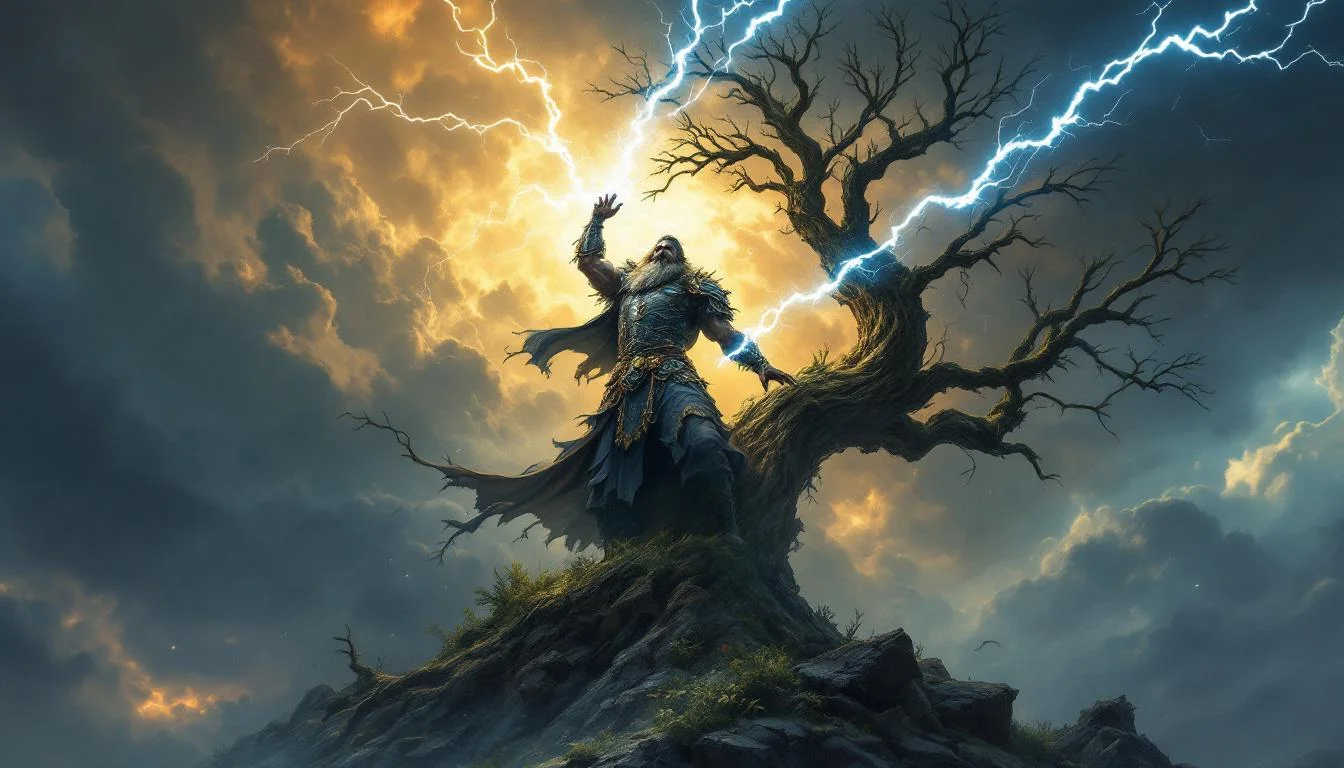
There are six gods in Vladimir's pantheon. Five of them make sense. Perun is the thunder god, the supreme authority. Khors and Dazhbog govern the sun in its physical and functional aspects. Stribog commands the winds. Mokosh holds the earth and the fate of women. Each one has a clear domain, a legible purpose, a reason to stand on that hilltop above the Dnieper in 980 AD.
And then there is Simargl.
Fifth in the list. No physical description. No silver head or golden mustache. No recorded prayers, no documented rituals, no feast day, no folk memory that survived Christianization with anything approaching clarity. The Primary Chronicle mentions the name once, in a list, between Stribog and Mokosh, and moves on. Later medieval polemics against paganism occasionally include the name in their catalogues of false gods, but they add nothing — just the name, dropped among others, never explained.
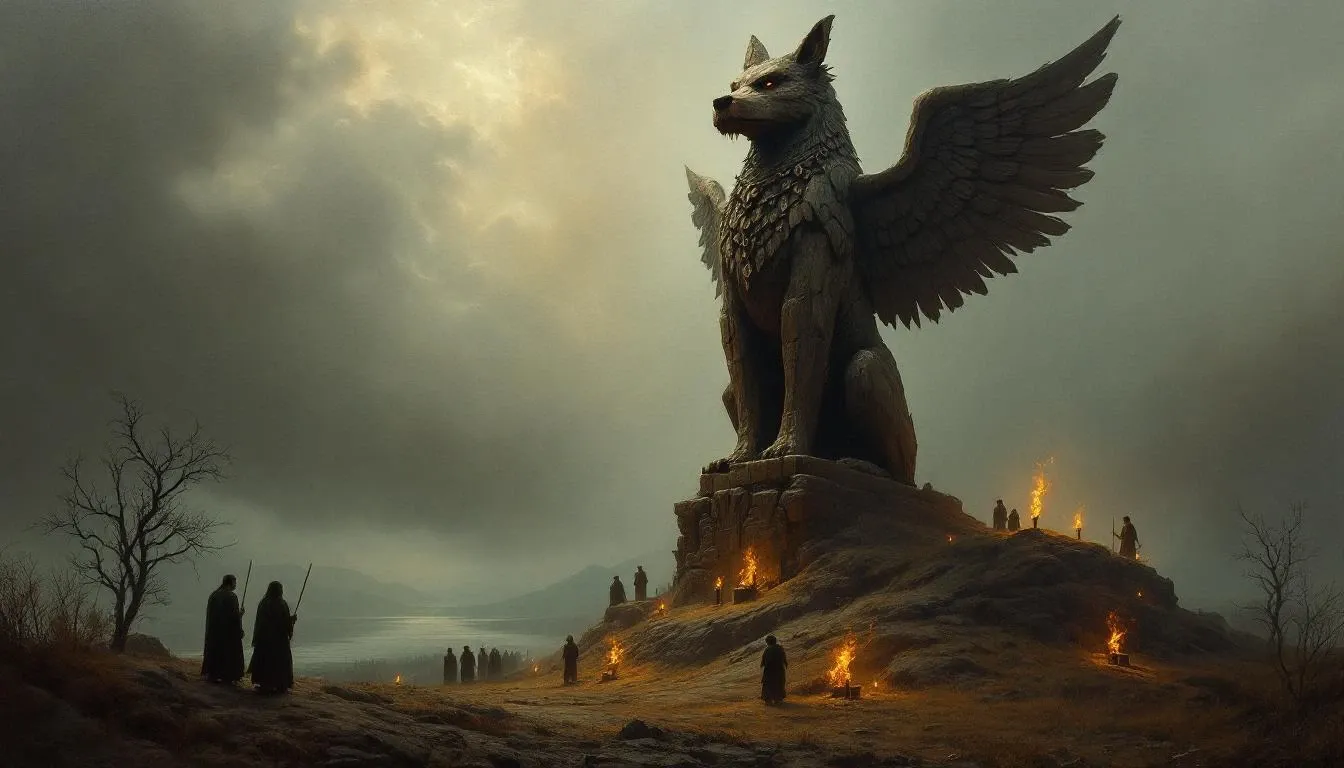
For centuries, scholars did not even agree on what the word meant. Some read it as two gods — Sim and Rgl — rather than one. Others dismissed it as a scribal error. It took the work of comparative mythologists to piece together what Vladimir's fifth god probably was: a winged dog wreathed in flame, guardian of the seeds of all living plants, borrowed from a Persian mythology so ancient that by the time it reached Kyiv, its original context had been forgotten.
Simargl is the god nobody understands. And that, it turns out, is what makes him interesting.
The Name: From Simurgh to Simargl
The etymology is the one thing about Simargl that scholars broadly agree on. The name derives from the Iranian Simurgh — the great bird of Persian mythology, a creature that nests in the World Tree, possesses the knowledge of all ages, and serves as a bridge between the mortal world and the divine.
The Simurgh appears in the Avesta, the sacred texts of Zoroastrianism, under the name Saena Meregh — "the Saena bird." In the Shahnameh, Ferdowsi's eleventh-century Persian epic, the Simurgh raises the hero Zal, teaches him wisdom, and gives him a feather that, when burned, summons the great bird in moments of desperate need. The Simurgh is not a simple animal. It is the oldest living thing, perched atop the Tree of All Seeds (Vispobish), and when it takes flight, the force of its wings shakes all the seeds loose and scatters them across the world. It is simultaneously a creature and a cosmic mechanism — the engine by which plant life propagates.
The pathway from Persian Simurgh to East Slavic Simargl ran through the Iranian-speaking peoples of the Pontic steppe — the Scythians, Sarmatians, and Alans who inhabited the territories between the Caspian and the Dnieper for over a millennium. The East Slavic tribes had deep and sustained contact with these populations. The borrowing of religious concepts was not unusual — Khors, also in Vladimir's pantheon, carries an Iranian name meaning "sun." Simargl and Khors together represent an Iranian theological stratum in East Slavic religion, deities adopted from steppe neighbors and absorbed into a framework that no longer remembered their foreign origin.
But something happened in the transfer. The Simurgh was a bird — specifically, a raptor of enormous size, often depicted with a peacock's tail and a dog's head (in some Persian traditions) or simply as a vast eagle-like creature. When the concept crossed into Slavic territory, it shifted. The bird became a dog. Or rather, it became something that was neither fully bird nor fully dog — a winged canine, a creature with feathers and fur, talons and paws.
The Seed-Guardian
The Simurgh, in Iranian cosmology, sits in the Vispobish — the Tree of All Seeds, the cosmic tree that contains within itself the seeds of every plant that exists. When the Simurgh lands on the tree, the seeds fall. When it takes flight, the seeds scatter across the world, carried by wind and rain to the places where they will grow.
Simargl inherited this function. In the reconstructed Slavic theology proposed by Boris Rybakov — the most influential (and most contested) twentieth-century scholar of Slavic paganism — Simargl was the guardian of the World Tree's seeds. He sat at the base of the tree, or among its roots, and his task was to protect the vegetative force of the cosmos. Every plant that grew, every crop that emerged from the soil, every forest that spread across the land, did so because Simargl guarded the source.
This places Simargl in a specific ecological niche within the Slavic divine hierarchy. Perun governed the sky and thunder. Veles governed the underworld and cattle. Mokosh governed the earth and women's fate. Dazhbog governed the sun's generosity. But who governed the fundamental mechanism by which plant life propagated? Who ensured that the seeds existed at all, that the generative potential of the natural world was maintained and protected?
That was Simargl. Not a god of harvest — that was a function of collective worship, of seasonal ritual, of the interplay between earth and sky. Simargl was more fundamental. He was the god of the possibility of harvest. The guardian of potential. The watchdog of the source.
Rybakov argued that Simargl's positioning in Vladimir's pantheon — fifth of six, between the wind god and the earth goddess — reflected a deliberate cosmological ordering. Stribog sends the winds. Simargl protects the seeds. Mokosh receives them into the earth. The sequence describes the process of agricultural fertility: wind scatters, the guardian releases, the earth receives. Whether Vladimir or his priests consciously arranged the gods in this order is unknowable. But the logic is there, waiting beneath the surface of the list.
The Fire-Dog Debate
Not all scholars accept the Simurgh derivation. An alternative hypothesis, advanced by the historian Henryk Lowmianski and others, argues that Simargl was not a borrowed Persian creature at all but a native Slavic fire-spirit — a dog associated with the hearth flame, the domestic fire that protected the household.
The evidence for this reading is slim but suggestive. In some medieval Russian texts, the word simargl (or semargl) appears in contexts associated with fire or burning. The hearth-dog is a known figure in Indo-European folklore: the dog that lies beside the fire, the domestic guardian that protects the household through the night. If Simargl was the divine version of this figure — the cosmic hearth-dog, the fire-guardian writ large — then his presence in the pantheon makes a different kind of sense: he is the protector of the domestic sphere, the god who watches over the flame that keeps the family alive through winter.
The fire-dog hypothesis also connects to a broader pattern in Slavic belief. Fire in the Slavic world was not merely a physical phenomenon — it was alive, sacred, and demanding. The hearth fire was never allowed to go out. Spitting into the fire was forbidden. The fire was fed, spoken to, and treated with the respect due a living presence. If that fire had a divine patron — a creature of wings and flame who embodied the fire's protective nature — Simargl fits.
Simargl was the divine guardian of seeds, plants, and the roots of the World Tree. His Iranian origin — from the Simurgh, the bird of the Tree of All Seeds — connects him to the most ancient stratum of Indo-Iranian cosmology. His transformation in Slavic lands from bird to winged dog reflects the practical theology of an agricultural people: they needed not a flying distributor of seeds but a grounded protector of them. The dog guards. The wings signal divine authority. The flame signals purification and power.
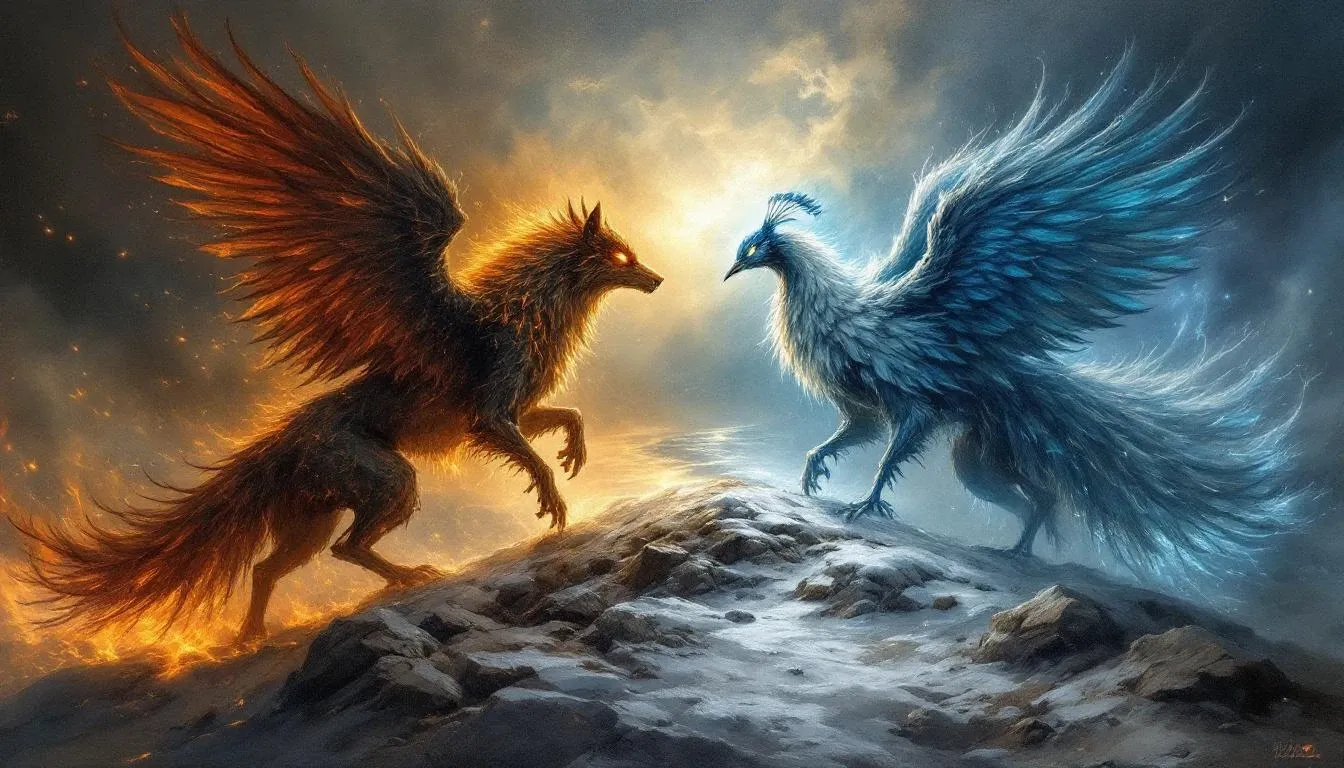
The debate between seed-guardian and fire-dog has never been resolved. It is possible — and this is the interpretation that the evidence best supports — that both functions merged in the figure of Simargl. The Simurgh origin provided the cosmic role: guardian of the World Tree, protector of seeds. The Slavic context added the fire: the hearth, the domestic flame, the watchful dog by the embers. Simargl became a creature that combined Persian cosmology with Slavic domestic religion — a winged dog of fire and seed, neither purely Iranian nor purely Slavic, but something that existed only in the space where those two worlds overlapped.
Semargl or Simargl: The Spelling Problem
The Primary Chronicle spells the name inconsistently across different manuscript copies. Some versions read Simargl. Others read Semargl. Still others write Sim and Rgl (or Regl) as two separate words, which led early scholars to propose that Vladimir's pantheon contained not six gods but seven — with Sim and Rgl being two distinct minor deities rather than one compound name.
This seven-god theory persisted for a surprisingly long time. It was convenient: seven is a more symbolically satisfying number than six, and it resolved the awkwardness of having an unrecognized name in the pantheon by splitting it into two equally unrecognized names. But the comparative evidence — the clear derivation from Simurgh — eventually settled the matter for most scholars. Simargl is one being. The scribes who separated the name were copying a word they did not understand, and like scribes throughout history, they made the unfamiliar fit their expectations by breaking it into smaller, seemingly manageable pieces.
The instability of the name itself tells a story. By the time the Primary Chronicle was compiled around 1113 — roughly a century and a half after Vladimir erected the pantheon and a century and a quarter after he tore it down — the name Simargl had already become opaque. The chronicler who recorded it did not know what it meant. The scribes who copied it did not know how to spell it. The god had been forgotten so thoroughly that even his name had become noise — a sequence of sounds that no longer connected to any image, any story, any prayer.
The Zorya Connection
Rybakov proposed a further connection that, if accepted, places Simargl in a cosmic drama of extraordinary scope. In Russian folk astronomy, two Zorya — the Morning Star and the Evening Star — guard the chained doomsday-hound that is tethered to the star Polaris. If the chain breaks and the hound escapes, the world ends. The Zorya sisters stand eternal watch, ensuring the chain holds.
Rybakov suggested that this doomsday-hound was a folk memory of Simargl — the winged dog, chained to the axis of the cosmos (the World Tree, identified with the Pole Star), guarding the seeds of existence. In this reading, Simargl does not merely protect the seeds. He is the chain that holds the world together. His vigilance is not optional. If he fails, if he sleeps, if he is unchained, everything ends.
This interpretation is speculative. No medieval text explicitly connects Simargl to Polaris or to the Zorya. But the structural parallels are striking: a canine figure tethered to the cosmic axis, forbidden from leaving his post, performing a guardian function that sustains the entire world. The folk tradition about the chained hound survived into the nineteenth century in Russian peasant astronomy. If it does preserve a memory of Simargl, then the god survived Christianization not in his name but in his function — a winged dog reduced to a chained hound, a guardian of seeds reduced to a guardian of a chain, the cosmic protector demoted to a folk-astronomical footnote but never entirely forgotten.
Why Vladimir Included Him
The question remains: why was Simargl in the pantheon at all? Vladimir's selection of gods in 980 AD was political, not devotional. Each deity represented a constituency. Perun was the god of the warrior elite. Khors and Dazhbog served the Iranian-influenced populations of the steppe frontier. Stribog governed the winds — essential for a people whose rivers were their highways and whose trade depended on favorable weather. Mokosh held the agricultural heartland, the women, the textile workers.
What constituency did Simargl serve?
The most plausible answer is agricultural. Simargl, as guardian of seeds and vegetation, represented the fundamental concern of the vast majority of Vladimir's subjects: would the crops grow? Would the seeds sprout? Would the earth produce? In a society where famine was never more than one bad harvest away, a god who guaranteed the basic mechanism of plant growth was not a minor figure. He was existential.
The fact that his name was Iranian suggests he may also have served the same diplomatic function as Khors: an acknowledgment of the Scythian-Sarmatian cultural substrate in the eastern territories. By including Simargl, Vladimir signaled that the old steppe traditions were part of his state religion — that the Iranian-flavored beliefs of the frontier were recognized and incorporated, not suppressed.
The Last of the Unknown Gods
Simargl vanished more completely than any other member of Vladimir's pantheon. Perun survived as the Prophet Elijah. Mokosh survived as Saint Paraskeva. Veles survived as Saint Vlasiy. Even Khors, the disc-god, may survive in the word khorosho and the circular khorovod dance. These gods left traces — in folk practice, in the Christian calendar, in language itself.
Simargl left nothing. No saint absorbed his function. No folk practice clearly preserves his memory. No holiday, no dance, no word in the modern Russian language carries his name forward. The winged dog of fire and seed was erased so completely that for centuries scholars could not even agree whether he was one god or two.
And yet the image persists — not in documented tradition but in the persistence of the idea itself. A winged dog, wreathed in flame, sitting at the base of the cosmic tree, guarding the seeds of everything that will ever grow. Never sleeping. Never leaving his post. The world turning above him, the roots spreading below him, and the seeds — all the seeds, every plant that will ever push through the soil into the light — held safe in the shadow of his burning wings.
It is too good a story to have come from nowhere. Somewhere behind the single line in the Primary Chronicle, behind the confused spelling and the lost context, there was a real belief held by real people who understood that the world's fertility was not automatic — that it required a guardian, that something had to watch the source, that the seeds could not be left unprotected.
They gave that guardian wings and fire and the loyalty of a dog. They placed him in their most important shrine. And then they forgot his name.
The seeds kept growing anyway. He was, apparently, very good at his job.