Every morning, a woman opens the gates of a palace in the sky. Every evening, her sister closes them. Between those two acts — the opening and the shutting — the sun crosses the heavens, the world receives its light, and a monstrous hound chained to the North Star strains against its iron tether but does not break free. The system holds. It has held for as long as the sky has existed. But the chain is not unbreakable, and the women are not immortal, and the old Slavic sources are blunt about what happens if either sister falters: the hound devours the constellation that pins it in place, the stars go dark, and the universe ends.
These women are the Zorya — the Auroras, the dawn goddesses of East Slavic mythology. They are daughters of the sun god Dazhbog and servants of the celestial order, and their job is simultaneously the simplest and the most terrifying in the entire Slavic pantheon. Open the gate. Close the gate. Watch the chain. Do not look away. The world depends on the routine never being interrupted.
They are not warrior goddesses. They carry no weapons forged by divine smiths. They command no armies, claim no thrones, and have no great myths of personal triumph or suffering. Their power lies entirely in repetition — in the fact that they have done the same thing every single day since the beginning of time and have never once failed. In a mythology full of thunderers and tricksters and bone-legged witches, the Zorya are the quiet ones, the reliable ones, the ones whose importance you only understand when you imagine what would happen if they stopped.
The Two Sisters: Morning and Evening
In the oldest East Slavic tradition, the Zorya are two virgin sisters. Their names describe their shifts.
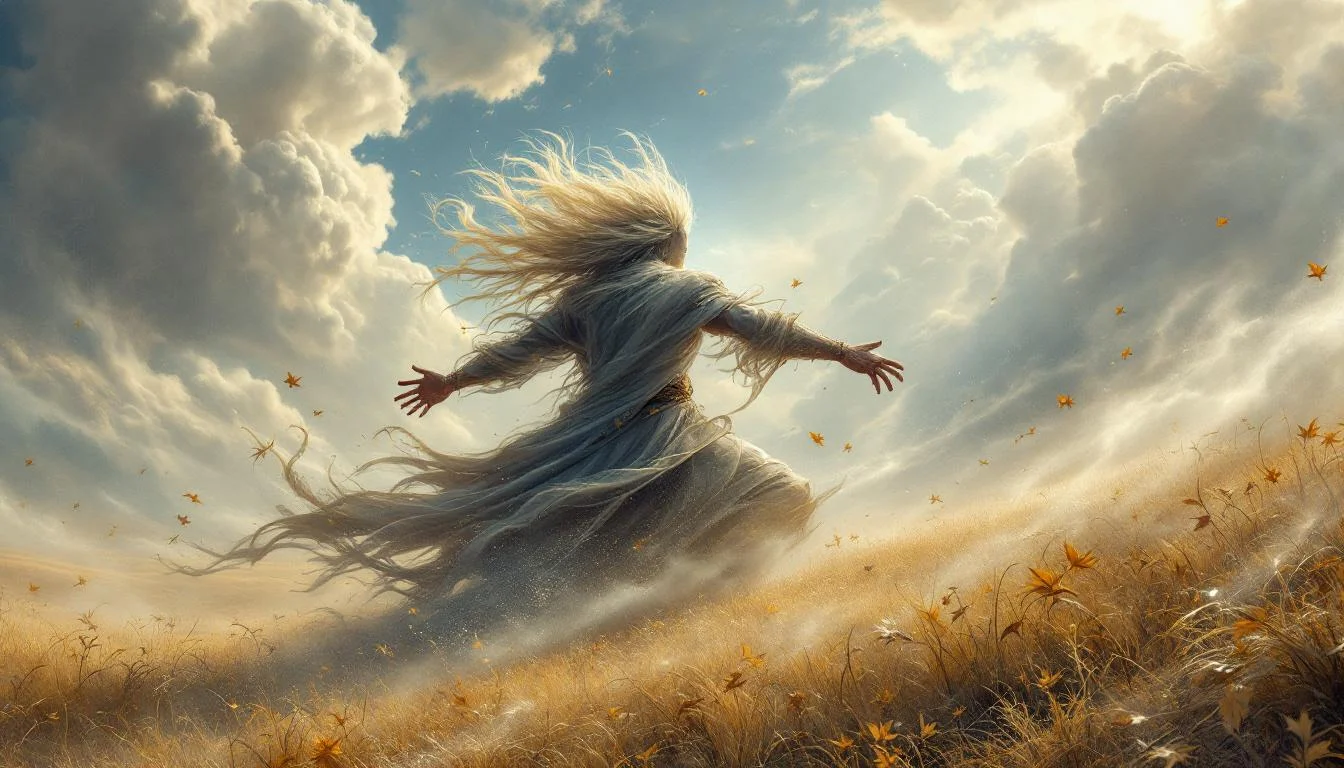
Zorya Utrennyaya — the Morning Zorya, from the Russian utro, meaning morning — opens the gates of her father's celestial palace at dawn. She lets the sun's chariot out onto the sky road, and the world below receives light. In folk sources she is sometimes called the Morning Star, and her celestial identity is the planet Venus as it appears before sunrise — the brightest object in the pre-dawn sky, the signal that the night is ending and the gate is about to open.
Zorya Vechernyaya — the Evening Zorya, from vecher, meaning evening — closes those same gates at dusk, after the sun has returned from its daily journey across the heavens. She is the Evening Star, Venus again, but now appearing after sunset on the western horizon. She receives the chariot, secures the palace, and begins the vigil that lasts until her sister takes over at dawn.
The twin structure is elegant and absolute. Zorya Utrennyaya belongs to the east, to beginnings, to the first breath of the day. Zorya Vechernyaya belongs to the west, to endings, to the last exhalation before darkness. Between them they bracket everything. Nothing in the mortal world happens outside the window they maintain — not a harvest, not a battle, not a birth, not a death. All of it occurs between the opening of the gate and its closing.
The Chained Hound and the Star That Holds the World Together
The Zorya open and close the gates. That much is poetic and orderly and fits the kind of solar mythology that appears in dozens of cultures. But the Slavic tradition layers something far more dangerous beneath the beauty. The gate duty is not the real job. The real job is watching the chain.
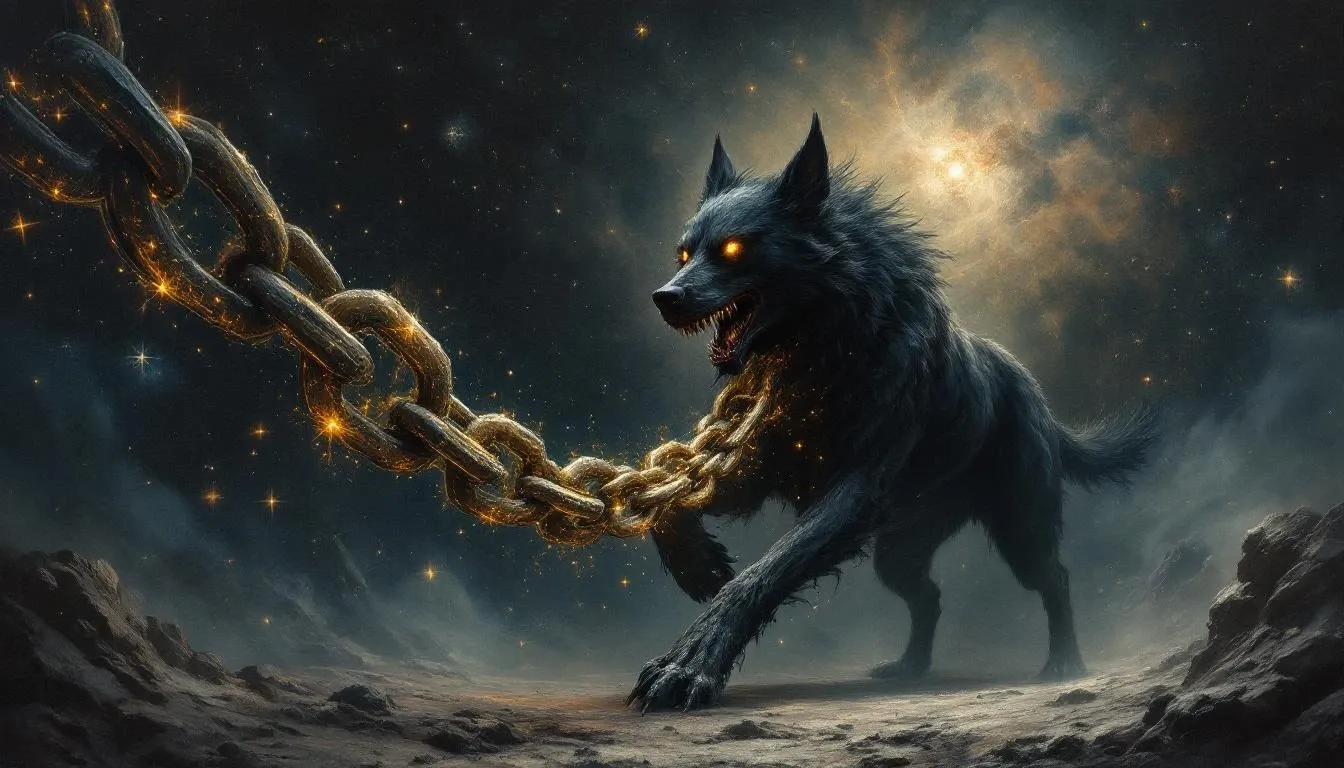
In East Slavic cosmological tradition, a great hound — most commonly identified as Simargl, the winged dog-deity of the Slavic pantheon — is chained to Polaris, the North Star, at the tip of the constellation Ursa Minor, the Little Bear. The chain is cosmic in scale, forged in the first age of the world, and it holds the hound in place at the fixed point around which the entire night sky revolves. The Zorya are tasked with watching this chain. They must ensure it holds. They must ensure the hound does not slip its bonds.
The stakes are not metaphorical. If the chain breaks, Simargl devours Ursa Minor. The constellation that anchors the rotation of the heavens disappears. The sky — the organized, rotating, predictable sky that separates the mortal world from chaos — ceases to function. The old sources describe this not as a gradual decline but as a sudden catastrophic collapse: the end of the ordered universe, the return to the formless void that existed before the gods set the stars in their courses.
This is an eschatological tradition — a story about the end of the world — and it places the Zorya at the exact center of the mechanism that prevents it. They are not guarding a symbolic threshold. They are guarding the literal structural integrity of the cosmos. The chained hound at the pole star is the Slavic equivalent of Fenrir bound by the gods in Norse mythology, or the great serpent that Hindu tradition places beneath the world. These are the creatures whose restraint is the world order. Their freedom is the apocalypse.
The connection between the Zorya and the chained beast adds a dimension to their mythology that the simple gate-opening narrative does not contain. These are not passive celestial servants. They are wardens. The daily opening and closing of the heavenly gates is the visible part of their function — the part that mortals see as dawn and dusk. The invisible part, the part that matters more, is the constant surveillance of a chain that must never break. The beauty of the sunrise is the surface. Beneath it is dread.
The Celestial Palace and the Island of Buyan
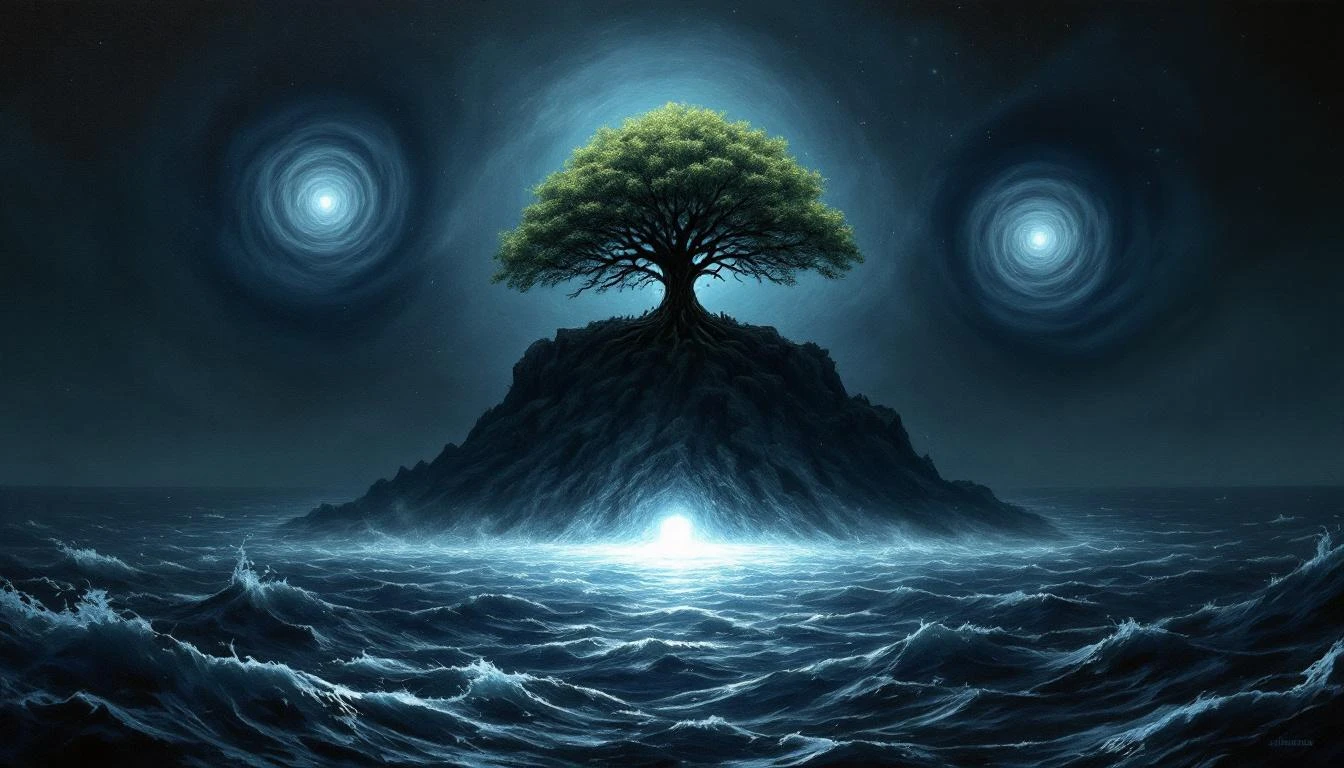
The palace whose gates the Zorya open and close belongs to their father, Dazhbog — the sun god, the "giving god," the deity who rides his golden chariot from east to west each day and whose light is the source of all earthly warmth and fertility. In some traditions, this palace sits at the eastern edge of the sky, and the sun emerges from it each morning the way a king leaves his court to survey his lands. In other versions, the palace is located on Buyan Island — the mythical island in the primordial ocean where the Alatyr stone rests and where all the winds of the world are born.
The Buyan connection is significant because it places the Zorya inside the deepest layer of Slavic cosmological architecture. Buyan is not an ordinary island. It is the first dry land — the fragment of solid earth that rose from the waters of creation before anything else existed. The Alatyr stone on its surface is the navel of the world, the foundation beneath the World Tree, the point from which all sacred geography radiates outward. If the Zorya live on Buyan, then they are not peripheral figures stationed at some remote celestial outpost. They are at the center of everything. They guard the chain from the most sacred location in the Slavic universe.
The winds — Stribog's grandchildren, according to the Tale of Igor's Campaign — are also born on Buyan, and they serve as messengers and agents across the three worlds. The Zorya share this cosmic address with the fundamental forces of nature. They are neighbors to the source of weather, the origin of magic, and the root of the World Tree. Their mythology is not a minor appendix to the Slavic pantheon. It is woven into the structural core.
Venus, Lucifer, and the Light-Bearer
The Zorya's identification with Venus — the morning and evening star — connects them to one of the most persistent and cross-cultural mythological motifs in human history. The planet Venus, because of its orbit inside Earth's, is only ever visible near the horizon at dawn or dusk. It is the brightest object in the sky after the sun and moon, and it appears to die each morning when the sun rises and to be reborn each evening when the sun sets. Cultures around the world attached profound religious significance to this cycle of appearance and disappearance.
In the Greco-Roman tradition, the morning star was called Phosphorus ("light-bearer") or Lucifer — the Latin lux (light) and ferre (to carry). Before Christianity repurposed the name as a title for the fallen angel, Lucifer was simply the morning star personified: a radiant figure who carried a torch across the pre-dawn sky, announcing the arrival of the sun. The Zorya Utrennyaya fills exactly this role in the Slavic system. She is the light-bearer, the one who appears before the sun, the herald of the day. The parallel is not borrowed — it is convergent. Two cultures looked at the same planet and arrived at the same mythological conclusion: something that bright, appearing at that hour, must be a divine messenger whose job is to open the door for the sun.
The evening star equivalent — Hesperus in Greek, Vesper in Latin — maps onto Zorya Vechernyaya with equal precision. She is the last light, the signal that the sun has been received back into its palace, the final visible divinity before the sky belongs entirely to the stars. The symmetry is astronomical before it is mythological. Venus does what the Zorya do. The myth is a reading of the sky.
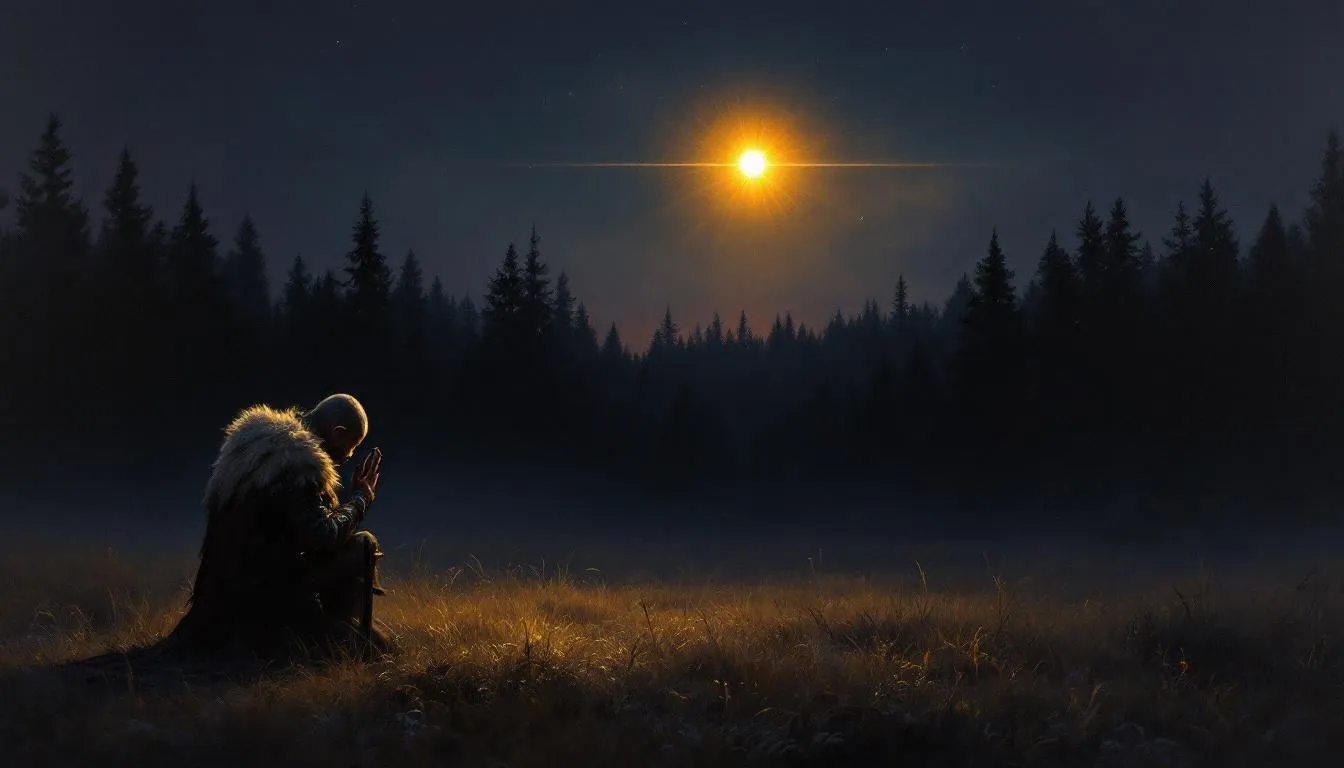
The Zorya in American Gods
Neil Gaiman's 2001 novel American Gods gave the Zorya their most prominent appearance in modern Western popular culture, and he did it by adding a third sister who does not exist in traditional Slavic sources.
In Gaiman's version, the Zorya live in a cramped Chicago apartment with Czernobog — the Slavic black god — and they have become three: Zorya Utrennyaya, who wakes at dawn and makes coffee; Zorya Vechernyaya, who stays up through the evening and reads fortunes in the coffee grounds; and Zorya Polunochnaya, the Midnight Star, who sleeps all day and wakes only at night to keep watch over the sky.
It is Zorya Polunochnaya — the invented sister — who delivers the novel's most symbolically loaded moment. When Shadow Moon, the protagonist, cannot sleep one night on the sisters' apartment rooftop, Polunochnaya appears and tells him she guards the sky so that "the thing in the constellation" cannot break free and eat the world. Then she reaches up, plucks the moon from the sky, and places it in Shadow's hand. It becomes a 1922 Liberty-head silver dollar — a coin that will protect Shadow through the underworld, light his way through death, and ultimately become the instrument of his return to life.
What Gaiman understood — and what makes his adaptation work despite the invention — is the essential nature of the Zorya's function. They watch. They guard. They keep something terrible from breaking loose. The specific number of sisters matters less than the cosmic duty they perform. In the novel, Czernobog plays checkers and broods about the old country. The Zorya keep the universe from collapsing. The contrast is the point. The most important work in the cosmos is being done by three women in a walk-up apartment who look like somebody's aging aunts, and nobody outside that apartment has any idea.
The moon coin scene also echoes the Zorya's connection to celestial bodies in the original mythology. Zorya Utrennyaya is the morning star. Zorya Vechernyaya is the evening star. Gaiman's Polunochnaya claims the moon — completing a set, giving each sister dominion over a different light in the sky. It is invention, but it is invention that understands the grammar of the source material.
Warriors, Protectors, and the Slavic Prayer
There is one more dimension to the Zorya that the mythological record preserves. In some East Slavic folk traditions, warriors and soldiers would pray to the Zorya before battle, asking the dawn goddesses for protection. The prayer treated them not as distant celestial functionaries but as active guardian spirits who could intervene in human affairs — wrapping a warrior in their protective veil, turning aside arrows and blades, shielding the faithful from harm.
This martial aspect may seem at odds with the image of two sisters quietly opening and closing gates, but it follows logically from their cosmic role. If the Zorya can hold back the doomsday hound — if they can prevent the end of the universe through nothing but vigilance and constancy — then protecting a single soldier on a single battlefield is well within their capabilities. The logic of the folk prayer is simple: nothing gets past the Zorya. Not the hound, not the darkness, and not the enemy's sword.
The prayer also reveals something about the emotional register of the Zorya's worship. These are not terrifying deities. They are not capricious or cruel. They do not demand blood sacrifice or elaborate ritual. They are the goddesses you pray to when you need someone reliable — someone who has never failed, who has never slept through her shift, who has opened the gate every single morning since the first morning. In a pantheon that includes Perun with his thunderbolts and Koschei with his hidden death, the Zorya offer something rarer and perhaps more valuable: consistency. They are the proof that the system works, that the cosmos is maintained, that someone is paying attention.
The Chain Holds — For Now
The Zorya do not have a dramatic ending in the mythological record. There is no tale of their death, no story of the chain finally breaking, no narrative of the doomsday hound's release. The Slavic eschatological tradition — unlike the Norse Ragnarok, which describes the end of the world in vivid, sequential detail — leaves the apocalypse as a possibility rather than a prophecy. The hound strains. The chain holds. The Zorya watch. The gate opens. The gate closes.
This absence of a climactic ending is itself a kind of statement. The Zorya's story is not a story in the conventional sense, with a beginning, middle, and end. It is a description of a permanent condition — the condition of the universe being maintained by attention, by duty, by the refusal to look away. The most frightening thing about the Zorya myth is not the chained hound or the cosmic collapse that its release would trigger. It is the implication that the only thing separating existence from oblivion is two women doing their job. Not divine power. Not magical artifacts. Not the intervention of supreme gods. Just two sisters, one chain, and the discipline to never, ever stop watching.
Dawn tomorrow will mean the gate opened. The Zorya were at their post. The chain held another night. It is the most ordinary miracle in the Slavic cosmos, and it happens every single day.