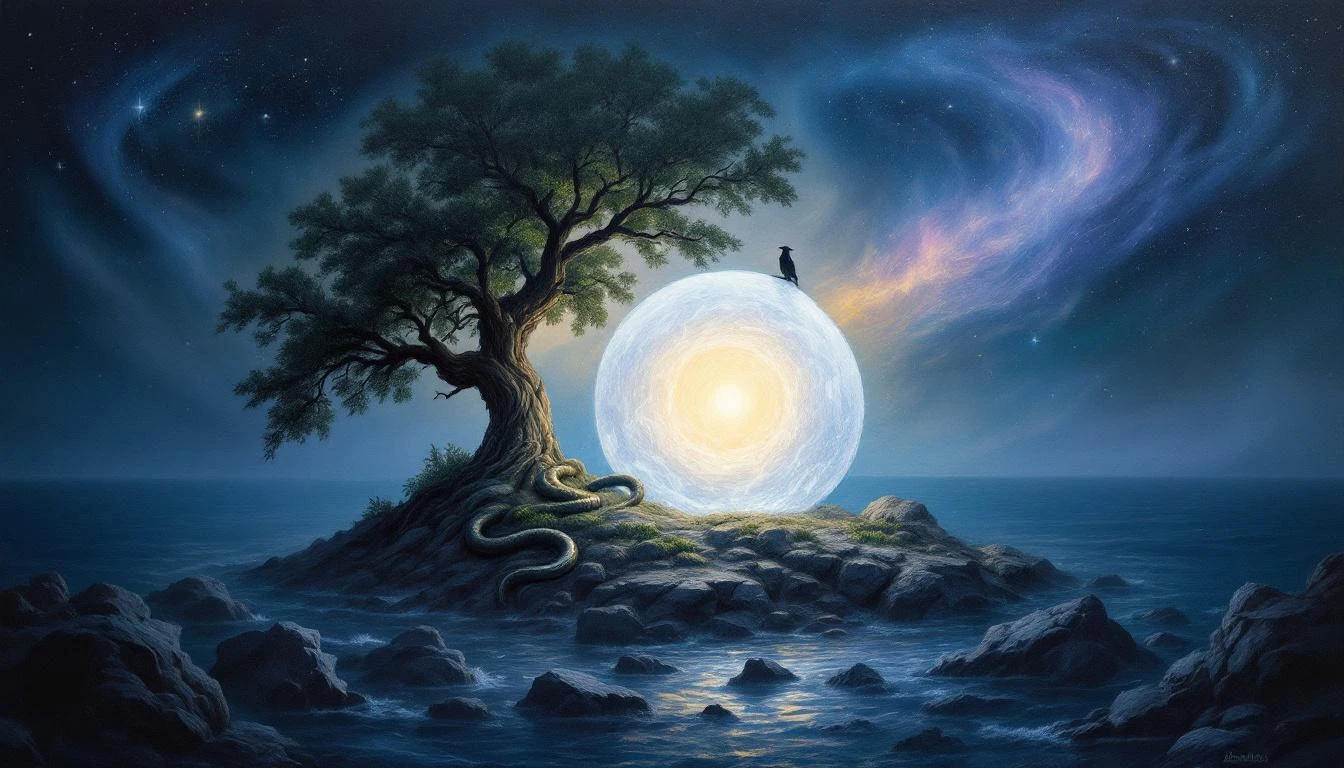
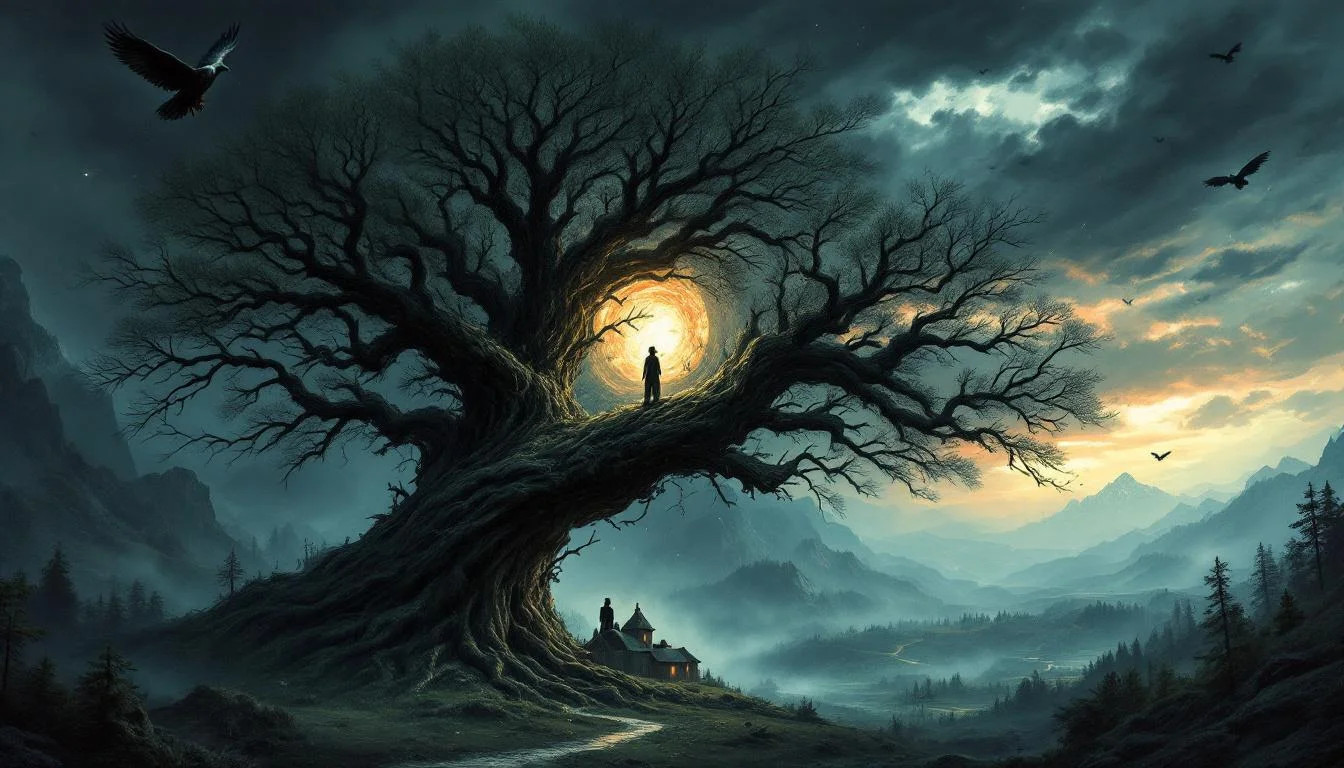
There is a place that no sailor has ever reached on purpose. It sits somewhere in the ocean-sea — not the Baltic, not the Black Sea, not any body of water you can find on a chart. It is in the ocean that existed before the continents formed, the primordial water that covered everything before the gods dragged the first clump of earth from the deep. The island rises from that water when it chooses, and it sinks back when it does not wish to be found. It has been there since the beginning. It will be there at the end. Every spell ever spoken by a Slavic healer begins by reaching toward it, because this island is the place where all power originates.
The Slavs called it Buyan. Not every Slav knew the name — it belongs primarily to the East Slavic tradition, to the Russians, Ukrainians, and Belarusians who preserved it in hundreds of healing charms, love spells, protective incantations, and the strange spiritual verses that circulated among wandering pilgrims for centuries. But the idea behind it — a sacred island at the center of the world, floating in the cosmic ocean, containing the source of all natural and supernatural force — runs through Slavic thought like a root through dark soil. Buyan is the navel of the Slavic universe. Everything that matters is either on it or flows from it.
The First Earth
The oldest layer of the Buyan myth is cosmogonic. Before there was land, there was water. The primordial ocean — called the "sea-ocean" (more-okiyan) in the folk formulae — stretched in every direction without shore or bottom. Then something rose from beneath. A piece of earth broke the surface and became the first solid ground in existence. That was Buyan. It was not created by a god standing on dry land and shaping mud with his hands. It emerged from below, from the deep, the way an idea surfaces in a mind that has been thinking for a long time without knowing what it was thinking about.
This image of land rising from a primordial ocean has parallels across Indo-European and even broader world mythology — the earth-diver motif, in which a creature descends into the cosmic water to bring up mud that becomes the world. But Buyan is not the whole world. It is the seed of it, the first point of solidity in an infinite liquid chaos. The island concentrates all the creative power of the cosmos in one place, and from that concentration everything else radiates outward. The winds blow from Buyan. The dawn rises behind it. The rivers of healing water flow from beneath its central stone. It is not a piece of geography. It is the origin point of geography itself.
The fact that Buyan appears and disappears is essential, not decorative. An island that is always visible is just land. An island that hides itself is something else — it is a threshold, a place that exists on the boundary between the manifest and the hidden, between Yav and something deeper. The Slavs understood, long before anyone wrote a philosophical treatise about it, that the source of the world's power cannot be permanently accessible. It reveals itself to those who need it and withdraws from those who would exploit it. Buyan breathes with the tides of a cosmic ocean that has nothing to do with salt water and everything to do with the rhythm of creation.
The Stone, the Oak, and the Geography of Power
What stands on Buyan is not random. Every object placed on the island by the folk tradition occupies its position because it must, the way organs occupy their positions inside a body. At the center sits the Alatyr stone — the white burning stone, the "father of all stones," the navel of the earth. From beneath the Alatyr flows a river of healing water that gives the whole world sustenance. The stone is not merely large or old. It is the first stone, the original solid matter, the point from which the mineral world unfurled. When a healer sealed a charm with the words "and that word is stronger than stone, stronger than the white burning Alatyr," she was invoking the most immovable object in creation as the lock on her spell.
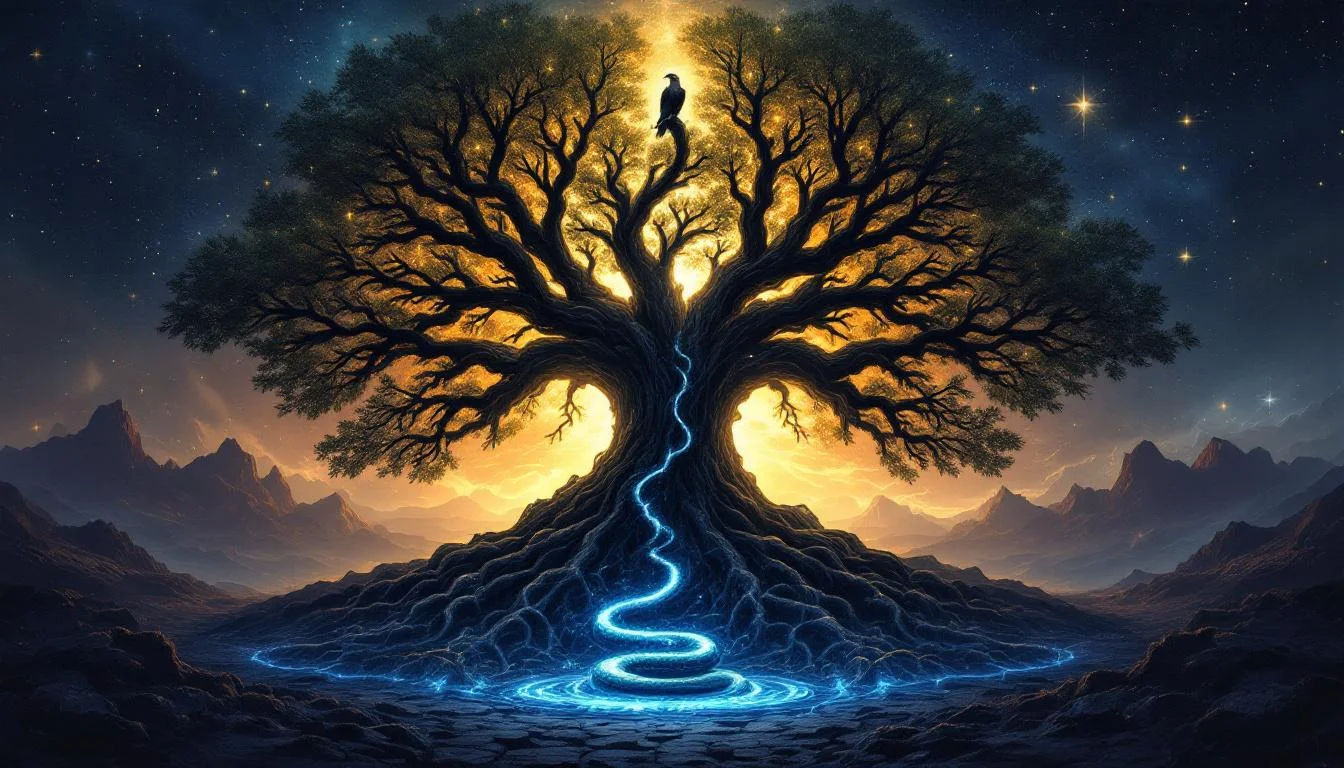
Growing from beside — or above, or through — the Alatyr stands an oak. Not any oak, but the cosmic oak, the World Tree whose roots descend into the underworld and whose crown holds the sky. The folk charms describe it as the "dub-starodub," the ancient oak, or sometimes the "moist oak" (dub mokretsky), meaning alive, green, still growing — a tree that has never dried out and never will. This oak is the axis of the universe, and it grows on Buyan because Buyan is where the axis must be anchored. The Alatyr is its foundation. The island is its ground. The ocean-sea is the void that surrounds all structured reality.
Beneath the oak, in some versions, lives the serpent Garafena, wise and watchful. In the branches sits the bird Gagana, or sometimes the Alkonost and Sirin — the paradise birds whose songs cause men to forget everything they have ever known. The entire vertical structure of the Slavic cosmos is compressed onto this one island: underworld serpent at the roots, mortal world at the trunk, celestial birds in the crown, and the Alatyr beneath it all as the foundation stone of existence. Buyan is not merely a location in the mythic landscape. It is a scale model of the three worlds, a miniature cosmos floating in the ocean that preceded creation.
The Home of the Winds and the Dawn
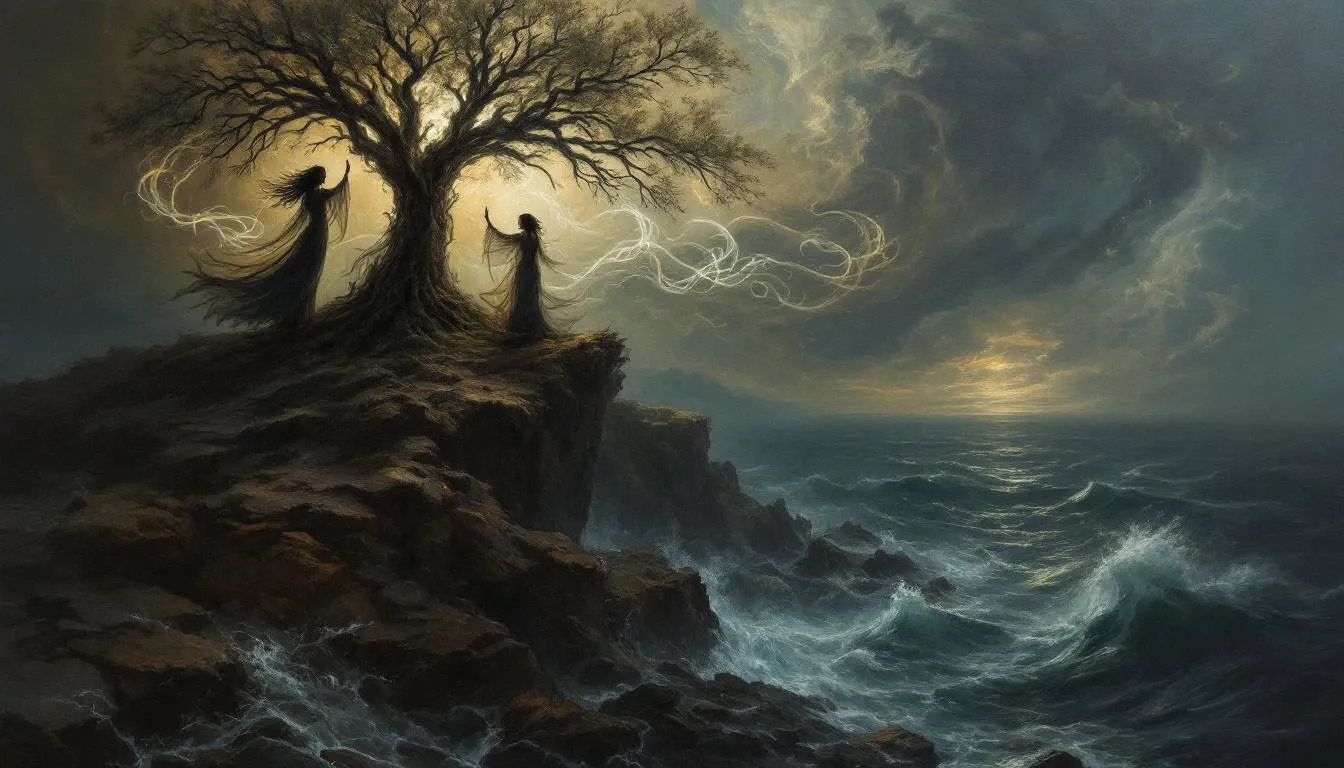
Buyan is populated, but not by men. The beings who dwell there are the fundamental forces of the natural world, and their residence on the island is what makes it the engine room of creation. Stribog — the god of winds, or the grandfather of winds, as the Slovo o polku Igoreve calls him — keeps his domain on Buyan. The Northern, Western, and Eastern winds live there as three brothers, and when they leave the island, the weather of the world changes. Every gale that strips the thatch from a peasant's roof, every spring breeze that carries the scent of thawing soil — all of it blows from Buyan, dispatched by forces that reside in the one place mortals cannot reach.
The Zorya also dwell there — the two (or sometimes three) sister-goddesses of the dawn and dusk. Zorya Utrennyaya, the Morning Star, opens the gates of the sun's palace each day. Zorya Vechernyaya, the Evening Star, closes them at night. In some traditions, a third Zorya — the Midnight Star — guards the chain that holds a monstrous hound to the constellation of the Little Bear, a hound whose escape would signal the end of the world. Their palace stands on Buyan, and the sun rises each morning because a goddess on an invisible island swings open a gate. The daily cycle of light and darkness is a function of Buyan's existence.
This accumulation of cosmic functions on one island is not an accident of storytelling. It reflects a consistent theological logic: if the world's power has a source, that source must be singular and concentrated. The Slavs did not scatter their cosmological machinery across a dozen locations. They placed it all on Buyan — the winds, the dawn, the World Tree, the healing stone, the cosmic serpent, the paradise birds — because the whole point of Buyan is that it is the one place where everything converges. It is the hub of the wheel. Remove it, and the spokes fly apart.
The Death That Cannot Be Reached
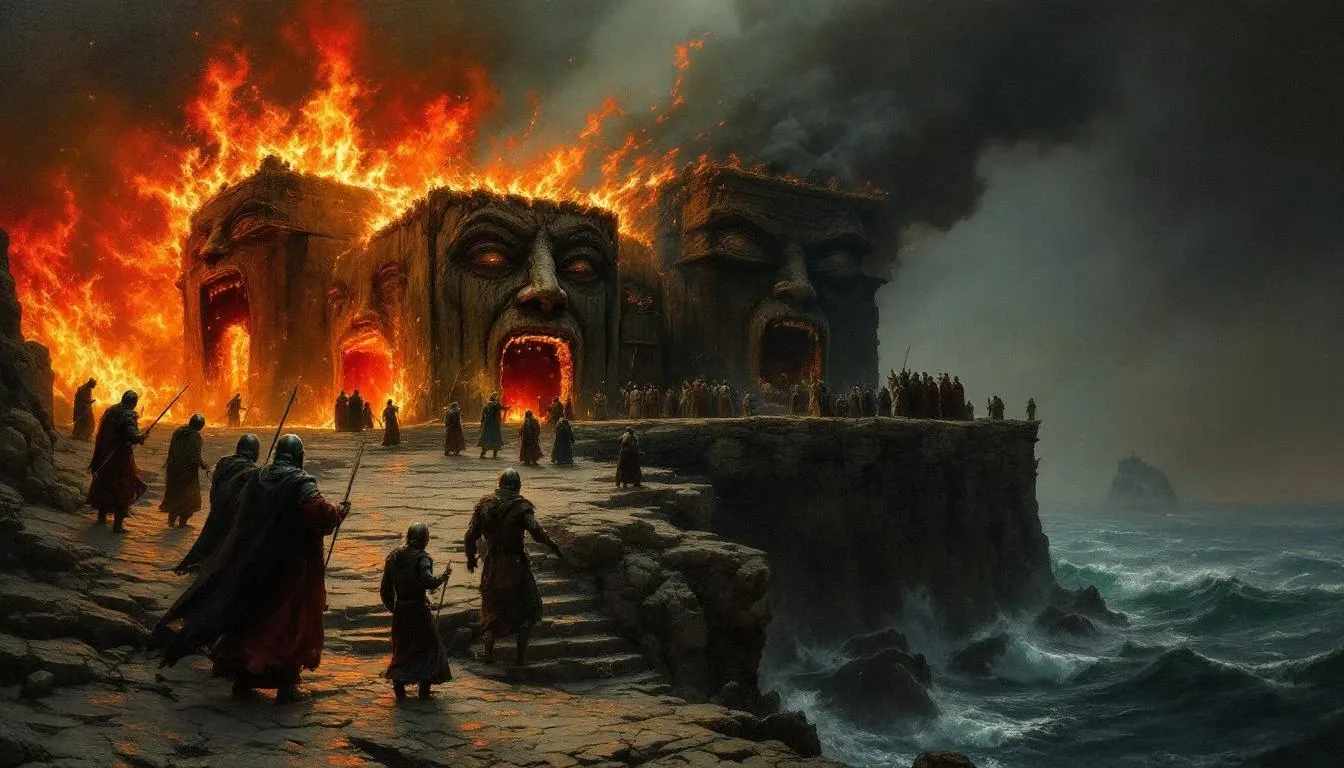
One of the most famous inhabitants of Buyan is not a god, not a bird, and not a natural force. It is a death — specifically, the death of Koschei the Deathless, the skeletal sorcerer-king of Russian fairy tales who cannot be killed by any ordinary means. In the best-known versions of his story, Koschei's death is hidden in a needle, the needle is inside an egg, the egg is inside a duck, the duck is inside a hare, the hare is locked in an iron chest, and the chest is buried beneath an oak tree on the island of Buyan in the middle of the ocean-sea.
This is not merely a narrative device to make the hero's quest difficult. It is a cosmological statement. Koschei hides his mortality at the center of the universe — at the one point in all creation that is hardest to reach, most heavily guarded, and most ontologically fundamental. The oak on Buyan is the World Tree. The chest at its roots sits where the Alatyr stone sits. The layers of protection — chest, hare, duck, egg, needle — are a nesting structure that mirrors the layered structure of the cosmos itself. Ocean contains island. Island contains tree. Tree contains chest. Chest contains animals, each nested inside the other like the layers of reality: water, earth, wood, animal, the fragile shell of the egg, and at the innermost point, the needle-thin line between life and death.
The symbolism runs deeper than plot mechanics. Scholars have noted that the sequence — ocean, island, oak, chest, hare, duck, egg — recapitulates the cosmogonic layers in reverse: the primordial ocean, the first land, the World Tree, and then progressively smaller and more fragile containers until you reach the irreducible point of mortality. Koschei has not just hidden his death cleverly. He has woven it into the fabric of the universe. To kill him, the hero must unravel creation itself, layer by layer, starting from the widest ocean and working inward to the thinnest needle. That the quest is even possible is a statement about human courage. That it requires reaching Buyan is a statement about what Buyan is: the place where the deepest secrets of existence are kept.
On the sea, on the ocean, on the island of Buyan, stands an oak, green and moist. Beneath that oak is an iron chest, bound with iron bands. In the chest sits a hare, in the hare sits a duck, in the duck lies an egg, and in the egg is a needle — and in that needle is the death of Koschei, whom men call the Deathless.
The Island and the Charm
The most enduring function of Buyan in Slavic culture is not narrative but ritual. For centuries — stretching from the pre-Christian period through the medieval era and well into the nineteenth and even twentieth centuries — East Slavic healers, cunning-folk, and village wise women used Buyan as the anchor point of their magical practice. The overwhelming majority of Russian healing charms (zagovory) begin with a journey to Buyan. The healer speaks the opening formula, and in doing so, she does not merely mention a mythical place. She travels there in word and intent, carrying her spell to the one location where it will have cosmic authority.
A typical blood-stopping charm might run: "On the sea, on the ocean, on the island of Buyan, sits a fair maiden, a master seamstress. She holds a steel needle, threads a silken thread, and sews shut the bloody wound. Thread, do not break. Blood, do not flow. Wound, do not ache." The maiden on Buyan is not a character in a story. She is a force — an archetype of healing and binding, stationed at the navel of the world where her stitches carry the weight of cosmic law. The charm works because it reaches Buyan, and Buyan is the place where intent becomes reality.
After Christianization, the charms absorbed Christian imagery without abandoning the pagan framework. The Virgin Mary replaced the nameless maiden. Saints appeared beside the Alatyr stone. But Buyan itself was never Christianized, because it could not be. There is no Christian equivalent for a mythical island in a primordial ocean that contains the World Tree and the source of all healing power. The Church could repopulate the island with approved figures, but it could not replace the island itself. Buyan persisted beneath the Christian surface of Russian folk magic like a stone beneath shallow water — always visible to anyone who looked.
Ruyan, Rugen, and the Question of the Real
Scholars have long debated whether Buyan corresponds to a real place. The most persistent identification connects it to the island of Rugen in the Baltic Sea — called Ruyan by the West Slavic Rani tribe who inhabited it from the seventh to the twelfth century. Rugen held the great temple of Svantevit at Cape Arkona, the most important pagan cult site in the western Slavic world. Pilgrims traveled from across the Baltic to worship there. Tributes flowed in from every Wendish tribe. The temple's four-headed idol held a horn that priests used to prophesy the harvest. When the Danes under King Valdemar I stormed Arkona in 1168, they destroyed the last major bastion of organized Slavic paganism in Europe.
The phonetic link between Buyan and Ruyan is plausible. The mythic qualities of Buyan — a sacred island in the sea, a place of divine power inaccessible to ordinary men — align with what Rugen-Arkona would have meant to Slavic memory after its destruction: a holy place that once existed and then vanished, swallowed not by tides but by history. An island that appeared and then disappeared. It is entirely possible that the fall of Arkona in 1168 imprinted itself on East Slavic folk memory as the loss of a sacred center, and that Buyan preserves the echo of a real island whose temple fires went dark eight centuries before the first folklorist wrote down the healing charms that still invoked its name.
But this identification, however attractive, misses something. Buyan in the zagovory is not a historical place. It is not located in the Baltic. It is located in the "sea-ocean" — the cosmic water, the primordial deep. It is not a place you sail to. It is a place you speak yourself into, through the ritual power of words. Whatever Rugen contributed to the myth, Buyan outgrew it. The island in the charms is not a memory of a real island. It is the idea of a sacred center, a permanent origin point, the place your mind goes when it needs to touch the foundation of the world.
Why Buyan Matters
Every cosmology needs a center. The Greeks had Delphi, the omphalos, the navel of the earth. The Norse had the well of Urd at the base of Yggdrasil. The Hindus had Mount Meru. The Slavs had Buyan — an island that you cannot find, that rises and falls with the breathing of the cosmic ocean, that holds the World Tree and the Alatyr stone and the winds and the dawn and the death of the deathless king, all compressed into one place that exists at the intersection of every force in the universe.
What makes Buyan distinctive among these cosmic centers is its invisibility. Delphi was a physical sanctuary. Meru was a permanent mountain. But Buyan hides. It does not want to be found by casual seekers. It reveals itself only through the ritual act of the charm — through the spoken word, the healer's formula, the deliberate linguistic journey from the mundane world to the sacred center. This makes Buyan fundamentally a place of language. It exists most powerfully in the moment of invocation. When the healer says "On the sea, on the ocean, on the island of Buyan," the island rises from the deep for the duration of the spell and sinks again when the last word is spoken.
That is why Buyan survived a thousand years of Christianization, persecution, and forgetting. You cannot burn down an island that only exists in speech. You cannot storm its temples because it has no shore for your ships to reach. The Danes could destroy Arkona. The missionaries could fell the sacred oaks. The Soviet atheists could close the churches and ridicule the old women who still whispered charms over sick children. But none of them could reach Buyan, because Buyan is not on any map. It is in the words. It is in the formula. It rises when you speak it, and as long as someone remembers the opening line — on the sea, on the ocean, on the island of Buyan — the island is still there, holding the stone, sheltering the oak, anchoring the cosmos in place.