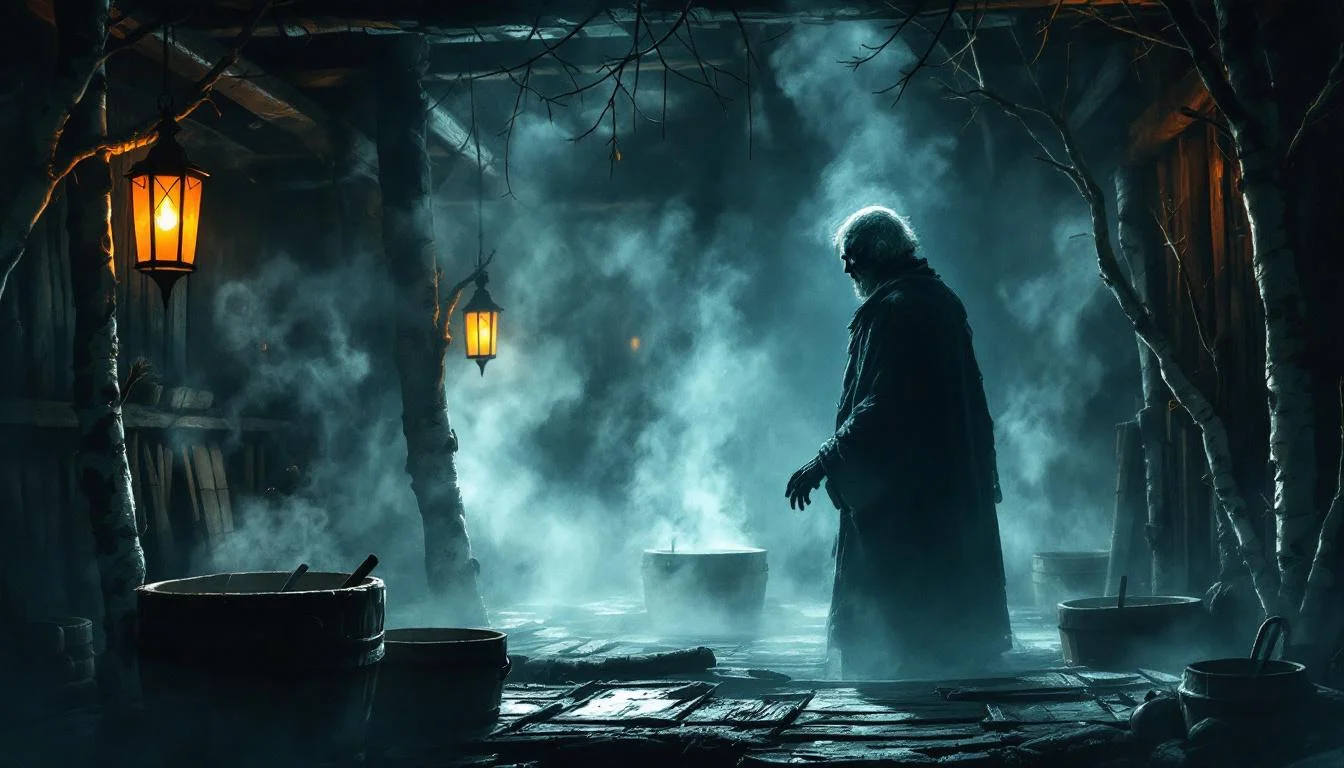
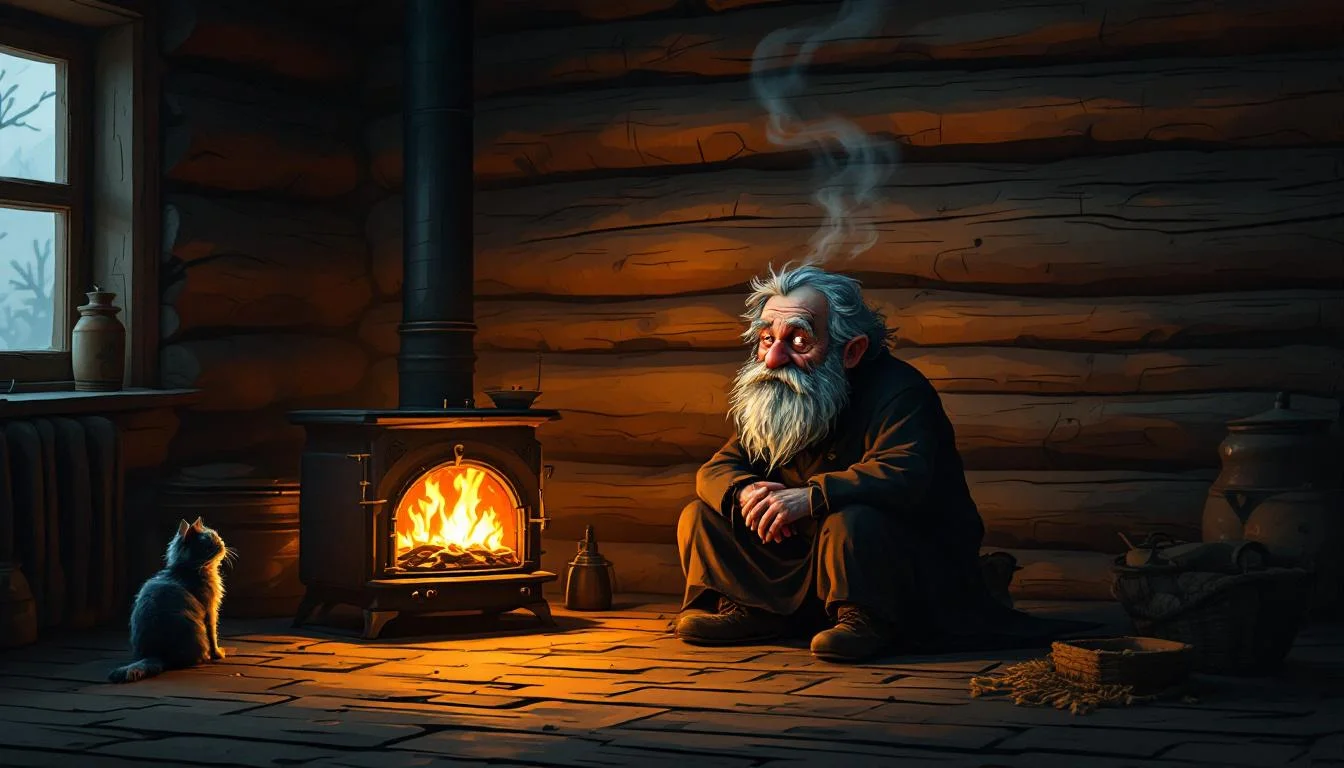
There was a building on every Slavic farmstead that the family needed more than almost any other, and feared more than all of them combined. It was not the house, where the Domovoy watched from behind the stove. It was not the bathhouse, where the Bannik waited in the steam. It was the ovin — the threshing barn — a low, dark structure built over a pit furnace, where sheaves of grain were dried before threshing. The ovin was the difference between eating through winter and starving. And something lived inside it that could take that difference away in a single night.
His name was Ovinnik. He was the spirit of the threshing barn, and among all the domestic spirits of the Slavic homestead — the helpful Domovoy, the moody Bannik, the watchful Dvorovoy — he was considered the most dangerous, the most volatile, and the hardest to appease. The other spirits could be reasoned with. The Ovinnik could only be fed, obeyed, and avoided at the wrong times. If you failed at any of these, you lost your grain to fire. And in a world without grain stores or insurance, that meant you lost everything.
The Black Cat with Burning Eyes
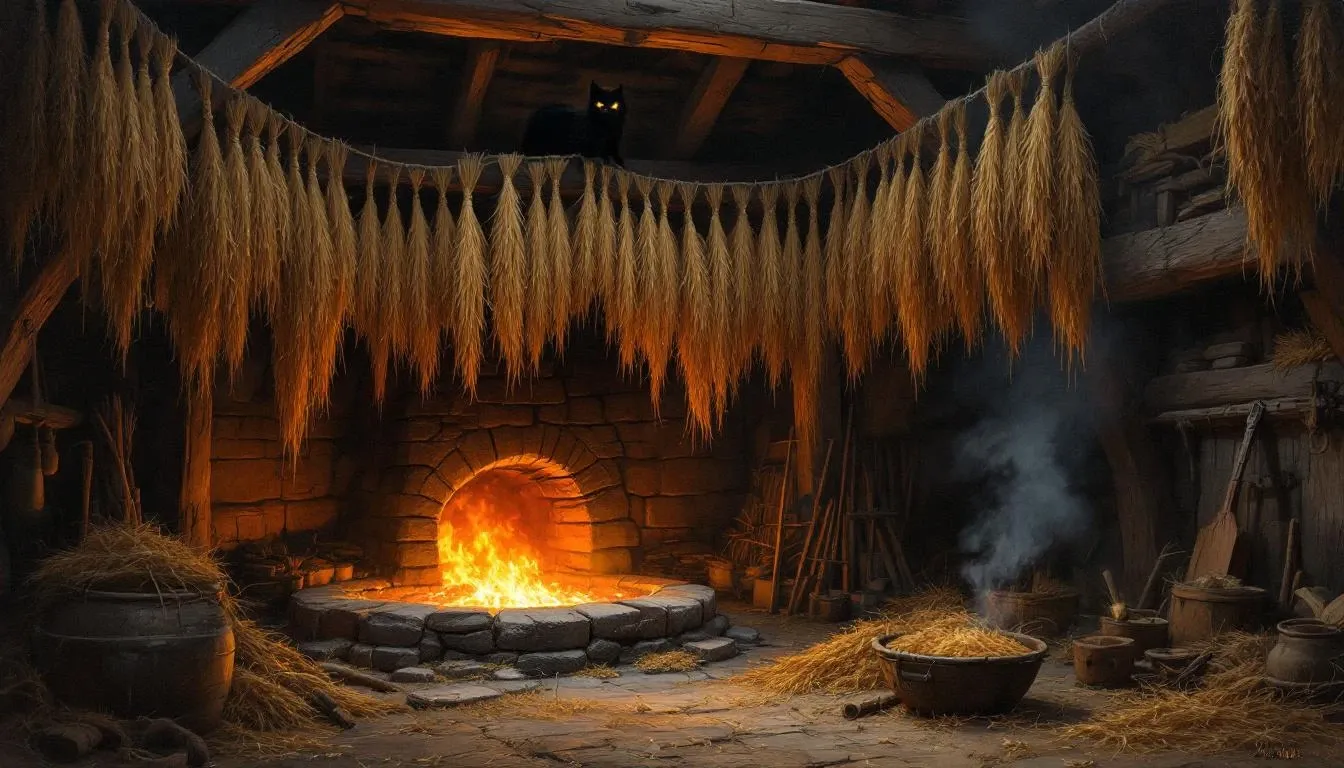
The Ovinnik did not have a single fixed appearance, because Slavic domestic spirits are shapeshifters by nature, but his most iconic form was a large black cat — unnaturally large, with eyes that glowed red like the embers in the pit furnace below the drying floor. This was the form most often reported across Russian, Belarusian, and Ukrainian folklore, and it makes a kind of terrible sense: cats inhabit barns, cats move silently in darkness, and a pair of luminous eyes watching from the grain pile is the sort of image that stays in the mind long after the barn door has been bolted shut.
But the cat was not the only mask. In some regions, the Ovinnik appeared as a large black dog, and he could bark fiercely enough to frighten anyone away from the barn at night. In the Smolensk region, he was seen as a black ram. In parts of Kostroma province, his form was that of a dead man — a pokoynik — which suggests one of the oldest layers of the belief, a time when the spirit of the ovin was understood as the ghost of someone buried in the foundation, a sacrificial offering to ensure the building's safety. In Latvian traditions, a related figure called the Rigačnik appeared as a short man with curly hair in tattered clothing, hovering near the furnace. Across all forms, the Ovinnik was thin, dark, and unnervingly strong for his size. One of his most distinctive traits was a pair of asymmetrical hands: one covered in coarse hair, the other bare and cold, with fingers noticeably longer than a human's. These hands were not merely decorative — they were instruments of prophecy, as anyone who visited the ovin during Yuletide would discover.
He could also laugh. He could clap his hands. And when angered, he howled and barked so that the dogs of the village howled in answer, not knowing that the sound came from something that was not a dog at all.
The Furnace, the Fire, and the Rules
To understand why the Ovinnik was feared above other household spirits, you must understand what the ovin was and why it was so dangerous. The ovin was a two-level structure: the upper floor held the sheaves of freshly harvested grain, spread across wooden slats or a lattice of poles. Below, in a pit dug into the earth, a furnace burned — sometimes an open fire, sometimes a clay or stone oven. The heat rose through the slats and dried the grain so that the husks could be beaten free during threshing. The entire upper level was, essentially, a room full of bone-dry straw suspended over an open flame. Every ovin was a fire waiting to happen, and every peasant family knew it.
The Ovinnik's primary function was to govern this fire. He decided when the furnace could be lit and when it could not. He enforced a set of rules that were not negotiable, and the punishment for breaking them was always the same: the ovin burned, and the grain burned with it. The rules were as follows. The furnace must never be lit on certain holy days — the Feast of the Exaltation of the Cross on September 27th, the feast of Saint Thekla (known as Fyokla Zarevnitsa, "Thekla the Fire-Lighter") on October 7th, and the Feast of the Intercession of the Theotokos (Pokrov) on October 14th. These were the Ovinnik's days of rest. On these dates, the barn belonged entirely to him, and any attempt to use the furnace was an act of invasion. Second, the furnace must never be lit during a strong wind, because wind carried sparks into dry straw with fatal efficiency, and the Ovinnik knew this better than any human. Third, no one was to sleep in the ovin overnight. The barn after dark was the Ovinnik's domain, as surely as the bathhouse during the third steam belonged to the Bannik.
The consequences for breaking these rules were not symbolic. Ethnographic accounts from the 18th and 19th centuries record stories of women burned to death for beating flax on holy days, of families who lost their entire harvest because someone lit the furnace during a gale, of men found unconscious in the ovin the morning after they had tried to sleep there, their skin red with burns and their hair singed as though they had been dragged across the furnace stones. The Ovinnik did not give warnings. He gave fire.
Of all the spirits of the homestead, the ovinnik is the most ill-tempered and the least forgiving. He does not merely punish the careless — he punishes the unlucky. A shift in wind, a forgotten ember, a sheaf placed too close to the slats, and the ovin is gone before morning. The peasants know this, and they fear the ovinnik more than the bannik, more even than the leshii who steals children in the forest.
Blood on the Threshold: How to Feed the Ovinnik
The Ovinnik could be appeased, but his appetite was more demanding than that of the Domovoy, who was content with bread and porridge left behind the stove, or the Bannik, who asked only for soap and a fresh birch broom. The Ovinnik wanted blood.
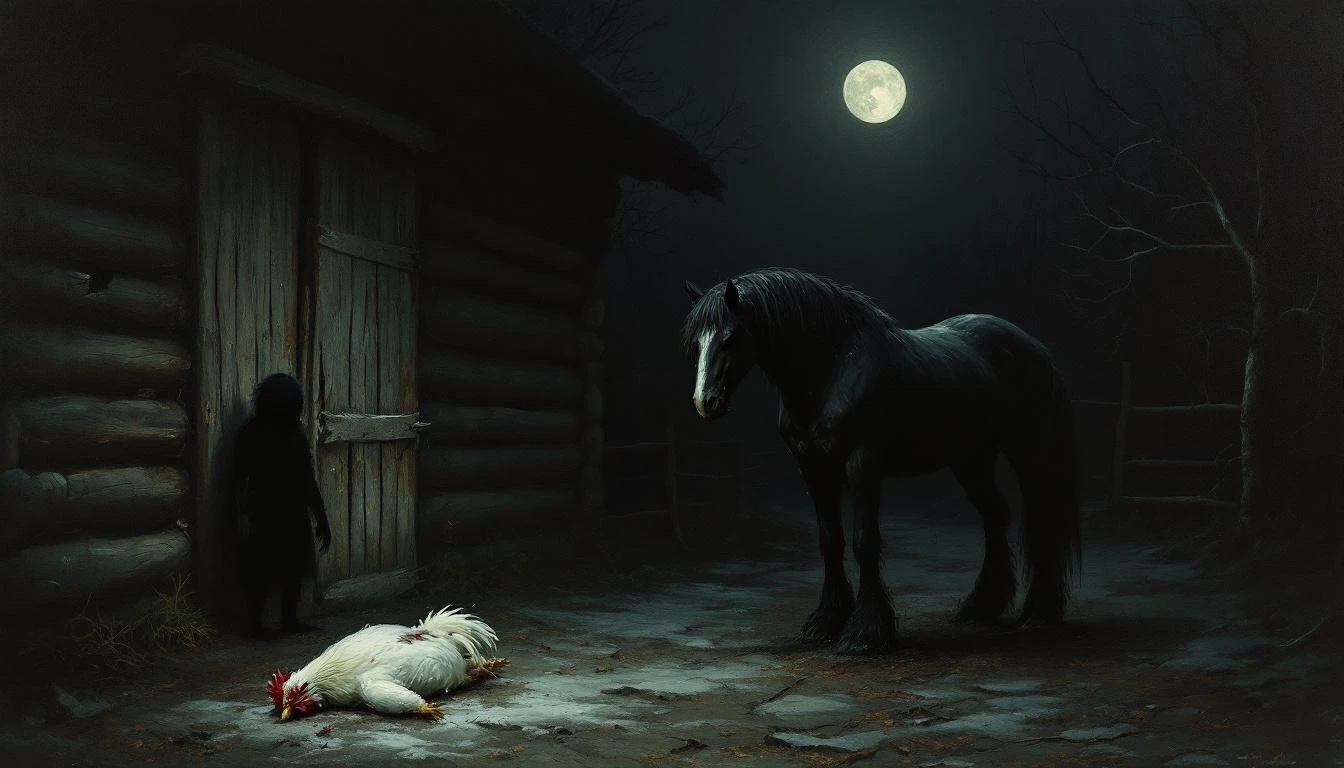
The central ritual of appeasement took place at the start of the threshing season, often on the feast of Saints Cosmas and Damian (November 14th in the Julian calendar). The head of the household would bring a rooster to the ovin. At the threshold — always at the threshold, the liminal point between human space and spirit space — the rooster's head was struck off. The blood was collected and sprinkled deliberately into all four corners of the barn, consecrating the space and renewing the pact between the family and the spirit who lived there. The body of the rooster was then left as an offering. In some accounts, the bird was placed inside the furnace pit itself; in others, it was hung from a beam above the drying floor, where the Ovinnik could reach it from any of his favored perches.
Additional offerings supplemented the blood sacrifice throughout the year. Porridge was brought on important dates. Pirozhki — small filled pies — were placed in the podlaz, the low crawl space beneath the drying floor where the Ovinnik was thought to sleep. On the evening before threshing began, some families brought bliny — the thin buckwheat pancakes that are themselves an ancient symbol of the sun and fire — and left them on the furnace stones, still warm. These were gentler gestures, maintenance payments on a debt that the rooster's blood had settled in principle but that the Ovinnik's temper required constant servicing.
The offerings were never casual. They were accompanied by spoken formulas — words of invitation, supplication, or outright negotiation. "Ovinnik-batushka," some formulas began — "little father of the ovin" — borrowing the same respectful diminutive used for the Domovoy. Others were blunter: "Here is your share. Guard the grain. Do not burn." The tone depended on the region and the family's relationship with their particular spirit, because every ovin had its own Ovinnik, and each one had its own temperament, its own history of grievances, its own preferences in food and flattery.
Fortune by Touch: The Yuletide Divination
The Ovinnik was dangerous, but he possessed something that made people seek him out despite the danger: he could see the future. And during Svyatki — the Yuletide season from Christmas Eve to Epiphany, when the boundary between worlds was at its thinnest — the Ovinnik's prophecy could be bought with nothing more than bare skin and courage.
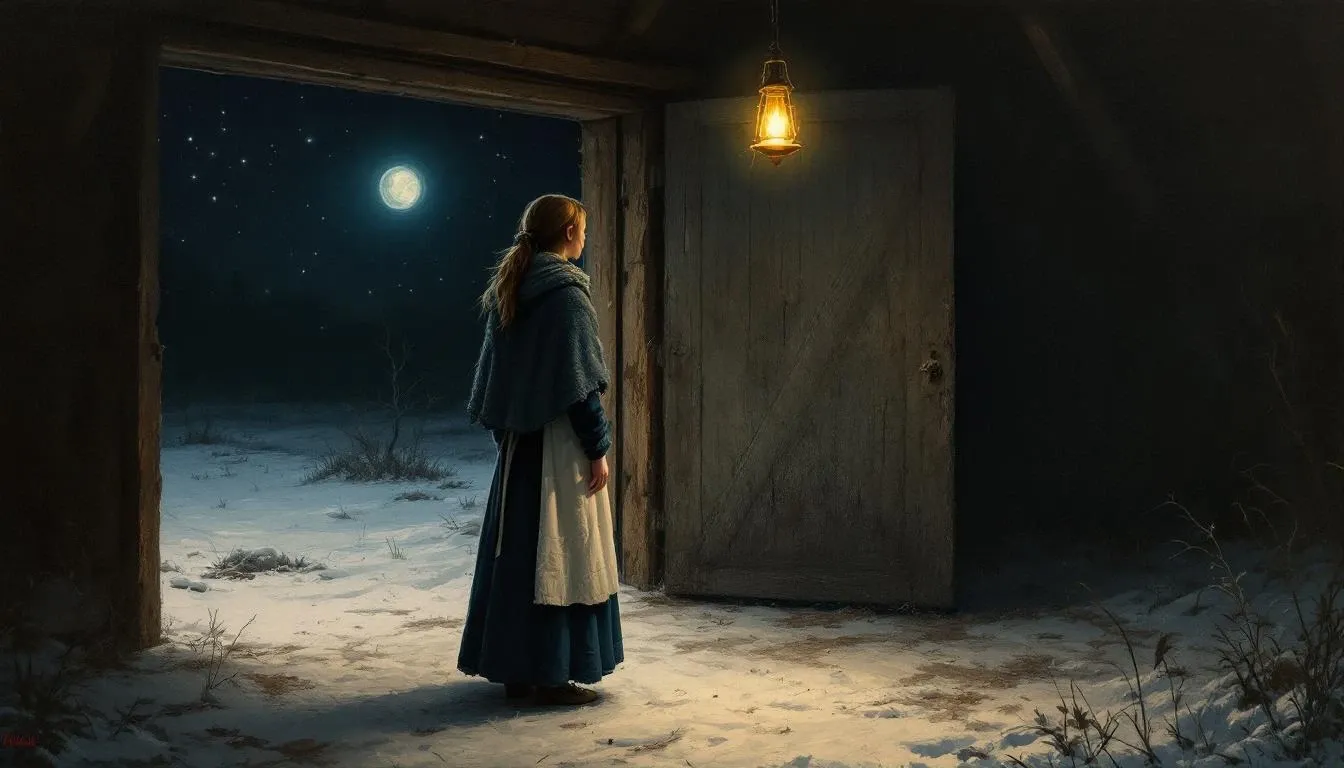
The ritual was performed almost exclusively by young women, and it closely mirrored the better-known divination practiced at the bathhouse with the Bannik. Late at night, the girl would approach the ovin alone. She would open the small window or the low door of the furnace pit — the podlaz — turn her back to the darkness inside, and extend her bare hand or, in more daring versions, lift her clothing and expose her back to whatever waited within. Then she held still and waited for the Ovinnik to touch her.
The interpretation of the touch was precise and consistent across regions. If a warm, hairy hand pressed against her skin, the girl would marry a rich man — the hair signifying abundance, the warmth signifying prosperity and a kind heart. If a bare, cold hand touched her, the marriage would be to a poor man, or the husband would be cruel, or both. If nothing touched her at all — if the darkness simply breathed on her and stayed silent — she would not marry that year, and perhaps not for many years to come. In some central Russian variants, a wet touch meant the future husband would be a drunkard, and a rough, calloused touch meant he would be a hard worker but without tenderness.
This was not a game. The girls who went to the ovin on Yuletide night went in groups for protection, but only one could stand at the opening at a time, and the others waited at a distance, watching for any sign that the spirit had turned violent. There are recorded accounts of girls returning from the ovin door with scratches on their arms, with burns on their exposed skin, or in a state of terror so profound that they could not speak until morning. The Ovinnik's prophecy was real to them, and its price was the willingness to stand alone in the dark, half-naked, with your back turned to something that had burned people alive for lesser provocations.
The Ovinnik Who Fought the Dead
The Ovinnik's reputation was overwhelmingly fearsome, but Slavic folklore rarely allows any spirit to be purely evil. Spirits are not demons in the Christian sense — they are forces, and forces serve purposes that do not map neatly onto human categories of good and bad. And so there exists, scattered through the oral tradition, a story that casts the Ovinnik in a role no one would expect from the cruelest spirit of the homestead.
A child, alone and lost after dark — the accounts vary on the specifics, but the core is stable — was being pursued by an undead revenant, the restless ghost of an old woman who had died badly and refused to stay in her grave. The child ran toward the ovin, the only shelter within reach, and stumbled through the door into the darkness. The Ovinnik was there. He could have punished the child for trespassing at night. Instead, he turned on the dead woman. The two spirits fought — the Ovinnik clawing and spitting like the great black cat of his most common form, the revenant shrieking with the cold fury of the unquiet dead — and they fought until dawn broke over the fields and the sunrise dissolved the ghost's power. The child survived.
This story serves a purpose larger than itself. It marks the Ovinnik as a territorial spirit, bound not merely to the building but to the land, the grain, and by extension the people who depend on that grain. He does not protect out of love. He protects because the ovin is his, and everything inside it — every sheaf, every tool, every terrified child who stumbles through the door — falls under his jurisdiction. He is not kind. He is sovereign, and sovereignty includes defense against intruders, even intruders from the world of the dead.
The Quiet Disappearance: From Ovinnik to Domovoy
The Ovinnik belongs to a class of spirits that modern scholarship groups under the umbrella of "domestic" or "household" spirits — a family that includes the Domovoy of the house, the Bannik of the bathhouse, the Dvorovoy of the courtyard, and the Kikimora who haunts the spinning corner. Each spirit governed a specific space within the farmstead, and each demanded its own protocols of respect. The Slavic homestead was not a single territory but a patchwork of spiritual jurisdictions, and a competent head of household needed to maintain diplomatic relations with every spirit on the property.
But as Russian rural life changed — as threshing methods evolved, as communal granaries replaced family ovins, as the old two-level drying barns fell out of use — the Ovinnik lost his home. A spirit without a building is a spirit without a purpose, and over the course of the 18th and 19th centuries, the Ovinnik's attributes were gradually absorbed by the Domovoy, who was always the most adaptable and the most enduring of the household spirits. The Domovoy took on the Ovinnik's fire-guarding duties, his divination abilities, even his temper. The Ovinnik did not die in any dramatic sense. He was subsumed, folded into a larger figure, the way small rivers disappear into a great one and cease to have their own names.
This process was accelerated by Christianity, which had always been uncomfortable with the idea of household spirits and worked steadily to either demonize them or reinterpret them as saints. The Ovinnik, with his blood sacrifices and his association with pre-Christian fire worship — the medieval chronicles explicitly mention "praying to fire beneath the ovin" as a pagan practice — was an easier target for suppression than the more benign Domovoy. The holy days on which the Ovinnik forbade work were gradually reframed as Christian feast days, and the spirit himself was quietly edited out of the observance, replaced by the saint whose name the day bore.
Why the Ovinnik Matters
The Ovinnik matters because he is the most honest expression of what Slavic domestic spirits actually were: not cute household guardians, not fairy-tale characters, but embodiments of real and lethal danger dressed in the language of the supernatural. The ovin burned. It burned often, it burned catastrophically, and it burned without warning. The Ovinnik was the name that Slavic peasants gave to that danger — a way of understanding fire not as a random physical event but as a personality, with moods, appetites, and rules that could be learned and obeyed. Calling the fire a spirit did not make it less dangerous. It made it comprehensible. It turned a disaster into a negotiation, and it gave the family a protocol — offerings, rituals, forbidden days — that at least created the feeling of control over something fundamentally uncontrollable.
He also matters because he preserves, in a thin layer of folklore, the memory of something far older than the medieval farmstead: the worship of Svarozhich, the divine fire, the son of the sky-god Svarog. The Ovinnik is the last, degraded form of a deity — a god reduced to a barn cat, but still commanding blood sacrifices and still punishing those who show insufficient respect to the flame. In his red, burning eyes, if you look carefully enough, you can still see the ancient fire that the Slavs once called holy.